
What does EMDR actually do in couples therapy?
EMDR’s core function in couples therapy is trauma stabilization. Before two people can repair a relationship, each nervous system has to be calm enough to tolerate the work. That sounds simple, but it’s the piece most traditional couples approaches skip entirely, and it’s why so many couples arrive week after week feeling stuck.
Eye Movement Desensitization and Reprocessing, or EMDR, was originally developed for individual trauma treatment. Clinicians began adapting it for relational work after noticing a consistent pattern: partners who completed individual EMDR showed up to couples sessions with greater emotional presence, less reactivity, and a real capacity to engage. The EMDR International Association describes this shift plainly: EMDR moves individuals out of survival-driven, reactive states, which is the prerequisite for any genuine relational repair.
The role of EMDR in couples therapy spans several interconnected functions:
- Nervous system regulation. EMDR reduces the hyperactivation that turns ordinary disagreements into full-blown crises, giving partners the physiological steadiness to stay present.
- Trauma processing. Unresolved past experiences, whether from childhood or from within the relationship itself, drive many of the patterns couples fight about. EMDR targets those memory networks directly.
- Clearer communication. When survival responses quiet down, partners can actually hear each other. Defensiveness, shutdown, and withdrawal often reflect trauma responses rather than bad intentions.
- Relational repair. By reducing shame and fear-based beliefs, EMDR creates the internal conditions for accountability and empathy to emerge naturally.
- Integration with other modalities. EMDR works alongside emotionally focused therapy (EFT), cognitive behavioral therapy (CBT), and Internal Family Systems (IFS) rather than replacing them, extending the reach of each approach.
The goal is not to preserve a relationship at any cost. EMDR supports clearer discernment, and what couples do with that clarity is their own.
How therapists assess readiness for EMDR in couples work
Not every couple is ready to begin EMDR on day one, and a skilled therapist knows the difference. Assessment is where the work actually starts, long before any bilateral stimulation is introduced.

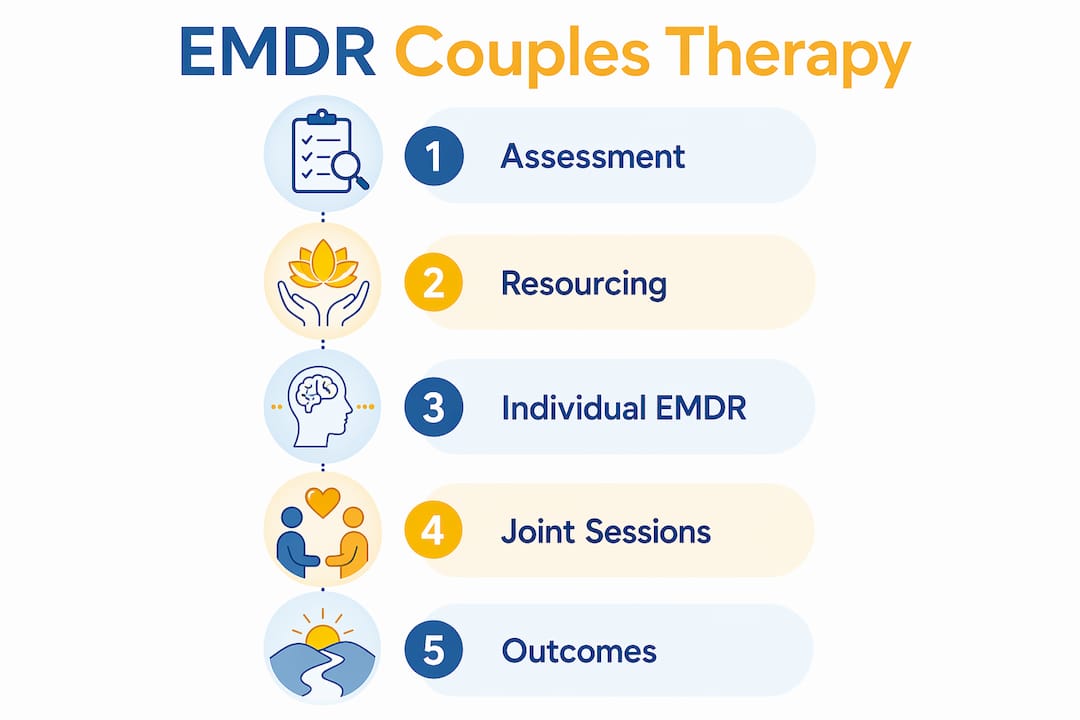
The eight-phase EMDR framework is not just a treatment sequence; it’s a trauma-informed assessment structure. Phases one and two cover history-taking, case conceptualization, and stabilization, and those phases carry as much clinical weight as the reprocessing phases that follow. Therapists evaluate each partner individually before any conjoint EMDR work begins.
Key areas of clinical assessment include:
- Nervous system regulation capacity. Can each partner tolerate distressing material without flooding or dissociating? If not, stabilization work comes first.
- Trauma history and type. Attachment wounds, betrayal, childhood abuse, and shared traumatic events each call for different pacing and sequencing.
- Relational safety. Active domestic violence, ongoing deception, or severe power imbalances are contraindications for joint EMDR sessions. Safety is non-negotiable.
- Individual vs. conjoint readiness. Most practitioners begin with individual EMDR sessions for each partner before introducing joint work. This prevents unresolved trauma from destabilizing the couples session itself.
- Motivation and relational goals. The EMDR Couple Protocol is designed for couples who want to improve their relationship, not for those in acute crisis without any shared commitment to the process.
- Therapist qualifications. EMDR with couples requires both EMDR training and competence in couples therapy. These are distinct skill sets, and combining them safely demands specific preparation. EMDR Europe Level 2 certification is one recognized benchmark for this level of clinical work.
- Client preparation. Partners need psychoeducation about what EMDR involves, what bilateral stimulation feels like, and what to expect emotionally during and after sessions. Surprises in session undermine safety.
Pro Tip: If you’re a couple considering EMDR, ask your therapist directly whether they have training in both EMDR and couples modalities. A therapist trained in only one area may not be equipped to manage what surfaces in joint sessions.
How EMDR is applied in couples therapy settings
Application varies considerably depending on where a couple is in treatment, what trauma is being addressed, and how regulated each partner is at any given point. There is no single script.

The most common starting point is individual EMDR sessions for each partner, conducted within the couples therapy framework or as a parallel track. Individual preparation reduces activation and strengthens internal regulation before conjoint sessions begin, making the joint work safer and more productive. Once both partners are more regulated, the therapist can introduce joint EMDR work with confidence.
Practical elements of EMDR application in couples settings include:
- Resourcing before reprocessing. Skills like calm safe place, container, light stream, and clench-and-release are introduced early and revisited often. These are not warm-up exercises; they are the foundation that makes everything else possible.
- Bilateral stimulation. Eye movements, tapping, or auditory tones are used to facilitate processing. In joint sessions, both partners may engage in bilateral stimulation simultaneously, targeting shared distressing events.
- Extended session length. Joint EMDR sessions typically run 90 minutes or longer to allow adequate time for preparation, processing, stabilization, and closure. Rushing closure is one of the most common errors in couples EMDR work.
- Witnessing. One powerful application involves one partner engaging in EMDR while the other remains present as a witness. Observing trauma resolution can deepen empathy and emotional attunement in ways that conversation alone rarely achieves.
- Integration with EFT and CBT. EMDR’s bilateral stimulation accesses core emotions that emotionally focused interventions sometimes struggle to reach. Once those primary emotions surface, EFT techniques can work more effectively. CBT-informed communication work also becomes more productive once the nervous system is better regulated.
- Between-session resourcing. EMDR-informed skills extend therapeutic benefits into daily life. Couples who practice resourcing between sessions tend to de-escalate conflicts more quickly and reconnect faster after ruptures.
- Pacing. This is the variable that separates effective EMDR couples work from harmful work. Moving too fast into reprocessing before adequate stabilization is in place can destabilize a couple rather than help them.
You can learn more about what to expect from the process in Revivehealththerapy’s session readiness guide for EMDR clients.
Case examples illustrating EMDR in couples therapy
Clinical examples show what the research describes in abstract terms. The following anonymized scenarios reflect common presentations in trauma-informed couples work.
Betrayal trauma and the urgency to decide
A couple in their late thirties arrived after a discovered affair. Both partners were dysregulated: one flooded with intrusive images and hypervigilance, the other paralyzed by shame and the fear of abandonment. Traditional couples work stalled almost immediately. Every session escalated before any productive conversation could begin.
The therapist introduced individual EMDR sessions for each partner, targeting the acute trauma responses rather than the relationship dynamics directly. Within several sessions, the injured partner’s intrusive symptoms decreased enough to allow sustained conversation. The partner who had the affair processed the shame-based beliefs driving their avoidance. Joint sessions became possible only after this individual stabilization.
The outcome was not a guaranteed reconciliation. What EMDR provided was the clarity and steadiness for both partners to make a real decision, rather than a reactive one.
Attachment wounds from childhood reshaping the relationship
A couple in their mid-forties had been in couples therapy for two years with limited progress. Both partners were committed and genuinely cared for each other, but a recurring cycle of criticism and withdrawal had become entrenched. The therapist recognized that the cycle was being driven by each partner’s early attachment experiences rather than by anything happening between them in the present.
Individual EMDR sessions targeted each partner’s childhood experiences of emotional unavailability and criticism. As those memory networks processed, the automatic reactivity in couples sessions visibly decreased. The partner who typically withdrew began staying present during conflict. The partner who typically criticized began expressing the underlying fear rather than the anger.
Joint sessions then used the EMDR Couple Protocol to process a shared painful event from early in their relationship. Research on the EMDR Couple Protocol showed significant improvements in relationship satisfaction, depression, and anxiety symptoms, with large effect sizes across all three measures. This couple’s experience tracked closely with that pattern.
Shared trauma and the perinatal period
A younger couple sought therapy after a pregnancy loss. Both partners were grieving, but in different ways and on different timelines, which created distance and misattunement at a moment when they needed connection most. Neither partner had a significant individual trauma history, which made them good candidates for joint EMDR work relatively early in treatment.
The therapist used EMDR-informed resourcing at the start of each session to help both partners settle before engaging with the grief material. Over time, joint bilateral stimulation sessions targeted the shared traumatic memory of the loss. Witnessing each other’s processing shifted the dynamic from parallel grieving to shared grieving, which is a different experience entirely.
Expert insights on EMDR’s role in couples therapy
Patrick Monette, LMHC, CASAC, an EMDR clinician and instructor, frames the central question precisely. The issue is not whether EMDR can be used with couples. The question is which phase of the eight-phase framework is being asked about, because most people asking about EMDR with couples are thinking only about reprocessing, which is just one part of a much larger clinical structure.
Monette’s couples work consistently returns to EMDR-based resourcing skills introduced gradually and practiced with intention. When couples begin sessions with brief resourcing, something shifts. Partners who arrive overwhelmed by work stress, parenting demands, or unresolved conflict begin to settle. They stop seeing each other as adversaries. That shift happens before any reprocessing occurs, which tells you something important about where the therapeutic leverage actually lives.
The clinical literature on EMDR and couples also highlights a consistent finding: therapists integrating EMDR into couples work observe a reduction in negative cognitions and improved self-regulation, which enables deeper relational work to proceed. This is not a secondary benefit. It’s the mechanism that makes everything else in couples therapy more effective.
Therapists working in this area also caution against rushing. EMDR with couples does not automatically mean joint reprocessing. Sometimes EMDR functions as a conceptual framework for understanding why partners react the way they do. Sometimes it becomes an active intervention. The clinical judgment about which role it plays, and when, is what separates competent EMDR couples work from well-intentioned but poorly timed intervention.
Revivehealththerapy integrates EMDR with trauma-informed couples therapy at its Walnut Creek and Oakland locations, as well as through telehealth couples therapy statewide. The team draws on EMDR, EFT, CBT, and IFS to meet couples where they are, whether the presenting issue is betrayal, attachment wounds, grief, or chronic relational conflict. If you’re ready to explore what trauma-informed therapy can do for your relationship, Revivehealththerapy offers sliding-scale fees and accepts most major insurance plans, including HSA and FSA.

Key Takeaways
EMDR’s primary role in couples therapy is nervous system stabilization, which creates the conditions for relational repair, empathy, and clearer decision-making that traditional couples approaches alone cannot reliably produce.
| Point | Details |
|---|---|
| Stabilization precedes repair | EMDR reduces survival-driven reactivity before relational work begins, making couples sessions more productive. |
| Individual sessions come first | Most practitioners conduct individual EMDR for each partner before introducing joint reprocessing to protect relational safety. |
| Resourcing extends beyond sessions | Skills like calm safe place and containment help couples regulate during daily conflicts, not just in the therapy room. |
| Witnessing deepens empathy | One partner observing the other’s trauma processing can build accountability and attunement beyond what conversation achieves. |
| EMDR Couple Protocol shows measurable gains | Research found large effect sizes for relationship satisfaction, depression, and anxiety after couples completed the EMDR Couple Protocol. |