
Mindfulness can help many trauma survivors manage anxiety, hypervigilance, and intrusive memories, but only when it’s taught with trauma-sensitive adaptations. Offered without those adjustments, the same practices that calm one person can activate flashbacks or dissociation in another.
- Who benefits most: people with mild-to-moderate traumatic stress, those seeking a complement to talk therapy, and survivors who’ve already built some coping capacity.
- Who should prioritize trauma-focused therapy first: anyone with moderate-to-severe PTSD, active dissociation, or a history of destabilizing during meditation.
- Safety note: this article is educational, not a substitute for individualized clinical care.
If a mindfulness practice triggers a flashback, intense panic, or a sense of leaving your body, that’s a signal to stop and reach out to a licensed trauma clinician, not to push through.
Key Takeaways
Trauma-sensitive mindfulness works best as an adjunct to, not a replacement for, first-line trauma therapies like EMDR, CPT, and PE.
| Point | Details |
|---|---|
| Mindfulness helps, with caveats | Small-to-moderate effects on PTSD symptoms, smaller than trauma-focused therapy alone. |
| Trauma sensitivity changes everything | Invitational language, choice, and grounding anchors reduce risk of triggering symptoms. |
| Watch for adverse signs | Flashbacks, dissociation, and panic mean stop and ground, not push through. |
| Match the method to readiness | First-line trauma therapy comes first for moderate-to-severe PTSD; mindfulness can build capacity beforehand. |
| Revive Health Therapy integrates both | Offers EMDR, CBT, and trauma-sensitive mindfulness across in-person and telehealth care in California. |
Table of Contents
- What Is Trauma-Sensitive Mindfulness?
- Does Mindfulness Actually Help With PTSD?
- What Are the Warning Signs of a Triggered Trauma Response?
- Which Mindfulness Practices Are Safe for Trauma Recovery?
- When Should Trauma-Focused Therapy Come First?
- How Can Clinicians Offer Mindfulness Safely?
- How Do You Find a Safe Teacher or Therapist?
- Get Trauma-Sensitive Care That Adapts to You
- Frequently Asked Questions
- Sources
What Is Trauma-Sensitive Mindfulness?
Mindfulness means paying attention to the present moment without judging what shows up. Clinical programs like Mindfulness-Based Stress Reduction (MBSR) and its cousin, Mindfulness-Based Cognitive Therapy, built entire treatment protocols around that skill, and both are widely used for stress, anxiety, and relapse prevention.
Trauma-sensitive mindfulness (TSM) applies that same skill differently. Therapist and researcher David Treleaven developed the framework after watching well-meaning meditation teachers unintentionally retraumatize students. His approach centers on offering invitations instead of commands, giving people real choice over posture and eye position, using grounding anchors before asking anyone to sit with difficult sensations, and keeping practices short enough that no one gets stuck in overwhelming material.
- Language shifts from “close your eyes” to “you might close your eyes, or soften your gaze downward.”
- Exercises stay brief, especially early on, rather than stretching into long silent stretches.
- Grounding always comes before, not after, any exercise that asks someone to notice bodily sensation.
Safety and choice aren’t optional add-ons to trauma-sensitive mindfulness. They’re the entire point.
Does Mindfulness Actually Help With PTSD?
The honest answer: yes, often, but not as much as trauma-focused therapy, and not for everyone. Meta-analytic reviews of mindfulness-based interventions (MBIs) for PTSD find small-to-moderate effect sizes, with plausible mechanisms including improved attention control, better emotion regulation, and changes in connectivity between brain networks tied to threat detection and self-referential thinking.
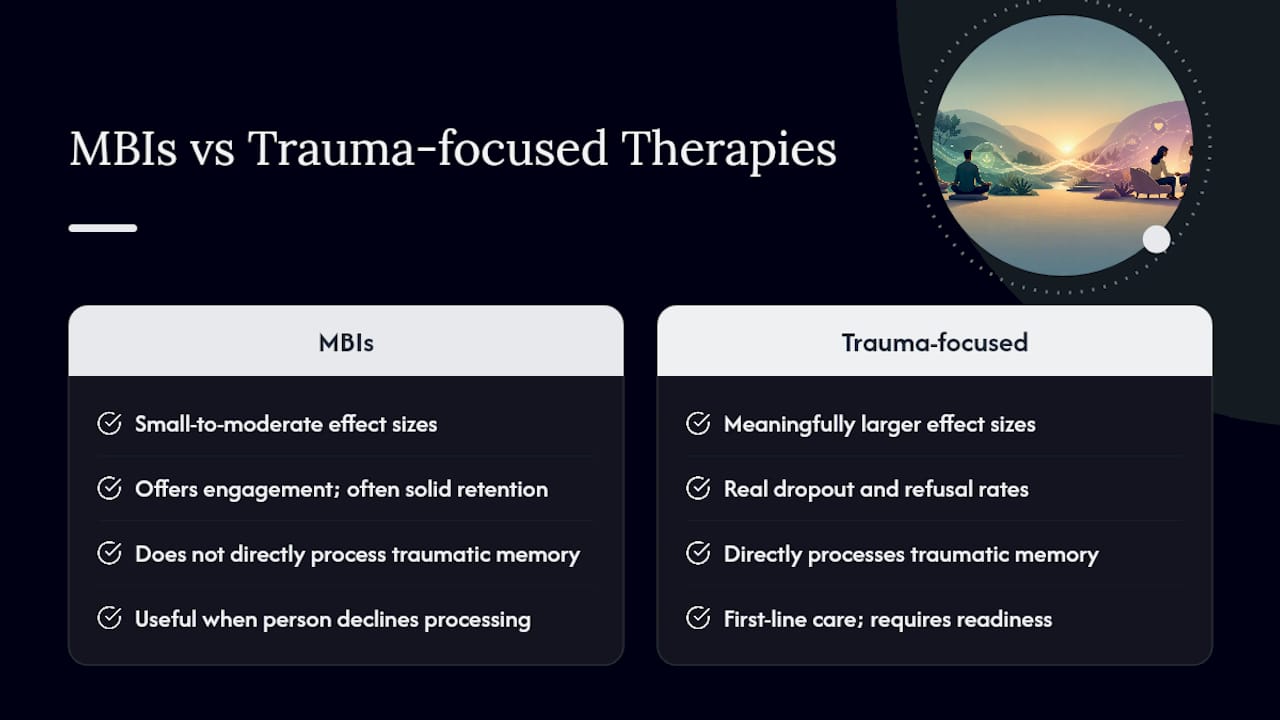
These effects are meaningfully smaller than those typically seen with the trauma-focused psychotherapies that remain first-line care for PTSD: Prolonged Exposure, Cognitive Processing Therapy, and EMDR. Those approaches directly process the traumatic memory, which mindfulness does not attempt to do.
Where mindfulness earns its place is in the gaps first-line treatment leaves open. Trauma-focused therapies have real dropout and refusal rates. Some survivors aren’t ready to process the memory directly, or they’ve tried exposure-based work and found it too intense. For veterans, survivors of intimate partner violence, and people who decline trauma processing altogether, MBIs offer engagement and often solid retention, even when the symptom reduction is more modest.
Lifetime trauma exposure is common, estimated around 70% of people, while lifetime PTSD affects a smaller share, estimated to be a minority. That gap matters: most people exposed to trauma don’t develop PTSD, and mindfulness may serve very different roles depending on where someone falls on that spectrum.
The research isn’t uniform, either. One review found that certain facets of mindfulness, like “observing” sensations, sometimes correlate with higher symptom levels in PTSD populations rather than lower ones. A 2025 Frontiers in Psychology analysis goes further, suggesting some mindfulness facets are non-monotonic: helpful in smaller doses, counterproductive when pushed too far, particularly for hypervigilant populations. Tailoring matters more than blanket recommendations.
What Are the Warning Signs of a Triggered Trauma Response?
Mindfulness exercises ask people to turn attention inward, and for a trauma survivor, the inside of the body can hold landmines. Adverse reactions are documented in the literature, though likely underreported: flashbacks, dissociation (feeling unreal, detached, or “floaty”), sudden panic, re-experiencing the traumatic event, hyperarousal (racing heart, jitteriness), and its opposite, hypoarousal (numbness, shutting down, feeling frozen).

Body scans and silent breath meditations are two of the more commonly cited triggers, since both ask for sustained, unguarded attention to internal sensation.
A simple safety plan makes these moments survivable rather than destabilizing:
- A stop signal. Decide in advance on a word or gesture that means “I’m exiting this exercise now,” no explanation required.
- A grounding anchor. Something external and sensory, like naming three things you can see or pressing your feet into the floor.
- Brief movement. Standing up, shaking out your hands, or walking a few steps can interrupt a freeze response.
- A trusted contact. Someone you can text or call if the distress doesn’t settle within a few minutes.
- A clinician check-in. If symptoms persist beyond the session or recur across multiple practices, that’s a conversation for your therapist, not something to self-manage indefinitely.
The goal isn’t to avoid all discomfort. It’s to stay within a range where you can process what’s happening instead of being swept away by it.
Pro Tip: Rate your distress on a 0 to 10 scale before and during practice. If it climbs past a 6 or 7, that’s your cue to ground, not push through.
Which Mindfulness Practices Are Safe for Trauma Recovery?
Trauma-sensitive practice starts small and stays optional at every step. These five adaptations show up across most clinical protocols:
Arriving practice. Before anything else, orient to time and place: state the date, name the room you’re in, notice one sound. This anchors you in the present before asking for deeper attention.
Grounding anchors. Hold a textured object, or run through the classic 5-4-3-2-1 exercise: five things you see, four you can touch, three you hear, two you smell, one you taste.

Movement-based mindfulness. Walking meditation, gentle stretching, or simply noticing the sensation of your feet on the ground gives the nervous system an outlet that stillness sometimes doesn’t.
Breathing with real options. Offer eyes open or closed, and never insist on a specific breath pattern. Forced deep breathing can itself feel like a trigger for some survivors.
Scaffolded body awareness. Instead of a 20-minute body scan, try 90 seconds on a single, low-charge area (hands, feet) with permission to skip anywhere that feels unsafe.
A short list of specific swaps helps translate principle into practice:
- Do offer a choice of eyes open, closed, or a soft downward gaze. Don’t mandate closed eyes.
- Do shorten body scans to a minute or two initially. Don’t default to the standard 20 to 45-minute version.
- Do let people choose who receives loving-kindness phrases, including themselves last. Don’t assume everyone can start with self-directed compassion.
- Do build in a stated exit option before starting. Don’t rely on silence as the only signal something’s wrong.
Pro Tip: Pace new practices across several days rather than trying everything in one sitting, and pair each one with a brief self-compassion phrase, something as simple as “this is hard, and I’m doing my best,” to keep difficult sensations from reinforcing self-criticism.
When Should Trauma-Focused Therapy Come First?
For PTSD with moderate-to-severe symptoms, EMDR, CPT, and Prolonged Exposure remain the treatments with the strongest evidence base, and clinical guidance from the VA positions them as first-line care. Mindfulness fits in as an adjunct, useful for building stabilization and grounding capacity before trauma processing begins, or as an alternative for people who decline direct trauma work.
In practice, many clinicians use short mindfulness exercises to widen a client’s window of tolerance first, teaching the body to tolerate activation in small doses before asking it to process the traumatic memory directly.
No single approach fits everyone. The clinician’s job is to match the method to the person’s readiness, preference, and nervous system, not the other way around.
Informed consent matters here: a client should always understand why a particular technique is being offered and retain the right to decline it.
How Can Clinicians Offer Mindfulness Safely?
A short, practical checklist for anyone teaching or offering mindfulness to trauma survivors:
- Screen for trauma history and current symptom severity before beginning.
- Use invitational language rather than directives.
- Offer real choices of posture and eye position.
- Start every session with a grounding anchor.
- Establish a stated safety plan and exit signal in advance.
- Limit long stretches of silence, especially early on.
- Scaffold body-focused exercises in short increments.
- Teach the concept of the window of tolerance explicitly.
- Obtain informed consent before introducing new techniques.
- Know your referral pathways for clients who need trauma-focused care.
Formal training in trauma-sensitive mindfulness, such as programs built on Treleaven’s framework, builds these skills systematically. Clinicians looking to deepen their trauma training can also explore resources through organizations like the Trauma Institute, and every provider should have a clear referral path to EMDR, CPT, or PE when a client needs more than mindfulness alone can offer.
How Do You Find a Safe Teacher or Therapist?
Not every meditation teacher understands trauma, and not every therapist integrates mindfulness well. Look for trauma-informed training, a clinical background if you’re seeking therapy rather than a meditation class, direct experience with PTSD, and a willingness to modify any exercise on request.
Before joining a group or starting individual work, ask how they screen participants, what their safety plan looks like if someone becomes distressed, how confidentiality works, and whether there’s a clinician available for backup support.
Red flags are usually easy to spot once you know to look: mandatory silence with no exceptions, coercive or shaming language around “resistance,” zero options for posture or eye position, and no plan whatsoever for handling an adverse reaction. Walk away from any of these.
Pro Tip: A genuinely trauma-informed provider will welcome your questions about their safety practices. Hesitation or defensiveness in response to those questions is itself useful information.
What Does Trauma-Sensitive Delivery Look Like in Practice?
A clinician working with a survivor of a car accident might start with a brief symptom screening, then a 60-second arriving practice to orient the client to the room. Next comes a grounding anchor, holding a smooth stone, before any deeper exercise. The clinician checks in after each step, adjusting or stopping based on the client’s response, and when the client is ready, refers them toward EMDR for direct processing of the memory itself.
Mindfulness bought this client stability. EMDR gave them resolution. Neither step worked without the other.
Revive Health Therapy supports this kind of staged approach through trauma-informed psychotherapy and telehealth access across California.
Why Trauma Sensitivity Isn’t Optional
Mindfulness without trauma sensitivity isn’t neutral. It carries real risk of harm for people whose nervous systems are already dysregulated, which means clinicians and teachers have an ethical obligation to build in choice, screening, and safety before ever asking someone to sit with difficult sensation. Amy has spent years examining trauma-informed care models and argues that the field’s enthusiasm for mindfulness has outpaced its caution around adaptation.
Get Trauma-Sensitive Care That Adapts to You
Reading about grounding anchors and window-of-tolerance concepts is one thing. Having a licensed clinician adjust them to your specific nervous system, in real time, is another. Revive Health Therapy offers trauma-informed psychotherapy, including EMDR, CBT, and mindfulness integrated by clinicians trained to recognize when a practice needs to shorten, pause, or shift entirely.
Sessions are available in person in Oakland and Walnut Creek, or through secure telehealth anywhere in California, with sliding-scale fees and insurance, HSA, and FSA options that make ongoing care realistic rather than aspirational. If you’ve noticed mindfulness apps or group classes leaving you more activated instead of calmer, that’s worth a real screening, not more trial and error on your own. Contact Revive Health Therapy to schedule an initial trauma-sensitive assessment and find the right starting point for your recovery.
Frequently Asked Questions
Can mindfulness make trauma symptoms worse?
Yes, in some cases. Body scans and silent breath meditation have been documented as triggers for flashbacks and dissociation in trauma survivors, which is why trauma-sensitive adaptations like grounding anchors and shorter exercises matter.
Is mindfulness a substitute for EMDR or trauma therapy?
No. Mindfulness typically shows smaller effects than trauma-focused therapies and doesn’t process the traumatic memory directly. It works best alongside or before therapies like EMDR, CPT, or Prolonged Exposure.
What is trauma-sensitive mindfulness?
It’s an adapted approach that uses invitational language, offers choice over posture and eye position, keeps exercises short, and prioritizes grounding and safety, developed largely through David Treleaven’s framework.
How do I know if a mindfulness teacher is trauma-informed?
Ask about their screening process, safety plan for distress, training background, and whether they’ll modify exercises on request. Mandatory silence or no exit option are red flags.
Should I try mindfulness if I have complex or developmental trauma?
Possibly, but with extra caution. Complex and developmental trauma often involve deeper dysregulation, so working with a trauma-trained clinician who can pace and adapt practices individually is safer than a general meditation class.
Sources
- PTSD: Treatment Essentials Overview — U.S. Department of Veterans Affairs
- Mindfulness-based treatments for posttraumatic stress disorder: a review of the treatment literature and neurobiological evidence (PMC)
- Mindfulness as a mediator between trauma exposure and outcomes (PMC)
- Mindfulness in trauma recovery: applications, insights, and future directions — Frontiers in Psychology (2025)