
The Gottman Four Horsemen are criticism, contempt, defensiveness, and stonewalling, the four communication patterns John Gottman’s research identified as the strongest predictors of divorce. Each has a specific antidote: gentle start-up replaces criticism, a culture of appreciation counters contempt, taking responsibility disarms defensiveness, and physiological self-soothing interrupts stonewalling. Every couple slips into these sometimes. What separates stable relationships from struggling ones is how fast they repair.
TL;DR:
- Contempt is the strongest predictor of divorce, with high levels significantly increasing the risk of separation.
- Practicing specific antidotes like gentle start-up and self-soothing can effectively counteract criticism and stonewalling.
- Repairing relationship patterns early and consistently, especially through low-stakes exercises, helps maintain stability and reduce escalation.
- Professional therapy may be necessary when contempt is ingrained, repair attempts fail, or safety concerns arise beyond self-guided efforts.
Table of Contents
- What Do the Four Horsemen Look Like in Real Arguments?
- What Are the Antidotes to Each Horseman?
- Does the Research Actually Support This Model?
- How Do You Practice These Antidotes Between Arguments?
- When Does This Need a Therapist Instead of a Worksheet?
- Why Scripts Beat Advice for Most Couples
- Ready for Backup? Revivehealththerapy Can Help
- Sources
- FAQ
What Do the Four Horsemen Look Like in Real Arguments?
Criticism attacks character instead of addressing behavior. “You never think about anyone but yourself” is criticism. “I was frustrated you forgot to call” is a complaint. The difference sounds small, but it’s the line between a fixable gripe and a personal indictment.
Contempt goes further. It’s sarcasm, eye-rolling, mockery, or name-calling, anything that communicates disgust or superiority. A partner who says “Wow, impressive, you actually remembered something” in a mocking tone is deploying contempt, even without raising their voice.
Defensiveness shows up as self-protection dressed up as innocence: counter-attacking, making excuses, or the classic “yes, but…” That reflexive “I only did that because you…” is defensiveness in action, and it almost always escalates rather than resolves.
Stonewalling is withdrawal. It’s the partner who goes silent, turns away, crosses their arms, or physically leaves the room mid-conversation. It looks like indifference, but it’s usually the opposite: a nervous system in overload.
Here’s how one ordinary disagreement, someone forgetting to pick up groceries, can spiral through all four:
- Criticism: “You always forget everything I ask you to do.”
- Contempt: “Of course you forgot. Typical. You can’t handle anything.”
- Defensiveness: “Well maybe if you didn’t ask me fifteen things at once, I’d remember.”
- Stonewalling: One partner shuts down, stares at the phone, and stops responding entirely.
That’s the whole cycle, start to finish, over a bag of groceries. Recognizing the sequence in the moment is the first practical skill of Gottman couples therapy, and it’s a skill you can build without a therapist in the room.
What Are the Antidotes to Each Horseman?
The Gottman Institute has spent decades identifying and testing a specific counter-move for each horseman. Here’s each one, why it works, and a script to try.
-
Gentle start-up counters criticism. The formula is situation plus feeling plus need: “When the kitchen is left messy after dinner (situation), I feel taken for granted (feeling), and I need us to split cleanup (need).” It works because it drops the accusation and gives the other person something concrete to respond to instead of defend against.
-
A culture of appreciation counters contempt. Aim for a rough 5:1 ratio of positive to negative interactions, a ratio a psychologist explains in depth. A daily scan takes 60 seconds: name one specific thing your partner did that you valued. “Thanks for handling the school pickup today” beats a generic “you’re great.”
-
Taking responsibility counters defensiveness. Own a slice, even a small one: “You’re right, I was 10% at fault for snapping earlier.” This single move reliably de-escalates conflict because it signals respect instead of triggering a fight over blame.
-
Physiological self-soothing counters stonewalling. Watch for flooding: racing heart, tight chest, the urge to flee. Say “I’m flooded, I need some time to calm down, then I’ll come back.” Then actually self-soothe, breathe, walk, stretch, don’t rehearse your rebuttal.
Pro Tip: Write your own gentle start-up sentence on your phone before a hard conversation. Reading it out loud, even once, cuts the odds you’ll default to an attack when emotions spike.
Does the Research Actually Support This Model?
Gottman’s lab observed thousands of couples and found these four patterns reliably predicted whether relationships stayed together or ended. Contempt stood out as the single strongest predictor of the four, worse than the other three combined.
Couples showing high, unaddressed contempt face a measurably steeper path toward separation than those who criticize or withdraw without the added layer of disgust or mockery, according to Gottman’s lab work.
Stonewalling isn’t a character flaw. It’s tied to physiological flooding, a nervous system so overwhelmed that rational conversation becomes physically difficult, which is why self-soothing breaks work better than pushing through. Separate peer-reviewed work has connected these same four patterns to lower relationship satisfaction and, in some clinical populations, to symptoms like borderline personality features affecting how criticism gets sent and received. The research has real limits, much of it comes from lab observation of couples who agreed to be studied, which may not capture every relationship style or cultural context. Still, the core finding holds up: how you fight matters more than whether you fight at all.
How Do You Practice These Antidotes Between Arguments?
Skills fade if you only use them during a crisis. Build them into low-stakes moments first.
- Daily appreciation (5 to 10 minutes): Each partner names one specific thing the other did that day, no generic compliments, and says why it mattered.
- Gentle start-up rehearsal (10 minutes): Pick a minor, non-urgent complaint. Write it using the situation, feeling, need formula, then say it out loud to your partner, who just listens and reflects it back.
- Structured timeout of sufficient length to allow genuine calming: Agree on a signal word, a return time, and separate spaces. Use the break for genuine calming, walking, breathing, music, not stewing or drafting counterarguments.
- Repair phrases: Keep two or three short lines ready, like “Can we start over?” or “I don’t want to fight about this, I want to fix it.” Practice saying them when you’re calm so they come out naturally when you’re not.
Pro Tip: A timeout only works if it has a committed return time. Walking away without one often reads as stonewalling itself, even when your intention was to cool down.
When Does This Need a Therapist Instead of a Worksheet?
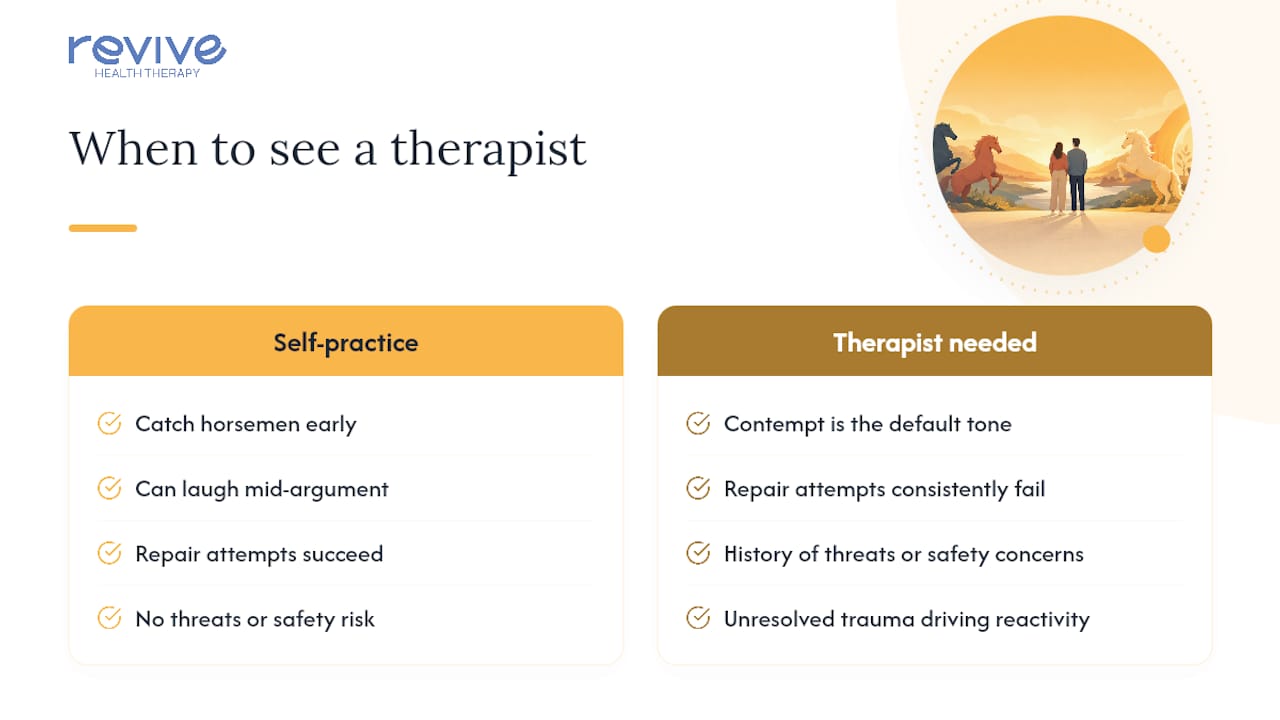
Self-practice works for couples who catch the horsemen early and can still laugh at themselves mid-argument. It’s not enough when contempt has become the default tone, when repair attempts consistently fail, or when there’s a history of threats, safety concerns, unresolved trauma, or patterns suggesting a personality disorder.
Couples therapy builds on Gottman’s framework and adds tools like CBT for thought patterns, EMDR for trauma driving reactivity, and mindfulness for nervous system regulation. Revivehealththerapy offers trauma-informed couples work through telehealth statewide or in-person sessions, useful when the horsemen trace back to something deeper than a bad habit.
Why Scripts Beat Advice for Most Couples
Most relationship advice tells couples what’s wrong without giving them anything to say in the moment. That’s the gap. Knowing that criticism is bad doesn’t help you at 11 p.m. when you’re furious about dishes. Having an actual sentence ready does.
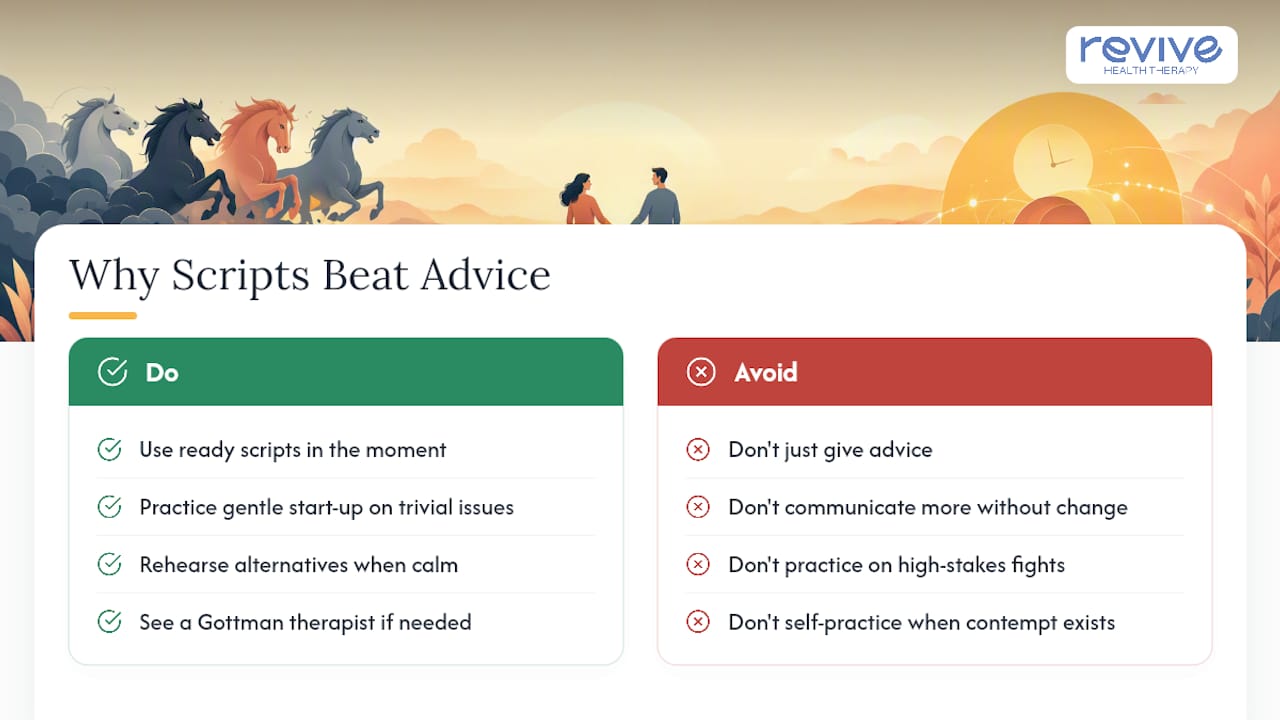
The overrated piece of conventional wisdom here is “communicate more.” Couples in conflict usually communicate constantly, just badly. The fix isn’t more talking, it’s swapping four specific behaviors for four specific alternatives, then rehearsing them when nobody’s angry.
If you take one thing from this: practice the gentle start-up formula on something trivial this week, a comment about laundry, not a decade-old grievance. Skills built on low stakes hold up better under pressure. And if the pattern feels too entrenched for self-practice, a Gottman-informed therapist can shorten the learning curve considerably, especially when contempt has already taken root.
— Amy
Ready for Backup? Revivehealththerapy Can Help
Reading about the antidotes is one thing. Practicing them with a trained therapist watching for the moment defensiveness creeps in, that’s what actually rewires the pattern for couples who’ve tried the scripts and still hit the same wall.

Licensed, trauma-informed clinicians apply Gottman-based methods alongside CBT and EMDR, available through telehealth in California and in-person at multiple locations. Sliding-scale fees and insurance, including HSA/FSA, help make sessions accessible. Start with the couples therapy services page to see how sessions work, or explore the full range of therapy services to find the right fit and book a session this week.
Sources
- The Four Horsemen: The antidotes | Gottman Institute
- The Four Horsemen: The Communication Patterns That Predict Breakups | SimplyPsychology
- Conflict behaviors and relationship satisfaction (PMC article)
- Stonewalling | Gottman Institute
- The 4 antidotes for the 4 strongest predictors of divorce | Psychology Today
This article is general information, not a substitute for advice from a qualified doctor. Consult a qualified healthcare professional about your own circumstances before acting on anything here.
FAQ
What Are the Seven Principles of the Gottman Method?
The Gottman Method centers on building love maps, nurturing fondness and admiration, turning toward each other, accepting influence, solving solvable problems, overcoming gridlock, and creating shared meaning, all supported by the horsemen antidotes.
How Many Times Has John Gottman Been Married?
John Gottman has been married twice; he and his current wife, Julie Schwartz Gottman, co-founded the Gottman Institute and co-developed much of the couples therapy research cited today.
What Are the Criticisms of the Gottman Method?
Some researchers note the lab studies rely on couples who volunteered to be observed, which may not reflect every relationship style, and question how well findings generalize across different cultural or demographic groups.
What Four Behaviors Are Linked to the Most Divorces?
Gottman’s research identifies criticism, contempt, defensiveness, and stonewalling as the four behaviors most strongly linked to relationship breakdown, with contempt standing out as the single strongest predictor.
Can Couples Fix These Patterns Without Therapy?
Many couples reduce these patterns on their own using the antidotes and repair scripts, but chronic contempt, failed repair attempts, or safety concerns usually call for professional support such as couples therapy.