
You can find a therapist in Walnut Creek who offers both in-person and telehealth appointments: start by booking a short, free consultation and verifying your insurance before committing. If you are in crisis, call or text 988 right now. For a checkable local option, we offer in-person sessions in Walnut Creek and Oakland alongside statewide telehealth.
TL;DR:
- Confirm the clinician is accepting new patients and has availability, especially for in-person sessions at Walnut Creek if required.
- Use insurer directories first to verify in-network status and ask about sliding-scale options or HSA/FSA acceptance to reduce costs.
- Prioritize therapists with experience in your specific concern and ensure their modality, such as CBT or EMDR, matches your needs.
- Conduct brief interviews to assess rapport, clarify treatment plans, and identify red flags like boundary issues or vague approaches.
- Track your goals and progress over time, and be prepared to switch therapists if the relationship or approach does not feel right after a few sessions.
Table of Contents
- Where to search for Walnut Creek therapists
- How to choose a therapist: criteria, questions, and red flags
- Understanding therapy cost: rates, insurance, and sliding-scale options
- Matching therapy types to your concern
- Preparing for your intake call and first sessions
- Revive Health Therapy: a local Walnut Creek option
- Setting therapy goals and tracking progress
- Amy’s perspective: trial and error is normal, not a failure
- How we can help you take the next step
- FAQ
- Sources
Where to search for Walnut Creek therapists
Most people start their search in the wrong place: a generic web search that surfaces ads instead of clinicians who are actually taking new patients. A more reliable approach is to work through a short list of sources in order, filtering as you go.
Start with your insurer’s own provider directory if you have coverage you want to use. This tells you who is in-network before you fall in love with a profile that turns out to be out-of-network. From there, broaden your search:
- Insurer directories: filter by Walnut Creek zip codes and confirm the listing is current by calling the office directly.
- Clinician and directory listings: Psychology Today–style directories let you filter by specialty, insurance accepted, and whether a provider sees clients in person or online.
- Local practice pages: clinics with a physical Walnut Creek address, such as our own Walnut Creek therapy location page, typically list every clinician’s specialty and availability in one place.
- University training clinics: graduate psychology programs in the East Bay often run low-cost clinics supervised by licensed faculty.
- Community mental health centers: county-funded programs serve residents regardless of insurance status, though wait times can run longer.
- Clinic networks: multi-location practices, including groups like LifeStance, often accept major insurance plans and offer both telehealth and office visits across the East Bay.
Once you have a shortlist, filter hard for logistics before you filter for anything else. If you need in-person sessions, confirm the Walnut Creek office is the clinician’s actual base, not just a satellite address listed for SEO purposes. If telehealth works for you, your options widen considerably since many California-licensed clinicians see clients anywhere in the state.
Verification is the step most people skip, and it costs them weeks. Call the office and ask three things: are they currently accepting new patients, is there a waitlist, and can you book a free or low-cost initial consultation. A clinician’s listing can be months out of date, so a two-minute call saves you from waiting on a reply that never comes. If a practice offers a free consultation, as ours does through a quick consultation request, use it. It is the fastest way to find out whether someone is actually available before you invest emotional energy in reading their bio.
Keep a simple log as you go: clinician name, credential, specialty, in-person or telehealth, and whether they returned your call within a reasonable window. This turns a frustrating search into a short, trackable process.
How to choose a therapist: criteria, questions, and red flags
Choosing a therapist is closer to hiring someone than picking a product off a shelf. The American Psychological Association treats personal rapport as a central factor, not a nice-to-have, and recommends weighing it alongside credentials and specialty.
Five criteria matter most when you compare clinicians:
- Therapeutic relationship: do you feel heard and safe within the first few minutes of talking to them?
- Relevant experience: have they worked with your specific concern, whether that is anxiety, grief, or a relationship issue?
- Modality fit: does their approach, such as CBT or EMDR, match what you are looking for?
- Logistics: does their fee, location, and availability actually work for your life?
- Cultural and language match: do they understand or share relevant aspects of your identity or background?
The APA and NAMI both suggest treating the first call as a real interview. Useful questions include: What is your license and how long have you practiced? What is your experience with this specific issue? What does a typical session look like? How do you track whether therapy is working? What are your fees, and how do you handle insurance or cancellations? What happens if I am in crisis between sessions?
Pro Tip: Write your three biggest questions down before the call. Nerves make people forget even the questions that matter most.
Red flags are just as important as green lights. Watch for a therapist who dismisses your concerns, blurs professional boundaries, offers a vague or nonexistent treatment plan, or pressures you into committing to services you have not asked about. Any one of these is a reason to end the call politely and move to the next name on your list. Trusting your gut here is not impatience, it is good self-protection.
Understanding therapy cost: rates, insurance, and sliding-scale options
Private-pay therapy in California typically varies widely in cost per session, and the NAMI HelpLine suggests asking directly about fees during your first call rather than guessing from a website. Rates vary by clinician experience, specialty, and whether you see a licensed therapist or an associate working toward licensure.
Many clinicians now accept HSA or FSA funds for out-of-network sessions, according to Simply Psychology’s 2026 guide to finding the right therapist, which also points to community resources as a path to lower-cost care.
If your preferred therapist is out-of-network, ask whether they provide a superbill, a receipt you submit to your insurer for partial reimbursement. This is standard practice and worth asking about before you assume a clinician is unaffordable.
- Check your insurer’s directory first to confirm in-network status before booking.
- Ask about sliding-scale availability if cost is a barrier.
- Look into Open Path or university training clinics for reduced-fee sessions.
- Confirm whether HSA/FSA funds apply to your sessions.
Sliding-scale fees and HSA/FSA acceptance can narrow the gap between what a session costs and what you can realistically pay.
Matching therapy types to your concern
Different concerns respond to different approaches, and knowing the basics helps you ask sharper questions on that first call.
- CBT (Cognitive Behavioral Therapy): focuses on identifying and shifting unhelpful thought patterns, often used for anxiety and depression.
- EMDR (Eye Movement Desensitization and Reprocessing): a structured approach often used to process traumatic memories.
- EFT (Emotionally Focused Therapy): commonly used in couples work to shift negative interaction cycles.
- Family therapy: addresses patterns and communication within a family system rather than one person alone.
- Trauma-informed care: an overall framework that shapes how a clinician handles safety, pacing, and trust regardless of specific technique.
It helps to loosely match your concern to a likely modality: trauma often points toward EMDR or trauma-informed CBT, couples friction often points toward EFT, and a child or teen struggling at home or school often benefits from family-inclusive approaches. That said, the APA is clear that the relationship itself, not the technique on paper, tends to predict whether therapy actually helps. Do not let a long list of credentials substitute for how a person makes you feel in the room.
Preparing for your intake call and first sessions
Treat your first few sessions as a trial period, not a final decision. Going in with a short checklist keeps the process efficient instead of overwhelming.
- Write down your main goal for therapy in one or two sentences.
- List relevant history: past therapy, current medications, and anything you want kept confidential.
- For telehealth, test your camera, microphone, and internet connection before the call.
- Note your availability and budget so logistics come up early, not late.
- After each consult, score the clinician on rapport, clarity of their proposed plan, logistics, and affordability.
The APA specifically recommends interviewing two or three therapists this way before choosing, since brief consults let you compare fit without financial commitment. If, after a few sessions, the relationship still feels off or the plan stays vague, it is reasonable to switch. Progress in therapy is rarely linear, so give a good match a few sessions before judging it, but do not stay somewhere that consistently feels wrong.
Revive Health Therapy: a local Walnut Creek option
Clients can be seen in person at offices in Walnut Creek and Oakland, California, with secure telehealth sessions available statewide for those who prefer to meet from home. The team includes licensed and associate clinicians with various specialties listed on individual profile pages.
- Therapy is offered for individuals, couples, families, children, and teens, along with EMDR and CBT.
- Sliding-scale fees are available, and insurance along with HSA/FSA funds are accepted.
- The approach centers on trauma-informed, evidence-based care.
If you are weighing a trauma history, a relationship struggle, or simply want an affordable starting point, reviewing a few clinician bios, including Tabatha Beiser, AMFT and Bonnie Burset, LMFT, gives you a sense of how specialties and logistics are presented before you ever pick up the phone. A free 20-minute consultation is the fastest way to find out whether one of our clinicians is a fit for what you need.
Setting therapy goals and tracking progress
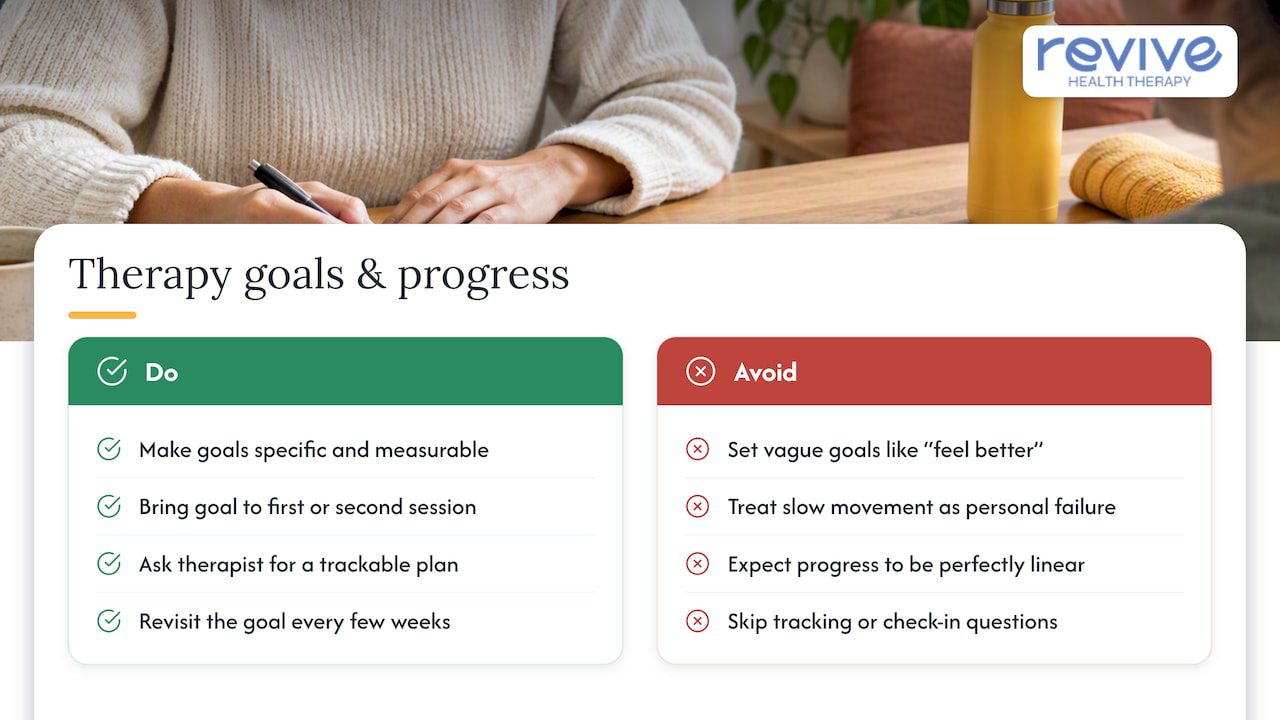
A vague goal like “feel better” is hard to work toward and even harder to measure. Specific goals give both you and your therapist something concrete to check in on: reducing panic attacks from several a week to one, improving communication with a partner, or re-establishing a sleep routine disrupted by grief.
Bring your goal into the first or second session and ask your therapist to help translate it into something trackable, whether that is a symptom scale, a weekly journal, or simply a recurring check-in question. Revisit the goal every few weeks. If you are not seeing movement after a reasonable stretch, that is useful information, not failure: it might mean adjusting the approach, or it might mean the current therapist is not the right match after all.
Progress in therapy rarely moves in a straight line, and a good clinician will expect some weeks to feel harder than others. What matters is whether the general trend, measured against your own stated goal, moves in the direction you want over time.
Amy’s perspective: trial and error is normal, not a failure
Choosing a therapist is one of the few decisions where trying something, deciding it is not right, and switching is not just acceptable, it is the recommended approach. I’d rather see someone interview three clinicians and pick the one who actually listens than stay with the first name they found out of politeness or fatigue.
Credentials matter, but they are a floor, not a ceiling. The relationship is what carries the work. Use the rubric in this guide, track your progress honestly, and do not be afraid to end a consult call early if something feels off.
And if things ever feel unsafe or urgent, do not wait for your next scheduled session; explore helpful grief resources online for immediate support. Call or text 988 immediately.
— Amy
How we can help you take the next step
If this guide has you ready to act, we make the next step simple. We offer individual, couples, family, child, and teen therapy, along with EMDR for trauma, at offices in Walnut Creek and Oakland, with telehealth available anywhere in California.

- Sliding-scale fees and HSA/FSA acceptance keep sessions within reach for more budgets.
- In-person sessions in Walnut Creek and Oakland, plus telehealth for the rest of California.
- A full list of specialties is on our services page.
Bring the checklist and questions from this guide to your free consult and use them exactly as written. You can book a free 20-minute consultation today and find out within one short call whether we are the right fit for you.
This article is general information, not a substitute for advice from a qualified doctor. Consult a qualified healthcare professional about your own circumstances before acting on anything here.
FAQ
Who are some good therapists in Walnut Creek, CA?
Walnut Creek has clinicians across many directories and practices, including licensed and associate therapists with varied specialties in trauma, couples work, and family therapy. Rather than relying on a single “best” list, compare a few profiles against your specific needs, such as insurance, specialty, and in-person versus telehealth availability, before booking a consult.
How do I find a therapist who is actually good?
Interview two or three clinicians through brief introductory calls and pay close attention to rapport, since the APA notes the relationship itself often matters more than any specific technique. Ask about their experience with your exact concern, how they structure sessions, and how they track progress before deciding.
What are some red flags to identify in a therapist?
Watch for dismissiveness toward your concerns, unclear or shifting boundaries, a treatment plan that stays vague after repeated questions, or pressure to commit to services you have not asked for. Any of these is a reasonable reason to end the conversation and continue your search.
What is the 2 year rule for therapists?
Licensing requirements and supervised-hour rules vary by state and credential type, so there is no single universal “2 year rule” that applies everywhere. If you want to understand a specific clinician’s path to licensure, ask them directly about their credential, such as AMFT or APCC, and what supervision they currently work under.
Sources
- How to Find the Right Therapist for You (2026) | Simply Psychology
- How can I find a therapist who is a good fit for me? – NAMI HelpLine
- 988 Frequently Asked Questions | SAMHSA
- How to choose a psychologist – APA