
TL;DR:
- Food noise involves persistent, intrusive thoughts about food that are emotionally charged and interfere with daily life. It is often amplified by anxiety, emotional distress, and environmental cues, creating a cycle of mental and emotional strain. Managing food noise benefits from structured meals, mindful eating, stress reduction, and emerging treatments like mindfulness practices and GLP-1 medications.
If you’ve ever sat down to work and found your mind drifting to thoughts of food every few minutes, even though you just ate, you’re not imagining things. Food noise refers to persistent, distressing thoughts about food that go beyond physical hunger and interfere with your daily life. It’s not a character flaw or a lack of discipline. For many people dealing with anxiety and emotional distress, it’s a real and exhausting mental experience. This article breaks down what food noise actually is, why it happens, and what you can do about it.
Table of Contents
- Key takeaways
- What food noise really means
- How food noise affects your mental health
- Practical strategies to quiet food noise
- Emerging treatments: GLP-1 medications and mindfulness
- Building your personal food noise management plan
- My take on why this matters more than people realize
- Support for managing food noise and anxiety
- FAQ
Key takeaways
| Point | Details |
|---|---|
| Food noise is not hunger | Intrusive food thoughts persist even when full and are often emotionally charged, not driven by physical need. |
| Anxiety amplifies the cycle | Emotional distress and stress intensify food noise, creating a feedback loop that worsens both. |
| Lifestyle changes reduce it | Structured meals, adequate sleep, and mindful eating practices can significantly lower the frequency of intrusive food thoughts. |
| Emerging treatments show promise | GLP-1 medications and mindfulness training both act on brain networks involved in craving and rumination. |
| Professional support matters | Therapy approaches like CBT and mindfulness-based interventions help address the emotional regulation issues driving food noise. |
What food noise really means
The term “food noise” might sound casual, but the experience behind it is anything but. Harvard Health defines food noise as food thoughts that become rigid, stressful, and cause social, mental, or physical problems. That’s a meaningful distinction from simply thinking about what to have for dinner.
From a psychological standpoint, food noise is best understood as a form of maladaptive prospection. A 2026 PMC review describes it as repetitive, reward-driven mental simulations driven by the brain’s default mode network. In plain terms, your brain keeps rehearsing food-related scenarios not because you’re hungry, but because it has learned to associate food with reward, comfort, or relief.
Several factors can trigger or worsen food noise:
- Stress and emotional distress: When you’re anxious or overwhelmed, your brain searches for relief. Food is a fast, accessible reward, so thoughts about it intensify.
- Restrictive dieting: Telling yourself certain foods are off-limits often makes those foods more mentally prominent, not less.
- Environmental food cues: Seeing food advertisements, scrolling past food content online, or even hearing the sounds of eating can trigger a cascade of food-related thoughts.
- Learned behavioral patterns: If food has historically been used for comfort or celebration, the brain builds strong associative pathways that are hard to quiet.
“Food noise can show up even when you’re physically full. It’s persistent, intrusive, and emotionally charged.” — Dr. Charlotte Ord, via BBC Food
The key distinction here is emotional charge. Normal food interest feels neutral and passes quickly. Food noise feels urgent, sticky, and often comes loaded with guilt or anxiety before you’ve even eaten anything.
How food noise affects your mental health
Food noise doesn’t stay in the background. Over time, it creates real cognitive and emotional strain that affects how you function at work, in relationships, and in your own skin.
The cognitive load alone is significant. When your mind is running a near-constant loop of food-related thoughts, there’s less mental bandwidth for everything else. Concentration suffers. Decision-making feels harder. Creative thinking takes a back seat. Many people describe it as trying to read a book while someone keeps interrupting you every few sentences.

The emotional toll compounds the problem. Persistent food thoughts are often accompanied by guilt, shame, anxiety, and frustration, particularly when they lead to eating behaviors the person later regrets. This creates a painful cycle: food noise triggers overeating or restriction, which triggers shame, which triggers more anxiety, which amplifies food noise.
Behaviorally, the consequences range from:
- Overeating or binge eating in response to the mental pressure of constant food focus
- Extreme restriction as an attempt to silence the thoughts through rigid control
- Social withdrawal from situations involving food, like dinners with friends or work lunches
- Impaired work performance due to difficulty concentrating and mental fatigue
A Nature study analyzing TikTok content found that social media food content significantly increases food cue reactivity, meaning that regular exposure to images and videos of food actively worsens food noise for many people. This is worth taking seriously if you notice your thoughts spiking after time on social media.
Practical strategies to quiet food noise
The good news is that food noise responds to consistent, deliberate changes in how you eat, how you manage stress, and how you relate to the thoughts themselves. None of these are quick fixes, but each one moves the needle.
- Eat regular, balanced meals. Structured meals with protein and fiber stabilize blood sugar and reduce the biological signals that fuel food thoughts. Skipping meals or eating erratically keeps your brain in a low-level state of food-seeking.
- Practice mindful eating. Sit down without screens. Chew slowly. Pay attention to taste, texture, and the actual experience of eating. This trains your brain to register satisfaction more accurately, which reduces the mental loop that says “more.”
- Reduce your exposure to food cues. Unfollow social media accounts that constantly post food content. Keep highly processed, hyper-palatable foods out of easy reach at home. Environmental food cues are a significant driver of food noise, and reducing them is one of the most direct levers you have.
- Prioritize sleep and physical activity. Poor sleep increases appetite-regulating hormone disruption and raises anxiety, both of which worsen food noise. Regular movement reduces cortisol and provides a non-food outlet for stress.
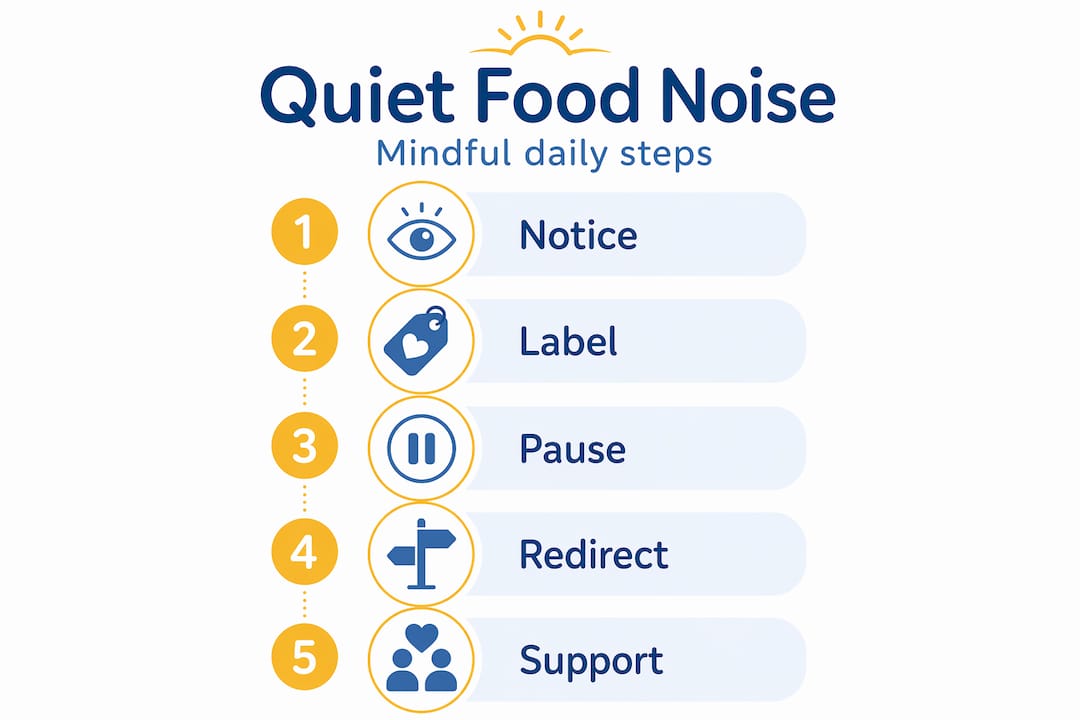
- Use the “cloud” technique for intrusive thoughts. When a food thought appears, notice it without engaging. Imagine it as a cloud passing through the sky. You don’t have to follow it or act on it. This is a core mindfulness skill that breaks the attentional loop.
Pro Tip: If you find the cloud technique difficult at first, try labeling the thought out loud: “There’s a food thought.” This simple act of naming creates a small but real psychological distance between you and the thought.
You can also explore a mindfulness workflow for anxiety that applies these principles step by step in a clinical context.
Emerging treatments: GLP-1 medications and mindfulness
Two areas of research are drawing significant attention right now, and both offer real promise for people whose food noise is severe or treatment-resistant.
GLP-1 receptor agonists
GLP-1 medications, originally developed for diabetes and weight management, have produced something unexpected in many patients: a quieting of the mental chatter around food. GLP-1 medications may reduce food-related intrusive thoughts by modulating the brain’s reward circuitry and default mode network, the same network involved in rumination and self-referential thinking.
Patients describe it as the food thoughts simply becoming quieter, less urgent, and easier to dismiss. This is subjectively meaningful, even if the evidence remains preliminary and causal confirmation requires longer-term studies. If you’re curious about whether GLP-1 options might be relevant for your situation, Revivehealththerapy has a dedicated resource on GLP-1 and mental health in California worth reviewing.
Mindfulness-based interventions
Mindfulness training works through a different but convergent neural pathway. Regular practice reduces activity in the default mode network and strengthens the prefrontal cortex’s ability to regulate craving responses. Over time, this changes how the brain responds to food cues rather than just suppressing the response in the moment.
| Approach | Mechanism | Evidence level | Requires professional oversight |
|---|---|---|---|
| GLP-1 medications | Modulates brain reward and DMN activity | Preliminary but promising | Yes, medical supervision required |
| Mindfulness training | Reduces DMN reactivity, strengthens regulation | Moderate, growing body of research | Recommended for best results |
| Dietary structure | Stabilizes hunger signals, reduces cue reactivity | Well-established | Nutrition counselor helpful |
| CBT and therapy | Addresses emotional triggers and thought patterns | Strong evidence base | Yes, licensed therapist |
“Mindfulness and GLP-1 medications may work through distinct but converging pathways to quiet the brain networks driving food noise.” — PMC, 2026
Building your personal food noise management plan
No single strategy works for everyone. What tends to work is a personalized combination of structure, awareness, and support, built around your specific triggers and patterns.
Start by tracking your food noise for one week. Note when it spikes, what you were doing, how you were feeling emotionally, and whether you were physically hungry. Patterns emerge quickly. You might notice it peaks in the late afternoon when you’re tired, or after stressful work calls, or when you’ve been scrolling social media.
Once you see your patterns, you can target them directly:
- If stress is your main trigger: Build a non-food stress relief practice, whether that’s a short walk, breathwork, or a creative hobby. The goal is to give your nervous system an alternative off-ramp.
- If restriction is driving it: Work with a registered dietitian to build a meal plan that feels satisfying and sustainable. Deprivation feeds food noise.
- If emotional regulation is the core issue: Therapy approaches like CBT, DBT, and mindfulness-based cognitive therapy directly address the thought patterns and emotional responses that keep food noise running. Resources on emotional regulation techniques can offer a starting point.
- If shame is a major factor: Reframing food noise as a neurological and emotional issue rather than a personal failing is not just compassionate. It’s clinically effective. Shame amplifies anxiety, and anxiety amplifies food noise. Breaking that link matters.
Pro Tip: Self-compassion is not the same as giving up. Research consistently shows that people who approach their struggles with kindness rather than self-criticism make more sustainable behavioral changes over time.
When food noise is significantly disrupting your quality of life, professional support is not optional. It’s the most direct path forward.
My take on why this matters more than people realize
I’ve worked with many clients who came in describing anxiety, concentration problems, and emotional exhaustion, and only later revealed that food thoughts were consuming hours of their day. They were embarrassed to say it out loud. They assumed it meant something was wrong with them as a person.
What I’ve learned from this work is that food noise is almost never about food. It’s about the brain seeking regulation. When someone’s nervous system is chronically dysregulated, whether from trauma, chronic stress, or untreated anxiety, the brain reaches for the fastest available source of comfort and predictability. For many people, that’s food.
The most counterproductive thing I see people do is try to white-knuckle their way through it. Suppressing thoughts doesn’t work. Shaming yourself into eating differently doesn’t work. What works is addressing the underlying emotional state while simultaneously changing the environment and building new responses to the thoughts themselves.
I also think the conversation around food noise needs to move away from willpower entirely. This isn’t a discipline problem. It’s a brain and emotional regulation problem. And that framing changes everything, because it opens the door to actual solutions rather than cycles of failure and self-blame.
— Amy
Support for managing food noise and anxiety
If food noise is affecting your mental health, your relationships, or your ability to function day to day, you don’t have to manage it alone. At Revivehealththerapy, we offer evidence-based therapy services designed specifically for anxiety, emotional regulation, and the distressing thought patterns that drive experiences like food noise. Our therapists use proven approaches including CBT, mindfulness-based therapy, and EMDR to help you build lasting change from the inside out.
We serve clients across California through both in-person sessions in Walnut Creek and Oakland, and secure telehealth sessions statewide. Sliding-scale fees and insurance acceptance make care accessible regardless of your income level. Whether you’re just beginning to understand what food noise is or you’ve been struggling with it for years, our adult mental health services can help you find a path forward. Reach out today to schedule a consultation.
FAQ
What is food noise?
Food noise refers to persistent, intrusive thoughts about food that go beyond physical hunger and interfere with daily functioning. Unlike normal food interest, food noise is emotionally charged and difficult to dismiss.
Can anxiety make food noise worse?
Yes. Anxiety and emotional distress are among the most common amplifiers of food noise, because a dysregulated nervous system turns to food-related thoughts as a source of anticipated comfort or relief. Treating underlying anxiety often reduces food noise significantly.
Is food noise a sign of an eating disorder?
Food noise is not a clinical diagnosis on its own, but it can be a feature of disordered eating patterns, anxiety disorders, or emotional dysregulation. If it’s causing significant distress or behavioral consequences, speaking with a mental health professional is a smart step.
Do GLP-1 medications stop food noise?
GLP-1 medications have been reported to reduce the intensity of food-related intrusive thoughts by modulating brain reward circuits, but the evidence is still preliminary. They require medical supervision and are not appropriate for everyone.
What is the fastest way to reduce food noise?
The most immediate strategies include eating a balanced meal with protein and fiber, reducing exposure to food-related media, and practicing the “cloud” mindfulness technique to observe thoughts without engaging them. Longer-term relief comes from addressing emotional triggers and stress patterns.
Recommended
- Mindfulness for California Families: A Practical How-To – Revive Health Therapy
- How mindfulness eases anxiety: Evidence-based strategies – Revive Health Therapy
- Build Your Anxiety Self-Care Checklist for Everyday Relief – Revive Health Therapy
- Emotional regulation steps for teens and families – Revive Health Therapy