
TL;DR:
- Individual therapy helps people navigate major life changes by providing a safe space to process emotions and clarify values. Most clients achieve meaningful progress within 10 to 20 weekly sessions, focusing on their specific transition challenges. Active participation and honest communication are key to maximizing therapy’s benefits during life’s most significant shifts.
Individual therapy for life transitions is a structured, focused form of psychotherapy designed to help people manage the emotional and psychological demands of major life changes. Career shifts, divorce, parenthood, relocation, retirement, and loss all qualify as significant transitions. These events disrupt identity, routine, and a person’s sense of what comes next. Therapy provides a steady space to process that disruption, clarify values, and build the resilience needed to move forward. Mental health practitioners typically recommend 10–20 sessions as a focused course of treatment, with weekly consistency balancing effectiveness and commitment.
What does individual therapy for life transitions actually involve?
Individual counseling for transitions is not crisis intervention. It is a deliberate, collaborative process that begins before the first session even ends. Intake sessions last 50–55 minutes and focus on three things: assessing symptoms, identifying personal strengths, and setting clear therapy goals. That structure matters because it shifts the work from vague emotional relief to something measurable and purposeful.

Knowing what to expect before you walk in reduces the anxiety that often keeps people from starting. A good resource for that preparation is Revivehealththerapy’s guide on preparing for your first session, which outlines what therapists typically ask and how to think about your goals in advance.
What the first session covers
The first session is an assessment, not a deep dive into solutions. Your therapist will gather personal history, ask about current stressors, and begin identifying which therapeutic approach fits your situation. Early sessions assess fit, modality, and goals before any deep intervention begins. That sequence protects you from being pushed into techniques that do not match your needs.
- Symptom and stress assessment: What is happening now, and how is it affecting your daily functioning?
- Personal history: Relevant background that shapes how you experience this transition.
- Strengths identification: What resources, relationships, and coping skills do you already have?
- Goal setting: What does progress look like for you in concrete terms?
- Modality discussion: Which therapeutic approach, such as ACT, narrative therapy, or CBT, fits your situation?
How does therapy help with emotional challenges and identity shifts?
Life transitions provoke emotions that do not follow a clean arc. Grief, ambivalence, relief, fear, and excitement can all show up at once, sometimes within the same hour. Therapy offers a steady space to process these feelings without rushing to fix or resolve them prematurely. That distinction matters more than most people realize.
Therapy is valid for psychological distress even without a clinical diagnosis. Therapy improves emotional regulation, values-based decision-making, and resilience during transitions, regardless of whether a diagnosable condition is present. You do not need to be in crisis to benefit. The emotional weight of a major change is reason enough.
One of the least discussed aspects of transitions is identity questioning. When a role ends, whether as a spouse, employee, or caregiver, the question “Who am I now?” becomes genuinely disorienting. Therapy addresses that directly through values clarification and meaning-making work. Understanding how counseling supports personal development during stagnation and change helps frame why this kind of support is worth pursuing.
“Therapy is not about having all the answers. It is about providing a steady, safe place to process emotions and rebuild identity. Feeling stuck is a normal part of transitions. That ‘neutral zone’ is where personal growth can actually occur.”
The outside perspective a therapist provides also helps you see strengths that stress and grief have made invisible. Therapists help clients recognize strengths they cannot see on their own because they are too close to the pain. That reframing is often the first real turning point in therapy.
What therapeutic approaches are used in life transition counseling?
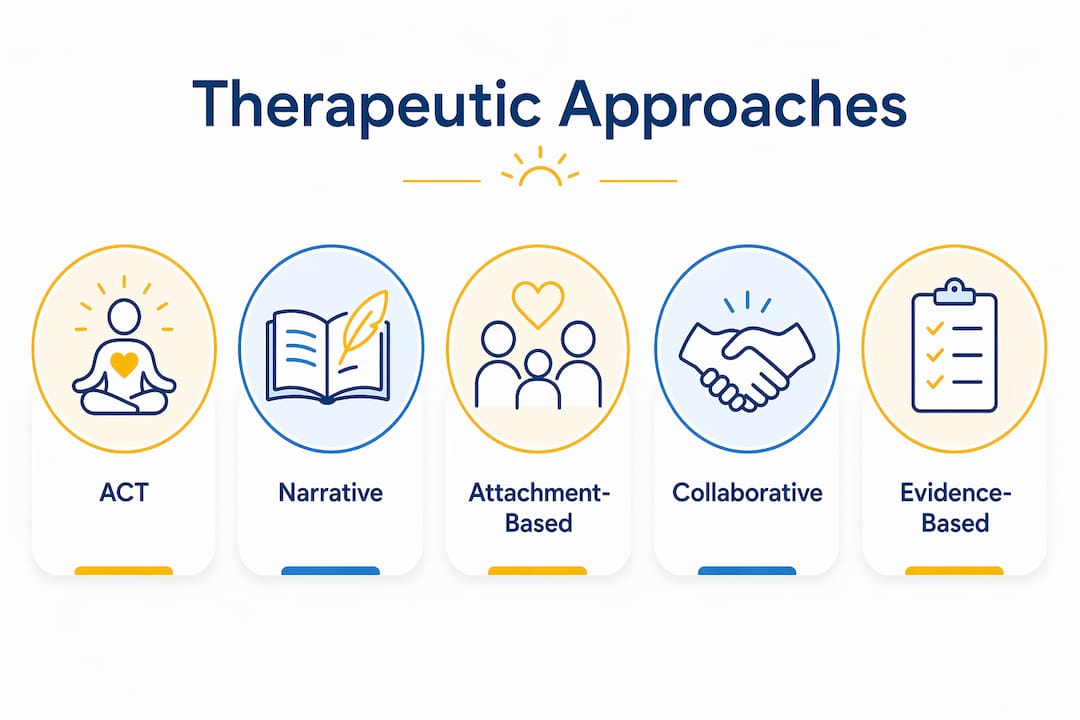
Therapists working with life transitions draw from several evidence-based modalities. The right approach depends on your transition type, emotional presentation, and personal history. Integrative therapists customize modality selection per client needs and adjust if progress stalls or the fit feels off. That flexibility is a feature, not a sign of inconsistency.
| Approach | Core focus | Best suited for |
|---|---|---|
| Acceptance and Commitment Therapy (ACT) | Values clarification and committed action despite discomfort | Career changes, identity shifts, ambivalence |
| Narrative therapy | Re-authoring life stories and integrating what has ended | Divorce, retirement, major loss |
| Attachment-based therapy | Uncovering deep relational patterns surfaced by change | Relationship transitions, grief, identity reorganization |
| Cognitive Behavioral Therapy (CBT) | Identifying and shifting unhelpful thought patterns | Anxiety, decision paralysis, new-role adjustment |
| Mindfulness-based approaches | Present-moment awareness and emotional regulation | Stress, overwhelm, physical symptoms of anxiety |
ACT focuses on values clarification and committed action, helping clients move forward even when discomfort is high. It does not ask you to feel better before acting. It asks you to act in line with your values while the difficult feelings are still present. That reframe alone changes how people relate to uncertainty.
Narrative therapy treats identity transitions as a chapter break, not a failure. The work involves integrating what has ended and building meaning around what is emerging. For people who feel like they have lost their story, this approach gives them authorship back.
Attachment-based depth work addresses the underlying emotional patterns that life changes tend to surface. A job loss, for example, can activate old fears about worthiness or belonging. Working at that level produces more durable growth than surface-level coping strategies alone.
Pro Tip: Ask your therapist directly which modality they plan to use and why. A good therapist will explain their reasoning clearly. If the answer feels vague, that is useful information about the fit.
How do you get the most from your therapy during a life transition?
Active participation is the single strongest predictor of good outcomes in transition therapy. Regular attendance and honest participation foster effective progress. Showing up weekly and being truthful about what is not working, including in the therapy itself, accelerates the process significantly.
Most clients find meaningful relief within 10–20 sessions, or roughly 6–9 months of weekly work. Transitions involving significant grief or trauma typically require longer engagement. Knowing that timeline upfront helps you commit rather than drop out when progress feels slow.
Here are the practices that make the biggest difference:
- Bring the hard stuff first. Do not spend the session on what is comfortable. Name the feelings or thoughts you have been avoiding. That is where the real work happens.
- Track your values between sessions. Write down one or two things each week that felt aligned with who you want to be. Bring that list to your next session.
- Say when something is not working. If a technique feels wrong or a topic feels off-limits, tell your therapist. Therapy works best when the relationship is honest in both directions.
- Expect the neutral zone. There will be a period where the old is gone and the new has not arrived. That discomfort is not a sign of failure. It is the transition itself.
- Use resources between sessions. Revivehealththerapy’s guide on getting the most from therapy offers concrete tools for staying engaged between appointments.
Pro Tip: If you are also managing a career change alongside other transitions, Revivehealththerapy’s resource on therapy for career transitions addresses the specific psychological pressures that professional shifts create.
Key Takeaways
Individual therapy for life transitions works best when it combines evidence-based modalities, consistent weekly attendance, and honest participation across a focused course of 10–20 sessions.
| Point | Details |
|---|---|
| Typical therapy duration | Most clients benefit from 10–20 sessions, or 6–9 months of weekly work, to regain stability. |
| First session purpose | Intake sessions assess symptoms, strengths, and goals before any deep intervention begins. |
| Therapy without a diagnosis | Emotional distress during transitions is a valid reason for therapy, even without a clinical diagnosis. |
| Modality selection | Integrative therapists choose from ACT, narrative, CBT, and attachment-based approaches based on your specific transition. |
| Active participation | Honest engagement and regular attendance are the strongest predictors of good outcomes in transition therapy. |
What I have learned from watching people move through transitions
The clients who struggle most in transition therapy are not the ones with the hardest circumstances. They are the ones who expect therapy to speed up the neutral zone. They want the disorientation to end faster than it naturally does, and they interpret the slowness as evidence that something is wrong with them or with the process.
What I have seen consistently is that the neutral zone is not a problem to solve. It is the transition itself. The people who come out of it with real clarity are the ones who stopped fighting it and started getting curious about it. Therapy gave them a place to do that without judgment or pressure to arrive somewhere before they were ready.
The other thing I would say plainly: therapy is not a substitute for making decisions. It is a place to understand yourself well enough that your decisions come from your actual values rather than from fear or habit. That distinction changes everything about how people use the time. The clients who treat therapy as a thinking partner rather than a rescue service consistently get more out of it.
Patience is not passive. It is the active work of staying present with uncertainty while continuing to move. That is what good transition therapy teaches, and it is harder and more valuable than any quick fix.
— Amy
Revivehealththerapy’s support for your transition
Life transitions do not wait for a convenient time, and neither should your access to support. Revivehealththerapy offers both in-person therapy in Oakland and Walnut Creek and secure telehealth sessions statewide, so geography does not limit your options. Therapists at Revivehealththerapy are trained in ACT, CBT, EMDR, and mindfulness-based approaches, the same modalities described throughout this article.
Sliding-scale fees and insurance acceptance, including HSA and FSA plans, make consistent weekly attendance financially realistic. If you are ready to take the first step, explore individual therapy services at Revivehealththerapy or read therapist bios to find the right fit before booking a consultation.
FAQ
How long does therapy for life transitions typically last?
Most clients find meaningful relief within 10–20 sessions, or roughly 6–9 months of weekly work. Transitions involving significant grief or trauma often require a longer course of treatment.
Do I need a diagnosis to start individual counseling for transitions?
No diagnosis is required. Therapy is valid for psychological distress during major life changes, including grief, ambivalence, and identity questioning, even without a clinical mental health diagnosis.
What is the difference between life coaching and therapy for life changes?
Life coaching is future-focused and action-oriented. Therapy addresses deeper psychological issues including grief, anxiety, and identity questions, making it the appropriate choice when those symptoms are present.
How do I know which therapeutic approach is right for me?
Your therapist will assess your transition type, emotional presentation, and personal history before selecting a modality. Integrative therapists adjust the approach if progress stalls or the fit feels wrong.
What should I bring to my first therapy session for a life transition?
Come prepared to discuss your current stressors, relevant personal history, and what you hope to gain from therapy. A clear sense of your goals, even a rough one, helps the intake session move from assessment to direction faster.