
TL;DR:
- Therapy promotes lasting personal growth by increasing self-awareness, resilience, and meaningful relationships.
- Evidence-based approaches like CBT and EMDR are highly effective for growth across various mental health concerns.
- The therapeutic alliance and progress tracking are critical factors influencing long-term success.
Therapy is widely associated with managing crises, diagnosing disorders, or coping with unbearable pain. But that picture is incomplete. For thousands of people across California, therapy is something much more proactive: a structured, evidence-backed partnership that builds self-awareness, strengthens relationships, and helps people live with more intention. You don’t need to be in freefall to benefit from working with a therapist. In fact, some of the most meaningful progress happens when you come in curious rather than desperate. This guide explores how therapists support personal growth at every stage, from everyday stress to complex trauma, and shows what the evidence actually says.
Table of Contents
- What does personal growth mean in therapy?
- How therapists support personal growth: Evidence-based methods
- Role of therapists in trauma recovery and complex presentations
- How therapists and clients measure growth: Progress tracking and benchmarks
- A fresh perspective: What most guides don’t tell you about therapists and personal growth
- Ready to grow? Connect with evidence-based therapists in California
- Frequently asked questions
Key Takeaways
| Point | Details |
|---|---|
| Growth-centered therapy | Therapists can facilitate meaningful personal growth beyond crisis support, guiding clients to fulfill more of their potential. |
| Evidence-based results | Proven methods like CBT and trauma-focused care improve symptoms and personal well-being—even in accessible, routine care settings. |
| Alliance is key | Trust and collaboration between client and therapist are critical factors in driving lasting growth and healing. |
| Progress tracking matters | Measurement-based care ensures that growth is not just aspirational but supported by real improvements. |
| Care can be affordable | Effective, evidence-based therapy is possible without high costs—accessible options deliver strong outcomes. |
What does personal growth mean in therapy?
To understand the therapist’s role, it’s essential to clarify what “personal growth” means within therapy. Most people expect therapy to reduce symptoms: less anxiety, fewer panic attacks, better sleep. And it absolutely does that. But symptom reduction is only one layer of what good therapy offers. Personal growth in a therapeutic context means something broader and more lasting.
At its core, personal growth in therapy refers to expanding your capacity to function well, relate meaningfully to others, and pursue what genuinely matters to you. It means recognizing patterns that hold you back and replacing them with habits and beliefs that serve your actual goals. This isn’t abstract self-help language. These are measurable, teachable skills.
Therapists work with clients across several key dimensions:
- Self-awareness: Understanding why you react the way you do, identifying core beliefs, and recognizing emotional triggers before they control your behavior
- Resilience: Building the internal resources to recover from adversity without losing your footing
- Healthy relationships: Learning to set boundaries, communicate needs, and repair conflict in ways that deepen rather than damage connection
- Purposeful living: Clarifying what you actually value and aligning daily decisions with those values instead of defaulting to anxiety-driven avoidance
- Emotional regulation: Developing real skills for managing intense feelings, rather than suppressing or being overwhelmed by them
Therapists help clients unpack limiting beliefs that were often formed in childhood or during difficult periods. A belief like “I’m only valuable when I’m productive” can quietly drive burnout, avoidance, and relationship strain for decades. Therapy makes that belief visible and gives you tools to challenge it.
The therapeutic approach matters here. Person-centered therapy sees the client as inherently motivated toward positive psychological functioning, with the therapist in a non-directive role. This means the therapist doesn’t hand you a roadmap. Instead, they create the conditions (warmth, unconditional positive regard, genuine empathy) that allow you to access your own capacity for growth.
Other modalities, like cognitive behavioral therapy (CBT), take a more structured approach, directly targeting thought patterns and behaviors. Both have merit. The choice often depends on what you need at a particular stage in life. If you’re considering starting therapy for growth, understanding these distinctions helps you have a more informed first conversation with a potential therapist.
Personal growth in therapy isn’t a straight line. Some sessions feel like breakthroughs. Others feel like you’re sifting through mud. That’s entirely normal, and both types of sessions serve a purpose.

How therapists support personal growth: Evidence-based methods
Once personal growth is defined, we can examine how therapists use different methods to achieve these outcomes. The field of psychotherapy offers many tools, and skilled therapists typically adapt their approach based on your needs, history, and goals rather than applying one method rigidly.
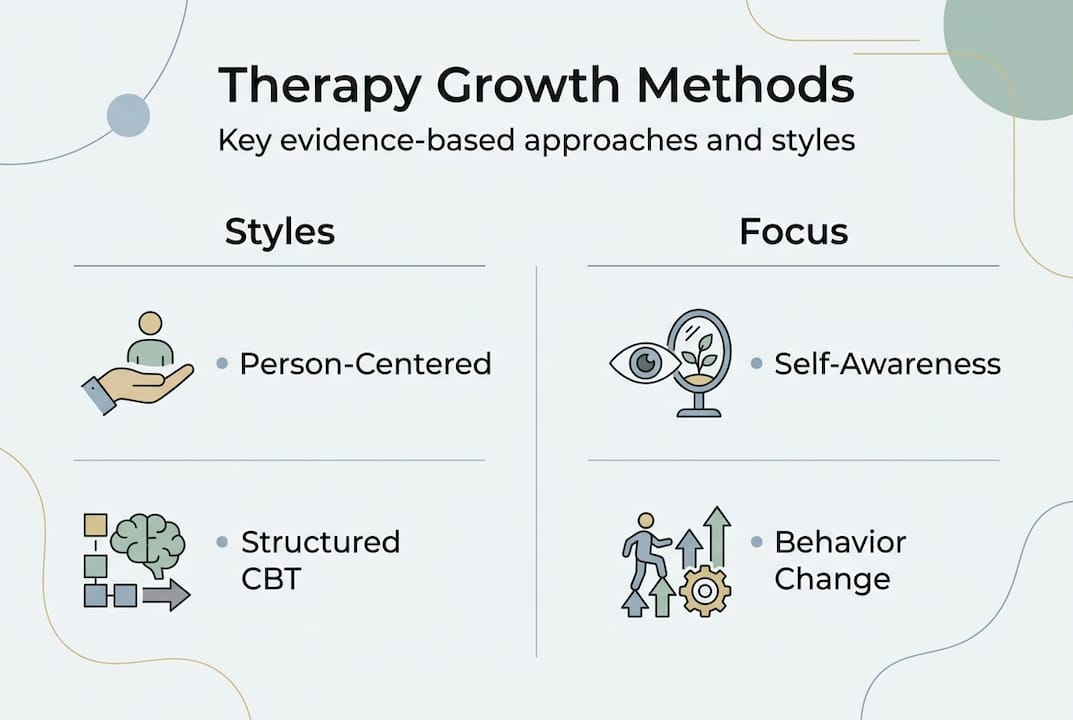
Here’s how common evidence-based approaches compare in supporting personal growth:
| Approach | Style | Best suited for | Growth focus |
|---|---|---|---|
| Person-centered therapy | Non-directive | Self-exploration, self-esteem | Self-actualization |
| Cognitive behavioral therapy (CBT) | Structured | Anxiety, depression, habits | Thought and behavior change |
| Trauma-focused CBT (TF-CBT) | Structured | Trauma, PTSD | Emotional processing, safety |
| EMDR | Protocol-based | Trauma, phobias | Reprocessing stuck memories |
| Mindfulness-based therapy | Integrative | Stress, mood, regulation | Present-moment awareness |
The evidence for structured approaches is strong. CBT for adult anxiety in routine care has large effect sizes, demonstrating that therapy is effective in real-world settings, not just controlled research environments. This matters because many people wonder whether therapy will actually work for them outside of a clinical study. The answer, based on large real-world data, is yes.
Perhaps even more encouraging is what large-scale affordable care data shows. People receiving evidence-based therapy for anxiety and depression report reliable improvement or recovery in over 81% of cases, even in affordable, non-specialized care settings. That means the growth results aren’t limited to expensive private practices. They’re happening in community clinics, sliding-scale practices, and telehealth platforms across California.
The numbered steps below outline how a typical growth-focused therapy process might unfold:
- Initial assessment: Your therapist gathers a detailed picture of your current concerns, history, strengths, and goals. This isn’t just intake paperwork; it’s the foundation of a personalized growth plan.
- Goal setting: Together, you identify specific, meaningful goals. Not vague aims like “feel better,” but concrete changes: “manage work stress without snapping at my partner” or “stop avoiding medical appointments.”
- Skill building: Your therapist teaches practical techniques. This might be thought records in CBT, grounding exercises for anxiety, or communication scripts for relationship challenges.
- Practice and integration: Growth happens between sessions. Homework, reflection, and real-world practice are what turn insights into lasting change.
- Review and adjustment: Progress is evaluated regularly, and the approach shifts as your needs evolve.
Pro Tip: Ask your therapist early on how they’ll know whether therapy is working. A good therapist will have a clear answer involving specific markers, validated measures, or regular check-ins. If they can’t articulate this, that’s worth noting.
For those seeking individual therapy, the work is one-on-one and highly customized. Couples and family therapy involve more people and focus on relational dynamics, but the growth principles remain the same.
Role of therapists in trauma recovery and complex presentations
Beyond common mental health issues, the therapist’s role becomes even more nuanced in trauma recovery, especially when situations are complex. Trauma doesn’t just leave emotional marks; it reshapes the nervous system, the way memory is stored, and even a person’s sense of self. Supporting personal growth in this context requires a different kind of skill.
Complex trauma, often called complex PTSD (C-PTSD), develops from prolonged, repeated exposure to threatening or harmful experiences, such as childhood abuse, domestic violence, or long-term neglect. It frequently involves difficulties with emotional regulation, a distorted self-concept, problems with relationships, and sometimes dissociation (a sense of detachment from thoughts, feelings, or surroundings).
Key considerations for therapists working with complex trauma include:
- Phase-based treatment: Most guidelines recommend starting with safety and stabilization before moving into trauma processing. Jumping straight into trauma memories without adequate grounding can worsen symptoms rather than help.
- Therapeutic alliance as a healing mechanism: Alliance, trust, and rupture repair are repeatedly emphasized as key to success in complex trauma recovery. The relationship itself is therapeutic, not just the techniques used within it.
- Adapting for dissociation: Many therapists working with complex trauma receive additional training to recognize and respond to dissociative states, helping clients stay grounded during sessions without being retraumatized.
- Addressing comorbidities: Complex trauma rarely appears alone. Depression, substance use, eating disorders, and chronic pain often co-occur, requiring a therapist skilled in holding multiple treatment targets at once.
The evidence for specific interventions varies. TF-CBT is superior to no treatment for PTSD and co-occurring depression, making it one of the more robust options for trauma-focused growth. However, for more complex presentations, clinical guidelines advise incorporating dissociation-targeting interventions for complex PTSD, while noting that evidence quality is limited and those recommendations remain tentative.
“In complex trauma, the therapeutic relationship isn’t just the context for healing. For many clients, it’s the primary mechanism. Learning that a relationship can be safe, consistent, and repairable is itself transformative.”
This is why finding the right therapist for trauma isn’t just about credentials. It’s about fit. You can read more about the therapy for trauma recovery process, explore types of trauma therapy, or learn how therapist-client alliance shapes the outcomes you’ll actually experience in sessions.
For those recovering from birth-related trauma or other deeply somatic experiences, holistic trauma recovery approaches can complement clinical therapy by addressing the body’s role in healing. The two don’t have to be separate.
How therapists and clients measure growth: Progress tracking and benchmarks
But how do therapists and clients make sure that personal growth is more than just a feeling? Let’s look at how progress is measured. This might sound clinical, but tracking progress is one of the most empowering things you can do as a therapy client. It transforms growth from an abstract hope into something concrete and verifiable.
Modern therapists increasingly use what’s called measurement-based care (MBC). This involves administering validated questionnaires, often called Patient-Reported Outcome Measures (PROMs), at regular intervals throughout treatment. These tools ask specific questions about symptoms, functioning, and quality of life. The results help both you and your therapist see whether the current approach is working, and when it might be time to change direction.
Here’s a practical step-by-step for advocating for measurement-based care in your own therapy:
- Ask about outcome tracking: During your first or second session, ask whether your therapist uses any standardized measures. Tools like the PHQ-9 (for depression) or GAD-7 (for anxiety) are widely used and easy to complete.
- Request regular reviews: Agree on a schedule for reviewing your progress, whether that’s monthly or every 6 to 8 sessions. Don’t wait until something feels wrong to check in.
- Track your own observations: Keep a simple journal or use a mood-tracking app between sessions. Bring patterns you notice to your therapist rather than waiting for them to ask.
- Compare against benchmarks: Ask your therapist how your progress compares to typical outcomes for your concerns. This isn’t about competition; it’s about making sure the therapy is calibrated to your actual needs.
- Adjust without shame: If progress stalls, that’s data, not failure. Use it as a cue to adapt the approach, add new techniques, or reassess goals.
Research confirms this approach works. Measurement-based care and quality improvement narrowed the outcome gap for depression, with effect sizes improving enough to meet established clinical benchmarks. This means tracking isn’t just bureaucratic overhead; it actively improves your results.
If you want more detail on how to define and track your own goals, the resource on measuring therapy progress explains the practical side in plain terms.
Pro Tip: If your therapist never mentions how progress will be evaluated, bring it up yourself. Asking “how will we know if this is working?” is one of the highest-leverage questions you can ask in therapy. A confident therapist will welcome it.
A fresh perspective: What most guides don’t tell you about therapists and personal growth
Most articles on this topic read like a tour of therapy modalities. They list approaches, cite studies, and then tell you to “find a therapist who’s right for you.” That’s not wrong, but it skips the most important part.
The research on the power of the therapeutic alliance consistently shows that the quality of the relationship between you and your therapist predicts outcomes more reliably than the specific technique being used. This doesn’t mean technique doesn’t matter. It means that even the best technique, applied by a therapist you don’t trust or feel safe with, is unlikely to produce lasting growth.
Our experience tells us that people often stay too long with a therapist who isn’t a good fit because they feel guilty about switching or worry that their discomfort is just “resistance.” Sometimes discomfort is resistance. But sometimes it’s a signal that the fit is genuinely wrong. Knowing the difference is part of your growth.
California offers a wide range of affordable, evidence-based options. Sliding-scale fees, telehealth platforms, and community-based providers mean that access is better than it’s ever been. But access only matters if you use it wisely. Your growth journey will likely shift forms over time. What you need at 28 may look very different from what you need at 45. A great therapist expects that and helps you honor it.
Advocate for yourself from the first session. Ask about their approach, how they handle difficult moments in the relationship, and how they define progress. Those questions tell you a lot about whether this is someone who can genuinely support your growth.
Ready to grow? Connect with evidence-based therapists in California
If you’re ready to start your growth journey, finding support is easier than ever.
At ReviveHealthTherapy, we offer evidence-based therapy for individuals at every stage, whether you’re managing anxiety, processing trauma, or simply wanting to live with more clarity and purpose. Our therapists are trained in proven approaches including CBT, EMDR, and mindfulness-based methods.
We serve clients across California through both in-person sessions in Walnut Creek and Oakland, and secure telehealth options statewide. Sliding-scale fees and insurance acceptance, including HSA and FSA plans, make our top mental health services accessible regardless of your budget. Your growth doesn’t have to wait for the “right” moment or financial windfall. It can start now, with the right support in your corner.
Frequently asked questions
Can therapy help with personal growth if I’m not in crisis?
Yes, evidence shows therapy can foster self-actualization, resilience, and life satisfaction even if you’re not experiencing acute symptoms. Person-centered therapy is built on the belief in people’s innate drive toward positive growth.
How do therapists tailor their approach for trauma and depression?
They combine trauma-focused, relational, and evidence-based interventions, adapting for complex cases and monitoring progress with validated tools. Phase-based approaches and relational focus are essential for complex trauma, where alliance and empathy are critical.
Are affordable therapy options as effective as high-cost services?
Yes, studies show high improvement rates with evidence-based care in routine and blended-care settings. Blended-care therapy yielded over 81% improvement and recovery rates for anxiety and depression across diverse care settings.
What if progress in therapy feels slow or unclear?
Using measurement-based care and regular progress checks helps ensure you and your therapist stay on track. Quality improvement and benchmarking have been shown to increase effectiveness to match clinical benchmarks.
Is online or telehealth therapy a good choice for personal growth?
Yes, telehealth-based evidence-based therapy has shown reliable improvement for many people and increases access to effective care. Blended and telehealth models remain effective for both improvement and full recovery across anxiety and depression presentations.
Recommended
- How therapists guide self-discovery for growth in California – Revive Health Therapy
- How to Start Therapy for Emotional Growth in California – ReviveHealthTherapy
- Therapy for Teens: Building Self-Growth and Resilience – ReviveHealthTherapy
- Therapy session structure: Evidence-based approaches explained – Revive Health Therapy