
TL;DR:
- Mindfulness exercises help adolescents build emotional awareness and reduce stress through present-moment focus. Consistent practice of brief activities like breathing or journaling yields lasting benefits within a few weeks. Framing mindfulness as a personal choice and normalizing initial discomfort increases teen engagement and adherence.
Mindfulness practices for adolescents are purposeful exercises that build emotional awareness, reduce stress, and strengthen resilience through present-moment attention without judgment. A large-scale randomized controlled trial involving 3,519 Finnish youth aged 12–15 found that a 9-week mindfulness intervention increased life satisfaction and positive affect, especially when teens practiced independently. The good news for busy schedules: 5-minute mindfulness exercises like guided breathing effectively manage stress for high school students. Short, consistent practice beats long, occasional sessions every time.
1. What are the most effective mindfulness activities for adolescents?
The most effective mindfulness activities for teens are ones they will actually do. Accessibility and personal appeal matter more than clinical perfection. Below are the top exercises, organized from the simplest entry points to more creative options.
- Focused breathing. Three to five slow breaths, inhaling for four counts and exhaling for six, activates the parasympathetic nervous system. Teens can do this before a test, in a bathroom stall, or on the bus. No app or quiet room required.
- Body scan. Starting at the feet and moving upward, teens notice physical sensations without trying to change them. A five-minute body scan before bed reduces nighttime rumination and improves sleep quality.
- Mindful walking. Each step becomes a point of focus: the feel of the ground, the rhythm of movement, the sounds nearby. This works especially well for teens who find sitting still frustrating.
- Gratitude journaling. Writing three specific things to be grateful for each day shifts attention from threat to appreciation. Specificity matters: “my friend laughed at my joke today” works better than “I’m grateful for my friends.”
- Creative expression. Drawing, playing an instrument, or even doodling with full attention counts as mindfulness. The key is single-task focus, not multitasking while half-watching a screen.
- Partner breathing. Two teens sit back-to-back and synchronize their breath. This social format appeals to extroverted teens who find solo meditation isolating.
- Mindful eating. Taking one minute to notice the color, smell, and texture of food before eating builds present-moment awareness into a daily habit teens already have.
Pro Tip: Start with whichever activity a teen finds least boring. Engagement beats technique every time, especially in the first two weeks.
2. How can teens integrate mindfulness into their daily routines?
Consistency in daily mindfulness of 2–5 minutes builds more habit strength than occasional long sessions. That finding changes how parents and educators should frame the practice. The goal is not a 30-minute meditation retreat. The goal is a two-minute anchor repeated daily.
Here is a practical framework for fitting mindfulness into a teen’s existing schedule:
- Morning anchor. Before picking up a phone, take three slow breaths. This sets a calm baseline before the day’s demands begin.
- Between-class reset. A 60-second breathing exercise in the hallway or at a locker resets focus between subjects. Teachers can build this into transition time.
- Lunch pause. One minute of mindful eating at the start of lunch, noticing food before scrolling, creates a mid-day break from cognitive overload.
- After-school decompression. A five-minute body scan or mindful walk after school separates the school day from home life. This boundary reduces stress carryover.
- Bedtime wind-down. Gratitude journaling or a guided breathing exercise replaces screen time in the last 10 minutes before sleep.
Most teens notice improved focus and emotional space within 2–4 weeks of daily practice. That timeline gives parents and educators a realistic benchmark. Habit-tracking apps or a simple paper calendar can make progress visible and reinforce the routine.
Pro Tip: Attach mindfulness to an existing habit, like brushing teeth or putting on shoes. Habit stacking removes the need for willpower.
3. What challenges do adolescents face when starting mindfulness?
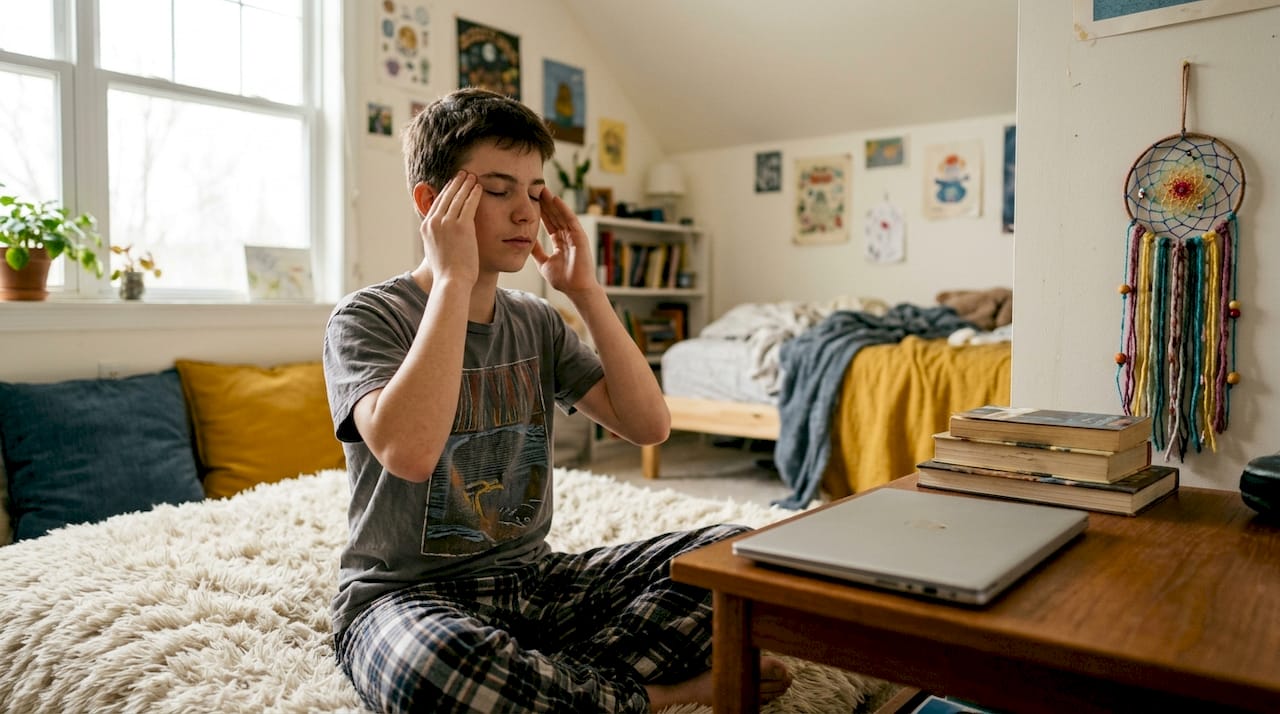
The biggest barrier to teen mindfulness is a single misconception: that the goal is to empty the mind. Clarifying that mindfulness means noticing thoughts and gently returning attention to the present removes this barrier immediately. A wandering mind is not a failed mind. It is a normal mind doing what minds do.
Other common challenges include:
- Resistance to “homework” framing. When mindfulness feels assigned or forced, teens disengage. Framing it as a personal tool rather than a school requirement changes the dynamic entirely.
- Boredom in the first sessions. The first few minutes of any new mindfulness practice feel awkward. Normalizing this discomfort prevents early dropout.
- Feeling self-conscious. Teens are acutely aware of how they appear to peers. Group mindfulness works best when it is normalized by a trusted adult modeling the practice alongside them.
- Expecting instant results. Teens accustomed to immediate digital feedback may feel frustrated when mindfulness does not produce instant calm. Setting a two-week evaluation window manages expectations.
- Lack of choice. Giving teens agency in selecting their mindfulness format increases adherence and reduces resistance. Offering three options and letting them choose one is more effective than prescribing a single method.
Mindfulness framed as curiosity-building helps teens approach emotions with less judgment. That reframe alone shifts the practice from a chore to a skill. For teens managing anxiety, pairing mindfulness with professional support through therapy for teen anxiety accelerates results.
4. How do different mindfulness modalities match adolescent personality types?
Personality type predicts which mindfulness format a teen will sustain. Matching the practice to the person is not optional. It is the difference between a two-day experiment and a lasting habit.
Extroverted teens benefit more from active mindfulness like walking meditation or partner breathing than from seated, silent practice. Movement keeps their attention engaged. Social formats like partner breathing add a relational element that makes the practice feel natural rather than isolating.
Introverted teens, by contrast, often thrive with journaling, body scans, and quiet reflection. These formats give them private space to process emotions without external pressure. A five-minute body scan before bed suits an introvert’s preference for internal focus.
The table below maps common mindfulness modalities to personality suitability.
| Modality | Best suited for | Format | Duration |
|---|---|---|---|
| Focused breathing | All teens | Solo or group | 2–5 minutes |
| Body scan | Introverted teens | Solo | 5–10 minutes |
| Gratitude journaling | Introverted teens | Solo, written | 3–5 minutes |
| Mindful walking | Extroverted teens | Solo or paired | 5–15 minutes |
| Partner breathing | Extroverted teens | Paired or group | 3–5 minutes |
| Creative expression | All teens | Solo or group | Open-ended |
Personalization requires experimentation. Teens should try at least two or three formats before deciding what fits. Asking for feedback after each session, “Did that feel useful or annoying?”, gives educators and parents the data to adjust. For families wanting structured guidance on this process, mindfulness for California families offers practical frameworks tailored to home settings.
Understanding why meditation supports health at a biological level also helps teens buy into the practice. When they understand that slow breathing literally slows their heart rate, the practice feels less abstract and more like a tool they control.
Key Takeaways
Mindfulness practices for adolescents work best when they are brief, consistent, and chosen by the teen rather than assigned to them.
| Point | Details |
|---|---|
| Start with 2–5 minutes daily | Short daily sessions build stronger habits than occasional long ones. |
| Match format to personality | Introverts benefit from journaling and body scans; extroverts from walking and partner breathing. |
| Correct the core misconception | Mindfulness means noticing thoughts, not eliminating them. |
| Give teens real choice | Letting teens pick their format increases adherence and reduces resistance. |
| Expect results in 2–4 weeks | Most teens notice improved focus and emotional space within two weeks of consistent practice. |
What I’ve learned about teen mindfulness after years of watching it work and fail
The teens who stick with mindfulness are almost never the ones who were told to do it. They are the ones who discovered it felt useful. That distinction matters more than any technique or app.
The biggest mistake I see adults make is turning mindfulness into a performance. When a teacher asks students to close their eyes and breathe in front of 30 peers, half the room is focused on not looking weird. The practice collapses before it starts. Small, private, optional entry points work far better.
Mindfulness is a lifelong skill, not a six-week program. A teen who learns to take three slow breaths before reacting to a difficult text message has something that will serve them at 25, 40, and 60. That is the real return on investment. The emotional regulation skills built through consistent mindfulness practice compound over time in ways that are genuinely hard to overstate.
My honest advice: stop trying to get teens to meditate. Start helping them notice one thing at a time. That is the whole practice. Everything else is detail.
— Amy
Supporting teen mental health with Revivehealththerapy
Mindfulness is a powerful starting point, but some teens need more than a breathing exercise.

Revivehealththerapy provides evidence-based therapy for teens in California, including mindfulness-integrated approaches, Cognitive Behavioral Therapy (CBT), and trauma-informed care. Sessions are available in person in Walnut Creek and Oakland, and statewide via secure telehealth. Sliding-scale fees and insurance acceptance make professional support accessible regardless of income. For families ready to take the next step, mental health services for children and teens outlines the full range of options available through Revivehealththerapy. Dedicated teen therapy services are also available for teens who need structured, professional support for anxiety, stress, and emotional regulation.
FAQ
What is mindfulness and why does it help teens?
Mindfulness is the practice of paying attention to the present moment without judgment. Research shows it increases life satisfaction and positive affect in adolescents, particularly with consistent independent practice.
How long does it take for mindfulness to work for teenagers?
Most teens notice improved focus and emotional space within 2–4 weeks of daily practice. Experts recommend evaluating benefits after at least two weeks of consistent effort.
What mindfulness exercises work best for anxious teens?
Focused breathing and body scans are the most accessible starting points for anxious teens. Both can be done in under five minutes and require no equipment or prior experience.
Can mindfulness replace therapy for teens with anxiety?
Mindfulness is a useful skill-building tool but does not replace professional therapy for teens with clinical anxiety. Combining mindfulness with CBT or trauma-informed therapy produces stronger outcomes than either approach alone.
How do parents and educators introduce mindfulness without resistance?
Offer teens a choice of two or three formats rather than prescribing one method. Framing mindfulness as a personal tool rather than a school assignment significantly reduces resistance and increases long-term engagement.
Recommended
- Mindfulness for California Families: A Practical How-To – Revive Health Therapy
- Mental health checklist for California teens: strategies & support – Revive Health Therapy
- Start teen counseling in California: 2026 parent guide – ReviveHealthTherapy
- Your guide to trauma-informed care for teens in CA – Revive Health Therapy