
You already know rest matters. The problem is that knowing it and actually doing it without the creeping sense that you should be editing, posting, or pitching are two completely different things. Here is the short answer: resting without guilt means treating rest as a scheduled, non-negotiable part of your creative work, not something you earn after exhaustion.
A few things that actually move the needle:
- Reframe rest as recovery, not reward. Rest is a prerequisite for sustained output, not a prize you collect after burning out.
- Block rest on your calendar the same way you block a brand deal call. If it is not scheduled, it will not happen.
- End work with a shutdown ritual. Write down unfinished tasks, close your laptop, and do one physical transition activity like a short walk. This signals to your brain that work is genuinely over.
- Challenge the self-talk. When guilt surfaces, ask whether the thought is a fact or a learned belief about productivity.
- Build a “rest menu.” A short list of activities that genuinely recharge you, from reading fiction to a slow walk, so you are not staring at the ceiling wondering what to do with free time.
Table of Contents
- Why content creators feel guilty about resting
- Practical strategies to take guilt-free breaks as a creator
- Self-compassion is one of the most effective tools against burnout
- When rest guilt becomes something you need professional support for
- Key Takeaways
Why content creators feel guilty about resting
The guilt is not random, and it is not a character flaw. It comes from a specific set of pressures that most creators live inside every day.
- Cultural conditioning ties self-worth to output. American hustle culture has spent decades equating busyness with virtue. For creators, that message lands hard because your work is also your identity.
- Algorithms punish absence. Posting less often can mean lower reach, fewer followers, and reduced income. That structural reality makes rest feel financially dangerous, not just lazy.
- Identity monetization blurs the line between you and your work. When your personality, opinions, and creativity are the product, switching off feels like switching you off.
- The brain does not go quiet during rest. Neuroscience research shows the default mode network, the brain’s “idle” state, is actually highly active during downtime. For anxious creators, that activity often surfaces as rumination rather than restoration.
- Social comparison amplifies the pressure. Seeing peers post daily while you take a Saturday off triggers the sense that you are falling behind, even when you are not.
Productivity guilt is not a moral failing. It is a learned emotional cycle where rest gets mislabeled as laziness rather than recognized as vital recovery. Understanding that distinction is the first real step out of it.
Practical strategies to take guilt-free breaks as a creator
These are not vague suggestions. They are specific behaviors that interrupt the guilt cycle at the structural level.
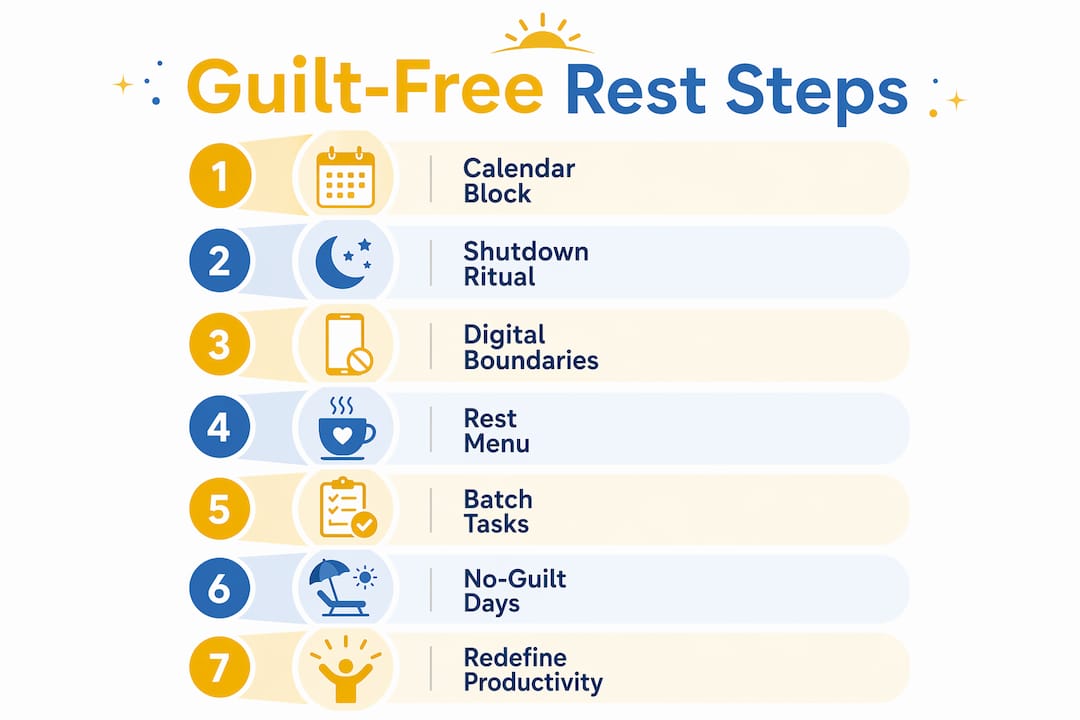
1. Calendar-block your rest like a client meeting.
Open your scheduling app right now and add at least one hour of protected rest time this week. Calendar-blocking rest creates the psychological detachment needed to actually recover, rather than turning downtime into avoidance that feeds more guilt.
2. Use a shutdown ritual.
Psychology Today recommends a three-step close: write down every unfinished task so your brain stops holding it, close all work apps and your laptop, then do a physical transition activity. Walking works. So does making tea or changing clothes. The point is a clear sensory signal that work is done.
3. Set firm digital boundaries.
Patreon’s creator self-care guidance recommends defining hard start and stop times for work, using timers for breaks, and limiting screen time outside those windows. Notifications off is not optional; it is the boundary.
4. Build a personal rest menu.
Write down five to ten activities that genuinely restore you without feeling like work. The list might include a walk without headphones, cooking something new, or reading a novel. Having it ready removes the decision fatigue that makes rest feel effortful.

5. Batch tasks and set realistic daily goals.
Trying to do everything every day guarantees guilt. Batching similar tasks, filming multiple videos in one session, writing several captions at once, compresses work so rest periods feel earned and protected rather than stolen.
6. Try selective “no-guilt” days.
Designate one day per week where you do not check analytics, respond to DMs, or open a content doc. Treat it as a policy, not a mood-dependent choice.
7. Redefine what counts as productive.
Balancing work and rest starts with expanding your definition of productivity to include energy-refilling activities. A walk that clears your head before a creative session is productive. Sleep that prevents a week of brain fog is productive.
Pro Tip: Keep a short rest journal. After each rest period, write one sentence about how you felt before and one about how you felt after. Over two to three weeks, the pattern becomes undeniable: rest improves your output. That data is more persuasive than any motivational quote.
Self-compassion is one of the most effective tools against burnout
This is not soft advice. A randomized controlled trial published in Frontiers in Psychology found that Mindful Self-Compassion training produced a significant increase in self-compassion and meaningful reductions in perceived stress and burnout symptoms post-intervention. Those are meaningful effect sizes across all three dimensions.
What those numbers mean in practice: participants who completed the training did not just feel slightly better. They showed clinically significant reductions in the exact symptoms, stress, burnout, and self-criticism, that drive rest guilt in creators.
Self-compassion works differently from general mindfulness because it directly targets self-coldness, the harsh internal voice that says you are failing when you rest. Mindfulness helps you notice the thought; self-compassion helps you respond to it without punishment. The role of self-compassion in healing is well-documented: treating yourself with the same basic decency you would offer a friend is not indulgence. Research from Wharton shows self-compassion actually predicts greater responsibility for recovery, not less.
Practically, this looks like three things: noticing when you are being harsh with yourself, reminding yourself that struggle with rest guilt is common among creators, and responding with a kind rather than punitive internal statement. It sounds simple. It takes real practice.
When rest guilt becomes something you need professional support for
There is a difference between occasional guilt about taking a Saturday off and a pattern that is genuinely disrupting your mental health and creative life. These are the signs the line has been crossed:
- Persistent exhaustion that does not improve even when you do rest
- Emotional numbness or a flat, detached feeling toward work you used to love
- Diminished creativity, where ideas that once came easily now feel inaccessible
- Anxiety or dread that spikes whenever you try to step away from work
- Rest avoidance that has become a fixed habit, not a bad week
When guilt and rest avoidance reach this level, they have moved from a mindset problem into a mental health pattern. That is where evidence-based psychotherapy becomes the right tool.
Cognitive Behavioral Therapy, or CBT, is particularly effective for the thought distortions that drive productivity guilt. It helps you identify the specific beliefs (“I am only valuable when I produce”) and systematically test whether they hold up. Mindfulness-based approaches build the capacity to observe guilt without being controlled by it. Trauma-informed therapy is worth considering if your relationship with productivity and rest is tied to deeper experiences of conditional approval or instability.
Revivehealththerapy offers individual therapy in Oakland, Walnut Creek, and San Francisco, as well as telehealth sessions across California. Sliding-scale fees and insurance options, including HSA and FSA plans, are available, so cost does not have to be the barrier that keeps you stuck.
Key Takeaways
Resting without guilt as a content creator requires structural changes, not just mindset shifts: schedule rest, end work with a ritual, and build self-compassion as a practiced skill.
| Point | Details |
|---|---|
| Rest is recovery, not reward | Treat rest as a prerequisite for creative output, not something earned after exhaustion. |
| Schedule it or it won’t happen | Calendar-blocking rest creates the psychological detachment needed for genuine recovery. |
| Self-compassion has clinical backing | An RCT found self-compassion training produced a significant increase in self-compassion and meaningful reductions in burnout. |
| Shutdown rituals break the work-rest blur | Writing unfinished tasks, closing devices, and a physical transition signal to your brain that work is done. |
| Persistent burnout warrants professional support | When guilt and exhaustion don’t lift with self-help strategies, CBT or mindfulness-based therapy can help. |