
If you’re looking for alternatives to lauranorthruppsychotherapy.com, three categories cover most situations: local private practices, licensed telehealth platforms, and community mental health centers. For Californians who want trauma-informed, evidence-based care with both in-person and telehealth access, Revivehealththerapy is the recommended first call.
Here’s a quick shortlist organized by category:
Local private practices:
- Revivehealththerapy (Oakland, Walnut Creek, San Francisco + statewide telehealth) — trauma-informed EMDR, CBT, sliding-scale fees, insurance/HSA/FSA accepted
- Private practice via Psychology Today directory — searchable by specialty, insurance, and location; quality varies by individual clinician
Licensed telehealth platforms:
- BetterHelp — subscription-based matching to licensed therapists; fast access, no insurance billing
- Talkspace — subscription plans with text, audio, and video sessions; accepts some insurance
- Brightside Health — combines therapy and psychiatry (medication management); strong for depression and anxiety
- SonderMind — insurance-friendly matching platform; in-network with many major carriers
Community and low-cost options:
- Headway — insurance-focused therapist network; helps clients find in-network providers quickly
- Community Mental Health Centers — sliding-scale or free care; longer wait times but no cost barrier
Pro Tip: Stacking low-intensity supports alongside licensed therapy — journaling, peer groups, guided apps — often produces better real-world outcomes than relying on any single resource alone.
Table of Contents
- How do the main alternative types actually compare?
- What should you look for when choosing a therapy alternative?
- What should you expect when switching providers?
- Why Revivehealththerapy is a strong alternative for Californians
- Key Takeaways
- What actually matters when you’re choosing care
- Ready to book with Revivehealththerapy?
- Authoritative sources and further reading
How do the main alternative types actually compare?
The table below maps each category across the dimensions that actually drive your decision.

| Category | Best for | Therapy model | Typical access | Pricing shape | Modalities | Geographic limits |
|---|---|---|---|---|---|---|
| Local private practice (e.g., Revivehealththerapy) | Trauma, EMDR, couples, families, teens | Licensed therapist, in-person + telehealth | Typically about one to two weeks wait time; telehealth appointments may be available sooner | Per-session; sliding scale; insurance/HSA/FSA | EMDR, CBT, mindfulness, trauma-informed | State-licensed; CA statewide telehealth |
| Telehealth platforms (BetterHelp, Talkspace) | Mild-to-moderate anxiety, depression, life stress | Licensed therapist, video/text/audio | Often within days | Subscription-based pricing without insurance billing | CBT, talk therapy; limited trauma specialties | Multi-state; check clinician’s state license |
| Insurance-matching networks (SonderMind, Headway) | Clients with insurance who want in-network coverage | Licensed therapist, telehealth or in-person | Typically one to three weeks | In-network copay; out-of-pocket varies | Varies by matched clinician | Multi-state; in-network by state |
| Psychiatry + therapy (Brightside Health) | Depression, anxiety needing medication management | Licensed therapist + prescriber | Typically about one to two weeks | Subscription; accepts some insurance | CBT; medication management | Telehealth; most U.S. states |
| Therapy directories (Psychology Today) | Anyone doing their own search | Licensed therapist (self-selected) | Varies widely | Per-session; sliding scale common | Full range; filter by specialty | National; clinician sets own state coverage |
| Community Mental Health Centers | Uninsured, low-income, crisis support | Licensed + supervised staff | Weeks to months | Free to sliding scale | Varies; often CBT, case management | County/region specific |
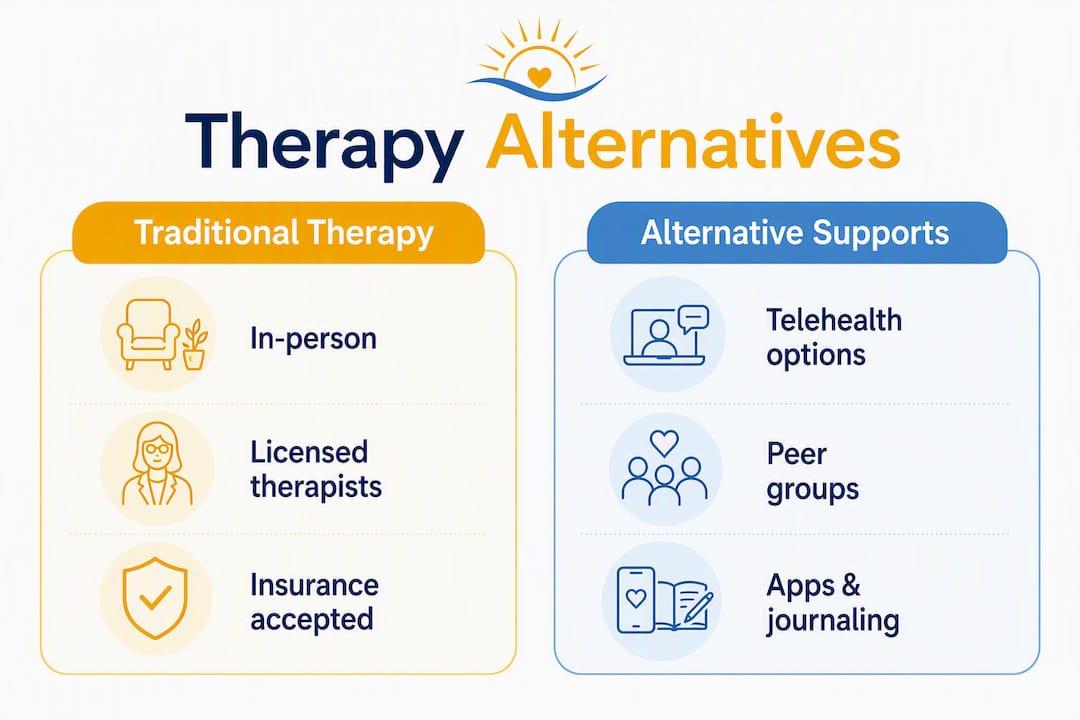
Telehealth platforms like BetterHelp and Talkspace work well for people who need fast access and don’t require insurance billing. The tradeoff is that subscription models don’t always align with how insurance reimburses, and trauma-specific modalities like EMDR are less consistently available. Insurance-matching networks (SonderMind, Headway) solve the billing problem but add a week or two to the matching timeline. Community mental health centers carry the longest waits but remove the cost barrier entirely — a real option when finances are the primary obstacle.

What should you look for when choosing a therapy alternative?
Match your care goal to the provider type first. Symptom relief from anxiety or depression maps well to CBT-focused platforms. Trauma processing calls for a clinician trained in EMDR or sensorimotor approaches. Medication management requires a prescriber, not just a therapist. Long-term identity or relationship work fits a psychodynamic or integrative model better than a subscription app. The APA’s overview of therapy approaches notes that many skilled clinicians integrate techniques rather than working from a single model — which is worth asking about directly.
Core criteria checklist:
- State licensure: Confirm the clinician holds an active license in your state. Telehealth expands access but providers must follow state licensure rules — a California-licensed therapist cannot legally treat a client who has relocated to Texas.
- Clinician credentials: Look for LCSW, MFT, LMFT, PhD, PsyD, or MD/DO for psychiatry. Supervised trainees (ASW, AMFT) are legitimate and often more affordable — just confirm supervision structure.
- Modalities offered: Ask specifically. “Trauma-informed” is a philosophy; EMDR and CPT are structured protocols with evidence behind them.
- Insurance and superbill support: In-network billing is simplest. Out-of-network providers can often supply a superbill for partial reimbursement — ask before booking.
- Sliding-scale availability: Open Path Psychotherapy Collective lists vetted therapists offering reduced-fee sessions, and supervised trainees and community clinics commonly charge $30–70 per session under faculty oversight.
- Confidentiality and data privacy: Telehealth platforms vary significantly. Ask whether session notes are stored on third-party servers and whether the platform sells aggregate data.
Questions to ask before booking:
- What is your typical wait time for a first appointment?
- How long are sessions, and what is your cancellation policy?
- Do you offer a superbill for out-of-network reimbursement?
- What modalities do you use for [your specific concern]?
- Are you currently accepting new clients with my insurance?
Red flags to watch for:
- No verifiable license number or state board listing
- Evasive or hidden pricing with no clear per-session or subscription rate
- No stated specialties or clinical approach
- Reviews that are unverifiable, generic, or suspiciously uniform
- Platforms that cannot confirm the clinician’s state licensure for your location
Pro Tip: For urgent access, telehealth matching services often schedule a first session within 48–72 hours. If you’re in crisis, the 988 Suicide and Crisis Lifeline provides immediate support — do not wait for a scheduled intake.
What should you expect when switching providers?
Switching is usually straightforward when you plan ahead for three things: records transfer, medication continuity, and a clear first-session brief. Most of the friction comes from skipping one of those.
Step-by-step switching checklist:
- Request your records. Contact your current or previous provider and request a release of records. Most practices turn these around within 5–10 business days. You are legally entitled to them.
- Coordinate medication continuity. If you’re on a prescribed medication, ask your current prescriber for a bridge prescription or a direct referral to a new psychiatrist before your last appointment. Never let a prescription lapse between providers.
- Prepare a brief intake summary. Write down your current diagnoses (if any), medications and dosages, prior therapy approaches that helped or didn’t, and your top two or three goals for the new provider. This saves 20 minutes of intake time and helps the new clinician start in the right place.
- Confirm telehealth setup in advance. If you’re moving to a telehealth provider, test the platform before your first session — check audio, video, and browser permissions. Most platforms offer a test call.
- Ask about a warm handoff. Some clinicians will send a brief summary to your new provider with your consent. This is especially useful for complex cases or when switching mid-treatment.
Insurance note: If your new provider is out-of-network, ask for a superbill after each session. Submit it to your insurer directly — many PPO plans reimburse 50–80% of the allowed amount. HSA and FSA funds can typically cover out-of-pocket therapy costs regardless of network status.
On overlapping care: There’s no rule against seeing a new provider for a consult while wrapping up with a current one. A brief overlap of one to two sessions can smooth the transition, especially when working through trauma or a significant life event.
Why Revivehealththerapy is a strong alternative for Californians
Revivehealththerapy offers trauma-informed, evidence-based psychotherapy with in-person sessions at Oakland, Walnut Creek, and San Francisco, plus secure statewide telehealth for clients anywhere in California. That combination — local presence and full telehealth coverage — is less common than it sounds among private practices.
Services offered:
- EMDR therapy for trauma processing
- CBT and mindfulness-based approaches for anxiety, depression, and emotional regulation
- Individual, couples, and family therapy
- Child and teen therapy, including trauma-informed care for adolescents
- Sliding-scale fees for income-qualified clients
- Insurance accepted; HSA/FSA eligible; superbill support for out-of-network reimbursement
The NIMH recommends matching therapeutic modality to treatment goal — EMDR for trauma, CBT for structured symptom relief. Revivehealththerapy’s clinicians work across both, which matters when a client’s presenting concern involves more than one layer.
Scheduling flexibility is a practical differentiator. Telehealth sessions remove the commute barrier for clients across California, and the sliding-scale structure means cost doesn’t have to be the deciding factor. For anyone who has been on a waitlist elsewhere or found telehealth-only platforms too impersonal, the in-person option in the Bay Area is worth noting.
Key Takeaways
The strongest alternative to any single therapist is the one that matches your care goal, fits your budget, and removes the most barriers to actually showing up.
| Point | Details |
|---|---|
| Match modality to goal | Use EMDR or trauma-focused care for trauma; CBT for symptom relief; psychodynamic for long-term exploration. |
| Verify licensure first | Confirm the clinician holds an active state license before booking — telehealth providers must be licensed in your state. |
| Sliding scale is real | Open Path and supervised trainee clinics commonly offer sessions at $30–70 per session; always ask before assuming full private-pay rates. |
| Switching is manageable | Request records, coordinate medications, and prepare a brief intake summary to make any provider transition smooth. |
| Revivehealththerapy | Offers EMDR, CBT, and trauma-informed care in-person (Oakland, Walnut Creek, SF) and via telehealth statewide in California. |
What actually matters when you’re choosing care
The conventional wisdom says to shop for a therapist the way you’d shop for a contractor — check credentials, read reviews, compare prices. That framing isn’t wrong, but it misses the part that actually predicts whether therapy works. Therapist-client fit — the sense that this person understands your specific situation and works in a way that makes sense to you — is the single strongest predictor of engagement and positive outcomes, according to the APA and clinical literature. A highly credentialed clinician using the wrong modality for your goals will produce worse results than a less decorated one who gets the fit right.
The other thing people underestimate is that alternatives aren’t a hierarchy. Peer support, structured journaling, and lifestyle work aren’t consolation prizes for people who can’t afford “real” therapy. They’re tools that stack well alongside licensed care and sometimes address dimensions that weekly sessions don’t reach. The goal is a support system, not a single provider.
For Californians specifically, the in-person option still matters. Telehealth is genuinely effective for many concerns, but some people — especially those processing trauma or working through relational patterns — do better with a physical space. Revivehealththerapy’s Bay Area locations exist for exactly that reason. Pick the option that removes the most barriers to getting care now, and adjust from there.
Ready to book with Revivehealththerapy?
Revivehealththerapy offers something the large telehealth platforms don’t: a licensed clinical team that knows California, works in-person in Oakland, Walnut Creek, and San Francisco, and covers the rest of the state via secure telehealth. Specialties include EMDR, trauma-informed care, CBT, mindfulness, and therapy for children, teens, couples, and families.

Sliding-scale fees are available for income-qualified clients, and the practice accepts insurance with HSA/FSA eligibility and superbill support for out-of-network reimbursement. Before your first session, have your insurance card, a list of current medications, and a rough sense of your top goals ready — it makes the intake faster and more useful.
To get started, visit the psychotherapy services page or reach out directly to schedule a consult. If trauma processing is your primary focus, the trauma-informed care overview is a good place to start.
This article is general information, not professional medical or mental health advice. Confirm current provider availability, licensure, and treatment options with a qualified clinician for your specific situation.
Authoritative sources and further reading
| Source | What it covers | Relevance to this article |
|---|---|---|
| NIMH — Psychotherapies | Licensed provider guidance, telehealth licensure rules, modality descriptions | Licensure criteria, telehealth limits, modality-to-goal matching |
| Mayo Clinic — Psychotherapy | Therapist-client fit, integrative approaches, what to expect | How-to-choose criteria and fit as a predictor of outcomes |
| APA — Approaches to Psychotherapy | Major therapy categories; integrative models | Modality mapping and clinician evaluation |
| Open Path Psychotherapy Collective | Reduced-fee therapist network; trainee clinic guidance | Sliding-scale pricing, affordable alternatives |
| NAMI — Psychotherapy | Peer support vs. clinical care distinctions | Community support options and appropriate use cases |
| Verke — Therapy Alternatives | Stacking low-intensity supports; alternatives framework | Complementary tools and the stacking approach |
Recommended
- Top 6 alternative-health-experts.com Alternatives 2026 – Revive Health Therapy
- Top 6 Blueoaktherapycenter.org Alternatives 2026 – Revive Health Therapy
- Top 3 Greenleafpsych.com Alternatives for Providers 2026 – Revive Health Therapy
- Top 4 dotcenteroakland.com Alternatives 2026 – Revive Health Therapy