
Co-parenting counseling is short-term, child-focused therapy that teaches separated or divorced parents to communicate as business partners instead of exes, and it works best when frequent handoff fights, unresolved decision disputes, or a judge’s recommendation are already pushing your family toward crisis. The goal isn’t reconciliation. It’s a predictable, lower-conflict parenting system your kids can count on.
TL;DR:
- Co-parenting counseling focuses on improving communication and logistics between parents, especially when conflicts threaten to destabilize the child’s stability.
- It is structured in 6 to 12 sessions with an emphasis on practical tools like shared calendars, neutral messaging, and clear escalation rules to reduce reactive conflicts.
- Counseling prioritizes establishing safety, predictability, and working partnership, often recommending parallel parenting for severe conflicts or safety concerns.
- Costs vary from $100 to $250 per session, with insurance less likely to cover it, so verifying billing options is essential.
- Court-ordered classes and community programs can supplement counseling but may not satisfy all jurisdictions’ requirements; always check local court guidance first.
Table of Contents
- What Is Co-Parenting Counseling, and How Is It Different From Couples Therapy?
- What Happens in a Co-Parenting Counseling Session?
- Communication Scripts and Tools Counselors Actually Teach
- Counseling vs. Mediation vs. a Parenting Coordinator: Which Do You Need?
- What Co-Parenting Counseling Costs and Where to Find a Counselor
- Court-Approved Classes and Community Resources Worth Knowing About
- A Clinician’s View on What Actually Moves the Needle
- Getting Started With Co-Parenting Support at Revive Health Therapy
- Sources
What Is Co-Parenting Counseling, and How Is It Different From Couples Therapy?
Co-parenting counseling treats the relationship between two parents as a working partnership, not a romantic one. Sessions stay focused on the children: custody logistics, decision-making, and how you talk to each other in front of the kids. Couples counseling, by contrast, digs into emotional intimacy and relationship repair. If you’re divorced or separated and the goal is reconciliation, you want a couples therapist. If the goal is getting through Saturday pickups without a screaming match, you want a co-parenting counselor.
You’ll also see the terms co-parent coaching, co-parenting therapy, and parenting coordination used loosely online, and they aren’t quite the same thing. Coaching tends to be shorter and more tactical, often without a clinical diagnosis component. Counseling (sometimes called coparenting therapy) is delivered by a licensed clinician and can address deeper patterns like reactivity or trauma history. Parenting coordination is a more formal, often court-appointed role that has actual decision-making authority in ongoing disputes.
Sessions usually start with separate intake interviews, one parent at a time, before moving into joint sessions, either in person or via telehealth. This structure matters: a counselor needs to screen for safety concerns privately before putting two conflicted parents in a room together. Confidentiality also works differently here than in typical therapy. Court-ordered custody evaluations often come with reporting requirements, while standard counseling stays private unless there’s a safety issue.
What Happens in a Co-Parenting Counseling Session?
Most co-parenting counseling runs 6 to 12 sessions of 50 to 90 minutes each, often weekly or biweekly at first, then spacing out as things stabilize. Some families come back for a tune-up months later when a new stressor hits, like a move or a new partner. There’s no fixed endpoint. You continue as long as the sessions are still reducing conflict and stop when the system holds on its own.
The first move is almost always separate intake interviews. A clinician needs to hear each parent’s version privately, screen for domestic violence or safety concerns, and understand what’s actually driving the conflict before anyone sits in a joint session together. From there, the counselor sets ground rules for how sessions will run and helps both parents identify two or three concrete, child-focused goals, like “agree on a consistent bedtime routine” or “stop arguing about schedule changes over text.”
Inside sessions, expect practical, almost rehearsal-like work. Counselors use role-play to practice difficult conversations before they happen in real life, help draft scripts for recurring flashpoints (school pickup changes, holiday scheduling), and set up shared calendars so logistics stop living in group texts. When conflict is severe, or one parent has a history of coercive control, the clinician may recommend parallel parenting instead. That’s a structure where parents operate almost independently, with minimal direct contact, rather than trying to co-manage every decision jointly. It’s not a failure state. For some families, it’s the safest and most stable long-term arrangement.

Communication Scripts and Tools Counselors Actually Teach
The biggest shift counselors push for isn’t emotional. It’s structural. Framing the other parent as a professional partner rather than an emotional adversary changes how you write a text message before you even send it. That reframe alone reduces a huge amount of reactive conflict, because you stop responding to old wounds and start responding to a scheduling problem.
Here’s what that looks like in practice:
- Business-like messaging. Texts stick to logistics: “Confirming Friday pickup at 5pm at school” instead of a paragraph relitigating last week’s argument.
- Agenda messages for anything non-urgent. Save it, batch it, send one weekly check-in instead of five reactive texts.
- Shared calendars for logistics. Custody schedules, activities, and appointments live in one app both parents can see, cutting out the “you never told me” fights.
- A clear escalation rule. Anything involving safety or a same-day change gets a call. Everything else waits for the weekly check-in.
- Cool-down scripts. A simple line like “I need an hour before I respond” gets used instead of firing back mid-argument.
- Short, timed meetings. Five-minute agenda calls with two or three bullet points, not open-ended conversations that spiral.
For high-conflict pairs, counselors often introduce parallel parenting boundaries: no discussion of parenting philosophy, no unscheduled contact, and all changes routed through a written log or app rather than a conversation.
Pro Tip: Before you send a tense message, ask yourself if a coworker would tolerate the tone. If not, rewrite it. That single filter catches most of the messages you’d later regret sending.
Counseling vs. Mediation vs. a Parenting Coordinator: Which Do You Need?
These three services solve different problems, and picking the wrong one wastes time and money. Start by asking what’s actually broken: is it the agreement itself, or how you talk to each other day to day?
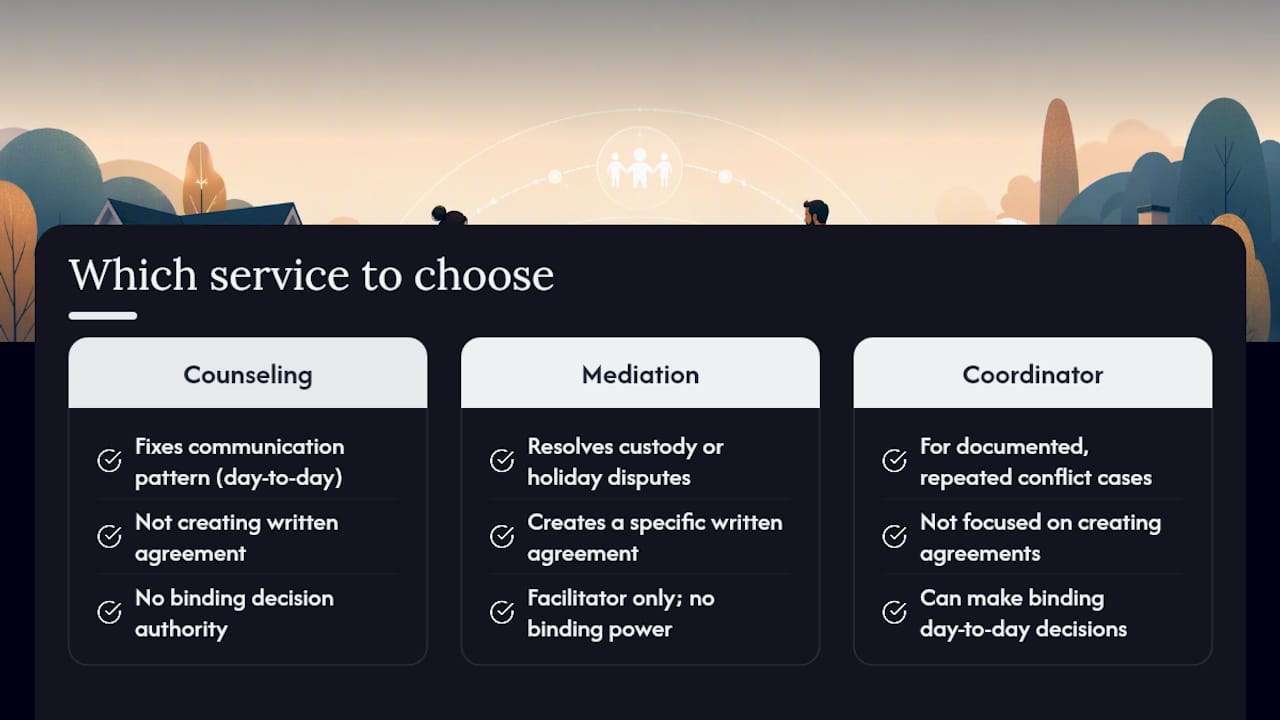
If you and your co-parent can’t agree on a custody schedule or holiday split, mediation is built for that. A mediator’s job is to help you reach a specific, written agreement, often one that becomes part of your parenting plan. California’s court self-help resources note that judges frequently require mediation, or custody-recommending counseling, before they’ll rule when parents can’t agree on their own.
Co-parenting counseling is different. You might already have a workable custody agreement on paper, but every handoff turns into a fight anyway. Counseling targets the communication pattern itself, not the underlying agreement.
A parenting coordinator sits above both of these. It’s a formal, often court-appointed role for cases with a documented history of conflict, and coordinators typically have real authority to make binding decisions on day-to-day disputes without going back to a judge every time. If your case already involves repeated court filings over small disagreements, a coordinator, not counseling, is usually the right escalation.
What Co-Parenting Counseling Costs and Where to Find a Counselor
Session fees for co-parenting counseling typically run about $100 to $250 per session, depending on the clinician’s credentials and your region. Many private-practice therapists, including sliding-scale providers, adjust fees based on income, so it’s worth asking directly rather than assuming a flat rate applies to you.
Insurance is the trickier part. A lot of health plans don’t cover co-parenting counseling because it isn’t diagnosis-driven treatment for one individual; it’s relational work involving two households. Before booking, ask the practice directly whether they can bill insurance for this specific service, or whether they issue a superbill you can submit for out-of-network reimbursement.
To find a qualified counselor:
- Check the Association of Family and Conciliation Courts (AFCC) directory, a professional body focused on family conflict resolution.
- Ask your local family court’s self-help center for a referral list.
- Look for university-affiliated training clinics, which often offer reduced-fee sessions.
- Search therapist directories filtering for “co-parenting” or “divorce adjustment” as a specialty.
- Reach out to a licensed telehealth provider if in-person options in your area are limited.
During intake, ask any provider about their experience with high-conflict cases, whether they’ve worked with court-involved families, and how they handle confidentiality if one parent later requests records.
Court-Approved Classes and Community Resources Worth Knowing About
Many family courts require or strongly recommend a short parenting class before, or alongside, counseling, especially in contested cases. Programs like Children in Between, run by the Center for Divorce Education, are widely accepted by courts nationwide and offer tiered modules, including versions built for higher-conflict situations. These run a few hours online and cost far less than ongoing counseling.
University extension programs are another underused option. Oklahoma State University’s Co-Parenting for Resilience program is a good example of a short, skills-based curriculum with measurable outcomes for kids, and some courts accept it in place of a generic class.
Before enrolling in any program, call your local family court clerk or check the court’s self-help website. Acceptance varies by county, and a class that satisfies one jurisdiction’s requirement may not satisfy another’s.
A Clinician’s View on What Actually Moves the Needle
Safety comes first, always. Before any conversation about better communication, a good counselor rules out coercive control or abuse, because scripts and calendars don’t fix a relationship where one parent isn’t safe engaging directly. Once safety is established, the work is almost entirely about predictability. Kids don’t need parents who like each other. They need parents whose systems don’t change without warning.
Evidence-based methods adapt well to this work. Cognitive behavioral techniques help parents catch and interrupt reactive thought patterns before they turn into a text message they’ll regret, and trauma-informed care matters when one parent’s reactivity traces back to the divorce itself rather than the current dispute. This isn’t therapy that dwells on the marriage. It’s forward-looking, structured, and measured by whether the handoffs get calmer over eight weeks, not by whether old grievances get resolved.
— Amy
Getting Started With Co-Parenting Support at Revive Health Therapy
Revive Health Therapy offers something most co-parenting resources don’t: a licensed clinical team that treats the whole family system, not just a scripted communication workshop. That means the same practice can address a child’s anxiety, a parent’s trauma history, and the co-parenting conflict driving both, without bouncing you between three separate providers.

Sessions are available statewide via secure telehealth or in person in Oakland, Walnut Creek, and San Francisco, and sliding-scale pricing plus HSA/FSA acceptance keep the cost realistic for most budgets. First contact typically starts with a brief intake conversation to understand what’s driving the conflict and match you with a clinician experienced in family and trauma-informed care. If your child is also struggling with the transition, the same team can coordinate family-focused therapy alongside your co-parenting work. Reach out through the contact page to schedule an initial session and get a clear read on next steps.
Sources
- Therapeutic Approaches to Strengthening Co-Parenting Relationships — National Parents Organization
- Resources to develop a parenting plan — California Courts
- Co-Parenting Counselors: What They Do, Cost & How to Find One – Co-Parenting Guide
This article is general information, not a substitute for advice from a qualified doctor. Consult a qualified healthcare professional about your own circumstances before acting on anything here.