
TL;DR:
- Child-focused therapy adapts to each child’s age, needs, and communication style for effective support.
- Parental involvement and collaboration are essential for successful outcomes in child and teen therapy.
- Finding a licensed, flexible therapist experienced in evidence-based methods is key in California.
Child-focused therapy is not a single treatment sitting in a therapist’s office waiting for your kid to walk in. Many parents assume there’s one standard approach, and when it doesn’t click, they conclude therapy simply doesn’t work for their child. That belief keeps too many children from getting the right help at the right time. The reality is that “child-focused therapy” covers a wide range of evidence-based treatments, each designed to match a child’s age, communication style, and specific challenges. This guide breaks down what these approaches actually look like, how families fit into them, and how to find the best fit for your child in California.
Table of Contents
- What does child-focused therapy actually mean?
- How does child-focused therapy work in real-life sessions?
- Key types of evidence-based child-focused therapy
- What role do parents and families play in child-focused therapy?
- How to find the right child-focused therapy in California
- What most parents miss about child-focused therapy
- Connect with expert child therapists in California
- Frequently asked questions
Key Takeaways
| Point | Details |
|---|---|
| Therapy is tailored to kids | Child-focused therapy uses play, talk, and activities to match the child’s age and communication style. |
| Evidence over one-size-fits-all | Effective therapy depends on using structured, research-supported approaches—not generic techniques. |
| Parents are partners | Caregiver involvement often boosts therapy results and helps reinforce skills at home. |
| Ask about fit | The best therapy choice is matched to your child’s unique situation and needs. |
What does child-focused therapy actually mean?
The phrase “child-focused therapy” confuses a lot of parents because it sounds like a formal diagnosis or a single program. It isn’t. Think of it less like a specific product and more like a philosophy of care, one that shapes how any therapy is adapted and delivered based on what a particular child needs.
According to the CDC, child-focused therapy generally means psychotherapy delivered in a developmentally appropriate way that prioritizes the child’s needs, communication style, and family context, sometimes including caregiver involvement. That distinction matters enormously. A six-year-old cannot process emotions the same way a sixteen-year-old can, and neither can process them the way an adult does.
Child-focused care starts from the child’s reality, not the therapist’s convenience. The method comes second. The child comes first.
In practice, child-focused therapy might look very different from session to session and child to child. It includes:
- One-on-one sessions between the child and therapist, using age-appropriate activities
- Caregiver-included sessions where parents observe, participate, or receive coaching
- Group sessions with peers working through similar challenges
- Family sessions that address patterns affecting the whole household
- Telehealth formats that make access easier for families across California
The key principle is that the approach bends to fit the child, not the other way around. For a deeper look at what that means in practice, the child therapy overview at Revive Health Therapy covers how this philosophy translates into real support. If you’re already trying to narrow down options, choosing a child therapist is a practical starting point.
How does child-focused therapy work in real-life sessions?
Knowing that therapy should fit the child is helpful, but parents often want to know what a session actually looks like. The honest answer is that it depends on age, the problem being addressed, and the therapist’s training. But there are consistent patterns worth knowing.
For children under ten, verbal conversation is rarely the main tool. Young children often cannot name what they feel or explain why they acted out. That’s developmentally normal, not a red flag. Therapists trained in child-centered methods use play-based approaches because, as the APA confirms, play-based methods are a common mechanism for helping children communicate feelings and address problems, especially when verbal expression is limited. A child who can’t say “I feel scared when my parents argue” might act it out through dolls, draw it in a picture, or reveal it through the themes of a story they build in session.
For teens, sessions look closer to adult therapy but with important adjustments. Adolescents need to feel respected, not lectured. Good therapists working with teenagers know how to present practical strategies, allow some session control, and avoid the preachy tone teens typically shut down.
| Age group | Common session methods | Goals |
|---|---|---|
| Ages 3 to 6 | Sand tray, puppet play, drawing | Emotional expression, safety |
| Ages 7 to 12 | Structured play, storytelling, activity-based CBT | Coping skills, behavior change |
| Ages 13 to 18 | Talk therapy, CBT, DBT skills, goal setting | Insight, regulation, identity |
Parents are sometimes invited into sessions for specific reasons: to help the therapist understand family dynamics, to receive coaching on how to respond to a child’s behavior at home, or to practice a new communication skill together. This isn’t about putting parents on the spot. It’s about making sure the work done in therapy extends into daily life, which is where it counts most.
Pro Tip: Before your child’s first session, ask the therapist how they typically structure sessions for your child’s age group. A good therapist will explain their approach in plain language and tell you honestly what your involvement will look like.
Understanding why psychotherapy matters for children can also help you set realistic expectations before sessions begin.
Key types of evidence-based child-focused therapy
Parents often hear terms like CBT or play therapy thrown around without a clear explanation of what they involve or when they apply. Here’s a straightforward breakdown of the main approaches you’re likely to encounter.
The CDC confirms that evidence-based child therapy includes established approaches such as behavioral therapy, CBT, and other structured interventions that fit the child’s problem, age, and severity. There is no universal best method. The approach has to match the presenting concern.
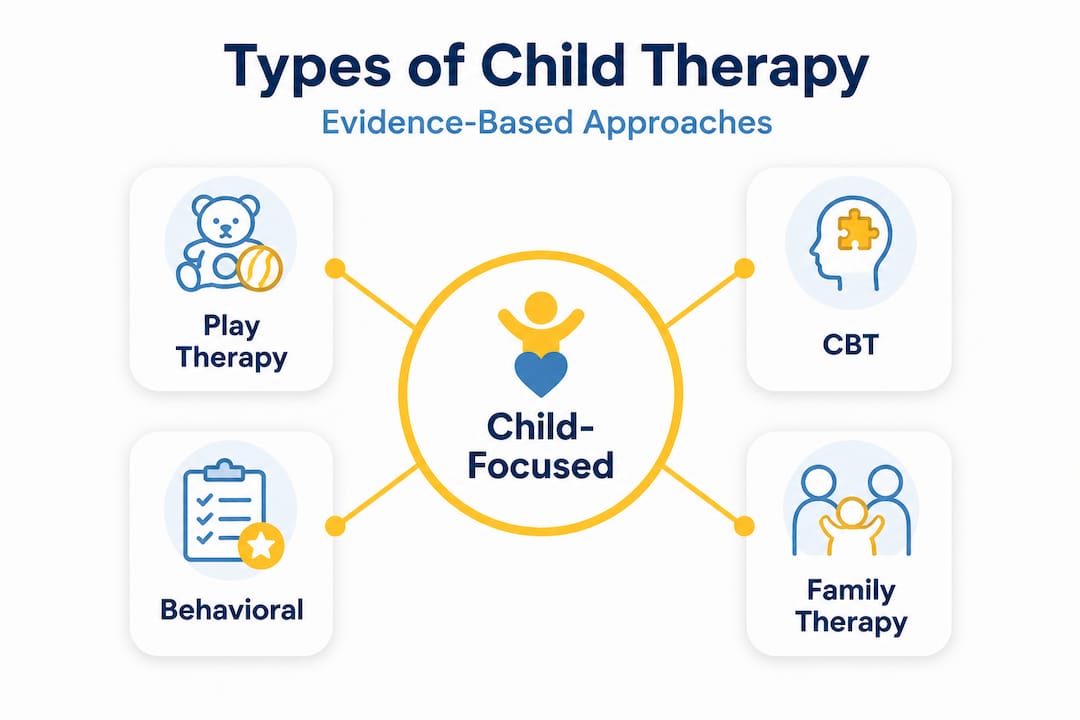
Here’s a comparison of the major models:
| Therapy type | Best suited for | Core method |
|---|---|---|
| Cognitive-Behavioral Therapy (CBT) | Anxiety, depression, OCD | Identifying and changing thought patterns |
| Behavioral therapy | Aggression, ADHD, defiance | Reinforcement, structure, skill practice |
| Play therapy | Young children, trauma, emotional blocks | Play as communication and processing |
| Family therapy | Family conflict, transitions, attachment issues | Relational patterns and communication |
| Trauma-focused CBT (TF-CBT) | PTSD, abuse history, grief | Trauma processing combined with CBT skills |
How do therapists decide which model to use? The process typically involves:
- Initial assessment to understand the child’s symptoms, history, and strengths
- Developmental review to determine what communication and learning styles fit the child’s age
- Identifying the primary concern such as anxiety, trauma, or behavioral difficulties
- Selecting an evidence-based match that fits the concern and the child’s profile
- Adjusting over time based on how the child responds across sessions
A well-trained therapist won’t rigidly stick to one method if it isn’t working. CBT for families is a good example of how a structured evidence-based model can flex to involve caregivers while still maintaining its scientific grounding. This adaptability is one of the hallmarks of skilled child therapy work.
What role do parents and families play in child-focused therapy?
Here’s something many parents don’t expect: you are often a significant part of the treatment, even when your child is the one in the room. Research and clinical experience consistently show that children make faster and more lasting progress when caregivers are actively involved.

AHRQ research confirms that some child-focused interventions explicitly coach parents and caregivers in-session and in everyday interactions, and these approaches can be especially effective for children with behavioral challenges. In other words, teaching a parent how to respond differently to a meltdown may do as much good as teaching the child directly.
Your role will vary depending on the type of therapy and your child’s age:
- Parent-only sessions: The therapist coaches you on strategies to use at home, often for young children with behavioral concerns
- Parent-child sessions: You and your child practice new skills together with the therapist guiding the interaction
- Observation sessions: You watch your child’s session, then debrief with the therapist afterward
- Home practice: You implement agreed-upon routines, responses, or activities between sessions
- Family-focused sessions: The entire family participates to shift relational patterns
For teens, the dynamic shifts. Adolescents often need their therapist to be their own advocate, and confidentiality becomes more central. That doesn’t mean parents are left out entirely. It means the balance changes. A good therapist navigates this with transparency.
Pro Tip: Keep a simple journal of behaviors or moments that concern you between sessions. Even a few quick notes on your phone are enough. Specific examples help therapists calibrate their approach much faster than general impressions.
Therapy for teens requires a different kind of parental involvement, one that respects growing autonomy while keeping communication open.
How to find the right child-focused therapy in California
California has a wide range of therapy options, which is a good thing. But that range also makes it easy to feel lost. Here’s a practical framework for evaluating your options with confidence.
The CDC emphasizes that when choosing therapy for a child, parents should look for a structured, evidence-based approach matched to the presenting concern rather than assuming there is one single child-focused method that covers everything.
Follow these steps when evaluating a therapist or program:
- Verify licensure and specialization. Look for licensed therapists with specific training in child or adolescent mental health, not just general adult therapy experience.
- Ask about the specific approach. A qualified therapist should be able to name the model they use and explain why it fits your child’s situation.
- Inquire about measurable goals. Effective therapy includes clear, trackable goals. Be cautious of therapists who offer only vague descriptions of “working through things.”
- Understand how families are involved. Ask directly: will you be part of sessions? How will the therapist communicate your child’s progress to you?
- Look for cultural responsiveness. Your child’s cultural background and family values should be respected, not ignored, in how therapy is delivered.
- Check access and logistics. Telehealth options, sliding-scale fees, and insurance acceptance all affect whether your family can realistically sustain treatment long enough to see results.
Warning signs to watch for include promises of rapid results with no assessment, reluctance to explain the treatment approach in plain language, and no mention of how progress will be measured. Exploring family therapy types that fit your family’s specific needs is also worth doing before committing to a single approach.
What most parents miss about child-focused therapy
After supporting California families through a wide range of concerns, from school anxiety to trauma recovery to behavioral struggles, one pattern stands out more than any other. Parents tend to focus almost entirely on finding the “right” therapy model. CBT or play therapy? Group or individual? These are reasonable questions. But they miss the more important one.
The most important question is: how does this therapist adapt?
The evidence on child therapy models consistently shows that therapeutic alliance, the relationship between the therapist and child, accounts for a significant portion of positive outcomes. A skilled therapist who blends methods flexibly, who notices when a child has shut down and pivots to something tactile, who adjusts their communication style when a teen gets defensive, will often outperform a rigid application of even the best-researched model.
This matters practically. When you interview a potential therapist, don’t just ask what they do. Ask how they adjust when something isn’t working. Ask how they handle a child who refuses to engage. Ask what they do when a parent and child are telling two completely different stories. Those answers reveal whether the therapist is a genuine practitioner or just a model-follower.
Parents are also more powerful than they realize. Too often, caregivers sit in the waiting room and hope the therapist works some kind of magic in the room. The families who see the most durable progress are the ones who treat therapy as a team project. They ask questions. They implement strategies at home. They give honest feedback to the therapist when something isn’t working. That collaboration is not optional. It is the engine of real change.
Connect with expert child therapists in California
If this guide has helped clarify what child-focused therapy really involves, you’re already ahead of where most parents start. Understanding the options is the first step. Finding a team that can deliver them is the next one.

At Revive Health Therapy, we offer evidence-based child and teen therapy across California, both in-person in Walnut Creek and Oakland and via secure telehealth statewide. Whether your child is struggling with anxiety, behavioral challenges, trauma, or emotional regulation, our team matches the approach to your child’s specific situation. We offer sliding-scale fees and accept most insurance plans, including HSA and FSA, so access doesn’t have to be a barrier. Explore our teen therapy services or learn more about why seek psychotherapy to take the next step toward real support.
Frequently asked questions
Is child-focused therapy effective for anxiety and behavioral issues?
Yes, evidence-based approaches like CBT and behavioral therapy are shown to meaningfully reduce symptoms in children and teens dealing with anxiety or behavioral issues, especially when the approach is matched to the specific concern. The CDC confirms that evidence-based child therapy includes multiple structured interventions suited to different problems, ages, and severity levels.
How involved are parents expected to be in therapy?
Most child-focused therapies actively involve parents or caregivers, particularly for behavioral challenges, and may include in-session coaching and take-home strategies. AHRQ research confirms that caregiver coaching in everyday interactions can be especially effective when behavioral issues are the main concern.
What if my child won’t talk in therapy?
Therapists are trained for this. They use play, drawing, storytelling, and other nonverbal activities to help children communicate when words are difficult. The APA notes that play-based approaches are a proven mechanism for helping children express feelings even when verbal expression is limited.
What should I look for in a child therapist in California?
Look for a licensed therapist with specific training in child or adolescent mental health, who can clearly explain their evidence-based approach, set measurable goals, and involve your family appropriately. The CDC advises that the right approach should be matched to the presenting concern, not applied as a one-size-fits-all solution.
Recommended
- Child Therapy – ReviveHealthTherapy
- How to Prepare for Child’s First Therapy Session Effectively – ReviveHealthTherapy
- 7 Types of Child Therapy Every Parent Should Know About – ReviveHealthTherapy
- How to Support Kids in Therapy for Effective Results – ReviveHealthTherapy
- How to prepare for birth: a complete guide for parents