
Any California minor aged 12 or older can consent to their own outpatient mental health therapy without parental permission, as long as the treating professional determines the minor is mature enough to participate meaningfully. That standard now applies consistently across the state after AB 665 took effect July 1, 2024. The self-consent rule covers outpatient counseling only. It does not include consent to psychotropic medication, inpatient hospitalization, convulsive therapy, or psychosurgery.
TL;DR:
- AB 665 aligned Family Code and Health and Safety Code standards, removing the danger or victim requirement for minors aged 12 and older to consent to outpatient therapy.
- Outpatient therapy consent covers talk therapy and counseling but does not include medication, inpatient care, or invasive procedures like psychosurgery.
- Clinicians must assess maturity based on the minor’s understanding and voluntary participation, with specific documentation and attempts to involve parents unless clinically inappropriate.
- Billing through Medi-Cal for minor consent services now follows consistent rules, though confidentiality gaps can still occur through insurance EOBs.
- Protecting a minor’s privacy requires careful planning, including potential use of self-pay options, and clinicians must follow strict documentation and safety protocols.
Table of Contents
- What the Law Says About Minor Consent Therapy in California
- Who Can Self-Consent to Therapy Without a Parent?
- What Outpatient Consent Covers, and What It Doesn’t
- What Providers Must Do Before and During Minor-Consent Treatment
- How AB 665 Changed Medi-Cal Billing for Minor Consent Therapy
- Confidentiality Limits Parents and Minors Should Know
- Getting Started: Steps for Minors and Families
- Provider Checklist for Compliant Minor-Consent Documentation
- A Clinician’s View on Access, Autonomy, and Safety
- How Revive Health Therapy Supports Minor-Consent Care
- Sources
What the Law Says About Minor Consent Therapy in California
Two statutes govern minor consent therapy in California, and until recently, they did not quite agree with each other.
Family Code §6924 has long allowed a minor 12 or older to consent to outpatient mental health treatment or counseling when a professional person determines the minor is mature enough to participate intelligently. Health and Safety Code §124260 says almost the same thing, defining “mental health treatment or counseling services” and listing which providers qualify to make that maturity call.
The catch was that Family Code §6924 used to carry an extra condition that HSC §124260 did not: a minor also had to show they presented a danger to themselves or others, or that they were the alleged victim of incest or child abuse. That mismatch created real confusion for clinics trying to figure out which standard applied.
AB 665 fixed that. Effective July 1, 2024, the bill stripped the danger/victim requirement out of Family Code §6924, aligning it fully with the more permissive HSC §124260 standard. A minor no longer needs to be in crisis to qualify for self-consented therapy. Being 12 or older and judged mature enough is now the whole test.
The practical effects of that alignment include:
- Consistent eligibility rules whether a clinic references Family Code or Health and Safety Code
- Fewer clinicians turning away teens who don’t meet a “danger” threshold
- Clearer path for Medi-Cal billing on minor-consent claims
- Simplified staff training since one standard now governs both codes
The National Center for Youth Law frames AB 665 as closing an access gap that disproportionately hurt Medi-Cal-enrolled youth, who were more likely to get turned away under the old, stricter Family Code language than teens with private insurance.
Who Can Self-Consent to Therapy Without a Parent?
The age floor is 12. Below that, a parent or guardian has to consent on the minor’s behalf, full stop. At 12 and above, the question shifts from “how old are you” to “are you mature enough to understand what you’re agreeing to.”
That maturity standard is not a checklist you can pass or fail in the way a driving test works. Providers look at whether the minor can grasp what therapy involves, understand the risks and benefits in plain terms, and voluntarily choose to participate rather than being pressured into or out of it. A 13-year-old who can explain why they want to talk to someone, and what they hope changes, usually clears that bar. A younger or more disoriented minor who can’t articulate why they’re there may not.
Not every therapist can make that call solo. The statutes limit who qualifies as a “professional person” authorized to assess maturity and provide treatment, including:
- Licensed psychiatrists, psychologists, and clinical social workers
- Marriage and family therapists and professional clinical counselors
- Registered nurses in specified mental health roles
- Credentialed school psychologists in defined settings
- Trainees and interns working under documented supervision, a category AB 665 clarified explicitly
That last point matters more than it might seem. Before the update, supervision language around trainees was murkier, which left some practicum students and associate-level clinicians unsure whether they could legally treat a self-consenting minor at all. AB 665 confirmed they can, provided a licensed supervisor is on record and involved.
What Outpatient Consent Covers, and What It Doesn’t
Minor consent under these statutes is narrow by design. It covers outpatient therapy sessions, meaning talk therapy, counseling, and related services delivered without an overnight stay, along with residential shelter services as defined in the statutes.
It does not cover anything more invasive. A minor’s signature on an outpatient intake form does not authorize a psychiatrist to prescribe an antidepressant, does not authorize a hospital to admit them for inpatient psychiatric care, and absolutely does not cover convulsive therapy or psychosurgery. Those categories still require parental or guardian consent, regardless of how mature the minor is or how urgently a clinician thinks intervention is needed.
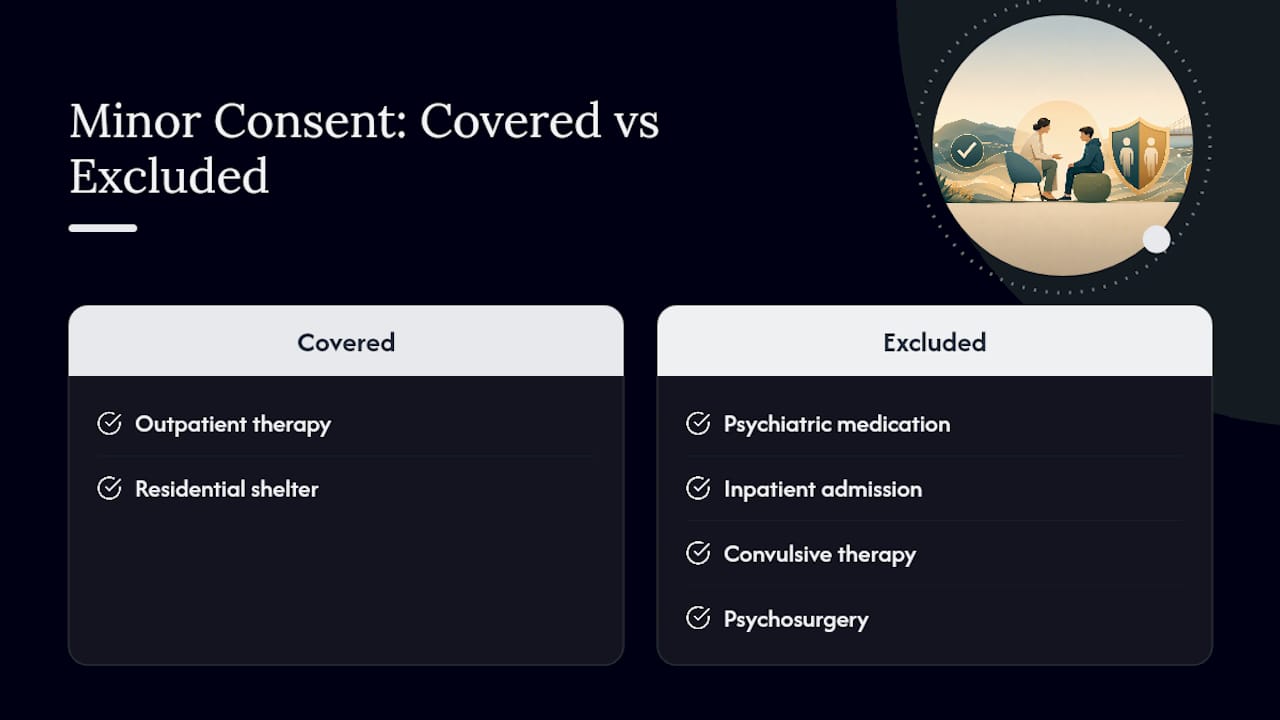
Picture the difference this way: a 15-year-old can walk into a clinic and start weekly CBT sessions for anxiety on their own signature. That same 15-year-old cannot independently start a course of psychiatric medication or check into a residential psychiatric unit. The CACFS FAQ on AB 665 restates this exclusion list plainly, because providers who blur it risk real legal exposure.
What Providers Must Do Before and During Minor-Consent Treatment
Consenting a minor into outpatient treatment isn’t a shortcut around parents. It’s a structured process with specific obligations attached, and skipping steps creates liability for the clinician, not just an ethical gray area.
- Consult with the minor directly about whether involving a parent or guardian makes sense, before deciding it doesn’t.
- Attempt contact with a parent or guardian unless the minor’s clinical situation makes that inappropriate, and record who tried, when, and how.
- Document the clinical rationale for any decision not to involve a parent, in specific enough terms that another clinician reviewing the chart later understands the reasoning.
- Follow supervision protocols if you’re a trainee. HSC §124260 requires trainees to notify a supervisor within 24 hours of beginning treatment with a self-consenting minor, and immediately if the minor shows signs of danger to themselves or others.
- Escalate immediately for safety concerns. Standard mandated-reporting and duty-to-warn obligations still apply in full, regardless of who consented to treatment.
Pro Tip: Keep a standing template in your intake workflow for parent-contact attempts. Log the date, time, method, and outcome every single time. A vague chart note like “tried to reach parent” will not hold up if the case is ever reviewed, but a dated, specific entry will.
None of this documentation is optional paperwork. If a chart ever gets audited or a dispute arises about whether a minor was properly consented, these entries are what protect both the clinician and the minor’s continued access to care.
How AB 665 Changed Medi-Cal Billing for Minor Consent Therapy
Before AB 665, Medi-Cal billing for minor-consent outpatient services was tangled up in the same inconsistency that plagued the underlying statutes. Because Family Code §6924 required proof of danger or victim status, plans and providers sometimes struggled to bill Medi-Cal for straightforward outpatient counseling that didn’t meet that higher bar, even when HSC §124260 would have allowed it.
DHCS guidance issued after the bill’s effective date clarifies how providers should bill Medi-Cal for minor-consent outpatient services now that the two codes align. A related DHCS policy letter fills in operational detail on eligibility and claims processing.
On the financial side, a few things stay constant:
- Parents aren’t automatically billed or liable for minor-consent treatment unless they choose to participate in payment or care.
- Explanation of Benefits (EOB) statements can still land in a parent’s mailbox if the minor is on the parent’s insurance plan, which creates a real privacy gap between legal consent and practical confidentiality.
- Sliding-scale fees and superbills remain common workarounds clinics use to keep minor-consent care both accessible and private when insurance billing risks disclosure.
- Clinic-level policies vary, so a family or minor should ask directly how a specific practice handles billing before treatment starts.
The National Center for Youth Law’s implementation notes point out that this billing fix was a central reason AB 665 mattered. Medi-Cal-enrolled youth, who tend to have fewer private-pay alternatives, were the group most affected by the old inconsistency.
Confidentiality Limits Parents and Minors Should Know
Legal consent and practical privacy are two different things, and conflating them causes most of the frustration around minor consent therapy. A minor’s legal right to consent doesn’t automatically mean their sessions stay invisible to a parent.
Insurance is the biggest leak. If a minor is covered under a parent’s health plan and the clinic bills that insurance, an EOB describing the type of service (even without session notes) can arrive at the parent’s address. DHCS guidance specifically flags billing as one of the most common confidentiality gaps in minor-consent cases.
A few practical steps reduce that exposure:
- Ask the clinic whether it can bill in a way that limits identifying detail on the EOB.
- Consider a sliding-scale, self-pay, or superbill arrangement instead of running the claim through a parent’s insurance plan.
- Use a private phone number or email for appointment reminders if a shared family device is a concern.
- Ask directly, at intake, what the clinic’s specific confidentiality policy is for minor clients.
Pro Tip: If privacy from a parent’s insurance statement is the main worry, ask the front desk about self-pay or sliding-scale rates before your first session. It’s often the simplest fix, and far less complicated than trying to intercept mail.
Parents, for their part, aren’t shut out entirely. A minor’s therapist can encourage, and often actively works toward, eventual parental involvement when it’s safe and appropriate, since most treatment goes more smoothly with family support in the picture. The law protects a minor’s ability to start therapy privately. It doesn’t forbid a therapist from helping build a bridge to parents over time.
Getting Started: Steps for Minors and Families
Finding the right entry point makes the difference between a smooth first appointment and a frustrating runaround.
- Search for providers who explicitly offer minor consent services and confirm whether they accept Medi-Cal, private insurance, or self-pay.
- Call ahead and ask directly whether the clinic handles minor-consent intake, since not every practice is set up for it.
- Bring identification and insurance information if available, though a minor consenting under these statutes doesn’t need parental paperwork to start.
- Expect an initial conversation about maturity and goals rather than a formal test, since that’s how providers assess whether self-consent applies.
- Ask about telehealth if privacy or transportation is a barrier. Statewide telehealth options widen access considerably for teens in areas with few local providers.
Community mental health clinics and sliding-scale practices are often the most realistic path for minors without easy access to private insurance or a supportive parent to help navigate coverage.
Provider Checklist for Compliant Minor-Consent Documentation
A clean chart is the single best protection a clinician has if a minor-consent case is ever questioned. The essentials break down into three categories.
- Assess and document maturity indicators: understanding of treatment, ability to weigh risks and benefits, and voluntary participation.
- Record every parent-contact attempt with date, method, and outcome, even when the attempt failed or wasn’t appropriate to make.
- State the specific clinical rationale whenever parental involvement is judged inappropriate, not just a general note that it was skipped.
- Log supervisory contact for trainees within the 24-hour window required by HSC §124260, and immediately for any safety concern.
- Bill Medi-Cal claims per current DHCS guidance to avoid claim denials tied to outdated consent language.
| Checklist item | Why it matters |
|---|---|
| Maturity assessment notes | Establishes the legal basis for self-consent |
| Parent-contact log | Required by statute regardless of outcome |
| Rationale for non-involvement | Protects clinician if involvement is later questioned |
| Trainee supervisor notification | Mandatory within 24 hours under HSC §124260 |
| Medi-Cal billing code accuracy | Prevents claim denial post-AB 665 |
For clinics building out phone intake workflows around these steps, structured phone protocol templates can help standardize how front-desk staff handle minor-consent calls consistently.
A Clinician’s View on Access, Autonomy, and Safety
AB 665 closes a gap that never should have existed. A Medi-Cal-enrolled teenager in crisis deserved the same easy path into outpatient therapy as a privately insured teenager, and for years, the law quietly made that harder. Aligning Family Code §6924 with HSC §124260 wasn’t a technical fix. It was an equity fix.
What gets underappreciated is how much this is about trust, not just access. A 13-year-old who has to prove they’re in danger before anyone will see them learns a bad lesson early: that their pain only counts once it’s severe enough. Removing that bar tells teens something healthier, that wanting support is reason enough.
None of this replaces family engagement. The best outcomes still happen when parents get looped in eventually, safely, and on the minor’s terms. Good documentation, careful maturity assessment, and a clear escalation plan for safety concerns aren’t bureaucratic hoops. They’re what make autonomy and safety work together instead of against each other.
— Amy
How Revive Health Therapy Supports Minor-Consent Care
Revive Health Therapy gives California teens a direct path into confidential outpatient care, without the wait times or narrow intake windows that make many clinics inaccessible to a 13-year-old trying to self-refer.
Teens working with Revive Health Therapy get trauma-informed care from clinicians trained in EMDR, CBT, and mindfulness-based approaches, delivered either in person in Oakland and Walnut Creek or through secure telehealth sessions available statewide. Intake conversations address maturity, treatment goals, and privacy preferences up front, and billing options include sliding-scale fees, insurance acceptance, and payment plans, so cost and confidentiality concerns get addressed before the first real session starts. For a minor weighing whether self-consent is the right move, or a parent trying to understand what support looks like, the teen therapy program page outlines what to expect from that first conversation. Reach out through the contact page to ask specific questions about minor-consent intake before booking anything.
This article is general information, not a substitute for advice from a qualified doctor. Consult a qualified healthcare professional about your own circumstances before acting on anything here.
Sources
- AB-665 Minors: consent to mental health services — bill text
- California Health & Safety Code §124260 — Mental health services for minors
- DHCS BHIN 24-046 — Minor consent to outpatient mental health treatment or counseling
- Minor consent mental health care — Implementing Assembly Bill 665 | National Center for Youth Law