
Yes, you can use your HSA for therapy, as long as the treatment addresses a diagnosed mental health condition and comes from a licensed provider. That’s the whole test under IRS guidelines. Telehealth sessions qualify exactly the same as sitting on a therapist’s couch, and you’ll want to hang onto an itemized receipt or superbill for every session in case your HSA administrator or the IRS ever asks for proof.
TL;DR:
- HSA funds can cover therapy with licensed providers treating diagnosed mental health conditions, including telehealth sessions, as long as proper documentation is maintained.
- Costs like individual sessions, medication management, psychological testing, and transportation may be reimbursed, but wellness apps or general coaching usually do not qualify.
- Paying with your HSA can be done via direct debit or reimbursement, with an itemized superbill required for out-of-pocket payments, and documentation stored for 3 to 7 years.
- A Letter of Medical Necessity can help convert borderline services like family therapy into eligible expenses if tied to a diagnosed condition.
- Delaying reimbursement allows the HSA to grow tax-free over time, and virtual therapy has the same eligibility and documentation standards as in-person care.
Table of Contents
- HSA for Therapy: What Counts Under IRS Rules
- Therapy Costs Your HSA Will Cover, and What It Won’t
- How to Pay for Therapy With Your HSA (and Document It Right)
- Gray Areas: When You Need a Letter of Medical Necessity
- Smart Tax Strategies for Using HSA Funds on Therapy
- Where to Find HSA-Friendly Therapy in California
- Why the HSA-Therapy Conversation Gets Oversimplified
- Ready to Use Your HSA for Therapy? Here’s the Simple Path
- Sources
HSA for Therapy: What Counts Under IRS Rules
The IRS doesn’t have a special list titled “therapy expenses.” Instead, Publication 502 sets a general standard: a medical expense qualifies if it’s for the diagnosis, cure, mitigation, treatment, or prevention of disease, including mental illness. Publication 969 borrows that exact definition for HSAs, so if an expense passes the Pub 502 test, your HSA can pay for it.
The provider matters as much as the service. A session with a friend who’s “good at listening” doesn’t qualify. A session with a licensed clinician does. That covers:
- Psychiatrists and psychiatric nurse practitioners
- Licensed psychologists (PhD or PsyD)
- Licensed Clinical Social Workers (LCSW)
- Licensed Professional Counselors (LPC) or Licensed Marriage and Family Therapists (LMFT)
- Board-certified behavior analysts treating a diagnosed condition
Telehealth doesn’t get a lesser status here. Federal health agencies treat virtual mental health care as clinically equivalent to in-person visits when delivered by a licensed clinician, a point the CDC reinforces in its own mental health guidance. So a video session with your therapist is just as HSA-eligible as an office visit. Medication management appointments, psychological testing, and diagnostic evaluations all clear the bar too, since they’re squarely aimed at treating a diagnosed condition.
Therapy Costs Your HSA Will Cover, and What It Won’t
Once a licensed provider is treating a diagnosed condition, most of the bill becomes fair game. Typical covered costs include:
- Individual therapy sessions, in-person or via telehealth
- Group therapy led by a licensed clinician
- Psychiatric visits and prescription medications for mental health conditions
- Psychological or neuropsychological testing
- Copays, coinsurance, and deductibles tied to any of the above
- Mileage or transportation costs to reach a therapy appointment, in some cases
The exclusions trip people up more often than the inclusions. Life coaching doesn’t qualify, no matter how therapeutic it feels, because coaches aren’t licensed to diagnose or treat disease. General wellness apps, meditation subscriptions, and stress-management courses fall into the same bucket unless a doctor specifically prescribes them for a diagnosed condition. Couples or family therapy is a gray area: it qualifies when one partner or family member has a diagnosed condition being treated, but pure relationship enrichment without a diagnosis usually doesn’t. A Letter of Medical Necessity can often tip these borderline cases toward eligibility, which is worth understanding before you assume a claim will bounce.
How to Pay for Therapy With Your HSA (and Document It Right)
You have two ways to actually spend the money. Either swipe your HSA debit card directly at checkout, or pay out-of-pocket with a personal card and reimburse yourself from the HSA later. Both are legitimate, and plenty of people default to the second option without realizing it.
- Try the HSA card first. If the therapist’s office accepts it, you’re done. No paperwork beyond the receipt.
- If the card is declined, pay with a personal card or check. This happens more than you’d expect.
- Request an itemized superbill. It should show the provider’s name and license or NPI number, the date of service, a CPT code or clear service description, the patient’s name, and the amount charged.
- Submit that superbill to your HSA administrator for reimbursement, or simply keep it filed if you’re reimbursing yourself informally.
- Store the documentation for 3 to 7 years, since the IRS can request proof of any HSA distribution during that window.
The decline in step 2 usually isn’t a coverage problem. It’s a merchant category code issue, where the therapist’s payment processor is coded in a way that HSA cards reject automatically. It’s an administrative glitch, not a sign the expense is ineligible. Reviewing a superbill checklist before your first appointment saves you from scrambling for missing details after the fact.
Pro Tip: Ask your therapist’s billing staff, before your first session, whether they routinely issue superbills. Practices that work with out-of-network or HSA clients regularly usually have a template ready, which saves you a follow-up email later.
Gray Areas: When You Need a Letter of Medical Necessity
Some services live in a genuine gray zone. Life coaching, general wellness platforms, and purely relational counseling without any diagnosis attached don’t automatically qualify, even though they can feel similar to therapy in practice.
A Letter of Medical Necessity is a short document from a licensed provider stating that a specific service treats a diagnosed condition. It converts a borderline expense, like family therapy tied to a teen’s anxiety diagnosis, into a clearly documented one. Any licensed clinician treating you can typically write one; it doesn’t need to come from a separate specialist.
Before paying, ask your provider or platform a few direct questions:
- Are you licensed, and can you provide your license number on receipts?
- Will you issue an itemized superbill automatically, or do I need to request one?
- Can you write a Letter of Medical Necessity if my HSA administrator asks for one?
For large or recurring claims, a quick conversation with a tax professional beats guessing.
Smart Tax Strategies for Using HSA Funds on Therapy
The most underused HSA move is delaying reimbursement. You can pay a therapy bill out-of-pocket today, let the receipt sit in a file, and reimburse yourself years later from the same HSA, as long as the account existed when you incurred the expense. That gap lets the money stay invested and grow tax-free in the meantime, something industry guidance on HSA therapy use points to as one of the account’s biggest structural advantages over a typical checking account.
Pair the HSA with your insurance deliberately: use it for copays, coinsurance, and the deductible portion of therapy costs rather than the full session rate if you’re in-network. If you know a year involves intensive treatment, sitting down during open enrollment to weigh an FSA against your HSA makes sense, since FSAs sometimes fit short-term, predictable therapy costs better.
Every dollar contributed to an HSA skips federal income tax going in, grows tax-free, and comes out tax-free for qualified expenses like therapy, a triple advantage no ordinary savings account offers.
- Contribute enough to cover expected copays and deductibles before the plan year starts
- Save every superbill even if you don’t reimburse immediately
- Revisit FSA vs. HSA elections annually if your therapy needs change
Where to Find HSA-Friendly Therapy in California
Finding a provider who actually understands HSA logistics matters as much as finding one who takes your insurance. Evidence-based psychotherapy is offered across California, built around trauma-informed approaches like EMDR, CBT, and mindfulness, for individuals, couples, families, and teens.
Sessions happen in person in Oakland and Walnut Creek, or through secure telehealth available statewide, so a video appointment with a licensed clinician carries the same HSA eligibility as an office visit under CDC guidance on virtual mental health parity.
Practically, that means:
- HSA and FSA payments accepted directly for sessions
- Itemized superbills provided for out-of-network reimbursement
- Sliding-scale fees may be available for clients managing budgets alongside HSA contributions
- Documentation support to help with paperwork requirements
If you already manage employer-based benefits, workplace mental health resources are worth reviewing alongside your HSA plan, since some employers now coordinate HSA contributions with mental health stipends.
Why the HSA-Therapy Conversation Gets Oversimplified
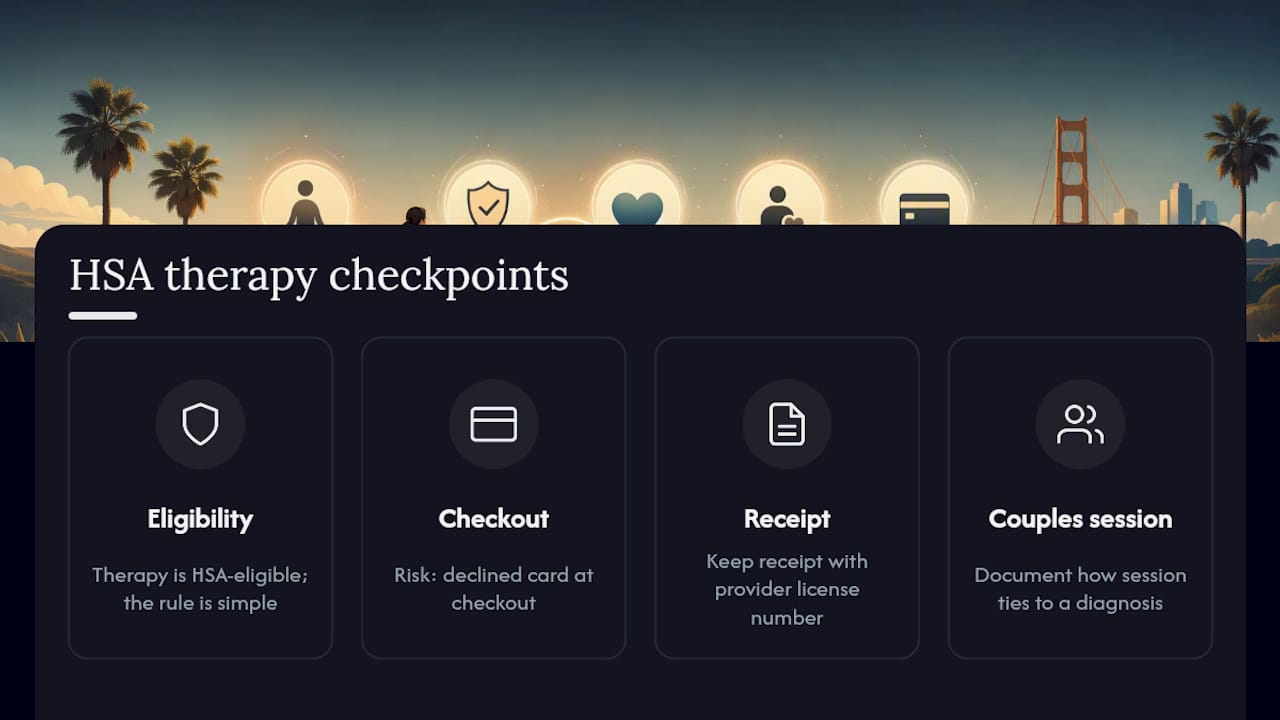
Most guidance on this topic stops at “yes, therapy is HSA-eligible” and leaves people to sort out the mess themselves. That’s backwards. The eligibility rule is simple. The friction is entirely operational: a declined card at checkout, a receipt missing a license number, a couples session that doesn’t obviously tie to a diagnosis.
What gets overlooked most is the reimburse-later strategy. People treat their HSA like a debit account for this month’s bills, when the bigger win is treating it like a retirement account for medical costs, paying cash now, investing the HSA balance, and reimbursing yourself a decade from now with tax-free growth attached. Few therapy clients realize that gap even exists.
The other blind spot is telehealth parity. Some people still assume virtual sessions carry weaker documentation standards than in-person visits. They don’t. A licensed clinician on a screen generates the exact same superbill, the exact same CPT code, and the exact same eligibility as a clinician across a desk. If cost or location has kept you from starting therapy, that distinction alone should change the calculation.
— Amy
Ready to Use Your HSA for Therapy? Here’s the Simple Path
Revivehealththerapy makes the HSA side of therapy easier than most practices, because superbills and itemized receipts are built into how the practice already bills, not an afterthought you have to request three times.

Every session, whether in-person in Oakland or Walnut Creek or through statewide telehealth, comes with documentation that includes the provider’s license information, CPT codes, and dates of service, exactly what your HSA administrator will want to see. If a session lands in a gray area, like family therapy tied to a teen’s diagnosis, clinicians can provide a Letter of Medical Necessity on request. Sliding-scale pricing is also available for clients stretching a tight HSA balance across multiple sessions.
If you’re ready to put your HSA to work, reach out through the contact page to ask about availability, HSA/FSA acceptance, and superbill turnaround before your first appointment.
This article is general information, not a substitute for advice from a qualified doctor. Consult a qualified healthcare professional about your own circumstances before acting on anything here.
Sources
- Publication 502 (Medical and Dental Expenses) — IRS
- Mental Health — Centers for Disease Control and Prevention (CDC)