
Intrusive thoughts are unwanted, involuntary thoughts, images, or urges that pop into your mind uninvited and often clash hard with your actual values. They are common. The Anxiety and Depression Association of America estimates a significant number of people in the United States struggle with them enough to seek support. Having one does not mean you want to act on it, and it doesn’t say anything about your character.
TL;DR:
- Intrusive thoughts often become more persistent and distressing when individuals try to suppress or avoid them, especially under stress, hormonal shifts, or trauma triggers.
- Treatment effectiveness relies on facing triggers gradually through exposure therapy rather than avoidance, which reinforces and prolongs the thoughts.
- The main difference between normal intrusive thoughts and OCD-related obsessions is that obsessions are persistent, compulsively managed, and linked to a pattern of ritualized responses.
- Addressing intrusive thoughts early with therapy, such as cognitive behavioral therapy or EMDR, can prevent them from developing into chronic dysfunction.
- Seeking help is advised if intrusive thoughts interfere with daily life, increase in frequency, or are accompanied by plans to harm oneself or others.
Table of Contents
- Understanding Intrusive Thoughts: Common Types and Examples
- Are Intrusive Thoughts Normal, or a Sign of a Problem?
- What Causes Intrusive Thoughts to Show Up
- When Intrusive Thoughts Signal an Underlying Condition
- How to Manage Intrusive Thoughts Right Now
- When to Seek Help and What to Do in an Emergency
- What’s Happening in the Brain During an Intrusive Thought
- Intrusive Thoughts vs. Obsessions: What’s the Difference?
- Why Avoiding the Trigger Usually Backfires
- How Therapists Approach Intrusive Thoughts in Practice
- Getting Support for Intrusive Thoughts at Revivehealththerapy
- Sources
- FAQ
Understanding Intrusive Thoughts: Common Types and Examples
The meaning of unwanted thoughts becomes clearer once you see the shapes they usually take. Clinicians who study this group content into a handful of recurring categories, and almost everyone who experiences intrusive thoughts recognizes at least one.
- Harm and aggression: sudden images of hurting someone you love, even a child or partner you’d never touch.
- Sexual or taboo content: disturbing sexual images involving inappropriate people or situations, often the exact opposite of what someone finds appealing.
- Contamination: fear of germs, disease, or “dirtiness” spreading from a doorknob, a handshake, a shared utensil.
- Doubt and relationships: “What if I don’t really love my partner?” or “What if I left the stove on?” looping on repeat.
- Blasphemous or morally repugnant thoughts: unwanted religious or sacrilegious images that feel like a betrayal of personal faith.
- Health and safety urges: a flash of jumping from a height or swerving into traffic, unrelated to any wish to die.
What separates these from garden-variety worry is the involuntary, jarring quality. Ordinary rumination feels like your own reasoning running in circles. An intrusive thought feels like it came from nowhere and doesn’t belong to you. The content is loud, but it does not reflect desire.
Are Intrusive Thoughts Normal, or a Sign of a Problem?
Occasional intrusive thoughts are close to universal. Research summarized in the NCBI Bookshelf overview on intrusive thoughts finds they show up in the vast majority of people surveyed, including student samples with no diagnosable condition. The ADAA’s figure of roughly many affected Americans refers specifically to people whose intrusive thoughts have become frequent, distressing, or disruptive enough to need help, not everyone who has ever had one.
The line between “normal” and “worth addressing” comes down to four questions:
- How often does the thought recur, and does it escalate over hours or days?
- Does it trigger real distress, shame, or anxiety rather than passing annoyance?
- Are you doing anything (checking, avoiding, mentally reviewing) to neutralize it?
- Is it interfering with work, relationships, sleep, or daily routines?
A single unsettling flash while driving past a bridge is common. A daily ritual built around avoiding that bridge is a red flag worth bringing to a clinician.
What Causes Intrusive Thoughts to Show Up
Intrusive thoughts often get “sticky” because of how the brain handles suppression. Try hard not to think about something, and your mind keeps checking whether you’re still not thinking about it, which paradoxically keeps the thought active. Cleveland Clinic notes that suppression tends to backfire this way, making thoughts more persistent rather than less.
Certain conditions make intrusive thoughts more frequent or more charged:
- Acute stress or exhaustion, which lowers the brain’s filtering capacity
- Hormonal shifts, including the postpartum period, which Harvard Health Publishing links to a spike in unwanted thoughts about a baby’s safety
- Trauma reminders that reactivate old threat responses
- Substance use, sleep deprivation, or anxiety disorders generally
The content of an intrusive thought is almost always the opposite of what a person values, according to ADAA’s explainer on why these thoughts occur. A devoted parent gets thoughts about harming their child. A deeply faithful person gets blasphemous images. That mismatch is the mechanism, not a hidden confession.
When Intrusive Thoughts Signal an Underlying Condition
Intrusive thoughts touch several diagnosable conditions, and the pattern around the thought, not the thought itself, is what clinicians look at.
- OCD: The National Institute of Mental Health describes obsessive-compulsive disorder as intrusive obsessions paired with compulsions, repetitive behaviors or mental rituals performed to reduce the anxiety the obsession creates. Common obsession themes include contamination, symmetry, harm, and taboo content, almost always followed by a ritual: washing, checking, counting, or silently repeating a phrase.
- PTSD: Here, intrusive thoughts usually take the form of memories or flashbacks tied to a specific traumatic event, triggered by sensory reminders like a smell, sound, or anniversary date.
- Depression: Intrusive negative thoughts about worthlessness or self-harm can appear alongside low mood, though not everyone with depression experiences them.
- Body dysmorphic disorder (BDD): Repetitive, intrusive thoughts fixate on a specific perceived physical flaw.
- ADHD: Racing, uncontrollable thoughts can look similar to intrusive thoughts but usually stem from executive function difficulty rather than a specific disturbing theme.
The diagnostic clue clinicians weigh most is what happens after the thought. A person without OCD has a disturbing thought and it fades. A person with OCD has the same thought and then performs a ritual, avoids a trigger, or mentally reviews the moment for reassurance, and that response is what a clinician assesses, not the thought’s content alone.
How to Manage Intrusive Thoughts Right Now
The instinct to fight an intrusive thought is usually the wrong move. Harvard Health Publishing recommends identifying the thought rather than battling it, since labeling it as “just an intrusive thought” and continuing with your day tends to drain its power faster than arguing with it.
Pro Tip: Try saying, silently or out loud, “That’s an intrusive thought, not a fact.” Naming it as a category, rather than engaging with its content, is one of the fastest ways to loosen its grip.
A few steps help in the moment:
- Label it and let it pass. Note “intrusive thought” the way you’d note a car alarm outside, then return to what you were doing.
- Skip the suppression trap. Trying to force the thought out usually makes it louder; acknowledging it and moving on works better, per Cleveland Clinic’s guidance.
- Ground yourself physically. Slow breathing, naming five things you can see, or splashing cold water interrupts the spiral.
- Keep doing your normal activities. Avoidance (skipping the kitchen because of a knife-related thought, for instance) reinforces the thought’s importance.
For thoughts that keep recurring or start driving behavior, structured therapy does more than any grounding technique. Cognitive behavioral therapy helps people change their relationship to the thought instead of trying to erase it. For OCD specifically, exposure and response prevention, a CBT subtype that gradually exposes someone to a feared trigger while blocking the compulsive response, is considered a first line approach. Acceptance and commitment therapy (ACT) and trauma focused approaches like EMDR are also used when a thought is rooted in a specific traumatic memory. In some cases, a psychiatrist may recommend SSRIs alongside therapy, particularly for OCD or PTSD, as part of a broader treatment plan.
Bringing this up with a therapist is simpler than most people expect. A useful script: “I’ve been having persistent unwanted thoughts about X, and I’m distressed by them.” That phrasing steers the first conversation with a clinician toward the distress and function that matter for assessment, not the graphic content itself.
When to Seek Help and What to Do in an Emergency
Get an evaluation if the thoughts are frequent, distressing, tied to compulsions, or interfering with work, sleep, or relationships. If you have any intent or a plan to harm yourself or someone else, that is an emergency: call 911 or dial 988 (the Suicide and Crisis Lifeline) right now, not later.
For a first appointment, bring a rough timeline of when the thoughts started, any medications you’re taking, and a note about anything that feels unsafe. Clinicians use that information to separate ordinary intrusive thoughts from a pattern that needs active treatment.
What’s Happening in the Brain During an Intrusive Thought
Intrusive thoughts aren’t a character flaw playing out; they’re a byproduct of how the brain filters and flags information. Two networks matter most here. The brain’s threat detection system, centered on the amygdala, tags certain thoughts as urgent or dangerous even when they’re harmless, which is why a random thought about dropping your baby feels alarming rather than neutral. Meanwhile, the prefrontal cortex, responsible for reasoning and impulse control, normally steps in to downgrade that alarm and move attention elsewhere.
When stress, sleep loss, or anxiety disorders are in play, that downgrading process gets sluggish. The alarm fires, but the calming signal from the prefrontal cortex arrives late or weak, so the thought lingers and repeats. In OCD specifically, imaging research has pointed to overactive circuits connecting the orbitofrontal cortex and the basal ganglia, a loop involved in error detection and repetitive checking behavior. That loop essentially gets stuck in a “something is wrong, check again” pattern, which is part of why compulsions feel so hard to resist even when a person knows, logically, that the danger isn’t real.
None of this means the wiring is broken. It means the brain’s alarm and filter systems are briefly out of sync, and that imbalance is exactly what therapies like exposure and response prevention are designed to retrain over time.
Intrusive Thoughts vs. Obsessions: What’s the Difference?
Every obsession starts as an intrusive thought, but not every intrusive thought becomes an obsession. The distinction is frequency, fixation, and what happens next.
An intrusive thought is a single, unwanted mental event: a flash, an image, an urge that shows up and, for most people, fades within minutes. An obsession is what happens when that same thought gets stuck on repeat and starts driving behavior. The NIMH’s description of OCD frames obsessions as recurring, persistent thoughts that cause marked anxiety and are almost always followed by a compulsion aimed at reducing that anxiety. That compulsive response is the piece an isolated intrusive thought never has.
Think of it this way: a person without OCD might have a fleeting thought about germs on a subway pole and wipe their hand on their jeans without a second thought. A person with obsessive patterns has the same initial thought, but it snowballs into hours of hand washing, avoidance of public transit, or repeated mental reassurance seeking. The content is identical. The trajectory is what changed.
This matters for self-assessment because plenty of people worry that having a disturbing thought means they’re developing OCD. In reality, the diagnostic threshold isn’t about having the thought. It’s about whether the thought has become obsessional, meaning persistent, anxiety driving, and paired with ritualized responses that eat up real time each day.

Why Avoiding the Trigger Usually Backfires
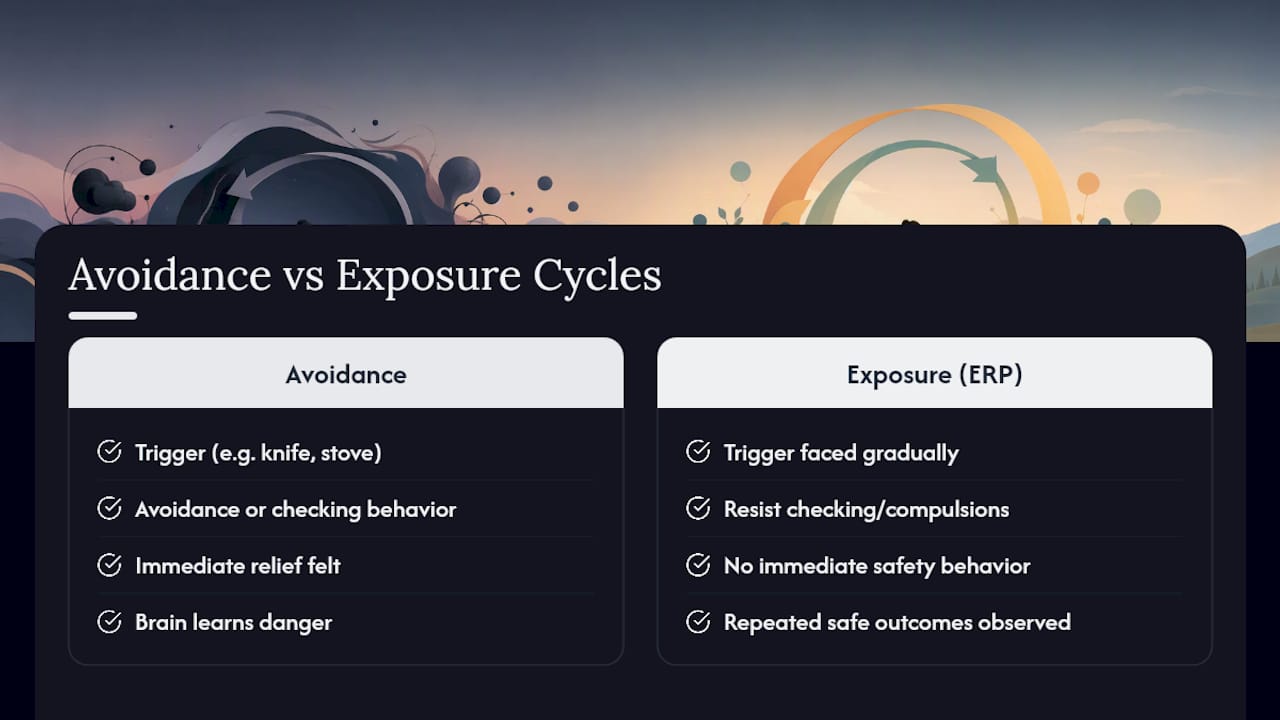
Avoidance feels like protection in the moment and works against you almost every time. If an intrusive thought about dropping a kitchen knife makes someone stop cooking, the relief is immediate, but it teaches the brain that the knife really was dangerous, which is the opposite of what actually happened.
This is the core mechanism behind why intrusive thoughts calcify into bigger problems. Each time a trigger gets avoided, the brain never gets the chance to learn that nothing bad happens when the trigger is faced. The anxiety response stays fully intact, ready to fire again the next time the trigger appears, often stronger than before. Checking behaviors work the same way: reviewing whether the stove is off ten times doesn’t build confidence, it just raises the bar for how many checks feel “enough” next time.
This is precisely why exposure and response prevention, the CBT approach used for OCD, works by doing the opposite of avoidance on purpose. A person gradually faces the trigger, be it the knife, the stove, the intrusive image, while resisting the urge to check, wash, or mentally neutralize it. Over repeated sessions, the anxiety spike shrinks because the brain finally gets the evidence it was missing: the feared outcome never happens. Breaking the avoidance cycle, not eliminating the thought itself, is usually the actual work of treatment.
How Therapists Approach Intrusive Thoughts in Practice
At Revivehealththerapy, clinicians treat intrusive thoughts as a symptom to understand, not a confession to judge. Sessions draw on cognitive behavioral therapy, EMDR for trauma-linked intrusions, and mindfulness-based approaches, delivered through trauma-informed care that treats disclosure as safe territory rather than something to brace for.
A first session usually starts with a plain conversation: when the thoughts began, how often they show up, and what, if anything, you’ve been doing in response. Everything discussed is confidential, and nobody is judged for the content of a thought they didn’t choose.
Care is available in-person at certain locations or through telehealth statewide for people who prefer or need remote access.
— Amy
Getting Support for Intrusive Thoughts at Revivehealththerapy
You don’t need a crisis to justify booking a session. Revivehealththerapy offers a more accessible path than the usual scramble for a provider who takes your insurance or fits your schedule: sliding-scale fees, HSA/FSA acceptance, and both in-person and statewide telehealth mean cost and location rarely have to be the reason you wait.

Individual therapy draws on CBT for reframing the thought patterns behind persistent intrusions, while EMDR therapy addresses intrusive thoughts rooted in trauma specifically. Parents looking for support for a teen dealing with repetitive, distressing thoughts can find teen-focused therapy built around the same evidence-based methods. Revivehealththerapy is one qualified option among several, and if you’re in crisis or have any thought of harming yourself or someone else, call 988 or 911 before anything else. For everything short of that, reach out through the contact page to ask about availability, insurance, or sliding-scale rates and get a session on the calendar.
Sources
- Unwanted Intrusive Thoughts — ADAA
- Managing intrusive thoughts — Harvard Health Publishing
- Obsessive-compulsive disorder — NIMH
- Intrusive thoughts — NCBI Bookshelf
This article is general information, not a substitute for advice from a qualified doctor. Consult a qualified healthcare professional about your own circumstances before acting on anything here.
FAQ
What is an example of an intrusive thought?
A common example is a sudden, unwanted image of dropping a baby you’re holding, or a flash of driving off the road, despite having no wish for either to happen. The disturbing content is the point: it clashes with what you actually want.
How do you stop intrusive thoughts?
You don’t stop them by fighting them; labeling the thought, avoiding suppression, and staying grounded in the present moment reduces their intensity faster than trying to force them out. For recurring or distressing patterns, CBT and exposure-based therapy address the underlying cycle directly.
Why do intrusive thoughts happen?
They happen because the brain’s threat detection system flags a thought as urgent even when it’s harmless, and stress, fatigue, hormonal shifts, or trauma reminders make that misfire more frequent. Suppressing the thought afterward tends to make it stickier, not weaker.
Do intrusive thoughts ever go away?
For most people, a given intrusive thought fades within minutes once it stops being fought or avoided. For thoughts that recur persistently or drive compulsive behavior, targeted therapy such as exposure and response prevention meaningfully reduces both their frequency and their grip over time.