
EMDR reprocesses distressing memories through guided bilateral stimulation, delivered inside an eight-phase protocol, so the memory keeps its facts but loses its emotional grip. The mechanism draws on the Adaptive Information Processing model: trauma gets stored in a way that keeps triggering the body’s alarm system, and EMDR helps the brain file it as something that happened rather than something still happening. Major clinical authorities, including the VA/DoD and the American Psychological Association, back it specifically for PTSD.
TL;DR:
- EMDR helps reprocess traumatic memories by guiding bilateral stimulation that competes for mental resources, reducing emotional intensity without erasing the memory itself.
- The therapy can involve eye movements, tactile taps, or auditory tones delivered in sets during focused recall, with modality choice based on client comfort and practicality.
- Typical treatment involves eight structured phases, including history taking, stabilization, assessment, desensitization, installation, body scan, closure, and reevaluation, with progress tracked via standardized scales.
- EMDR is endorsed by major organizations like the VA, APA, and Harvard Health, with strongest evidence for single-incident and combat-related PTSD, but outcomes can vary with trauma complexity.
- Sessions last 60 to 90 minutes, often requiring multiple visits, especially for complex trauma, and clinicians should confirm proper training and licensure before starting treatment.
Table of Contents
- Why Trauma Gets “Stuck”: The Adaptive Information Processing Model
- The Science of Bilateral Stimulation: How EMDR Reduces Distress
- What Happens During an EMDR Session: The Eight Phases
- Do the Guidelines and Evidence Back EMDR Up?
- Is EMDR Safe? Side Effects and When Therapists Pause Treatment
- How Long Does EMDR Take? Realistic Session Expectations
- Finding and Preparing for EMDR Therapy
- What Clinicians Wish More People Understood About EMDR
- EMDR Therapy Through ReviveHealthTherapy
- Sources
- FAQ
Why Trauma Gets “Stuck”: The Adaptive Information Processing Model
EMDR therapists work from a framework called Adaptive Information Processing, or AIP. The idea is that your brain has a natural system for digesting experience: something happens, you feel it, you make sense of it, and the memory settles into long-term storage as background information rather than a live threat. Trauma disrupts that process. A severe car accident, an assault, a childhood loss, an event where the nervous system got overwhelmed, can get locked into memory in a raw, fragmented form instead of a resolved one.
The EMDR International Association describes this as memory that was inadequately processed and stored in a way that keeps it easily triggered. That’s why a smell, a tone of voice, or a similar situation years later can flood someone with the same fear, shame, or helplessness they felt in the original moment. The memory network never got linked to more adaptive, resolved information.
What AIP predicts, and what EMDR tries to do about it, breaks down like this:
- Unprocessed memories stay isolated from other, more adaptive memory networks, so the brain can’t draw on later context or coping resources when the memory gets triggered.
- The nervous system treats the old memory as current danger, which produces disproportionate physical and emotional reactions to present-day triggers.
- EMDR doesn’t erase the memory. It helps the brain connect it to adaptive information, so it becomes something you remember instead of something you relive.
That distinction matters for anyone worried EMDR means forgetting. You keep the memory. What changes is its emotional voltage.
The Science of Bilateral Stimulation: How EMDR Reduces Distress
Bilateral stimulation, or BLS, is the part of EMDR most people picture: eyes moving side to side while recalling a difficult memory. But BLS comes in several forms, and the delivery method matters less than most people assume.
Clinicians deliver BLS through:
- Guided eye movements, using a therapist’s hand, a moving light bar, or an on-screen dot
- Auditory tones alternating between left and right ears through headphones
- Tactile tappers, small buzzers held in each hand or clipped to the knees
- Telehealth and app-based tools that replicate the same left-right pattern remotely
The National Center for PTSD confirms that eye movements, light bars, tones, and tactile tappers are all standard modalities, and that BLS is delivered in sets during focused recall of the target memory. Choice of modality is largely practical: what a client tolerates, what’s available in-session or via telehealth, and therapist preference, matter more than any inherent superiority of one method over another.
Why does moving your eyes back and forth reduce a memory’s punch? The leading behavioral explanation is the working memory hypothesis: BLS creates a dual task that competes for the same limited mental bandwidth used to hold a vivid memory in mind. Split attention between the memory and the stimulation, and the image tends to lose clarity and emotional charge, similar to how a nightmare fades faster if you’re asked to describe it while doing simple math.
Pro Tip: If eye movements make you uncomfortable or motion-sick, ask your clinician about switching to tactile tappers or auditory tones. They tend to work through the same mechanism.
Other researchers point to parallels with REM sleep, when the brain naturally processes emotional memory through similar rapid eye movement patterns. Neither explanation is fully settled science. Systematic reviews confirm EMDR’s clinical effectiveness for PTSD while acknowledging the exact neural mechanisms are still under study. The results are well documented; the underlying circuitry is still being mapped.
What Happens During an EMDR Session: The Eight Phases
EMDR follows a structured eight-phase protocol, not a loose conversation with some eye movements mixed in. Here’s how a course of treatment typically unfolds:
- History taking. The therapist gathers background, identifies target memories, and screens for factors that might require extra stabilization first.
- Preparation. You learn what to expect, practice grounding and calming techniques, and build trust with the clinician before touching traumatic material directly.
- Assessment. You identify a specific target image tied to the memory, name the negative belief attached to it (“I’m powerless”), and the positive belief you’d rather hold (“I survived and I’m safe now”). You rate distress using the Subjective Units of Disturbance (SUD) scale and rate the positive belief’s felt truth using the Validity of Cognition (VOC) scale.
- Desensitization. You hold the image and negative belief in mind while the therapist runs sets of bilateral stimulation, pausing periodically to check what’s shifting.
- Installation. Once distress drops, the focus shifts to strengthening the positive belief until it feels more true.
- Body scan. You notice any lingering physical tension connected to the memory and process that residue with more BLS sets.
- Closure. The therapist brings you back to a calm, stable state before ending, even if processing isn’t fully complete.
- Reevaluation. The next session opens by checking how the target memory feels now and deciding what to work on next.
The APA’s guideline page on EMDR confirms this eight-phase structure and the use of SUD and VOC ratings as the standard method for tracking progress within and across sessions.
Pro Tip: A single session rarely resolves a memory completely. Therapists deliberately end each session with closure exercises so you leave regulated, even mid-processing.
Do the Guidelines and Evidence Back EMDR Up?
EMDR isn’t a fringe technique. It carries explicit endorsement from the organizations clinicians actually rely on for treatment decisions.
- The National Center for PTSD, under the VA and Department of Defense, lists EMDR among recommended trauma treatments.
- The American Psychological Association includes EMDR in its PTSD treatment guideline.
- The EMDR International Association sets training and certification standards for practicing clinicians.
- Harvard Health describes EMDR as an established method for healing from trauma, tracing it back to psychologist Francine Shapiro’s original development of the technique.
The evidence base is strongest for single-incident and combat-related PTSD, where multiple clinical reviews show meaningful symptom reduction. Evidence is still emerging for anxiety disorders, depression, phobias, and complex or developmental trauma, where EMDR is often used alongside other approaches rather than as a standalone fix. Cleveland Clinic notes many patients report noticeable improvement after a relatively small number of sessions, particularly for trauma tied to a single event, though outcomes vary by history and severity.
Trials typically measure benefit through drops in SUD ratings, standardized PTSD symptom checklists, and remission rates, meaning a client no longer meets diagnostic criteria after treatment.
Is EMDR Safe? Side Effects and When Therapists Pause Treatment
EMDR is generally well tolerated, but processing a traumatic memory isn’t a neutral experience. Short-term reactions are common and expected.
- Intense emotion, vivid imagery, or fatigue during or immediately after a session
- Temporary spikes in symptoms like nightmares or intrusive thoughts in the day or two following a session
- Physical sensations (tension, nausea, lightheadedness) as somatic memory surfaces
Certain conditions call for extra caution, including unstable medical issues, active substance use, uncontrolled dissociation, or acute suicidality. Skilled clinicians screen for these before starting desensitization work and build in stabilization techniques, breathing exercises, safe-place imagery, and grounding skills, so clients have tools to manage distress between sessions. When stabilization isn’t holding, therapists may pause EMDR and shift to other approaches until the person is more regulated.
How Long Does EMDR Take? Realistic Session Expectations
Sessions generally run 60 to 90 minutes, scheduled weekly or twice weekly for active processing phases.
- Single-event trauma (one accident, one assault) often resolves in roughly 3 to 6 sessions of active processing.
- Complex or longstanding trauma, especially childhood or repeated trauma, typically requires more sessions of therapy.
- Therapists reassess progress at the start of each session using SUD ratings, comparing distress levels against where the target memory started.
Timelines vary by history, current stressors, and how many distinct memories need targeting, so these ranges are starting points, not guarantees.
Finding and Preparing for EMDR Therapy
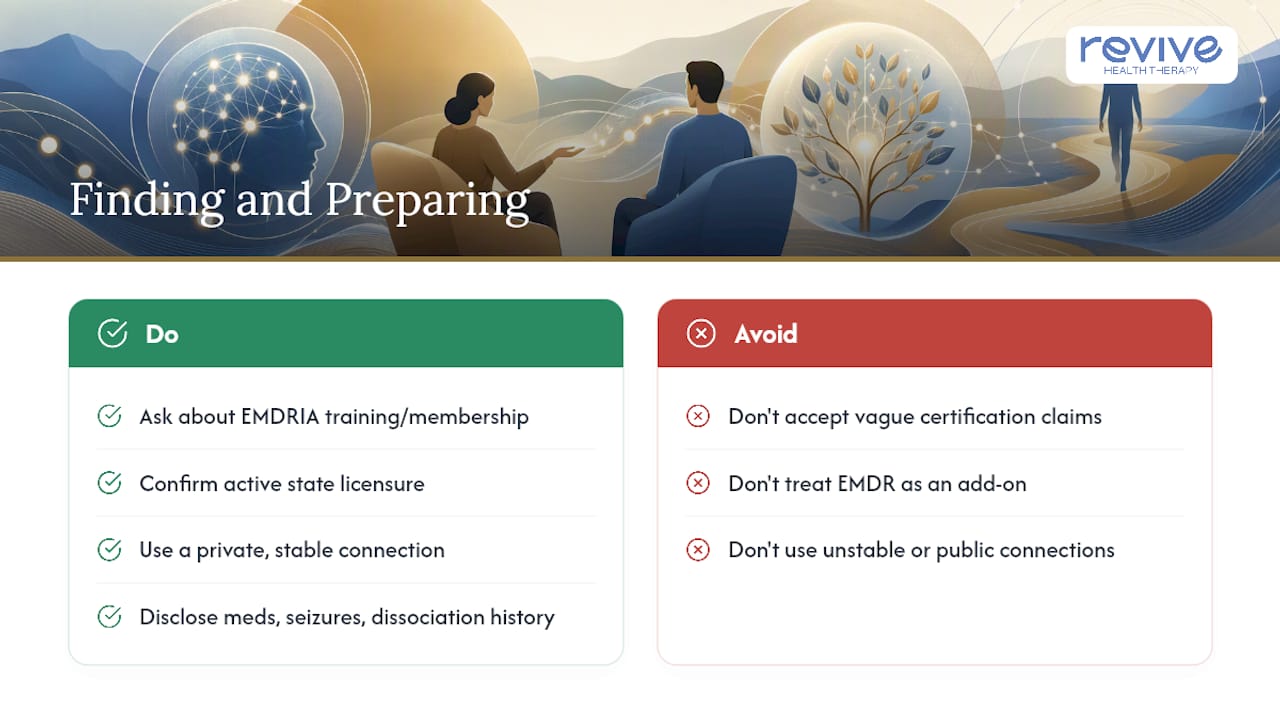
Not every therapist who mentions EMDR has equivalent training. Ask directly whether they hold EMDRIA membership or completed EMDRIA-approved training, and confirm active state licensure. A clinician who’s vague about certification, or who treats EMDR as an add-on technique rather than a structured protocol, is worth a second look.
Telehealth EMDR is legitimate and widely used; bilateral stimulation adapts well to video sessions through on-screen light bars, guided self-tapping, or auditory tones through headphones. Confirm your connection is stable and your space is private before a session, since interruptions during desensitization can be disruptive.
At intake, disclose current medications, medical conditions, and any history of dissociation or seizures, since this shapes how a clinician paces the work. Types of EMDR therapy vary in how they adapt the standard protocol for different presentations, which is worth understanding before you start.
Pro Tip: Practice one grounding technique, like naming five things you can see and hear, before your first session. It gives you something concrete to fall back on if a memory feels overwhelming.
What Clinicians Wish More People Understood About EMDR
Clients who’ve done well with EMDR usually describe the same shift: the memory stops feeling like a live wire. They can recall what happened without their body reacting as if it’s happening again. That outcome tends to show up fastest with single-incident trauma and slower, in layers, with complex or repeated trauma built over years.
EMDR isn’t a universal fix, and it isn’t meant to replace broader treatment for conditions like severe dissociation or ongoing unsafe environments. In those cases, it usually works best woven into a larger treatment plan rather than deployed alone.
— Amy
EMDR Therapy Through ReviveHealthTherapy
ReviveHealthTherapy is the option for Californians who want trauma treatment that doesn’t require choosing between quality care and what they can actually afford. EMDR sessions are available in person in Walnut Creek and Oakland or by secure telehealth statewide, with sliding-scale fees and insurance, HSA, and FSA acceptance built into how the practice prices care.

A first appointment focuses on history, current symptoms, and stabilization skills before any bilateral stimulation begins, matching the preparation phase described earlier in this guide. If you’re weighing EMDR against other trauma treatments, the practice’s comparison of EMDR and exposure therapy breaks down when each approach tends to move faster. Ready to talk to someone about whether EMDR fits your situation? Reach out through ReviveHealthTherapy’s EMDR services page to schedule an initial consultation and get matched with a trained clinician.
This article is general information, not a substitute for advice from a qualified doctor. Consult a qualified healthcare professional about your own circumstances before acting on anything here.
Sources
- About EMDR Therapy – EMDR International Association
- Eye Movement Desensitization and Reprocessing (EMDR) for PTSD – PTSD: National Center for PTSD
- Eye Movement Desensitization and Reprocessing (EMDR) Therapy – APA PTSD guideline
- What is EMDR therapy and who can it help? – Harvard Health
- EMDR Therapy: What It Is, Procedure & Effectiveness – Cleveland Clinic
FAQ
What exactly happens during EMDR?
You recall a specific distressing memory while a therapist guides bilateral stimulation, such as eye movements or tactile taps, in short sets, checking distress and belief ratings between each set until the memory’s charge decreases.
Is EMDR the hardest therapy?
EMDR can feel intense because it involves directly recalling distressing material, but sessions include structured stabilization and closure techniques specifically designed to keep the experience manageable rather than overwhelming.
Why do some therapists not like EMDR?
Skepticism usually centers on the fact that EMDR’s precise neural mechanism isn’t fully settled, even though its clinical outcomes for PTSD are well documented by systematic reviews; some clinicians simply prefer approaches with clearer causal explanations.
Can I blink during EMDR?
Yes. Blinking doesn’t interrupt the process, since bilateral stimulation works through the left right pattern of movement or sensation, not through keeping your eyes perfectly open or fixed.
2 Responses