
EMDR can effectively reduce many specific phobias, especially those tied to an identifiable conditioning memory, like a dog bite behind a dog phobia or a bad flight behind a fear of flying. Evidence strength varies by phobia type: dental phobia and acrophobia have the best trial support, while diffuse or non-memory-anchored fears often respond better to exposure. The sections below cover the research, the clinical protocol, and how to find the right therapist.
TL;DR:
- EMDR shows strong support for treating phobias linked to specific memories, such as dog bites, with evidence comparable to virtual reality exposure for height fears.
- Its effectiveness is most reliable when the fear has a clear, identifiable origin, but less conclusive for diffuse or developing fears without a specific traumatic event.
- The standard phobia protocol incorporates techniques like flashforward processing to address anticipatory anxiety, often reducing physical and emotional reactions significantly.
- EMDR sessions usually last 6 to 12 weekly visits, with remote therapy options widely available and rapid relief reported within the first few sessions.
- It is not suitable for individuals with active crises, severe dissociation, or unstable substance use without prior stabilization, requiring careful screening by a trained clinician.
Table of Contents
- How Does EMDR Work for Phobias?
- What Does the Research Say About EMDR and Specific Phobias?
- How Is EMDR Adapted Into a Phobia Protocol?
- Which Phobias Respond Best to EMDR?
- EMDR vs. Exposure Therapy: Which Should You Choose?
- What Happens in an EMDR Session for Phobias?
- When Is EMDR Not Recommended?
- How Do You Find a Qualified EMDR Therapist for Phobias?
- A Closer Look: Where EMDR Genuinely Earns Its Reputation, and Where It’s Oversold
- How Revivehealththerapy Can Help With Phobia Treatment
- Sources
- FAQ
How Does EMDR Work for Phobias?
EMDR, or Eye Movement Desensitization and Reprocessing, rests on the Adaptive Information Processing (AIP) model. The theory holds that a traumatic or frightening event can get stored in memory without being fully processed, so it keeps firing distress signals decades later as if the danger is still current. A person who was stung by a bee at age seven doesn’t just remember the sting. Their nervous system reacts to any buzzing insect as though the same threat is happening now.
Treatment works by having the person briefly recall the distressing memory while simultaneously engaging in a form of bilateral stimulation, alternating left right sensory input, most commonly guided eye movements, but also hand tapping, tactile pulsers, or alternating auditory tones through headphones. The VA/DoD clinical guidance for EMDR describes these modalities and confirms they translate well to remote care: light bars, handheld tappers, and audio tones all have telehealth versions that trained clinicians can walk a client through over video.
Nobody has fully settled why bilateral stimulation helps, but the leading explanation is that it taxes working memory just enough to loosen the emotional grip of the recalled image, similar to what happens naturally during REM sleep. That’s the working theory researchers point to; it isn’t proven mechanism, and you’ll find real debate in the literature about whether the eye movements themselves do the work or whether the exposure component of recalling the memory does most of it.
What matters clinically is the outcome, not the mechanism. As the memory gets reprocessed across several passes, most clients report the image loses its emotional charge. The dog is still a dog. The memory of being bitten is still there. But the automatic fear response that used to hijack the body stops firing the same way. That shift, from “this memory controls me” to “this memory is just information,” is the therapeutic target the entire phobia protocol is built around.
What Does the Research Say About EMDR and Specific Phobias?
The honest answer: EMDR has real trial support for phobias, but the evidence base is thinner and more mixed than it is for PTSD, where EMDR has decades of large studies behind it. Here’s what the actual data shows.
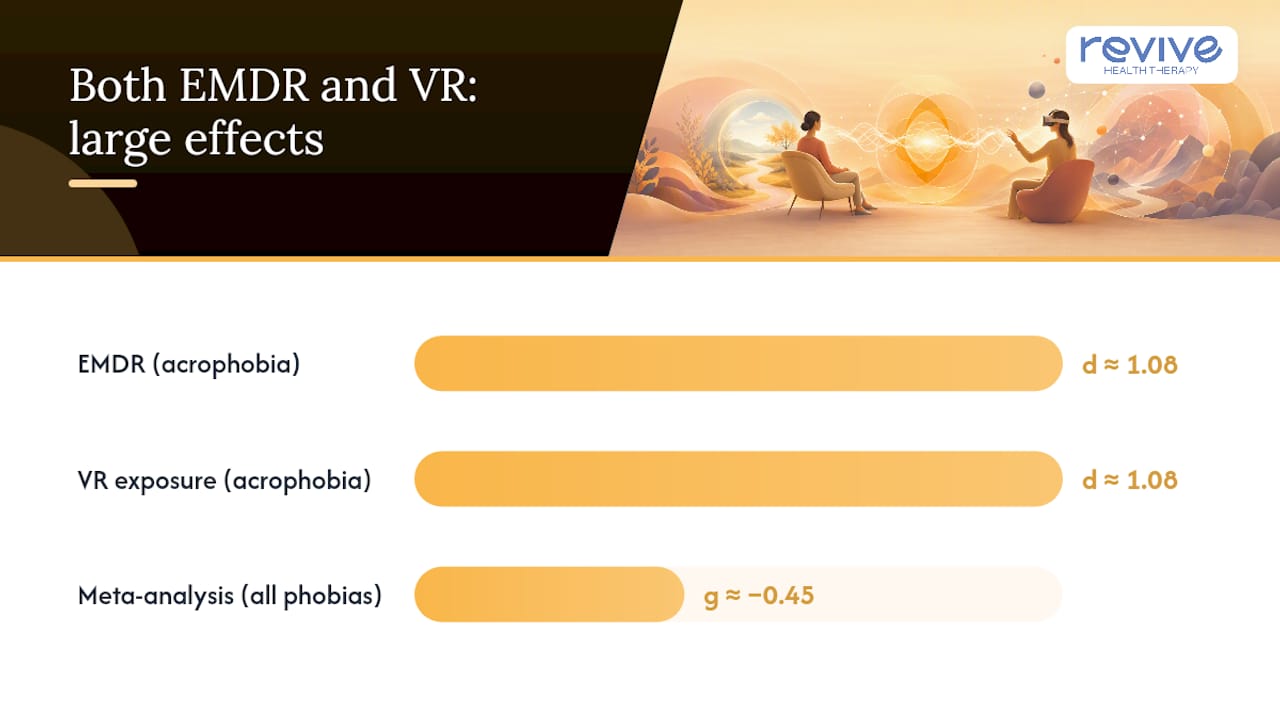
A randomized controlled trial comparing EMDR against virtual reality exposure therapy for acrophobia, fear of heights, found both treatments produced large symptom reductions with very similar strong effects in a modest sample, a difference the researchers called negligible between the two active treatments (Frontiers in Psychology). That’s a meaningful finding: two very different treatment approaches, similar payoff, at least for height phobia specifically.
Dental phobia has its own body of controlled research. The phobia protocol literature documents dental phobia trials where patients who had avoided the dentist for years, sometimes decades, completed EMDR treatment and went on to tolerate routine dental visits, according to the phobia protocol chapter that documents these controlled studies alongside detailed target selection procedures.
Zooming out to the aggregate picture, a meta-analysis of randomized trials found EMDR associated with reductions in anxiety and phobia symptoms, with a phobia effect size around g = −0.45, a moderate effect in statistical terms (Meta-analysis of EMDR toward anxiety disorders). The same analysis called for larger, better-controlled trials before drawing firm conclusions about long-term durability.
The evidence in plain numbers: A moderate meta-analytic effect (g ≈ −0.45) across combined trials, paired with large single-study effects for acrophobia (d ≈ 1.08) and controlled outcomes for dental phobia. Moderate on average, strong in specific well-studied phobias.
A few honest limitations worth naming:
- Most phobia-specific EMDR trials have small samples, often fewer than 50 participants, which limits how confidently results generalize.
- Phobia subtypes get lumped together in some analyses, making it hard to say whether EMDR works equally well for spiders, needles, flying, and social situations.
- Long-term follow-up data beyond six to twelve months is sparse, so questions about relapse rates over years remain partly unanswered.
- Comparison trials against gold-standard exposure therapy are fewer than comparisons against no treatment or waitlist controls.
The practical takeaway: if your phobia traces back to a specific, identifiable incident, the odds of a good response to EMDR look genuinely favorable based on current trials. If your fear feels more free-floating, with no clear origin story, the research is less conclusive, and that’s exactly where clinical judgment starts to matter more than any published effect size.
How Is EMDR Adapted Into a Phobia Protocol?
Standard EMDR follows eight phases developed for trauma processing. When a therapist treats a phobia specifically, they lean on an adapted version sometimes called the phobia protocol, most thoroughly documented in the de Jongh phobia protocol chapter. It follows the same structure with a few phobia-specific additions.
- History and readiness assessment. The therapist maps out when the fear started, whether a specific incident triggered it, and screens for factors like dissociation or unmanaged crisis risk that would need attention first.
- Target selection. Rather than treating “fear of dogs” as one abstract thing, the clinician identifies the actual memory network behind it, the original bite, maybe a scary news story about an attack later, maybe a parent’s own visible fear modeled during childhood. Each contributing memory can become its own target.
- Preparation. The client learns what bilateral stimulation will feel like and practices a calming technique they can use if distress spikes mid-session.
- Desensitization. The client briefly holds the target memory in mind while doing sets of eye movements or tapping, pausing periodically to report what’s coming up.
- Flashforward processing. This step is distinctive to phobia work. Beyond the past memory, the therapist has the client picture the feared future event, boarding the plane, sitting in the dental chair, and processes that anticipatory image the same way. Anticipatory dread is often what keeps a phobia alive long after the original incident, so leaving it unaddressed risks leaving the fear intact even after the memory itself feels resolved.
- Installation and body scan. Once distress ratings drop, the therapist helps install a more adaptive belief (“I can handle this now”) and checks for lingering physical tension tied to the memory.
- Closure and reevaluation. Sessions end with grounding, and later sessions reassess whether earlier gains held.
Throughout, clinicians use the Subjective Units of Disturbance (SUDs) scale, a 0 to 10 self-rating of distress, to track whether a target memory is losing its charge. A memory that started at a SUDs of 9 dropping to a 1 or 2 across a session is the marker that particular target has been adequately processed. Success isn’t only measured by that number, though; behavioral follow-through, actually getting on the plane or into the dental chair, is the real test.
Pro Tip: Ask your therapist directly whether they use flashforward processing for phobia work. It’s a specific technique, not every EMDR-trained clinician routinely includes it, and skipping it can leave anticipatory anxiety unaddressed even after the original memory feels resolved.

Which Phobias Respond Best to EMDR?
Not every phobia is an equally strong candidate. The clearer the origin story, the better EMDR tends to perform, based on the current trial evidence and clinical consensus.
- Strong candidates: Phobias with a specific, rememberable onset event, dog bites, car accidents leading to driving fear, a choking incident behind a swallowing phobia, or a traumatic dental experience.
- Good candidates with solid trial support: Acrophobia (fear of heights) and dental phobia both have controlled study backing, per the acrophobia RCT and dental phobia trials.
- Cases needing protocol adjustments: Blood, injection, and injury phobias carry a fainting risk tied to a vasovagal reflex, so clinicians often pair EMDR with applied tension techniques, physically tensing muscle groups to keep blood pressure up, alongside the standard reprocessing steps.
- Cases where exposure may be preferred or primary: Phobias with no identifiable conditioning event, generalized social anxiety that overlaps with a phobia presentation, or fears that seem to have developed gradually rather than from one incident.
Comorbidity changes the calculation too. Someone with a specific phobia layered on top of PTSD, high generalized anxiety, or dissociative symptoms usually needs a more individualized sequencing plan, sometimes stabilization work before any memory-focused processing begins. A good clinician doesn’t apply EMDR as a one-size template. They build the plan around what’s actually driving the fear, and around what else is going on for that particular person.
EMDR vs. Exposure Therapy: Which Should You Choose?
Both treatments are considered first-line options for specific phobias, and they work through different mechanisms. Exposure therapy, particularly in vivo exposure, gradually and repeatedly confronts the actual feared situation until the nervous system habituates to it. EMDR instead targets the memory network behind the fear without requiring the client to spend extended time in the feared situation itself during sessions.
- Choose EMDR when a clear conditioning memory exists and the client wants to avoid extended in-the-moment exposure to the feared stimulus during early treatment.
- Choose exposure when the fear is more generalized, has no clear origin event, or when the treatment goal specifically requires practiced behavioral tolerance of a real-world situation, like flying regularly for work.
- Consider combining them when distress is so high that graded exposure feels impossible to tolerate; some clinicians use EMDR first to lower the emotional charge, then move into in vivo exposure to build practical, real-world confidence.
- Speed and comfort differ, EMDR sessions often don’t require the client to physically approach the feared object or situation in the room, which some clients find more tolerable early on, while exposure inherently requires that direct confrontation as the core mechanism.
The acrophobia trial mentioned earlier found EMDR and VRET produced statistically similar results, suggesting that for at least some phobias, the choice may come down to client preference and access rather than one method being objectively superior. A detailed side by side of session counts and outcomes for EMDR versus exposure is worth reading if you’re trying to decide which path fits your situation.
What Happens in an EMDR Session for Phobias?
Sessions typically run 60 to 90 minutes, longer than a standard 50-minute talk therapy hour, because processing a memory to a stable resolution point mid-session takes time you don’t want to cut short (Harvard Health). Most clients meet weekly, and a full course for a single, well-defined phobia often falls somewhere between 6 and 12 sessions, though complexity and comorbidity can extend that.
- Progress gets tracked two ways: the SUDs rating inside sessions, and real-world behavioral approach tasks outside sessions, actually touching the dog, sitting in the dentist’s chair, driving on the freeway.
- Many clients report noticeable relief within the first several sessions, though the Harvard Health summary notes the total course still depends on how complex the underlying memory network turns out to be.
- Telehealth delivery is standard practice now. Therapists use on-screen moving dots, guided verbal eye-movement instructions, or handheld tactile pulsers synced through a video call, and the VA/DoD guidance confirms these remote adaptations are clinically appropriate when the therapist is properly trained in them.
- Relapse prevention typically includes a few spaced follow-up check-ins after the active phase ends, since reintroducing the client to the real-world trigger over time helps confirm the gains are holding, not just present in the therapy room.
Quick fact: A typical course for a single, clearly defined phobia runs 6 to 12 sessions at 60 to 90 minutes each, according to Harvard Health, roughly one to three months of weekly work for many clients.
For readers dealing with anxiety alongside a phobia, this step-by-step EMDR guide for anxiety walks through how the timeline shifts when more than one condition is being treated at once.
When Is EMDR Not Recommended?
EMDR isn’t the right starting point for everyone. Clinicians generally hold off or adjust the approach when someone has active suicidality, severe dissociation, or unstable substance use, since reprocessing distressing memories can temporarily intensify emotional reactivity before it resolves. Stabilization work, building coping skills and a safety plan first, usually comes before any memory-focused phase begins in those cases.
Short-term discomfort during processing is common and expected. Some clients feel more tired, tearful, or emotionally raw for a day or two after a session. A qualified therapist screens for this ahead of time, builds in grounding techniques, and paces the work so a client never leaves a session in worse shape than they arrived. If you’re currently in crisis, that’s a conversation to have with a clinician before booking phobia-specific work at all.
How Do You Find a Qualified EMDR Therapist for Phobias?
Not every EMDR-trained clinician has deep phobia-specific experience, so a little vetting up front saves time and disappointment later.
- Confirm licensure and training. Look for a licensed mental health clinician who has completed formal EMDR training through a recognized program; EMDRIA maintains standards and a therapist directory worth checking.
- Ask about phobia-specific experience. A therapist comfortable with PTSD work isn’t automatically fluent in the flashforward technique or applied tension adjustments phobia protocols sometimes require. Ask directly.
- Clarify telehealth logistics. If you want remote sessions, ask what bilateral stimulation tools they use on video and whether they’ve delivered EMDR remotely before.
- Discuss safety planning and fees upfront. A good clinician will walk you through what happens if distress spikes mid-treatment, and will be transparent about session cost, insurance, and sliding-scale options before you commit.
Red flags worth noting: a provider who can’t clearly explain the eight phases, who pushes straight into reprocessing without any assessment or readiness screening, or who seems unfamiliar with flashforward work when you ask about it directly.
A Closer Look: Where EMDR Genuinely Earns Its Reputation, and Where It’s Oversold
The pattern in phobia-specific EMDR research is more interesting than the usual pitch you hear. People tend to talk about EMDR like it’s one uniform treatment with one universal success rate, when the honest picture is closer to a treatment that performs unevenly depending on what’s actually driving the fear.
That distinction gets lost constantly in casual conversation about EMDR, and it matters for anyone trying to decide whether to try it. A fear of flying that traces back to one terrifying flight is a fundamentally different clinical problem than a fear of flying with no clear origin, layered on top of generalized anxiety about losing control. The first looks like exactly what the phobia protocol was designed for. The second may need a broader treatment plan where EMDR is one tool among several, not the whole intervention.
What I’d push back on is the framing, common in a lot of pop psychology content, that EMDR is either a miracle or a fad. Neither holds up against the actual trial data. The acrophobia RCT showing EMDR performing on par with virtual reality exposure is a genuinely strong result. The meta-analytic effect size for phobias overall, moderate rather than massive, is a more sober number that deserves equal airtime. Readers get a better decision when they see both.
The other place I’d correct the common narrative: EMDR isn’t a substitute for good clinical assessment. The flashforward step, the ancillary memory mapping, the applied tension adjustment for blood phobias, none of that happens automatically just because a therapist waves a light bar. It happens because a trained clinician built an individualized plan. That’s the actual differentiator between EMDR done well and EMDR done as a rote script, and it’s the piece most consumer-facing articles skip entirely.
At Revivehealththerapy, EMDR therapy sits alongside CBT and mindfulness-based work precisely because phobias rarely arrive in isolation, and a trauma-informed approach means the plan gets built around the whole person, not just the symptom checklist. Whether treatment happens in person in Oakland or Walnut Creek, or through telehealth, the goal is the same individualized assessment before any memory work begins.
— Amy
How Revivehealththerapy Can Help With Phobia Treatment
If a specific fear has been running your life, whether it’s kept you off planes, out of the dentist’s chair, or avoiding highways, therapy practices that offer sliding-scale fees and insurance acceptance, including HSA and FSA, can provide more accessible routes into EMDR than typical private-pay-only clinical practices.

Some practices offer EMDR alongside CBT and mindfulness-based approaches at multiple locations, plus secure telehealth sessions available statewide. That flexibility matters for phobia work specifically. If your fear involves travel or crowded medical settings, being able to start treatment from home through telehealth removes one more barrier before you’re even ready to tackle the phobia itself.
A first appointment typically includes a readiness screening and a conversation about safety planning, so you’ll know before any memory-focused work begins whether EMDR is the right fit for your specific fear or whether another approach may be appropriate. Browse the full therapy services list or reach out through the contact page to schedule an initial assessment and get a clear answer on what treatment path fits your situation.
This article is general information, not a substitute for advice from a qualified doctor. Consult a qualified healthcare professional about your own circumstances before acting on anything here.
Sources
- VA/DoD clinical guidance for EMDR
- EMDR Therapy for Specific Fears and Phobias: The Phobia Protocol (de Jongh chapter)
- Efficacy of VRET and EMDR for acrophobia — Frontiers in Psychology
- What is EMDR therapy—and who can it help? | Harvard Health
FAQ
What Is the Most Effective Way to Overcome a Phobia?
The strongest evidence points to two approaches: exposure-based therapy and EMDR, both considered first-line treatments for specific phobias. Which one works best depends on whether the fear traces back to a clear conditioning event, EMDR tends to perform well there, or is more generalized, where exposure often takes the lead.
When Is EMDR Not Recommended for Phobia Treatment?
EMDR is generally postponed when someone has active suicidality, severe dissociation, or unstable substance use, since memory-focused work can temporarily heighten distress before it resolves. A qualified clinician screens for these factors and builds stabilization skills first when needed.
Which Therapy Is Best for Phobias, EMDR or Exposure?
Neither is universally better. A randomized trial found EMDR and virtual reality exposure both produced large reductions in acrophobia symptoms with very similar effects, so the better choice often comes down to whether a clear conditioning memory exists and which approach the client finds more tolerable.
What Relaxation Techniques Help With Phobias?
Grounding exercises, paced breathing, and applied tension, tensing muscle groups to prevent fainting, are commonly used alongside formal treatment, especially for blood and injury phobias. These techniques support the main treatment; they aren’t a standalone cure for a diagnosed phobia.
Does Revivehealththerapy Offer EMDR for Phobias?
Yes. EMDR therapy is one of the core services offered at Revivehealththerapy’s Oakland, Walnut Creek, and San Francisco locations, along with telehealth sessions available statewide. Current pricing and sliding-scale details are listed on the practice’s services page.