
Every parent faces that moment when worry for their teenager’s emotional well-being keeps them up at night. With adolescence being a time of intense change, it is easy to feel unsure about where to turn for support. Teen therapy provides a safe, confidential space for your child to express themselves, build coping skills, and grow into resilient young adults. Discover how therapy options in California can meet your family’s unique needs without creating financial stress.
Table of Contents
- Defining Teen Therapy And Its Purpose
- Common Types Of Therapy For Teens
- Core Methods Used In Teen Therapy
- Accessing Teen Therapy In California
- Costs, Insurance, And Parental Involvement
- Risks, Limitations, And Alternatives
Key Takeaways
| Point | Details |
|---|---|
| Teen Therapy Provides a Safe Space | It allows adolescents to explore their feelings and challenges in a confidential environment tailored to their unique developmental needs. |
| Various Effective Therapy Types Available | Options like Cognitive Behavioral Therapy (CBT) and Family Therapy offer multiple strategies to address different teen issues. |
| Accessibility of Therapy in California | Families can utilize school programs, insurance coverage, and telehealth services to access mental health support easily. |
| Parental Involvement is Crucial | Parents play an important role in their teen’s therapy progress, enhancing the overall effectiveness of the treatment. |
Defining Teen Therapy and Its Purpose
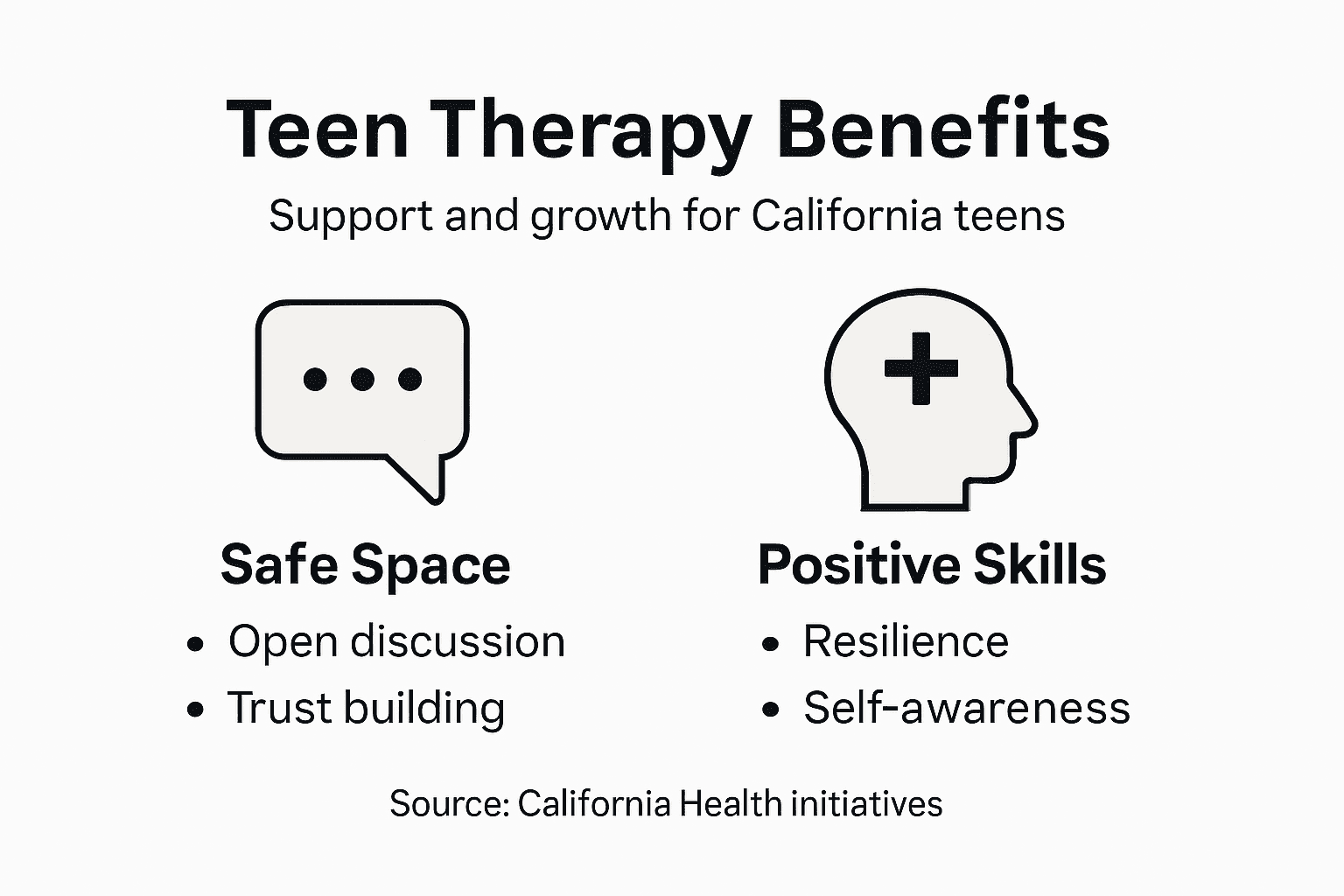
Teen therapy is a specialized form of mental health treatment designed specifically for adolescents aged 13 through 19. It creates a safe, confidential space where teenagers can explore their thoughts, feelings, and the challenges they face during one of life’s most critical periods. Unlike general counseling, teen therapy acknowledges that adolescence involves unique physical, emotional, and social transformations that require targeted, developmentally appropriate interventions. The goal isn’t to “fix” your teen but rather to equip them with tools to understand themselves better and navigate the complexities of growing up.
During adolescence, protecting psychological well-being becomes essential because this period sets the foundation for mental health throughout adulthood. Your teenager’s brain is still developing, particularly the areas responsible for decision-making, emotional regulation, and impulse control. This makes them more vulnerable to anxiety, depression, trauma responses, and other mental health challenges. Teen therapy addresses these vulnerabilities head-on by helping adolescents build emotional intelligence, develop healthy coping mechanisms, and cultivate resilience. Whether your teen is struggling with social pressures, academic stress, family conflict, grief, or past traumatic experiences, therapy provides evidence-based approaches like Cognitive Behavioral Therapy (CBT) and EMDR that have proven effective for young people.
The purpose of teen therapy extends beyond symptom relief. It teaches your teenager how to recognize emotional patterns, communicate their needs more effectively, and make healthier choices independently. Many parents worry that sending their teen to therapy means something is “wrong” with them. That’s not the case. Therapy is preventive care for the mind, much like a doctor’s checkup is preventive for the body. By getting support during challenging times, your teen learns coping skills that serve them throughout their lives. CaliforniaCalifornian families can access evidence-based therapy approaches designed specifically for teens, including both in-person and telehealth options that fit busy family schedules and varying comfort levels.
Pro tip: _When discussing therapy with your teen, frame it as a tool for personal growth and self-discovery rather than punishment or a sign something is wrong. Teens respond better when they understand how therapy helps them achieve their own goals, whether that’s managing stress, improving friendships, or feeling less anxious.
Common Types of Therapy for Teens
When your teen starts therapy, you might wonder what approach the therapist will use. The answer depends on your teenager’s specific challenges, personality, and what the therapist recommends after an initial assessment. Several evidence-based therapy types have proven effective for adolescents, and understanding the differences helps you feel more confident about your teen’s treatment plan.
Cognitive Behavioral Therapy (CBT) is one of the most widely used approaches for teens. It works by helping your teenager identify negative thought patterns and learn how to challenge and change them. If your teen catastrophizes about social situations or spirals into anxious thoughts, CBT teaches them practical tools to interrupt that cycle. Family Therapy takes a different angle by involving parents and siblings in sessions. This approach recognizes that family dynamics significantly impact teen mental health. By improving communication patterns and addressing conflict directly, family therapy can transform relationships that have become strained. Acceptance and Commitment Therapy (ACT) teaches teens to accept uncomfortable emotions rather than fight them, helping them move forward with what matters most in their lives. Dialectical Behavior Therapy (DBT) is particularly helpful for teens struggling with emotional dysregulation, self-harm, or suicidal thoughts. It combines CBT principles with mindfulness and acceptance strategies. Interpersonal Therapy (IPT) focuses specifically on improving relationships and social functioning, making it valuable for teens dealing with depression linked to relationship problems or major life transitions.
Another powerful option is group therapy, where your teen works with other adolescents facing similar challenges. Group therapy provides emotional support while reducing feelings of isolation. Many teens find comfort knowing they’re not alone in their struggles. The peer connection helps them practice social skills in a safe environment and often leads to genuine friendships that extend beyond therapy. Your teen might also benefit from approaches like EMDR (Eye Movement Desensitization and Reprocessing) if they’re processing trauma, or mindfulness-based interventions if they struggle with anxiety or stress. The best approach often combines elements from different methods tailored specifically to your teenager’s needs. A qualified therapist will assess where your teen stands and recommend the treatment that gives them the best chance of success.
Pro tip: Ask your therapist during the first session to explain which therapeutic approach they’re using and why it’s a good fit for your teen’s specific concerns. Understanding the method helps you support your teenager’s progress between sessions and reinforces what they’re learning in therapy.
Here’s a comparison of commonly used teen therapy approaches and their primary strengths:
| Therapy Type | Main Strength | Ideal For |
|---|---|---|
| Cognitive Behavioral Therapy | Teaches practical coping skills | Anxiety, negative thought cycles |
| Family Therapy | Improves communication | Family conflict, strained relationships |
| Acceptance & Commitment Therapy | Builds emotional acceptance | Teens resisting difficult feelings |
| Dialectical Behavior Therapy | Regulates intense emotions | Self-harm, emotional dysregulation |
| Interpersonal Therapy | Enhances relationship skills | Depression, social difficulties |
| Group Therapy | Reduces isolation | Social skills, peer support |
| EMDR | Processes trauma effectively | Trauma or PTSD |
| Mindfulness-Based Interventions | Reduces stress and anxiety | Teens overwhelmed by stress |
Core Methods Used in Teen Therapy
Effective teen therapy goes beyond just talking about problems. Therapists use specific, research-backed methods designed to work with how teenage brains actually function. Understanding these core methods helps you recognize what’s happening in your teen’s sessions and how it connects to real-life changes you might notice at home.

One foundational method is building a therapeutic alliance, which sounds formal but really means creating a relationship where your teen feels safe and understood. A skilled therapist uses transparency, appropriate humor, and genuine connection to help your teenager relax and open up. This foundation matters because teens are naturally skeptical and resistant to adults telling them what to do. When your teen trusts their therapist, they’re far more likely to engage honestly and actually apply what they learn. Systemic Family Therapy (SFT) is another key approach that integrates family engagement and communication improvement. Rather than treating your teen in isolation, SFT recognizes that family relationships directly shape their mental health. This method involves working with both your teenager and caregivers to identify dysfunctional patterns, reframe problems from a relational perspective, and build healthier problem-solving skills as a unit.
Therapists also apply developmentally responsive, strength-based care that acknowledges your teen’s need for increasing independence while still valuing parental involvement. This means the therapist doesn’t treat your 14-year-old the same way they’d treat a 9-year-old or a 25-year-old. They recognize the adolescent brain is still developing, particularly in areas related to impulse control and emotional regulation, which explains some of the behaviors you’re seeing at home. Rather than focusing only on problems, strength-based care identifies what your teen is already doing well and builds from there. Assessment and interventions are tailored to your teenager’s specific developmental stage, which increases clinical precision and improves outcomes.
Confidentiality is also a core method, though it has limits. Your therapist will explain that what your teen shares stays private except in specific situations like safety concerns. This boundary allows your teenager to speak freely without worrying that everything gets reported back to you. At the same time, your therapist will communicate strategically with you about progress and what you can do at home to support the work happening in sessions.
Pro tip: In your initial conversation with the therapist, ask specifically how they’ll work with your teen’s developmental needs and what role you’ll play in the process. Understanding the methods upfront helps you become an active partner in your teenager’s healing rather than a bystander.
Accessing Teen Therapy in California
Finding therapy for your teen in California is more accessible than you might think, especially with recent state initiatives designed to reduce barriers. California offers multiple pathways to get your teenager connected with mental health support, whether you have insurance, limited income, or prefer telehealth options for convenience.
If your teen attends public school, you have a built-in resource. The California Children and Youth Behavioral Health Initiative integrates mental health services directly into schools and community-based locations, making therapy available without leaving your neighborhood. This program reimburses schools and school-linked sites for therapy, screenings, case management, and wellness coaching for youth with Medi-Cal, commercial insurance, or disability coverage. The beauty of this approach is that many families don’t realize their teen can access therapy through school without additional out-of-pocket costs. If your teen qualifies for Medi-Cal, this is often your simplest entry point since therapists across California accept this coverage.
For families with commercial insurance, your plan likely covers mental health services including therapy. Call your insurance provider and ask about their mental health benefits, copay amounts, and whether they cover telehealth (which offers flexibility if your teen’s schedule is packed). Many therapists accept multiple insurance plans, including HSA and FSA payments, which can stretch your healthcare dollars further. If cost remains a concern even with insurance, numerous providers offer sliding-scale fees based on family income. This means you pay what you can afford rather than a fixed rate.
When searching for a therapist, consider whether you prefer in-person or telehealth sessions. Telehealth removes geographic barriers and works well for busy families, while in-person therapy allows your teen to build relationship with someone in their community. ReviveHealthTherapy offers both options statewide, with in-person locations in Walnut Creek and Oakland plus secure telehealth throughout California. Start your search by asking your pediatrician for referrals, checking your insurance provider’s directory, or contacting school counselors who often know local therapists accepting various insurance plans. Don’t hesitate to call a few therapists before booking. A good fit matters tremendously, and most therapists are happy to answer initial questions about their approach and availability.
Pro tip: Before your first appointment, gather your teen’s insurance card and ask about any referral requirements your plan might have. Some insurance plans require your primary care doctor to refer you to therapy, while others let you self-refer. Calling ahead saves frustration and gets your teen started faster.
Below is an overview of common ways to access affordable teen therapy in California:
| Access Pathway | Eligibility | Cost Range |
|---|---|---|
| Public School Programs | Enrolled students | Often no out-of-pocket cost |
| Medi-Cal Coverage | Low-income families | Fully covered, zero copay |
| Commercial Insurance | Policyholders, dependents | $20–$50 copay per session |
| Sliding-Scale Providers | All families | Adjusted to income level |
| Employee Assistance | Employees, dependents | Free or discounted sessions |
| Telehealth Services | Most families | Comparable to in-person, varies |
| Health Spending Accounts | HSA/FSA account holders | Utilizes pre-tax funds |
Costs, Insurance, and Parental Involvement
Money concerns often stop parents from seeking therapy for their teens, but California has multiple financial pathways that make mental health care affordable. Understanding your options removes a major barrier and gets your teen the support they need without breaking your budget.
Therapy costs vary significantly depending on your provider and insurance status. Without insurance, a typical therapy session ranges from 60 to 150 dollars per hour, though many therapists offer sliding-scale fees where you pay based on your family’s income. If you have commercial insurance, your copay might be 20 to 50 dollars per session, with your plan covering the rest. Medi-Cal covers therapy entirely for eligible families, with zero copays. HSA and FSA accounts can also be used to pay for therapy, stretching your healthcare dollars by using pre-tax money. Some employers offer Employee Assistance Programs (EAPs) that provide free or low-cost counseling sessions, sometimes up to six or eight sessions annually. It’s worth checking whether your employer offers this benefit, as many parents don’t realize it exists.
Parental involvement in therapy directly impacts how well your teen improves. Research shows that including parents in adolescent interventions significantly improves outcomes, particularly for behavioral issues. However, this doesn’t mean sitting in every session. The therapist will determine the right balance of individual teen sessions with occasional family sessions or parent check-ins. Your involvement might look like learning new communication strategies, helping your teen practice coping skills at home, or attending monthly family sessions. Some therapists send parents brief updates or homework assignments between sessions. This collaboration works because your teen spends far more time with you than with the therapist. When parents understand what’s happening in therapy and support it actively, the benefits multiply.
The extent of your involvement should be tailored to what works best for your teen. Some teenagers thrive with strong parental participation, while others need more independence and less direct parent involvement in sessions. A good therapist will discuss this with you early on and adjust as needed. Your teen’s confidentiality remains protected while you still play an active role in their healing.
Pro tip: Ask your therapist upfront about the payment plan options they offer and whether they accept your insurance. Some providers offer monthly payment plans if you’re uninsured, and many providers reduce fees for families demonstrating financial need.
Risks, Limitations, and Alternatives
While teen therapy offers significant benefits, it’s not a perfect solution for every teen or every situation. Understanding the real limitations helps you set realistic expectations and make informed decisions about whether therapy is the right choice for your teenager right now.
One major challenge is treatment engagement and dropout. Many teens enter therapy because parents insist, not because they want to be there. This resistance can lead to high dropout rates, particularly in the first few weeks. A teen who doesn’t buy into the process may sit silently in sessions or refuse to engage with assignments between appointments. Successful therapy depends heavily on therapist flexibility and relational quality, not just the clinical techniques. A rigid, impersonal therapist will lose your teen quickly, while an authentic, adaptable therapist who meets your teen where they are has a much better shot. Quality matters enormously, and unfortunately, not all therapists work equally well with adolescents.
Structural barriers also limit therapy’s reach. Inadequate resources, long waitlists, and poor service coordination can mean your teen waits months for an appointment or receives inconsistent care. If you’re accessing school-based mental health services, school programs face limitations including conflicting goals between education and clinical care. Schools prioritize academic outcomes, while therapists focus on mental health, and these goals don’t always align. Additionally, not all school-based interventions are evidence-based, which means some teens receive care that hasn’t been proven effective.
Alternatives to traditional therapy exist and may complement or supplement professional treatment. Peer support groups connect teens with others facing similar challenges without the clinical framework. Physical activity and sports provide structure, social connection, and proven mental health benefits. Mindfulness apps and online programs like Calm or Headspace offer accessible tools for anxiety and stress, though they shouldn’t replace professional care for serious mental health concerns. Creative outlets like art, music, or writing can be therapeutic. Family activities and open communication at home sometimes resolve issues before they require professional intervention. For some teens, particularly those with mild anxiety or stress, these alternatives may be sufficient. However, if your teen shows signs of depression, trauma, self-harm, or suicidal thoughts, professional therapy is necessary and shouldn’t be delayed.
The key is matching the intervention to your teen’s actual needs. Start with therapy if your teen is struggling significantly. But also recognize that therapy works best when your teen is willing to participate and when you find the right fit with a skilled therapist.
Pro tip: If your teen resists therapy initially, frame it as a trial period rather than a permanent commitment. Agreeing to six sessions to see if it helps reduces anxiety about being stuck in something they don’t want, and often teens become more engaged once they experience the benefits.
Empower Your Teen’s Journey With Expert Therapy Support in California
Navigating the challenges of adolescence can feel overwhelming both for your teen and your family. If your teenager struggles with anxiety, emotional regulation, or relationship difficulties, specialized teen therapy offers proven methods like CBT, EMDR, and mindfulness to build lasting resilience and growth. At ReviveHealthTherapy, we understand the unique needs of teens during this critical developmental stage and provide trauma-informed care tailored to support their emotional wellbeing. Whether your teen needs help managing stress, processing trauma, or improving communication skills, our flexible in-person sessions in Walnut Creek and Oakland or secure telehealth options make quality therapy accessible to you.

Take the important step toward empowering your teen today by exploring our approach in the Uncategorized – ReviveHealthTherapy section. Ready to see real change? Get started with a free 20-minute consultation designed to match your teen with the right therapist by filling out this quick form. Your teen’s mental wellness can’t wait. Act now to secure professional support proven to make a difference in California families like yours.
Frequently Asked Questions
What is teen therapy, and how does it differ from general counseling?
Teen therapy is a specialized form of mental health treatment for adolescents aged 13-19, focusing on their unique psychological, emotional, and social challenges. Unlike general counseling, it provides targeted interventions that are developmentally appropriate for teenagers.
What are the common types of therapy used for teens?
Common types of therapy for teens include Cognitive Behavioral Therapy (CBT), Family Therapy, Acceptance and Commitment Therapy (ACT), Dialectical Behavior Therapy (DBT), and Interpersonal Therapy (IPT). Each approach addresses different issues and relies on evidence-based practices tailored to the teen’s needs.
How can parents support their teens during therapy?
Parents can support their teens by staying involved in the therapeutic process, learning communication strategies, and helping practice coping skills at home. Being aware of the therapeutic goals and maintaining open lines of communication can also enhance their teen’s progress.
What if my teen is hesitant to try therapy?
If your teen is hesitant about therapy, consider framing it as a trial period to explore if it helps. Agreeing on a set number of sessions can reduce anxiety about being locked into something they don’t want, often leading to increased engagement once they see the benefits.
One Response