
TL;DR:
- Marriage counseling approaches vary, each targeting specific relationship issues and goals.
- Selecting the right modality depends on your couple’s unique emotional, behavioral, or pattern-based challenges.
- Therapists often blend techniques, emphasizing the importance of a good fit and cultural competence.
Most couples who consider therapy assume they’ll sit on a couch, talk through their problems, and leave with homework. That assumption misses something important. Modern marriage counseling offers a range of distinct, research-backed approaches, each designed to address specific relationship patterns, emotional wounds, and communication breakdowns. Choosing the wrong fit can stall progress. Choosing the right one can genuinely change how you and your partner connect, fight, repair, and grow. This guide breaks down the major modalities used by experienced counselors in California, so you can walk into your first session informed and ready.
Table of Contents
- What are marriage counseling modalities?
- Emotionally Focused Therapy (EFT): Rebuilding emotional bonds
- Integrative Behavioral Couple Therapy (IBCT): Balancing acceptance and change
- Cognitive Behavioral Couples Therapy (CBCT): Changing thoughts and behaviors
- Finding the right fit: When to choose or combine modalities
- Why the best marriage counseling is personalized, not one-size-fits-all
- Ready to explore marriage counseling with expert guidance?
- Frequently asked questions
Key Takeaways
| Point | Details |
|---|---|
| Match modality to need | Understanding each therapy approach helps you pick the most effective path for your relationship. |
| EFT heals emotional bonds | Emotionally Focused Therapy rebuilds trust and connection by shifting how couples relate. |
| IBCT aids gridlocked issues | Integrative Behavioral Couple Therapy balances acceptance and change for deeply rooted conflicts. |
| CBCT changes patterns | Cognitive Behavioral Couples Therapy focuses on altering thoughts and behaviors to create new, healthier habits. |
| Personalization matters | The most successful counseling blends approaches to fit your life, culture, and relationship dynamics. |
What are marriage counseling modalities?
The word “modality” simply refers to a structured therapeutic method. In marriage counseling, a modality is the specific framework a therapist uses to understand and treat your relationship challenges. Different modalities are grounded in different theories about why couples struggle and what it takes to create lasting change.
Think of it this way: if your relationship were a car with engine trouble, one mechanic might focus entirely on the electrical system, another might look at fuel delivery, and a third might examine structural damage. Each approach has its own diagnostic lens and repair strategy. None of them is universally better. The best one depends on what’s actually wrong.
This matters because couples come to counseling carrying very different histories, patterns, and goals. Some partners feel emotionally disconnected. Others cycle through the same arguments for years without resolution. Some want to rebuild trust after betrayal, while others simply want to communicate without constant misunderstanding. As couples therapy modalities research shows, different modalities offer different structures for improving couple dynamics, which is why matching the approach to your actual needs is so critical.
Here’s a quick look at what separates one modality from another:
- Focus area: Some modalities center on emotions, others on behaviors, and others on thought patterns
- Session structure: Certain approaches are highly structured with homework and skill practice, while others are more exploratory and emotionally driven
- Therapist role: In some modalities, the therapist is more of a coach; in others, they act as an empathic guide helping you access deeper feelings
- Timeline: Some modalities are designed as short-term interventions; others work better over an extended period
“The effectiveness of couples counseling often depends less on the therapist’s personality and more on whether the approach actually fits the couple’s core issues.”
Understanding the types of marriage therapy available to you as a California couple means you’re more likely to choose wisely and commit fully to the process. Commitment, after all, is half the battle.
Emotionally Focused Therapy (EFT): Rebuilding emotional bonds
EFT is one of the most widely studied approaches in couples counseling, and for good reason. It’s built on attachment theory, which holds that human beings are wired to seek close emotional bonds with partners. When that bond feels threatened or absent, partners respond with fear, anger, withdrawal, or protest. These reactive patterns become the relationship’s “negative cycle.”
As research confirms, EFT is attachment-based, identifying and reshaping these negative interaction cycles rather than just managing surface arguments. The goal isn’t to get you to fight nicer. It’s to help you understand why you fight the way you do, access the vulnerable emotions underneath, and respond to each other in ways that build trust rather than destroy it.
EFT typically moves through three stages, and understanding them helps you know what to expect when you begin:
- De-escalation: The therapist helps you identify the negative cycle you’re stuck in. This stage is about naming the pattern without blame, recognizing that both partners are caught in the cycle rather than one being the villain.
- Restructuring emotional engagement: Here you begin to access and share deeper, more vulnerable emotions like fear, grief, or shame rather than the defensive reactions of anger or withdrawal. You practice new ways of reaching for each other.
- Consolidation: This final stage solidifies new patterns and helps you apply what you’ve learned to future conflicts. You’re building a new emotional template for your relationship.
EFT is especially powerful for couples who feel emotionally distant, who experience high-conflict dynamics rooted in fear of abandonment, or who have lost the sense of being a safe haven for each other. Exploring EFT therapy steps in detail before starting can help you and your partner prepare mentally and emotionally.
“EFT doesn’t ask you to pretend the hurt doesn’t exist. It asks you to help your partner understand where that hurt really comes from.”
Pro Tip: Before starting EFT, both partners should reflect on what they feel during typical arguments. Do you tend to pursue, criticize, or demand? Or do you shut down and withdraw? Identifying your pattern early helps your therapist accelerate the process.
EFT is less appropriate in situations involving active domestic violence or recent, unaddressed infidelity. These situations require specialized screening and often a different starting point entirely.
Integrative Behavioral Couple Therapy (IBCT): Balancing acceptance and change
Some couples come to therapy carrying what researchers call “perpetual problems.” These are conflicts rooted in fundamental personality differences, deeply held values, or differing life goals that don’t simply resolve through better communication skills. For these couples, IBCT often proves to be the most effective path forward.

IBCT balances acceptance of individual differences with targeted behavior change. Rather than pushing both partners to change in ways that feel forced or inauthentic, IBCT introduces the concept of “unified detachment,” where couples learn to step back and observe their conflict pattern as a shared problem rather than a battle between two opponents.
IBCT also incorporates a practice called “radical acceptance,” meaning each partner develops a deeper, more compassionate understanding of why the other is the way they are, often rooted in their history and temperament. This doesn’t mean resignation. It means you stop trying to fundamentally change your partner and start working with who they actually are.
For example, a couple in the Bay Area with clashing approaches to finances (one is a spender, one is a saver) might find that their arguments about money never really end because they reflect a core values difference. IBCT is particularly effective for exactly this kind of gridlocked, perpetual issue, helping couples find workable compromises without demanding that either partner abandon their core identity.
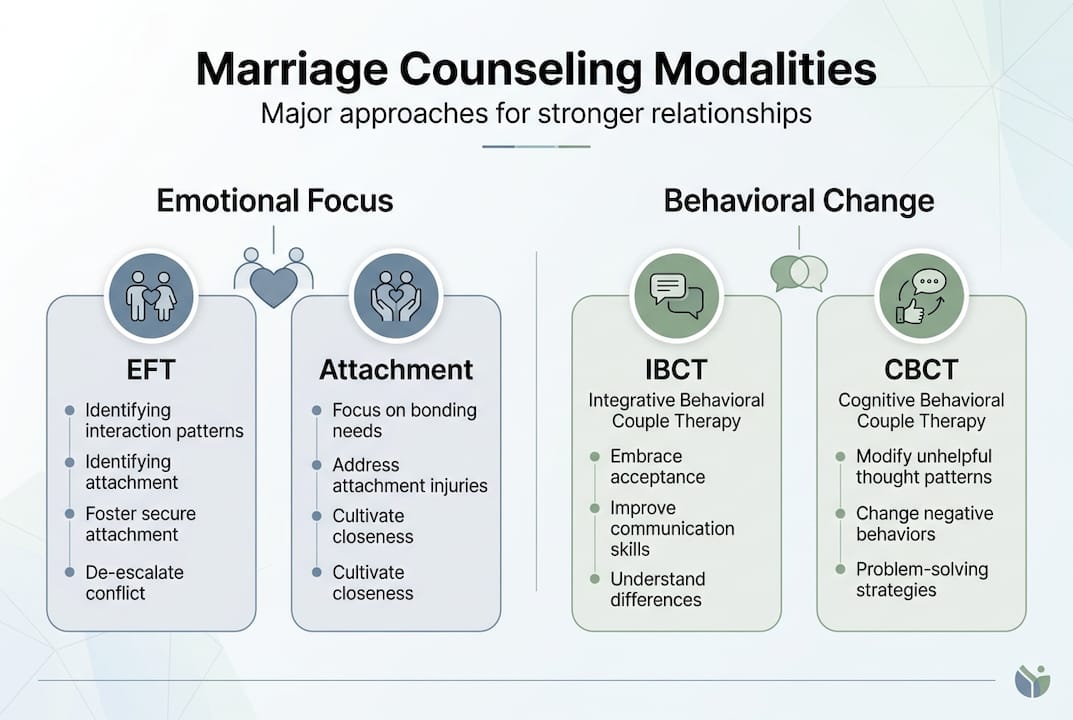
Here’s how IBCT compares to EFT and CBCT:
| Feature | EFT | IBCT | CBCT |
|---|---|---|---|
| Core focus | Emotional bonds | Acceptance and change | Thoughts and behaviors |
| Best for | Emotional disconnection | Recurring, perpetual conflicts | Communication skill gaps |
| Structure | Moderately structured | Flexible, exploratory | Highly structured |
| Homework | Minimal | Moderate | Frequent |
| Session style | Emotionally expressive | Collaborative, observational | Skills-based and goal-focused |
Pro Tip: If you and your partner return to the same fight month after month without resolution, consider asking your therapist specifically about IBCT. Not all counselors lead with this approach, so naming it directly can open the door to a better fit. Check out IBCT therapy techniques to understand what those sessions might look like in practice.
The lasting counseling benefits of IBCT often show up not in dramatic breakthroughs, but in quieter shifts, less defensiveness, more curiosity, and the ability to sit with difference without it becoming a crisis.
Cognitive Behavioral Couples Therapy (CBCT): Changing thoughts and behaviors
CBCT is the most structured of the major modalities. It’s rooted in the principle that the way you think about your partner directly affects how you behave toward them, and how they respond to you. Change the thoughts, change the patterns. That’s the core logic.
CBCT identifies and challenges cognitive distortions, unrealistic expectations, and negative behaviors through skill training and homework. Sessions are goal-oriented. You and your therapist define specific communication or behavior targets at the start, then work systematically toward them. Between sessions, you practice skills through structured exercises.
Common patterns CBCT addresses include:
- Mind-reading: Assuming you know what your partner is thinking without asking
- Catastrophizing: Treating small disappointments as proof the relationship is doomed
- Negative attribution: Consistently interpreting your partner’s neutral actions as deliberately hurtful
- Rigid expectations: Holding your partner to rules they never agreed to and may not even know exist
Here’s how CBCT typically reshapes those patterns over time:
| Old pattern | New skill | Likely outcome |
|---|---|---|
| Mind-reading partner’s intent | Asking open-ended questions | Fewer misunderstandings |
| Catastrophizing minor conflicts | Reframing as isolated events | Reduced emotional escalation |
| Negative attribution | Considering alternative explanations | Increased empathy and trust |
| Rigid expectations | Collaborative boundary-setting | Greater mutual respect |
How CBCT helps families follows similar logic, extending cognitive and behavioral skill-building beyond the couple to include how you co-parent, manage extended family dynamics, or navigate financial stress. California couples dealing with blended family challenges or high-pressure professional environments often find CBCT’s practical structure particularly useful.
If you’re ready to explore marriage counseling services that include CBCT alongside other modalities, it’s worth asking how your therapist integrates skill-building with emotional support, since the most effective counselors rarely use just one approach.
Finding the right fit: When to choose or combine modalities
Now that you understand the major approaches, how do you actually choose? The answer depends on what your relationship genuinely needs, not which modality sounds most appealing in theory.
Here’s a checklist to guide your thinking before selecting a modality:
- Are your conflicts emotionally driven, with partners feeling unseen or unloved? EFT is often the best starting point.
- Do you and your partner face the same unresolvable argument repeatedly? IBCT’s acceptance-based framework may be the key.
- Do you struggle with specific communication habits, negative assumptions, or unhelpful expectations? CBCT’s structured skill-building offers concrete tools.
- Is one or both partners uncertain about staying in the relationship? Discernment counseling, a specialized short-term approach, is designed exactly for this.
Many experienced therapists in California don’t limit themselves to a single modality. They blend elements based on where you are in the process. You might start with EFT to stabilize emotional reactivity, then shift into CBCT to build communication skills. Or begin with IBCT’s acceptance work, then introduce behavioral strategies as trust grows.
It’s also important to be honest about safety. Screening for violence and affairs before starting EFT or PACT is essential, and situations requiring safety planning, trauma processing, or legal considerations call for a therapist equipped to handle those layers. California’s family law landscape adds complexity for couples navigating separation, custody, or divorce ambiguity alongside relationship therapy.
Pro Tip: Ask any prospective therapist directly: “What modalities do you use, and how do you decide which approach fits a given couple?” A strong answer should be adaptive and specific, not a rehearsed pitch for a single method.
Understanding the therapist’s role in California goes beyond credentials. It includes their ability to meet you where you are culturally, emotionally, and situationally.
Why the best marriage counseling is personalized, not one-size-fits-all
After unpacking each modality, here’s the perspective that tends to get left out of most articles: the method matters far less than the fit. The research on what makes couples therapy work consistently points to the therapeutic alliance, meaning how safe and understood both partners feel with their therapist. A brilliant EFT practitioner who doesn’t understand your cultural background or family structure may be less effective than a flexible generalist who truly sees your relationship.
California’s diversity makes this especially relevant. Couples navigating bicultural relationships, LGBTQ+ partnerships, interfaith households, or immigration-related stress bring layers to the therapy room that a rigid adherence to one modality may miss entirely. The most skilled therapists we’ve seen adapt and blend therapy techniques that work across sessions, moving fluidly between approaches as the couple’s needs evolve.
The takeaway isn’t that any particular modality is superior. It’s that your counselor’s flexibility, cultural competence, and willingness to adjust the approach as you grow together is what makes the real difference.
Ready to explore marriage counseling with expert guidance?
Finding the right modality is a meaningful step, but taking action is what moves your relationship forward.
At Revive Health Therapy, we work with California couples across all stages of relationship, matching evidence-based modalities to your specific dynamics, goals, and cultural context. Whether you’re drawn to EFT, IBCT, CBCT, or a blended approach, our therapists help you find what actually fits your relationship. Understanding why seek psychotherapy can help you take that first step with confidence. We offer both in-person sessions in Walnut Creek and Oakland, as well as telehealth marriage therapy statewide, with sliding-scale fees and insurance options to make access simple. Reach out today to schedule a consultation.
Frequently asked questions
How do I know which marriage counseling modality is best for my relationship?
Consider your relationship challenges and goals. Emotion-focused approaches like EFT help rebuild bonds rooted in attachment, while behavioral or cognitive methods offer structure for resolving persistent conflict patterns. As attachment-based EFT research confirms, matching the modality to your core issue is what produces lasting results.
Can marriage counseling modalities be combined?
Many therapists blend techniques from different modalities to address each couple’s unique needs. As IBCT research at UCLA shows, even within a single approach, balancing acceptance with targeted behavior change creates more nuanced and durable results.
Is marriage counseling effective for couples facing infidelity or abuse?
Screening for affairs or violence is essential before starting therapy because these situations require specialized or safety-focused approaches first. Proper pre-therapy screening helps ensure that standard modalities like EFT or PACT are introduced only when the relationship context is safe enough to support them.
What if my partner is unsure about attending counseling?
Discernment counseling is specifically designed for couples where one or both partners are uncertain about whether to stay together or separate. This short-term approach focuses on clarity and decision-making, not immediate relationship repair, making it a better first step than traditional couples therapy when commitment itself is in question. Discernment counseling guidance can help you understand when this specialized approach is the right entry point.
Recommended
- Benefits of couples counseling for lasting connection – Revive Health Therapy
- Role of therapists in marriage health: California guide – ReviveHealthTherapy
- Top marriage therapy techniques that drive real results – Revive Health Therapy
- Top 4 Best Marriage Counseling Services 2026 – ReviveHealthTherapy