
A CBT thought record is a structured worksheet that pulls automatic thoughts out of your head and onto paper so you can test them against actual evidence. The goal is not positive thinking. It is accuracy: rating how intensely you feel something, checking that feeling against the facts, and landing on a more balanced conclusion. Start now by writing down the last situation that upset you and working through a seven-column entry before you read further.
TL;DR:
- The evidence against automatic thoughts often requires careful, specific fact-checking, which is the most critical step for effective cognitive restructuring.
- Filling out a thought record should be done within a few hours of the upsetting event to maintain emotional accuracy and clarity.
- Starting with fewer columns, such as situation, emotion, automatic thought, and outcome, can help build confidence before adding evidence and balanced thought columns.
- Consistent practice over two to four weeks significantly reduces cognitive distortions and emotional distress, especially with daily or several weekly entries.
- If automatic thoughts persist despite multiple entries, working with a trained therapist can help address deeper or more ingrained thought patterns.
Table of Contents
- What Goes In Each Column Of A CBT Thought Record?
- What A Filled-Out Thought Record Actually Looks Like
- When Should You Fill Out A Thought Record?
- Common Mistakes That Cancel Out The Benefits
- How Do Therapists Introduce Thought Records To Clients?
- Where To Find Printable And Interactive Thought Record Templates
- A Clinician’s Note On Sticking With It
- Working With A Therapist On Cognitive Restructuring
- Sources
- FAQ
What Goes In Each Column Of A CBT Thought Record?
The seven-column format is the version most therapists teach first, and it’s the one backed by the most practitioner research. Each column has a specific job, and skipping the order usually leads to a weaker result.
- Situation. Write only what a camera would have recorded. “My manager sent a two-line email at 6 p.m.” not “My manager is furious with me.”
- Emotions. Name each feeling in one word (anxious, embarrassed, angry) and rate its intensity from 0 to 100%. Multiple emotions can appear here with separate ratings.
- Automatic thought. Quote the thought exactly as it ran through your mind, then rate how much you believe it, also 0 to 100%. Write “I might get fired” rather than “I’m doomed,” since specific, falsifiable thoughts are actually easier to test than catastrophic ones.
- Evidence for. List facts, not interpretations, that support the automatic thought.
- Evidence against. List facts that complicate or contradict it. This column is where most people rush, and it’s the one that does the real work.
- Balanced thought. Write a conclusion that accounts for both evidence columns. It should feel plausible, not cheerful.
- Outcome. Re-rate the original emotion and the belief in the original automatic thought. Most people see both numbers drop.
Plan on 5 to 20 minutes per entry, with your first few taking longer while you get used to the format, a range Psychology Tools confirms is typical for new users. Avoid two traps: forcing a falsely positive balanced thought, and writing vague evidence like “things always work out” instead of a specific fact.
Pro Tip: If a column feels impossible to fill in, that’s information too. Struggling to find evidence against a thought often means the thought has been running unchallenged for a long time.
What A Filled-Out Thought Record Actually Looks Like
Here’s a full entry from a common scenario: a friend cancels weekend plans by text with no explanation.
- Situation: Friend texted “Can’t make it Saturday, sorry” with no further detail.
- Emotions: Rejected (70%), anxious (55%).
- Automatic thought: “She’s pulling away from me and doesn’t want to be friends anymore” (belief: 80%).
- Evidence for: She’s canceled plans twice in the past month. She’s replied to texts more slowly lately.
- Evidence against: She initiated these plans originally. She mentioned a hectic work deadline last week. She’s never cut off a friendship without a direct conversation before.
- Balanced thought: “She’s probably overwhelmed with work right now, not pulling away. If this pattern continues, I can ask her directly instead of guessing” (belief: 30%).
- Outcome: Rejected dropped to 30%, anxious dropped to 25%.
Notice the balanced thought isn’t “Everything is fine and she loves me.” It holds space for the pattern being real while refusing to treat one data point as proof of abandonment. That’s the difference between cognitive restructuring and simply talking yourself into feeling better, and it’s why the outcome ratings tend to hold up over time instead of bouncing back an hour later.
When Should You Fill Out A Thought Record?
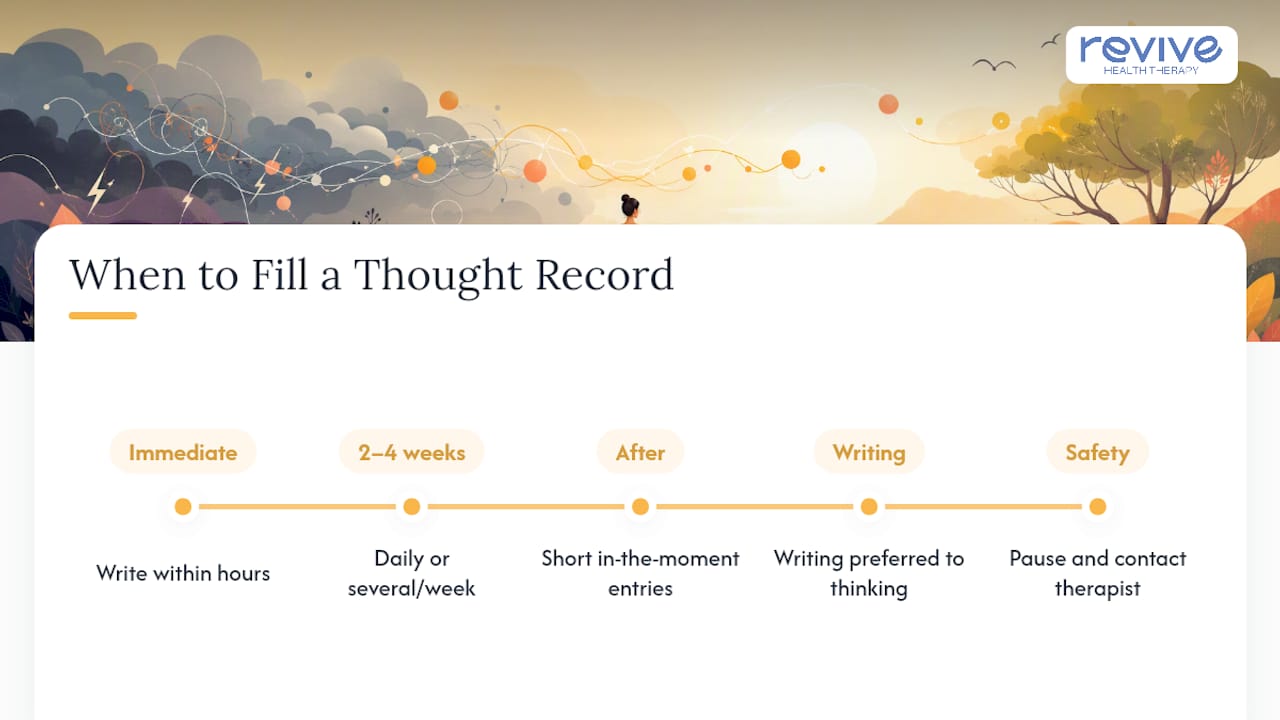
Complete a written entry within a few hours of the distressing event whenever you can. Waiting days flattens the emotional detail and makes the evidence columns harder to fill in accurately.
During a learning phase of two to four weeks, aim for a daily entry or at least several a week. Simply Psychology’s guide notes that consistent practice over that window produces measurable drops in cognitive distortions and emotional distress, not just occasional relief. After that, most people shift to shorter, in-the-moment versions and save full written records for bigger spikes.
Mental in-head versions work in a pinch, but writing beats thinking it through silently because putting words on a page creates real distance from the thought. If your thoughts feel overwhelming, include any suicidal ideation, or you notice dissociation while writing, pause the exercise and reach out to a therapist rather than working through it alone.
Common Mistakes That Cancel Out The Benefits
Three mistakes account for most failed attempts. Turning the exercise into rumination, where you replay the situation without ever reaching the evidence columns, is the most common. A second is forcing an unrealistically cheerful balanced thought that you don’t actually believe, which explains why the belief rating doesn’t move. Third is skipping the evidence steps entirely and jumping straight from automatic thought to conclusion.
- Start with the emotion, not the situation, when anxiety is running high. Naming and rating the feeling first gives you a stable anchor before you touch the thought itself.
- Write the automatic thought in the exact words it appeared in your head, quotes and all.
- Finish every entry with one small next action, even something as minor as “text her tomorrow to check in.”
- If seven columns feels like too much at first, start with a four-column diary (situation, thought, emotion, outcome) and add the rest later.
Pro Tip: Keep a photo of a blank worksheet on your phone. The version you’ll actually use during a bad moment is the one you don’t have to go looking for.
How Do Therapists Introduce Thought Records To Clients?
Most therapists don’t hand over all seven columns on day one. Clinical guidance from the Beck Institute’s worksheet materials supports starting with three or four columns, usually situation, emotion, and automatic thought, and adding evidence and balanced-thought columns once a client is comfortable spotting their own patterns.
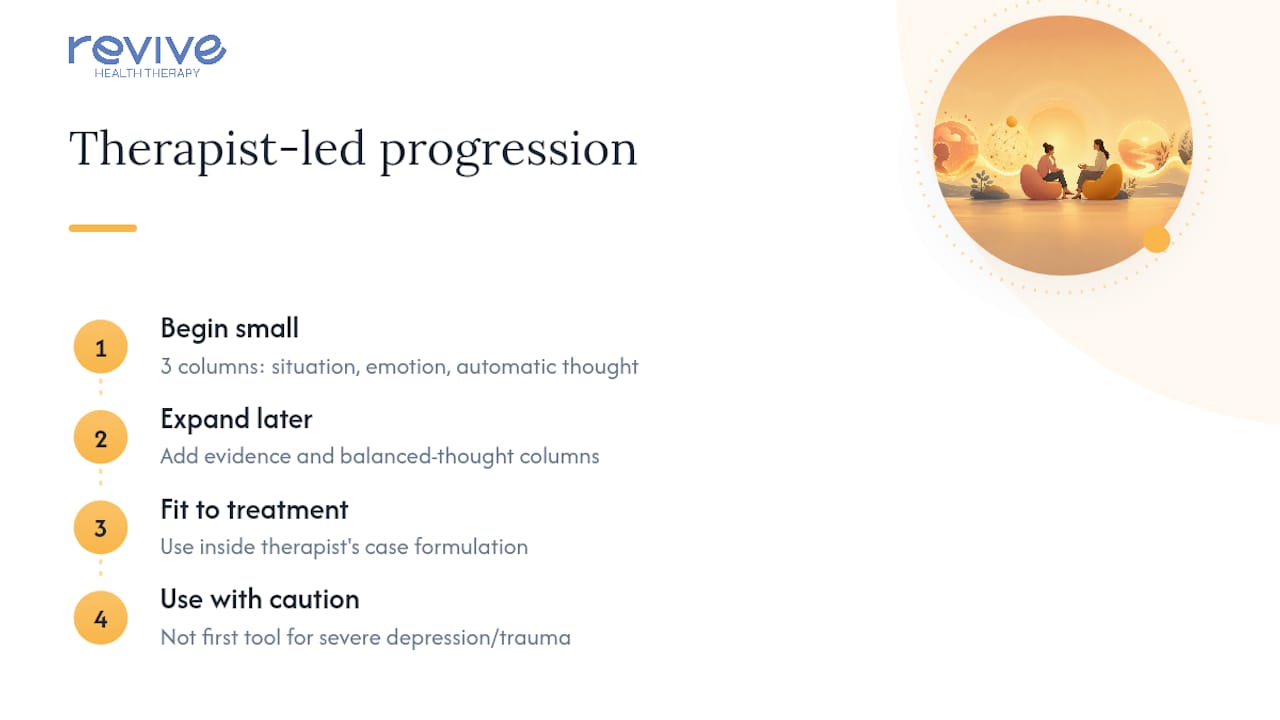
Thought records also work best inside a broader treatment plan rather than as a standalone fix. Clinical CBT resources note that the technique is most effective when it fits a therapist’s case formulation instead of being used in isolation. If you’re dealing with severe depression, suicidal thoughts, or trauma-related flashbacks, a thought record isn’t the right first tool. That’s a conversation for a licensed therapist, not a worksheet.
Where To Find Printable And Interactive Thought Record Templates
You don’t need to build a worksheet from scratch. Psychology Tools offers a downloadable seven-column PDF built around the classic format, and TherapistAid has a fillable version suited to both clinical and personal use.
- Print the seven-column version for your first few entries so you learn the full sequence.
- Keep a simplified four-column version on your phone for quick, in-the-moment use.
- If you want feedback on how you’re filling it out, Revive Health Therapy’s guide to step-by-step CBT for anxiety walks through how the tool fits into a broader treatment approach.
A Clinician’s Note On Sticking With It
Your first few entries will feel clunky, and that’s normal. It gets easier once the sequence stops feeling like homework and starts feeling like a habit. If you want a place to start tonight, try this prompt: “What happened, what did I feel, and what did I tell myself about it?” Answer those three questions honestly, and the rest of the worksheet tends to follow.
— Amy
Working With A Therapist On Cognitive Restructuring
A worksheet can only take you so far when the automatic thoughts keep repeating no matter how many entries you fill out. That’s usually a sign the thought pattern is older and stickier than a single exercise can unwind, and it’s exactly what a therapist trained in cognitive restructuring is built to work through with you.
Individual therapy using CBT can personalize the process: identifying specific distortion patterns, adjusting the worksheet to fit how a person thinks, and troubleshooting entries that don’t seem to move belief ratings. Sessions may be available in person or by telehealth, with sliding-scale fees and insurance, HSA, and FSA options that can make ongoing sessions accessible on a variety of budgets. If you’ve been filling out thought records on your own and want a therapist to help you go deeper, visit the Revive Health Therapy services page to find the right fit and get started.
Sources
- CBT thought record – Psychology Tools
- CBT Thought Records: How to Use Them to Challenge Anxious Thoughts | Simply Psychology
- Cognitive Behavior Therapy – StatPearls – NCBI Bookshelf
- Thought Record | Worksheet – TherapistAid
- CBT worksheet packet – Beck Institute (worksheet packet)
Reading is a starting point. A therapist can tell you how these tools apply to your specific situation.
This article is general information, not a substitute for advice from a qualified doctor. Consult a qualified healthcare professional about your own circumstances before acting on anything here.
FAQ
What Is A CBT Thought Record Used For?
A CBT thought record is used to catch automatic thoughts, check them against real evidence, and build a more balanced conclusion. It’s a core tool in cognitive restructuring, one of the main cognitive behavioral therapy techniques used for anxiety and depression.
How Long Should A Thought Record Take To Complete?
Most entries take 5 to 20 minutes, with earlier attempts running longer as you learn the format. Once the process feels familiar, many people complete a full seven-column entry in under 10 minutes.
How Often Should I Fill Out A Thought Record?
During the learning phase, aim for daily entries or several per week for two to four weeks, then shift to shorter versions as needed. Frequency matters more than perfection in the early weeks.
Can A Thought Record Replace Therapy?
A thought record is a self-help tool, not a replacement for professional care, especially with severe depression, trauma, or suicidal thoughts. Revive Health Therapy’s individual therapy services pair the same technique with clinical guidance tailored to your situation.
What If I Can’t Think Of A Balanced Thought?
Struggling to find one usually means the evidence-against column needs more work first. Go back and list concrete facts, not reassurances, since a credible balanced thought only comes from evidence you actually believe.