
Active listening, validation, “I” statements, weekly check-ins, and repair practice are the core exercises that work, because they train couples to attune to each other and interrupt the negative cycles that erode satisfaction. A randomized trial of an online couples intervention found significant gains in relationship satisfaction (Cohen’s d = 0.69) from structured communication practice. When patterns repeat despite practice, a therapist can help.
TL;DR:
- Choose one or two exercises before conflict begins; during mirroring, let the speaker finish short chunks and respond without adding a rebuttal.
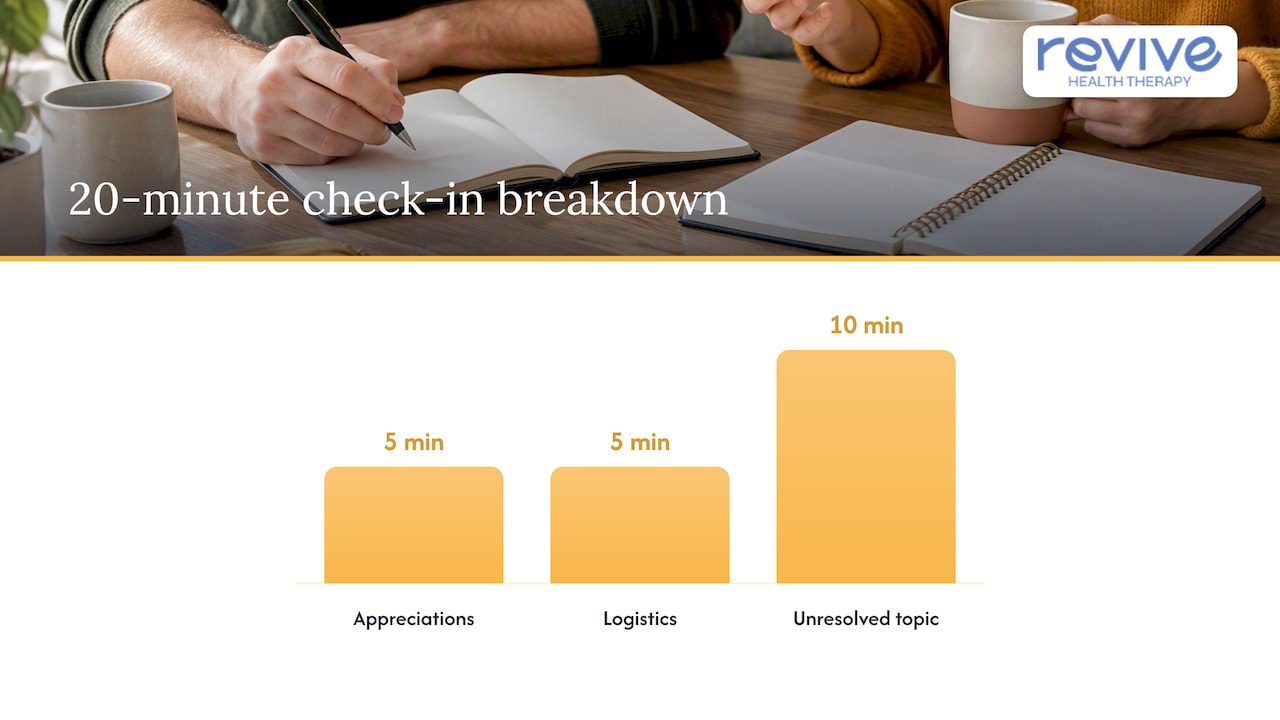
- Structure the weekly session as 20 minutes: five for appreciations, five for logistics, and ten for one unresolved issue; move longer discussions elsewhere.
- A repair attempt should acknowledge the impact, validate the hurt partner, apologize when appropriate, and offer a concrete next step; skipping acknowledgment can deepen hurt.
- When a partner feels flooded, pause for 20 minutes, agree on a return time, and restart gently rather than resuming the argument.
- Seek therapy if repeated conflict continues after several weeks, exercises trigger escalation, or addiction, abuse, suicidal thoughts, or emotional safety concerns arise.
Table of Contents
- 10 Communication Exercises to Try This Week
- How to Practice Each Exercise Correctly
- Building a Routine That Actually Sticks
- Handling Flooding: Regulation and the 20-Minute Pause
- When Exercises Aren’t Enough
- Worksheets and Scripts You Can Copy Tonight
- What the Research and Clinicians Say
- A Clinician’s View on the First Three Weeks
- Ready for More Support? Here’s What Couples Therapy Adds
- FAQ
- Sources
10 Communication Exercises to Try This Week
Pick one or two exercises rather than attempting all of them at once. Each works best when both partners agree to try it before a conflict starts, not in the middle of one.
- Active listening (10 minutes): One partner speaks for two minutes while the other reflects back what they heard before responding; best for couples who interrupt or jump to defend themselves.
- Validation practice (5 minutes): After listening, name the feeling behind your partner’s words (“that sounds exhausting”) without agreeing or disagreeing with the facts; useful when one partner feels dismissed.
- “I” statement swap (10 minutes): Each partner converts a recent complaint into “I feel X when Y happens” and reads it aloud; good for couples stuck in blame language.
- Weekly check-in (20 minutes): A set agenda covering appreciations, logistics, and one unresolved issue; works for busy couples who only talk about scheduling.
- Repair rehearsal (10 minutes): Practice a short “do-over” script for a recent small conflict, without re-litigating who was right; helpful after a rupture that never got addressed.
- Gratitude round (5 minutes): Each partner names one specific thing the other did that week; builds the positive habit, useful for couples who feel distant but not in active conflict.
- 20-minute pause drill (20 minutes): Practice calling a time-out and returning on schedule, even when nothing is wrong, so the skill is ready when needed.
- Soft start-up rewrite (10 minutes): Take a harsh opener from a recent argument and rewrite it as a gentler version; best for couples whose conflicts escalate fast.
- Curiosity questions (10 minutes): Ask open questions about your partner’s inner world unrelated to logistics or conflict; rebuilds friendship outside of problem-solving.
- Physical connection ritual (5 minutes): A daily hug, hand-hold, or six-second kiss with no agenda attached; low effort, high consistency for busy or touch-starved couples.
- Appreciation letter (15 minutes, monthly): Write a short note about why you chose your partner; works well for long-term couples who have drifted into routine.
- Shared play session (20 minutes): A game, walk, or activity with no talk about problems allowed; rebuilds positive association before tackling harder conversations.
How to Practice Each Exercise Correctly
Most couples already know these skills exist. What usually goes wrong is the execution: rushing the steps, skipping the setup, or practicing only during a fight when stress is already high.
Active listening and mirroring
The structure matters more than the words. One partner speaks in short chunks, two or three sentences at a time, while the other mirrors back the content before adding anything of their own.
- Speaker: “I felt alone handling the kids’ schedule this week.”
- Listener: “So you felt alone managing the schedule. Did I get that right?”
- Speaker confirms or corrects, then continues.
A common error is mirroring the words but inserting a rebuttal in the same breath (“I hear you felt alone, but I was working late every night”). That turns a listening exercise into a debate. Keep the mirror clean, save any response for after the speaker says they feel heard.
Validation
Validation is not agreement. It is confirming that a feeling makes sense given the other person’s experience, even when you see the situation differently. A short script: “Given everything on your plate, I get why that felt like too much.” Research on receiver perception suggests that feeling heard predicts relationship quality more reliably than how skilled the speaker believes they were, which is why validation from the listener’s side carries more weight than a well-worded explanation from the speaker’s side.
“I” statements and soft start-ups
Replace “you always” with a specific, feeling-based structure: “I feel [emotion] when [specific situation] because [impact].” A soft start-up adds one more layer: open with something true and kind before the complaint. “I know you’ve had a long week, and I also need to talk about the bills” lands differently than “We need to talk about the bills, again.”
Structured check-ins
A 20-minute check-in works best with a fixed order: five minutes of appreciations, five minutes of logistics, ten minutes on one unresolved topic. Set a timer. If the unresolved topic runs long, table it for a separate conversation rather than letting the check-in spiral.
Repair practice (the do-over)
Repair works when it follows a sequence: acknowledge the impact first, then validate, then apologize if appropriate, then offer a concrete next step. Attempting repair before the other person feels recognized tends to fail or even increase hurt, because an apology that skips acknowledgement can feel dismissive. A sample script: “I realize that came out harsh and it probably hurt. I’m sorry. Can we try that conversation again?”
Play and connection exercises
Not every exercise needs to address conflict. A short walk, a shared playlist, or a weekly game night rebuilds the baseline of goodwill that makes harder conversations easier later. Couples who only talk when something is wrong tend to associate conversation itself with stress.

Pro Tip: Practice active listening and validation during a calm moment first, not during your next disagreement; the skill needs to be automatic before it is useful under stress.
Building a Routine That Actually Sticks
A single good conversation rarely changes a pattern. Consistency does, and the structure matters as much as the content.
- Daily micro-check (2 to 5 minutes): A quick “how are you, really” exchange, no problem-solving required.
- Weekly session (30 minutes): One check-in covering appreciations, logistics, and a single unresolved issue.
- Monthly review (10 minutes): Ask each other what felt supportive this month and what didn’t.
Rules of engagement: set a time limit before you start, agree on a pause word either partner can use without penalty, and commit to no interrupting during the listening portion. These three rules prevent most sessions from turning into the argument they were meant to prevent.
Track one simple metric: after each check-in, each partner rates “I felt heard today” on a one-to-five scale. The number matters less than the trend. A score that climbs over a few weeks suggests the exercises are working, while a flat or falling score is a sign to adjust the format or get outside input.
Resistance is common in the first two weeks. If one partner drifts or forgets, shorten the session rather than canceling it, a five-minute check-in that happens is worth more than a thirty-minute one that gets skipped.
Pro Tip: If a partner resists the structure, let them pick the format for one week; ownership over the process reduces the sense that the exercise is being imposed on them.
Handling Flooding: Regulation and the 20-Minute Pause
Flooding happens when the nervous system shifts into a stress response during conflict, heart rate rises, and the capacity for calm problem-solving narrows sharply. Once flooded, neither partner can listen well or think clearly, which is why pushing through an argument at that point rarely helps.
- Box breathing: inhale for four counts, hold for four, exhale for four, repeat for one to two minutes.
- Grounding prompt: name five things you can see and three things you can hear to interrupt the stress response.
- Co-regulation script: “I’m getting overwhelmed. I care about this conversation and I need twenty minutes before we keep going.”
- Re-entry rule: return to the conversation at the agreed time, even if the urge to avoid it is strong, and open with a soft start-up rather than restarting the argument where it left off.
Clinician guidance from a couples podcast points to the “power of the pause,” along with guided breathing, as practical tools for managing escalation before it overwhelms either partner.
Bring regulation skills into weekly practice once you notice the same argument repeatedly escalating past the point of productive talk. Our emotional regulation strategies go into more detail on co-regulation techniques that pair well with the pause rule.
When Exercises Aren’t Enough
Self-guided practice helps most couples, but a few signs suggest it is time for outside support:
- The same conflict repeats without resolution after several weeks of consistent practice.
- Exercises themselves trigger escalation rather than calming it.
- Either partner shows signs of addiction, abuse, or suicidal thoughts, situations that call for professional support rather than self-directed exercises.
- One or both partners feel unable to stay emotionally safe during check-ins, even with the pause rule in place.
Couples therapy offers structured repair with a neutral third party, diagnostic clarity about recurring patterns, and trauma-informed approaches when past experiences are shaping current conflict. Our guide to what to expect in couples counseling walks through preparing for a first session: bring a short history of the relationship, a clear sense of what you each want to change, and realistic goals rather than a demand for a quick fix.
Worksheets and Scripts You Can Copy Tonight
A one-page agenda removes the guesswork that keeps couples from starting.
- Check-in agenda: 5 minutes appreciations, 5 minutes logistics, 10 minutes one unresolved topic, timer required.
- Validation template: “Given [situation], it makes sense you’d feel [emotion].”
- “I” statement template: “I feel [emotion] when [situation] because [impact].”
- Repair script: “I realize [impact]. I’m sorry. Can we try that again?”
| Day | Exercise | Time |
|---|---|---|
| Monday | Gratitude round | 5 minutes |
| Tuesday | Active listening | 10 minutes |
| Wednesday | Curiosity questions | 10 minutes |
| Thursday | “I” statement swap | 10 minutes |
| Friday | Shared play session | 20 minutes |
| Saturday | Weekly check-in | 20 minutes |
| Sunday | Physical connection ritual | 5 minutes |
What the Research and Clinicians Say
A randomized trial of an online adaptation of integrative behavioral couple therapy found measurable improvements in relationship confidence and reduced negative quality among U.S. couples who completed structured communication practice. Separate analysis of online interventions found that decreases in negative communication and increases in positive communication explained much of the improvement in satisfaction.
“Will you be there for me?” is the core relational question behind attunement, more than simply listening to words.
That framing comes from clinician discussion of attunement and the signal-and-respond dynamic in couples work. As a clinician writing for couples, I draw on this kind of research and clinical guidance, alongside our team’s trauma-informed, evidence-based approach at ReviveHealthTherapy, to shape the exercises above.
A Clinician’s View on the First Three Weeks
Week one, focus only on listening and validation, nothing else. Most couples try to fix everything at once and burn out by day three. Week two, add “I” statements and the weekly check-in, now that listening feels less forced. Week three, introduce the pause rule and repair script, since conflict skills need a foundation of calmer conversation first.
The most common beginner mistake is skipping straight to repair after a fight without the acknowledgement step, which tends to backfire. The second is treating the weekly check-in as a venue for every grievance instead of one topic.
If progress stalls past three weeks, that is not failure. It is useful information that outside support would help more than more self-practice.
— Amy
Ready for More Support? Here’s What Couples Therapy Adds
When the exercises above help but you want a trained guide for the harder conversations, couples therapy builds on exactly this foundation with a clinician trained in attunement, repair, and trauma-informed care. 
Our Couples Therapy sessions work alongside the exercises in this guide rather than replacing them, available both in-person in California and through telehealth sessions statewide for couples who prefer meeting from home. To prepare for a first session, bring a short relationship history and one or two concrete goals.
Sliding-scale fees are offered along with insurance acceptance, including HSA and FSA plans, so cost does not have to be a barrier to getting support. Reach out through our services page to find a time that works.
This article is general information, not a substitute for advice from a qualified doctor. Consult a qualified healthcare professional about your own circumstances before acting on anything here.
FAQ
What is the most effective communication exercise for couples?
Active listening paired with validation tends to produce the fastest shift, because it addresses the most common complaint in conflict: not feeling heard. A randomized trial of structured online communication practice found meaningful gains in satisfaction from this kind of skill-building.
How often should couples practice communication exercises?
A daily two-to-five-minute micro-check paired with one 30-minute weekly session tends to work better than occasional long sessions. Short, frequent practice builds the skill as a habit rather than a once-a-month event.
What is the 20-minute rule in relationships?
The 20-minute rule refers to taking a pause of at least 20 minutes when a conversation becomes too heated to continue productively, allowing the nervous system to settle before returning. Clinician guidance on managing escalation describes this pause as a practical tool for avoiding flooding.
Why do repair attempts sometimes fail even when they’re sincere?
Repair often fails when it comes before the hurt partner feels their experience has been acknowledged, so a well-meant apology can land as dismissive if it skips that step. Clinical guidance on repair recommends naming the impact first, then validating, then apologizing.
When should a couple consider therapy instead of self-guided exercises?
Consider therapy when the same conflict repeats after several weeks of consistent practice, when exercises themselves escalate tension, or when issues like addiction or safety concerns are present. Couples therapy adds structured repair and diagnostic clarity that self-practice alone often cannot reach.
Can substance use issues affect communication practice between partners?
Yes, substance use can disrupt trust and consistency in a relationship, making communication exercises harder to sustain until the underlying issue is addressed. Couples navigating recovery together may find additional support through resources like Reclaim Sobriety’s guide to rebuilding trust after alcohol, alongside professional therapy.
Sources
- Translation of Integrative Behavioral Couple Therapy to a Web‐based Intervention (OurRelationship)
- Why repair attempts fail (Even When You Mean Them) | Psychology Today
- The lost art of listening and emotional regulation | USU webinar