
Clinical trials on eye movement desensitization and reprocessing report remission or major symptom reduction rates that vary widely, depending on the study design and how “success” gets defined. Most researchers count success as a meaningful drop in PTSD symptoms or the loss of a PTSD diagnosis altogether, not the complete disappearance of every memory. The VA and ISTSS both give EMDR strong endorsements, though outcomes shift noticeably based on trauma complexity and whether someone has other conditions layered on top.
TL;DR:
- Success rates vary widely depending on trauma complexity, with single-incident cases reaching higher remission percentages after fewer sessions than layered, chronic trauma cases.
- EMDR typically outperforms waitlist and usual care, with durable benefits that often persist at follow-up assessments.
- Treatment duration depends on trauma type, with simpler cases sometimes resolving in 3 to 6 sessions, while more complex cases require a longer course.
- Clinician training and protocol fidelity significantly influence outcomes, making experienced, well-trained therapists a key factor for success.
- People with uncontrolled substance use, severe dissociation, or active suicidality usually need stabilization before engaging in standard EMDR therapy.
Table of Contents
- How Effective Is EMDR Therapy, According to the Evidence?
- Notable Studies Behind the EMDR Success Rate Numbers
- Why Success Rates Vary From Person to Person
- What a Typical EMDR Treatment Course Looks Like
- Who Might Not Be a Good Candidate for EMDR
- What a Clinician Wants You to Know About These Numbers
- Why We Stay Cautiously Optimistic About EMDR
- Getting Started With EMDR at Revive Health Therapy
- Sources
- FAQ
How Effective Is EMDR Therapy, According to the Evidence?
The research consensus is consistent on one point: EMDR beats waitlist conditions and usual care by a wide margin. A 2025 systematic review and meta-analysis found EMDR statistically outperformed control conditions for reducing PTSD symptoms, with benefits that held up at follow-up rather than fading once sessions ended, according to pooled trial data.
Where EMDR gets more interesting is in head-to-head comparisons with trauma-focused CBT. An individual participant data meta-analysis found no significant average difference between EMDR and other established psychological treatments for PTSD, indicating that EMDR is comparable to other first-line treatments. It’s operating in the same tier as the field’s other first-line options, according to a systematic review and individual patient data meta-analysis.
A few things stand out across the pooled evidence:
- EMDR shows moderate to large effect sizes against waitlist and usual-care comparisons.
- It frequently matches trauma-focused CBT on symptom reduction while needing fewer overall sessions.
- Comorbid anxiety and depression symptoms often improve alongside the primary PTSD symptoms.
- Gains reported at post-treatment tend to hold at follow-up assessments rather than reversing.
Pooled finding: Across the current meta-analytic evidence, EMDR is not just “better than nothing.” It’s a statistically significant improvement over usual care with durability at follow-up, which is a higher bar than most trauma treatments clear.
Notable Studies Behind the EMDR Success Rate Numbers
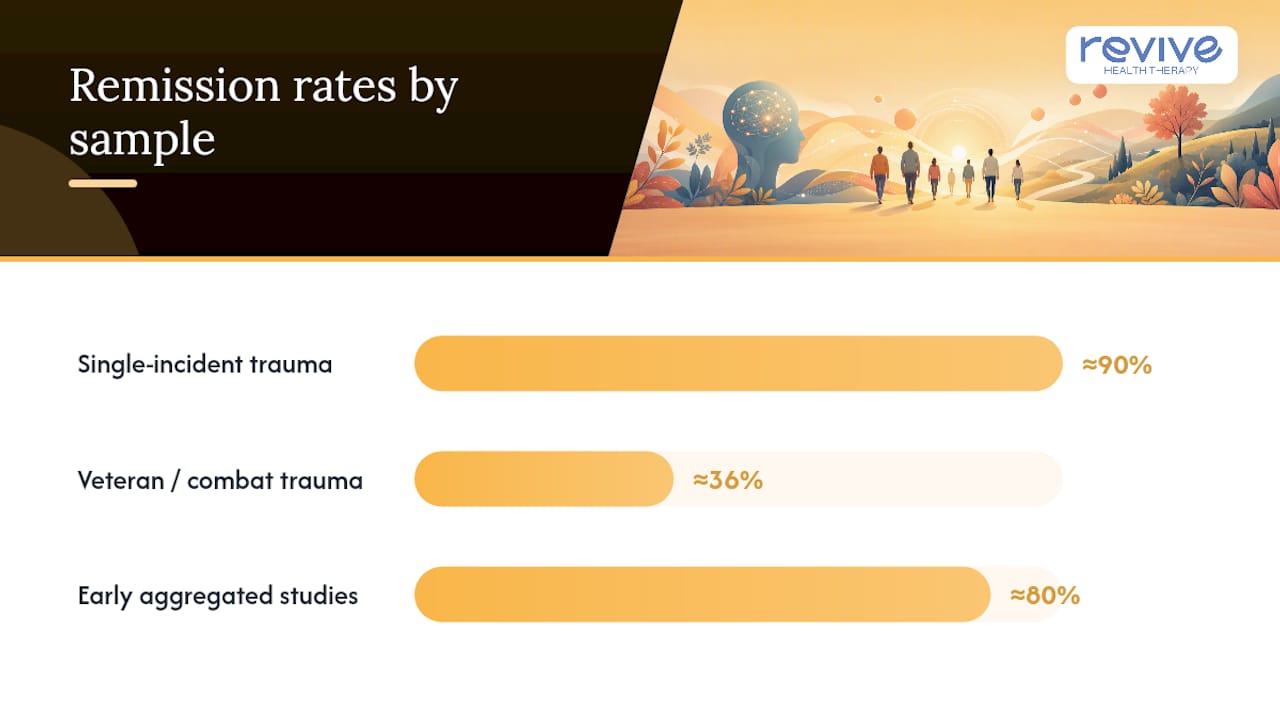
The wide range of reported success rates comes from real differences in who was studied and how long treatment lasted, not sloppy science. A comprehensive 2024 state-of-the-science review synthesized more than 30 randomized controlled trials and found remission rates spread across that range depending on the sample and measurement approach, per a detailed evidence synthesis.
Here’s roughly how the picture breaks down:
- Single-incident trauma samples (a car accident, an assault) tend to land at the higher end of the range, often after a handful of longer sessions.
- Veteran and combat-trauma samples, dealing with repeated and layered exposure, generally report lower remission percentages and need more sessions.
- Early aggregated evaluations, including work referenced in Francine Shapiro’s own reviews, cited success figures near 80%, though those early studies used more variable methods than today’s RCTs.
- Trials measuring cost and time efficiency found EMDR often reaches comparable symptom reduction in fewer total sessions than some alternative protocols.
The takeaway statistic: Complexity, not the therapy itself, mostly explains the spread. A single-trauma case and a decade of repeated trauma are not the same treatment problem, even when the same technique gets used.
Why Success Rates Vary From Person to Person
Numbers on a page don’t account for what walks into the therapy room. Trauma type matters most: a single, well-defined traumatic event usually responds faster than trauma that repeated over years or that’s tangled with attachment wounds. Comorbid conditions change the math too. Active substance use, unmanaged suicidality, or severe dissociation often need stabilization work before EMDR’s reprocessing phases can proceed safely.
Therapist training counts more than most clients realize. Protocol fidelity, meaning whether the clinician follows the full eight-phase model rather than an abbreviated version, correlates with better outcomes. Session length and pacing matter as well; rushing the preparation phase tends to backfire.
- Trauma complexity and duration
- Co-occurring conditions requiring stabilization first
- Clinician training and adherence to the standard protocol
- Session length, spacing, and pacing
- Client engagement and dropout risk
Pro Tip: Ask a prospective therapist how many EMDR cases they’ve completed and whether they follow the full eight-phase protocol. A clinician who can answer specifically, not vaguely, is usually the safer bet.
What a Typical EMDR Treatment Course Looks Like
Most randomized trials use multiple sessions of varying lengths, with noticeable improvement often occurring within a few months for many participants. That’s the standard research protocol, not a guarantee.
- Initial sessions (1 to 3): History-taking, stabilization, and identifying target memories.
- Core processing phases (roughly sessions 4 to 8): The reprocessing work most people associate with EMDR.
- Single-trauma cases: Some studies of one-time traumatic events report remission after as few as 3 to 6 longer sessions, though these results are sample-specific and don’t generalize to complex trauma.
- Consolidation and closure: Final sessions reinforce gains and build a relapse-prevention plan.
Frequency shifts the timeline too. Weekly sessions move slower than intensive formats, and a clinician’s judgment about pacing matters more than any fixed session count. For a side-by-side look at how EMDR’s session structure compares with exposure-based approaches, see this comparison of session counts and time burden.
Who Might Not Be a Good Candidate for EMDR
Adverse events during EMDR trials are rare, and dropout rates run comparable to other trauma-focused therapies, according to a systematic review of clinical and cost-effectiveness data. That said, EMDR isn’t a fit for everyone at every point in their recovery.
- People with active, uncontrolled substance use often need stabilization before reprocessing work begins.
- Severe dissociation can require preparatory grounding work first.
- Active suicidality or unstable medical risk usually calls for a different immediate treatment priority.
- Temporary distress during sessions is common and expected, not a sign something’s wrong.
- Working with a trained clinician who has a safety plan in place matters more than the technique itself.
What a Clinician Wants You to Know About These Numbers
Amy, a trauma clinician, points out that remission percentages describe groups, not individuals. A study reporting 70% remission doesn’t mean you have a 70% chance of a specific outcome. It means seven of ten people in that particular sample no longer met criteria for PTSD by the study’s own measurement tool.
Before starting, she suggests asking a therapist three direct questions:
- What specific EMDR training and certification do you hold?
- What’s a realistic session count and timeline for a case like mine?
- Do you accept insurance, HSA/FSA, or offer sliding-scale pricing?
Pro Tip: Track your progress with a standardized symptom measure, like the PCL-5, at intervals during treatment. Numbers on a validated scale tell you more than how you feel on any single hard day. Reviewing how the eight EMDR phases work before your first session also helps you know what to expect.
Why We Stay Cautiously Optimistic About EMDR
The evidence for EMDR is genuinely strong, and that’s not a hedge. But strong evidence at the population level doesn’t erase the need for individualized planning. Informed consent and collaborative progress tracking aren’t formalities. They’re how the research numbers actually translate into someone’s real recovery.
— Amy
Getting Started With EMDR at Revive Health Therapy
EMDR is offered both in person at select locations and through secure telehealth sessions available statewide, so distance or a packed schedule doesn’t have to be the reason trauma treatment gets delayed.

Insurance, HSA and FSA accounts are accepted, and income-based sliding-scale pricing is offered, which matters given how much session count and treatment length can vary case by case. An initial intake typically covers your trauma history, current symptoms, and any stabilization needs before reprocessing work begins, giving your clinician the full picture needed to set realistic expectations from session one. If you’re weighing EMDR against other PTSD treatments, the full range of services outlines how EMDR fits alongside CBT and other trauma-informed options offered. Ready to find out if EMDR fits your situation? Reach out through the individual therapy page to schedule an initial consultation and inquire about session pacing and payment options.
This article is general information, not a substitute for advice from a qualified doctor. Consult a qualified healthcare professional about your own circumstances before acting on anything here.
FAQ
What Are the Negatives of EMDR?
Some people experience temporary distress or emotional intensity during processing sessions, and complex or multiple-trauma cases often need more sessions than simpler cases. Systematic reviews find serious adverse events are rare, but the therapy still requires a trained clinician and adequate preparation time.
Who Is a Bad Candidate for EMDR?
People with active, uncontrolled substance use, severe untreated dissociation, or unstable suicidality typically need stabilization work first before starting standard EMDR reprocessing. A qualified clinician assesses this during intake rather than ruling someone out permanently.
Is EMDR the Hardest Therapy?
EMDR isn’t considered harder than other trauma-focused therapies, and it often requires less between-session work since it typically skips homework assignments. Some sessions can feel emotionally intense, but that intensity is common across most effective trauma treatments, not unique to EMDR.
How Effective Is EMDR Therapy?
Meta-analyses show EMDR is significantly more effective than waitlist or usual care, with remission rates across quality RCTs ranging from about 36% to over 90% depending on the study and trauma type. It performs comparably to trauma-focused CBT in most head-to-head comparisons, according to pooled trial evidence.
How Many Sessions Does EMDR Typically Take?
Most research protocols use multiple sessions of varying lengths, with noticeable improvement often occurring within a few months. Single-incident trauma cases sometimes resolve after a handful of longer sessions, while complex or chronic trauma usually needs a longer course.