
TL;DR:
- Proper EMDR preparation involves building stabilization skills, understanding the therapy’s phases, and maintaining honest communication with your therapist. This groundwork ensures safe processing and reduces the risk of destabilization, especially in complex trauma cases. Consistent practice of stabilization techniques and open dialogue enhance therapy outcomes and foster self-awareness throughout the process.
Eye Movement Desensitization and Reprocessing, known as EMDR, is a structured, evidence-based therapy that processes traumatic memories by pairing bilateral stimulation with targeted recall. Knowing how to prepare for EMDR before your first session is not optional. It directly determines how safe you feel, how quickly you progress, and how well your nervous system tolerates the work. The American Psychological Association, EMDRIA, and Harvard Health all recognize that preparation is a clinical phase in its own right, not a formality. This guide gives you the specific steps, realistic expectations, and self-care practices that make EMDR therapy work.
What are the key steps in preparing for EMDR therapy?
Effective preparation for EMDR follows a clear sequence grounded in the therapy’s eight-phase structure, with Phase 2 dedicated entirely to readiness before any trauma processing begins. Each step builds on the last, so skipping ahead creates real risk.
Understand how trauma affects the brain. EMDR operates on the Adaptive Information Processing model, which holds that traumatic memories get stored in a fragmented, unprocessed state. Your therapist will explain this so you understand why certain memories still feel raw and why bilateral stimulation helps the brain file them correctly.
Build stabilization skills. Before processing a single memory, you need reliable tools to regulate your emotional state. The core techniques include:
- Calm Place or Safe Place: A vividly imagined location where you feel completely at ease. You practice accessing it until you can reach that calm state in under a minute.
- Containment: A mental image of placing distressing thoughts in a locked container so you can set them aside between sessions.
- Grounding: Techniques like the 5-4-3-2-1 sensory method that anchor you in the present moment when memories feel overwhelming.
- Body scan: Noticing physical sensations without judgment so you can track where emotions live in your body.
Develop emotional literacy. You need to name what you feel and locate it physically. Saying “I feel tightness in my chest when I think about that event” gives your therapist far more to work with than “I feel bad.”
Map your trauma history and identify negative beliefs. Together with your therapist, you clarify the presenting problems and the core negative beliefs attached to them, such as “I am not safe” or “I am worthless.” This mapping determines which memories become processing targets.
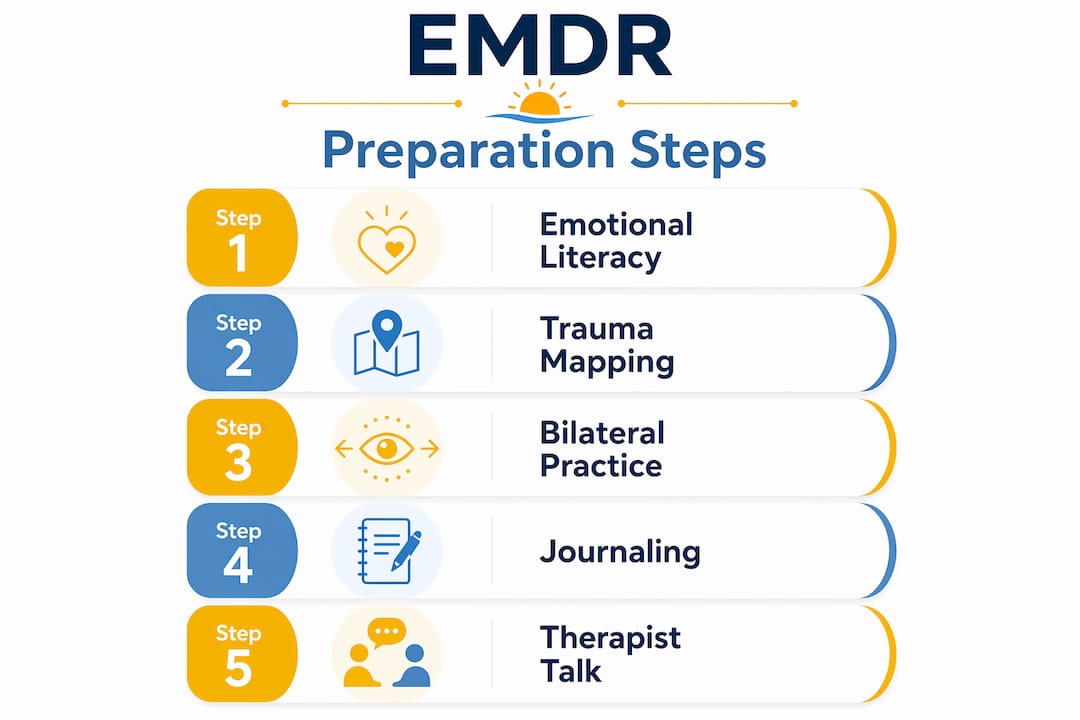
Practice bilateral stimulation. Bilateral stimulation techniques include guided eye movements, alternating taps on your knees, or audio tones that alternate between ears. Your therapist introduces these in Phase 2 so they feel familiar before any trauma work begins. Timelines vary. Simple trauma histories may move through preparation in two or three sessions. Complex or developmental trauma can require several weeks of stabilization work before processing is appropriate.

Pro Tip: Start a brief daily journaling practice before your first EMDR appointment. Write down recurring emotions, physical sensations, and any memories that surface spontaneously. This gives your therapist a richer picture from session one and accelerates the history-taking phase.
How do EMDR therapists explain preparation and what to expect during sessions?
Many people arrive at their first EMDR appointment expecting immediate trauma processing and feel confused when the early sessions look like traditional talk therapy. That confusion is worth addressing directly. Early EMDR sessions focus on history-taking, target identification, and building the internal resources you need to process safely. This is intentional and clinically necessary.
Here is what the structured session experience typically looks like:
- History and treatment planning (Phases 1 and 2). Your therapist gathers a detailed account of your background, current symptoms, and trauma history. You discuss what you want to change and identify specific memories or triggers to target.
- Preparation and resource building (Phase 2). The therapist teaches you the Safe/Calm Place exercise and other stabilization tools. You practice bilateral stimulation so it feels natural. Phase 2 builds emotional and bodily safety so you can tolerate activation during processing without becoming destabilized.
- Assessment (Phase 3). You and your therapist select a specific target memory, identify the negative belief attached to it, and rate your current distress level using the Subjective Units of Disturbance scale.
- Desensitization and reprocessing (Phases 4 through 7). You hold the target memory in mind while following bilateral stimulation. Your therapist adjusts stimulation and targets based on your feedback until distress decreases and adaptive resolution emerges.
- Body scan and closure (Phases 6 and 7). You scan your body for residual tension after processing. The session closes with grounding to return you to a stable baseline.
- Reevaluation (Phase 8). At the start of each subsequent session, your therapist checks how you responded between appointments and adjusts the plan accordingly.
EMDR sessions run 60 to 90 minutes, typically one to two times per week, for a course of 6 to 12 sessions. That time commitment matters for planning your schedule and your energy. Processing sessions are cognitively demanding, and many clients find they need quiet recovery time afterward.
Pro Tip: If you feel the pace is moving too fast or too slow, say so. Your therapist can only calibrate the work to your actual capacity if you tell them what you are experiencing. Transparency here is not weakness. It is the most effective thing you can do.
What should you do and avoid immediately before and after EMDR sessions?
The hours surrounding an EMDR session shape how much you get from it. Practical preparation matters as much as psychological readiness.
| Before your session | After your session |
|---|---|
| Sleep at least 7 hours the night before | Plan a low-demand activity for the rest of the day |
| Eat a light meal and hydrate well | Avoid alcohol or substances that alter your emotional state |
| Practice 5 minutes of deep breathing or mindfulness | Use your Safe/Calm Place exercise if distress surfaces |
| Write down any memories or emotions that arose since your last session | Journal briefly about what came up without trying to analyze it |
| Arrive 10 minutes early to settle your nervous system | Contact your therapist if distress feels unmanageable |
Beyond the logistics, the behaviors you build between sessions determine your overall progress. Repeated rehearsal of calming resources like the Safe/Calm Place is what makes them reliable under stress. Practicing once in session and never again means the resource will not be available when you need it most.
Common mistakes to avoid:
- Scheduling demanding work meetings or social obligations immediately after a processing session
- Using alcohol or cannabis to manage post-session emotions, which disrupts the brain’s natural consolidation of the work
- Avoiding all emotional content between sessions, which can stall progress
- Expecting linear improvement and interpreting a difficult week as failure
The period between sessions is active therapy time. Your brain continues processing material after the session ends. Protecting your schedule and practicing your stabilization tools during this window is not optional self-care. It is part of the treatment.
How can you manage challenges and setbacks during EMDR preparation?
Insufficient preparation carries real clinical risk. Clients who move into processing before they have reliable stabilization skills can experience destabilization, meaning distress that spills out of sessions and becomes difficult to contain in daily life. Readiness assessment by your therapist exists precisely to prevent this outcome.
Several challenges come up repeatedly for people preparing for EMDR therapy:
- Difficulty accepting safety. Some trauma survivors have nervous systems so conditioned to threat that the Safe/Calm Place exercise feels fake or inaccessible. This is not a personal failure. It signals that more stabilization work is needed before processing begins.
- Feeling unworthy of help. A core negative belief like “I do not deserve to get better” can quietly sabotage preparation. Naming this belief to your therapist turns it from an obstacle into a target.
- Emotional flooding between sessions. If material from a session continues to surface intensely for days, your therapist needs to know. Processing targets are adjusted based on client capacity, and starting on less intense memories is standard clinical practice, not a sign that your trauma is too severe to treat.
- Impatience with the preparation phase. Preparation can feel like waiting. It is not. Phase 2 resources linked with positive cognitions and strengthened through bilateral stimulation directly improve your capacity to process trauma without becoming overwhelmed.
The single most protective factor during this phase is honest communication with your therapist. Tell them when an exercise does not work. Tell them when you feel worse after a session. Tell them when you are not practicing between appointments. This information is data, and your therapist needs it to keep the work safe and effective.
Pro Tip: Keep a brief between-session log. Rate your distress level each morning on a scale of 1 to 10 and note any intrusive memories or physical symptoms. Bring this to your next session. It gives your therapist a precise picture of your week and removes the pressure of trying to remember everything in the moment.
Key takeaways
Effective EMDR preparation requires building stabilization skills, understanding the eight-phase structure, and maintaining honest communication with your therapist before and throughout the process.
| Point | Details |
|---|---|
| Preparation is a clinical phase | Phase 2 of EMDR is dedicated to readiness and must not be skipped or rushed. |
| Stabilization skills are non-negotiable | Practice Safe/Calm Place, grounding, and containment until they are reliably accessible. |
| Session logistics affect outcomes | Sleep, hydration, and a low-demand schedule around sessions protect your processing capacity. |
| Pacing is personalized | Therapists start with manageable memories and adjust targets based on your actual tolerance. |
| Communication drives safety | Telling your therapist about setbacks and distress is the most effective thing you can do. |
What I have learned about EMDR preparation after years of clinical work
Most people who come to EMDR therapy are ready to do the hard work. What they underestimate is how much the preparation phase is the hard work. I have watched clients rush through stabilization because they wanted to get to the “real” therapy, and I have watched those same clients hit a wall mid-processing because they had no reliable way to regulate when the intensity spiked.
The clients who do best are not the ones with the least severe trauma. They are the ones who take the Safe/Calm Place exercise seriously, who practice containment on a Tuesday afternoon when nothing particularly difficult is happening, and who come to sessions willing to say “I am not ready for that memory yet.” That kind of self-awareness is not a sign of fragility. It is clinical wisdom.
There is also something worth naming that most preparation guides skip. Some clients struggle to believe they deserve to feel better. That belief does not stay in the background. It shows up as forgetting to practice, arriving to sessions emotionally depleted, or minimizing distress signals. If that resonates with you, bring it to your therapist early. It is one of the most important things you can work on, and EMDR is well-suited to address it directly.
Preparation is not a waiting room. It is where you build the foundation that makes everything else possible. Trust the process, and trust yourself enough to take it seriously.
— Amy
Start your EMDR therapy with the right support

Revivehealththerapy provides specialized EMDR therapy services in Walnut Creek, Oakland, and via secure telehealth across California. Every client receives personalized preparation support, including stabilization skill-building and psychoeducation, before any trauma processing begins. The team at Revivehealththerapy accepts insurance, offers sliding-scale fees, and works with HSA and FSA plans to make care accessible. If you are ready to start EMDR therapy with experienced, trauma-informed clinicians who take preparation as seriously as you do, explore the EMDR therapy options available and schedule your first appointment today.
FAQ
What does EMDR preparation actually involve?
EMDR preparation, covered in Phase 2 of the eight-phase protocol, includes psychoeducation about trauma, practicing bilateral stimulation, and building stabilization skills like the Safe/Calm Place and grounding techniques. It also involves mapping your trauma history and identifying the negative beliefs attached to target memories.
How long does EMDR preparation take before processing starts?
Preparation length depends on trauma complexity. Straightforward cases may complete Phase 2 in two to three sessions, while complex or developmental trauma can require several weeks of stabilization work before processing is clinically appropriate.
What should I expect from my first EMDR session?
Your first session will resemble traditional talk therapy. Your therapist will gather your history, explain the EMDR process, and begin identifying potential targets. Initial sessions focus on building trust and understanding your background before any bilateral stimulation or trauma processing begins.
Can I do anything to prepare for EMDR on my own?
Yes. Start a daily journaling practice to track emotions and physical sensations, practice deep breathing or mindfulness to build body awareness, and research the Adaptive Information Processing model to understand the therapy’s framework. These steps give your therapist more to work with from the very first session.
Is it normal to feel worse during EMDR preparation?
Some increase in emotional awareness is normal as you begin identifying and naming trauma-related material. If distress feels unmanageable between sessions, contact your therapist immediately. Readiness assessment is an ongoing process, and your therapist will adjust the pace or targets to keep the work within your window of tolerance.
One Response