
Feeling constantly on edge or overwhelmed is more than just stress—it signals a deeper challenge affecting many California adults. When anxiety begins to disrupt your daily life, relationships, and even sleep, recognizing what sets persistent, distressing patterns apart from everyday worries becomes crucial. This guide reveals how affordable therapies like EMDR and CBT help you manage anxiety, discover concrete coping tools, and reclaim your wellbeing with solutions tailored for California’s diverse communities.
Table of Contents
- Defining Psychotherapy For Anxiety Disorders
- Types Of Anxiety Psychotherapy In California
- How EMDR, CBT, And Mindfulness Work
- Trauma-Informed Care And Accessibility Benefits
- Cost, Insurance Options, And Alternative Methods
Key Takeaways
| Point | Details |
|---|---|
| Understand Anxiety Disorders | Anxiety disorders are persistent and can significantly interfere with daily life, distinct from normal worry or stress. |
| Importance of Psychotherapy | Psychotherapy effectively addresses anxiety through systematic approaches, focusing on symptom reduction and functional improvement. |
| Personalized Treatment Approaches | Different anxiety types require tailored therapeutic methods, with Cognitive-Behavioral Therapy (CBT) often serving as a foundational approach. |
| Accessibility to Care | California offers various therapy payment options, including sliding scale fees and community health centers, making mental health care more accessible. |
Defining Psychotherapy for Anxiety Disorders
Anxiety disorders aren’t just a bad day or normal worry. They’re persistent, distressing patterns that keep you stuck and interfering with work, relationships, and quality of life.
Psychotherapy for anxiety disorders involves recognizing anxiety as both a physical and mental experience. You might feel racing thoughts, chest tightness, or that constant “what if” loop running in your head.
What Makes Anxiety a Disorder
Anxiety disorders are characterized by excessive distressing fear or worry that disrupts your daily functioning in ways that typical stress doesn’t.
Here’s how to spot the difference between normal anxiety and a disorder:
- Normal anxiety fades after a stressor ends; disorder-level anxiety lingers and amplifies
- Normal worry stays grounded in reality; disorder anxiety spirals into catastrophic thinking
- Normal stress motivates action; disorder anxiety paralyzes decision-making
- Normal fear protects you; disorder fear prevents you from living fully
Common anxiety disorders include generalized anxiety disorder (constant worry), panic disorder (sudden terror attacks), social anxiety, specific phobias, and trauma-related conditions. Each one looks and feels different, which is why diagnosis matters.
How Psychotherapy Addresses Anxiety
Psychotherapy goes beyond just talking about your worries. It’s a systematic approach to rewiring how your brain processes threat and fear.
The focus is on two things:
- Symptom reduction – Lowering the intensity and frequency of anxiety episodes
- Functional improvement – Getting your life back so you can work, socialize, and enjoy activities
You’ll learn concrete coping skills instead of white-knuckling through panic. You’ll identify the thinking patterns fueling your anxiety. You’ll gradually face what you’ve been avoiding.
Psychotherapy teaches your brain that anxiety is manageable, not something to run from. That shift changes everything.
Why the Specific Approach Matters
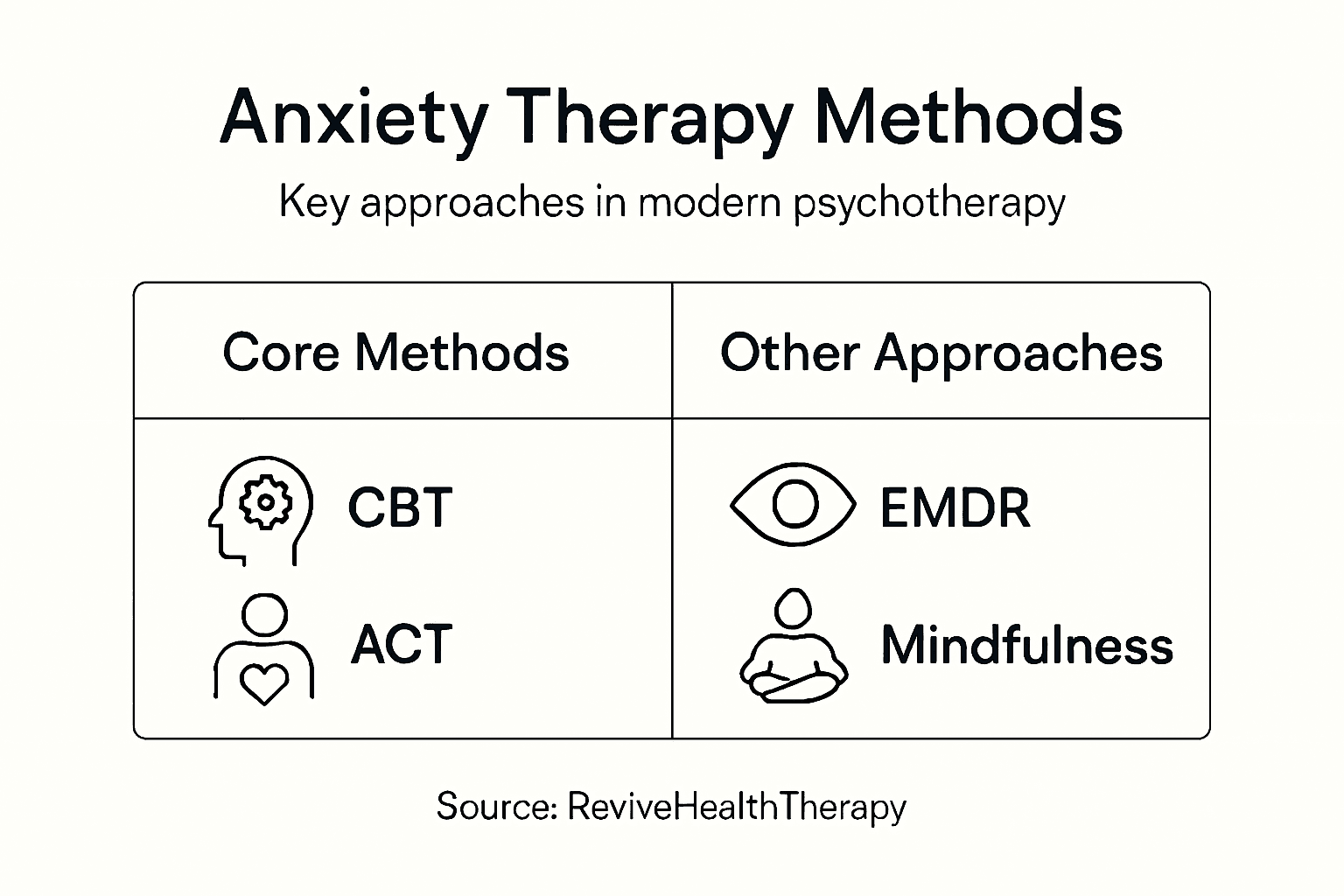
Different anxiety presentations respond best to different methods. Cognitive-behavioral therapy (CBT) serves as a foundational evidence-based approach because it targets both how you think and how you act.

Other approaches like EMDR work well for trauma-based anxiety. Mindfulness-based techniques help with the physical symptoms. Some people benefit from exploring underlying relationship patterns.
That’s why a good therapist doesn’t use the same playbook for everyone. They assess your specific anxiety profile and customize treatment accordingly.
Pro tip: When you first meet with a therapist, describe not just what you feel but how it’s impacting your daily life—which situations trigger it, what you’re avoiding, and what you want to reclaim.
Types of Anxiety Psychotherapy in California
California offers several evidence-based psychotherapy options for anxiety, each targeting different aspects of how anxiety works in your brain and body.
The good news: you don’t have to guess which approach fits you. Mental health providers across California use research-backed methods proven to reduce anxiety and get your life back on track.
Cognitive-Behavioral Therapy (CBT)
CBT is the gold standard for anxiety treatment in California and nationwide. It works by breaking the cycle between your thoughts, feelings, and behaviors.
Here’s what happens in CBT:
- You identify the specific thoughts triggering anxiety (“Something bad will happen”)
- You examine whether those thoughts match reality
- You test them through gradual exposure to feared situations
- Your brain learns the threat wasn’t as real as it felt
Cognitive-behavioral therapy addresses maladaptive thoughts and avoidance that keep anxiety alive. It’s practical, concrete, and gives you tools to use outside the therapist’s office.
Exposure Therapy and ACT
Exposure therapy involves gradually facing situations you’ve been avoiding. You might start small—sitting with mild discomfort—then work up to bigger challenges. Your nervous system learns that anxiety decreases on its own if you don’t run.
Acceptance and Commitment Therapy (ACT) takes a different angle. Instead of fighting anxiety, you learn to observe it without letting it control your choices. You clarify what matters most to you and take action aligned with those values, anxiety or not.
Both approaches work well and often complement CBT in treatment plans.
Trauma-Focused Approaches
If anxiety stems from trauma or past frightening events, trauma-focused CBT or EMDR (Eye Movement Desensitization and Reprocessing) may be recommended. These specialized methods help your brain process traumatic memories so they stop triggering constant threat responses.
Many California therapists specialize in trauma-informed care and can assess whether trauma is fueling your anxiety.
Below is a comparison of leading anxiety therapy approaches and when they may be most effective:
| Therapy Approach | Best For | Key Focus |
|---|---|---|
| Cognitive-Behavioral | Persistent, generalized anxiety | Challenging thoughts and behaviors |
| Exposure Therapy | Specific fears, phobias, panic | Gradual exposure, desensitization |
| EMDR | Trauma-driven anxiety/PTSD | Memory reprocessing, desensitization |
| Mindfulness-Based | Physical symptoms and stress | Nonjudgmental awareness, regulation |
| Acceptance & Commitment | Anxiety tied to values, avoidance | Acceptance, values-driven actions |
The best therapy type matches your specific anxiety presentation—not someone else’s. A skilled therapist evaluates your situation before recommending a path forward.
Combined Treatment Often Works Best
Combination therapy involving CBT and medication yields superior anxiety reduction compared to either approach alone. Some people need medication to stabilize enough for therapy to work. Others do fine with therapy alone.
This is why working with a qualified therapist matters. They assess whether you need additional support from a psychiatrist or physician.
California’s mix of private practice therapists, community mental health centers, and specialized clinics means options exist at different price points and locations.
Pro tip: Ask potential therapists which anxiety disorders they specialize in and what methods they use—CBT, exposure, ACT, or EMDR—so you know you’re getting matched with someone trained in the approach that fits your specific anxiety pattern.
How EMDR, CBT, and Mindfulness Work
These three approaches tackle anxiety from different angles, but they share one goal: rewiring how your brain processes threat and stress.
Understanding how each one works helps you recognize why a therapist might recommend one approach over another—or combine them.
How CBT Breaks the Anxiety Cycle
Cognitive-behavioral therapy starts with a simple idea: your thoughts, feelings, and behaviors feed each other. Change one, and the others shift too.
Here’s the process:
- You notice a triggering thought (“I’ll fail this presentation”)
- That thought creates physical anxiety (racing heart, sweating)
- Fear drives you to avoid the situation
- Avoidance reinforces the belief that you can’t handle it
CBT breaks this loop by identifying and restructuring maladaptive cognitive patterns that fuel anxiety. You learn to examine your thoughts, test whether they’re actually true, and practice facing situations instead of running from them.
You’re not just thinking differently—you’re building new neural pathways through repeated action and evidence.
How Mindfulness Changes Your Relationship With Anxiety
Mindfulness doesn’t fight anxiety. Instead, it teaches you to observe anxiety without letting it control you.
The core practice involves:
- Noticing physical sensations and thoughts without judgment
- Breathing into discomfort rather than resisting it
- Accepting that anxiety exists while choosing your next action anyway
Mindfulness promotes emotional regulation by cultivating awareness of internal states and building resilience. Over time, your nervous system becomes less reactive. Anxiety still shows up, but it doesn’t derail you.
Many people find this approach freeing because you’re not trying to eliminate anxiety—you’re just changing how much power it holds over your decisions.
How EMDR Processes Traumatic Memory
EMDR (Eye Movement Desensitization and Reprocessing) works differently. It uses bilateral stimulation—moving your eyes side-to-side or tapping alternately—while you focus on a distressing memory.
The mechanism sounds strange but is grounded in neuroscience. The bilateral stimulation taxes your working memory, allowing traumatic memories to be reprocessed and integrated rather than staying frozen as threat.
EMDR uses bilateral stimulation to tax working memory, facilitating traumatic memory processing and reducing symptoms. It’s especially effective for anxiety rooted in specific traumatic events or past overwhelming experiences.
How They Work Together
These approaches aren’t competing—they complement each other beautifully.
A therapist might use:
- CBT first to build foundational coping skills and reduce immediate anxiety
- Mindfulness throughout to help you tolerate discomfort during exposure exercises
- EMDR if trauma is driving your anxiety response
Combining methods gives you multiple tools. You’re not locked into one way of thinking about your anxiety.
The most effective treatment often involves layering approaches based on what your specific anxiety needs. Your therapist adjusts as you progress.
Pro tip: Ask your therapist which approach they’ll start with and why—whether it’s CBT fundamentals first, mindfulness breathing techniques, or EMDR if trauma is involved. Understanding the strategy helps you stay committed when things feel hard.
Trauma-Informed Care and Accessibility Benefits
Trauma-informed care isn’t just a buzzword—it’s a practical framework that changes how therapists work with you, especially if anxiety stems from past trauma or overwhelming life experiences.
When a therapist uses trauma-informed principles, you’re safer, more respected, and more likely to heal.
What Trauma-Informed Care Actually Means
Trauma-informed care recognizes that anxiety doesn’t exist in a vacuum. It’s often connected to past experiences that overwhelmed your nervous system.
A trauma-informed therapist understands this and adjusts their approach accordingly. They don’t push you faster than you’re ready. They explain what they’re doing before they do it. They give you control over the pace and direction of treatment.
Trauma-informed care enhances patient outcomes by recognizing trauma’s pervasive impacts and adapting healthcare environments to support safety and empowerment. This means fewer moments where therapy itself triggers re-traumatization.
How It Protects You During Treatment
There’s a real risk in therapy: pushing too hard, too fast can actually make anxiety worse. Trauma-informed care prevents this.
Key protections include:
- Collaborative choice – You decide what to discuss and when, not the therapist
- Transparency – The therapist explains their reasoning and approach upfront
- Pacing flexibility – You slow down or pause if something feels unsafe
- Physical safety awareness – The therapist understands that certain techniques or positions might trigger panic
You’re not being treated like a patient receiving something done to you. You’re a partner in your own recovery.
Accessibility Benefits: More Than Just Affordability
Accessibility in therapy means more than sliding-scale fees, though that matters. Trauma-informed providers offer flexible protocols that meet people where they actually are.
This includes:
- Telehealth options for people who can’t leave home or navigate to an office
- Flexible scheduling around work and family responsibilities
- Cultural responsiveness acknowledging your background and values
- Insurance acceptance reducing financial barriers
- Multiple treatment modalities so you’re not forced into one approach
Trauma-informed care training improves healthcare workers’ understanding and professional practices, which directly benefits you through more compassionate, effective sessions. Therapists with this training experience less burnout, meaning they show up present and engaged for your work.
Why This Matters for California Adults
California’s diverse population means therapists here often serve people with varied trauma histories—immigration stress, financial instability, discrimination, family conflict, or medical trauma.
Trauma-informed care acknowledges these realities rather than pretending everyone starts from the same place. Your therapist recognizes that anxiety isn’t weakness. It’s your nervous system protecting you based on real experiences.
Accessible, trauma-informed care means you can finally get help without worrying that therapy itself will hurt you. That changes everything about your willingness to show up.
Pro tip: When searching for a therapist, specifically ask if they practice trauma-informed care and how they ensure confidentiality, pacing flexibility, and informed consent throughout treatment.
Cost, Insurance Options, and Alternative Methods
Money shouldn’t keep you stuck with anxiety. But let’s be honest—therapy costs matter, and navigating insurance feels overwhelming.
Here’s what you actually need to know about paying for care in California.
Understanding Therapy Costs and Payment Models
Therapy prices vary wildly depending on who you see and how you pay. Private practice psychotherapists average around $143 per session when paying out of pocket directly.
But that’s not your only option. Payment models include:
- Insurance-covered therapy – You pay a copay (typically $20-50 per session)
- Sliding scale fees – Cost based on your actual income
- Community mental health centers – Low-cost services based on ability to pay
- Employer-sponsored programs – Often free through your workplace
- Telehealth options – Sometimes more affordable than in-person
Many people assume they can’t afford therapy without exploring these alternatives first.
Insurance and Out-of-Pocket Realities
Here’s the catch: approximately one-third of private practice therapists don’t accept insurance, relying entirely on direct payment. This creates a two-tier system where insured clients might have fewer provider options.
If you have insurance, verify your mental health benefits before selecting a therapist. Ask about:
- In-network providers covered at higher rates
- Deductibles you must meet first
- Visit limits on how many sessions annually
- Authorization requirements some plans demand
- Out-of-network coverage if you want more provider choice
Medicaid reimbursements are significantly lower than private pay rates, which affects which therapists accept Medicaid clients. California’s Medicaid (Medi-Cal) does cover psychotherapy, but your provider options may be limited.
Sliding Scale and Affordable Options
Sliding scale therapy adjusts your cost based on your actual income and expenses. You might pay $30-80 per session instead of $143, depending on your financial situation.
This isn’t charity. It’s how many therapists make their practice sustainable while serving people across income levels.
Other affordable routes include:
- Community health centers offering therapy at low cost
- University training clinics where graduate students provide therapy under supervision
- Employee Assistance Programs (EAPs) offering free therapy through your job
- HSA and FSA plans letting you use pre-tax dollars for mental health care
Affordability shouldn’t mean settling for low-quality care. Many sliding-scale therapists are highly trained and deeply committed to their work.
California-Specific Resources and Accessibility
California offers specific pathways to affordable therapy that other states don’t. Medi-Cal covers therapy for eligible residents. Many employers are required to offer mental health benefits.
Revive Health Therapy operates on a sliding-scale model specifically to increase access. You’re matched with qualified therapists regardless of your budget.
Telehealth therapy across California reduces barriers for people with transportation challenges, work inflexibility, or geographic isolation.
Here’s a summary of therapy payment and access options in California:
| Payment Option | Average Out-of-Pocket Cost | Accessibility |
|---|---|---|
| Private Pay (No Insurance) | $143 per session | Broad provider choice |
| Insurance-Covered Therapy | $20–$50 copay per session | Limited to in-network therapists |
| Sliding Scale | $30–$80 per session | Based on income/need |
| Community Mental Health Center | Low or no cost | Prioritizes underserved clients |
| Telehealth | Varies, often lower | Remote access statewide |
Pro tip: When contacting a therapist, directly ask about their sliding scale rates, insurance options, and whether they offer telehealth—don’t assume cost will be a dealbreaker until you’ve had that conversation.
Take Control of Anxiety with Evidence-Based Psychotherapy at ReviveHealthTherapy
The article highlights how anxiety disorders trap you in persistent worry and avoidance that disrupt daily life. You crave symptom relief and functional improvement through approaches like CBT, EMDR, and mindfulness. If you recognize the cycle of catastrophic thoughts, panic, or trauma-related anxiety holding you back, you deserve personalized, trauma-informed care that rewires your brain and empowers your choices. ReviveHealthTherapy specializes in these proven methods and prioritizes your safety and unique anxiety profile.
Ready to move beyond avoidance and reclaim your life? Explore tailored psychotherapy options with experts in California committed to accessibility and compassionate service. Discover how our flexible sliding-scale fees, insurance acceptance, and telehealth sessions meet you where you are. Take the first step today by visiting our Uncategorized Therapy Services page. Then connect directly with us at Contact Us to schedule an initial consultation. You do not have to face anxiety alone—help is here now.
Frequently Asked Questions
What is psychotherapy for anxiety disorders?
Psychotherapy for anxiety disorders is a systematic approach to addressing anxiety that involves understanding both its physical and mental aspects. It helps individuals recognize and manage their anxiety to improve daily functioning and overall quality of life.
How does cognitive-behavioral therapy (CBT) work for anxiety?
CBT works by breaking the cycle of negative thoughts, feelings, and behaviors associated with anxiety. It helps individuals identify triggering thoughts, assess their validity, and gradually expose themselves to feared situations to reduce anxiety over time.
What are the different types of psychotherapy available for anxiety?
Different types of psychotherapy for anxiety include cognitive-behavioral therapy (CBT), exposure therapy, acceptance and commitment therapy (ACT), trauma-focused approaches like EMDR, and mindfulness-based techniques. Each method targets various aspects of anxiety to provide tailored treatment.
How can trauma-informed care benefit my anxiety treatment?
Trauma-informed care benefits anxiety treatment by recognizing the connection between past trauma and anxiety symptoms. It ensures a safe and respectful therapeutic environment, promoting collaboration and pacing flexibility to avoid re-traumatization during therapy.
Recommended
- 7 Types of Therapy for Anxiety and How They Can Help You – ReviveHealthTherapy
- Therapy for Teen Anxiety: Proven Steps to Healing – ReviveHealthTherapy
- Role of Mindfulness in Therapy: Real Impact on Anxiety and Depression – ReviveHealthTherapy
- Why Psychotherapy for Children Matters Most – ReviveHealthTherapy