
Struggling with anxiety or depression can feel overwhelming, especially when cost stands between you and the support you need. For people across California, sliding scale therapy is changing how counseling is accessed by adjusting fees to match your financial situation rather than locking you out with high prices. Explore how this flexible system makes professional help realistic for those who thought therapy was financially out of reach.
Table of Contents
- Sliding Scale Therapy Defined and Debunked
- How Income-Based Fee Structures Operate
- Eligibility, Application, and What to Expect
- Benefits and Limitations for Clients
- Comparing Sliding Scale, Insurance, and Low-Cost Options
- Risks, Ethics, and Legal Considerations
Key Takeaways
| Point | Details |
|---|---|
| Sliding Scale Therapy Accessibility | Sliding scale therapy makes mental health counseling more affordable by adjusting fees based on income, allowing broader access for those in need. |
| Ethical Considerations | Transparency and fairness in fee adjustments are crucial to maintain the integrity of sliding scale therapy. |
| Documentation and Qualification | Potential clients must provide financial documentation to qualify for sliding scale rates to ensure the process is equitable. |
| Comparison with Other Payment Options | Understanding the differences between sliding scale fees, insurance coverage, and low-cost options helps clients choose the most suitable mental health support. |
Sliding Scale Therapy Defined and Debunked
Mental health treatment doesn’t have to break the bank. Sliding scale therapy offers an innovative approach to making professional counseling accessible for people across different income levels. Reducing financial barriers to mental healthcare means more individuals can receive the support they need without overwhelming financial stress.
At its core, sliding scale therapy is a flexible payment model where therapists adjust their fees based on a client’s income and financial circumstances. Here’s how it typically works:
- Fees are proportionally reduced based on verifiable income levels
- Clients provide documentation or self-report their financial situation
- Rates are negotiated directly with the therapist or mental health practice
- The goal is creating affordable access, not providing free services
Unlike traditional fixed-rate therapy models, sliding scale options recognize that mental health support shouldn’t be a luxury reserved only for those with substantial financial resources. By allowing flexible pricing, therapists can serve a broader range of clients while maintaining sustainable practice economics.
Sliding scale therapy transforms mental healthcare from an exclusive service to an inclusive resource for community well-being.
Key Benefits of Sliding Scale Therapy:
- Makes professional counseling more financially accessible
- Reduces economic barriers to mental health treatment
- Provides dignity and respect for clients with limited income
- Supports diverse populations in receiving necessary care
Pro tip: When exploring sliding scale therapy, always discuss pricing transparently with potential therapists and be prepared to provide basic financial documentation to qualify for reduced rates.
How Income-Based Fee Structures Operate
Income-based fee structures represent a sophisticated approach to making mental health services accessible across different financial backgrounds. Sliding fee discount programs provide a critical mechanism for ensuring that therapy remains affordable for diverse economic groups.
These flexible pricing models typically operate through a systematic approach that balances client affordability with therapist sustainability. Income-based fee calculation methods often involve creating structured pricing tiers linked directly to an individual’s financial circumstances.
Here’s how most income-based fee structures are typically designed:
- Establish a standard market-rate fee range
- Create income brackets with corresponding discount percentages
- Request income documentation or use self-reporting mechanisms
- Implement transparent fee adjustment processes
- Maintain consistent evaluation and fee recalculation periods
The core philosophy behind these structures is creating equitable access. Higher-income clients pay closer to standard rates, while lower-income individuals receive significant discounts, ensuring that financial constraints don’t prevent essential mental health support.
Income-based fee structures transform therapy from a privilege to a fundamental healthcare right.
Key Considerations in Fee Structure Design:
- Maintaining therapist financial sustainability
- Ensuring client privacy during income verification
- Creating clear, predictable pricing frameworks
- Balancing affordability with professional service quality
Pro tip: Always discuss the specific income verification process and potential fee ranges during your initial consultation to understand exactly how the sliding scale will apply to your personal financial situation.
Eligibility, Application, and What to Expect
Sliding scale therapy eligibility involves a nuanced process that balances individual financial needs with therapeutic accessibility. Sliding scale therapy qualification requires potential clients to demonstrate financial constraints while meeting specific therapeutic practice requirements.

The application process typically involves several key steps designed to verify financial need and determine appropriate fee adjustments. Therapist fee negotiation methods vary, but most follow a structured approach to ensure fairness and sustainability.
Common Eligibility Requirements:
- Demonstrate income below specific local thresholds
- Provide recent income documentation
- Show inability to afford standard therapy rates
- Prove residency in service area
- Meet specific mental health service criteria
Most therapists maintain a limited number of sliding scale slots to balance accessibility with practice sustainability. This means potential clients should apply early and be prepared to provide comprehensive financial documentation.
Sliding scale therapy is about creating access, not providing free services.
Typical Application Documentation:
- Recent tax returns
- Pay stubs
- Proof of unemployment or financial hardship
- Health insurance information
- Personal budget documentation
Pro tip: Prepare a comprehensive financial overview before your initial consultation, including recent income documents and a clear explanation of your current financial challenges.
Benefits and Limitations for Clients
Mental health accessibility takes a significant leap forward through sliding scale therapy. Breaking financial barriers represents more than a pricing strategy – it’s a fundamental approach to democratizing mental healthcare for diverse economic backgrounds.
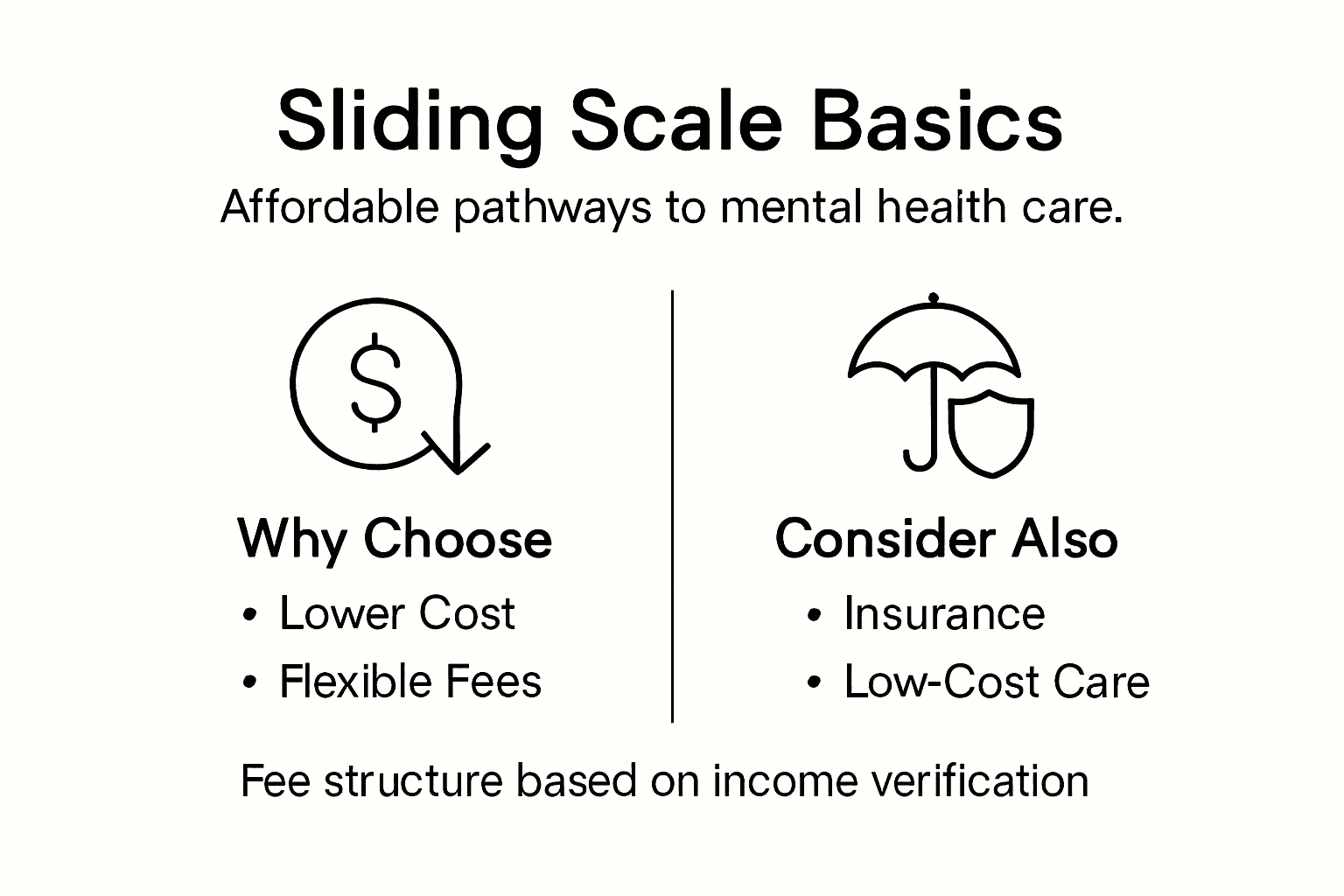
Sliding scale therapy’s ethical considerations reveal a complex landscape of benefits and challenges that impact both clients and practitioners. Understanding these nuances helps potential clients make informed decisions about their mental health journey.
Client Benefits:
- Reduced financial stress around therapy costs
- Access to professional mental health support
- Personalized fee structures based on income
- Increased likelihood of consistent treatment
- Preservation of personal dignity during financial challenges
Potential Limitations:
- Limited number of sliding scale slots
- Potential administrative complexity
- Varying availability across different regions
- Potential perception of reduced service quality
- Temporary nature of reduced fee arrangements
Sliding scale therapy transforms mental healthcare from a privilege to a fundamental right.
Practical Considerations for Clients:
- Understand the temporary nature of reduced fees
- Be prepared for potential income reassessment
- Maintain transparent communication with therapist
- Plan for potential fee adjustments
- Consider long-term treatment sustainability
Pro tip: Always discuss the specific duration and conditions of your sliding scale arrangement to avoid unexpected financial surprises during your therapeutic journey.
Comparing Sliding Scale, Insurance, and Low-Cost Options
Mental health payment strategies vary widely, each with unique advantages and limitations. Financial strategies in mental healthcare reveal complex options for individuals seeking affordable therapy.
Understanding the differences between sliding scale fees, insurance coverage, and low-cost alternatives helps clients make informed decisions about their mental health investment. Each approach offers distinct benefits tailored to different financial situations.
Sliding Scale Fees:
- Income-based pricing
- Direct negotiation with therapist
- Flexible rates
- No insurance requirements
- Immediate accessibility
Insurance Coverage:
- Predetermined network of providers
- Potential copays and deductibles
- Limited session numbers
- Requires active insurance plan
- Often involves pre-authorization
Low-Cost Community Options:
- Group therapy sessions
- Community mental health centers
- Training clinics
- Nonprofit organization services
- Reduced-fee programs
Mental health support should be accessible, not a financial burden.
Comparative Factors to Consider:
Here’s a comparison of mental health payment options to help you choose the best fit:
| Factor | Sliding Scale Fees | Insurance Coverage | Low-Cost Community Options |
|---|---|---|---|
| Payment Determination | Based on income | Determined by policy terms | Set by organization or grants |
| Flexibility | Highly flexible rates | Limited by plan rules | May be inflexible or group-focused |
| Access Requirements | Income verification | Valid insurance plan required | Proof of residency or need |
| Wait Times | Often shorter | Can be long for in-network | Varies, sometimes longer |
| Personalized Support | Typically one-on-one | Often one-on-one | May be group-based |
- Total out-of-pocket expenses
- Provider availability
- Treatment quality
- Confidentiality levels
- Long-term sustainability
Pro tip: Always compare multiple payment strategies and ask potential therapists about their flexible pricing options to find the most financially sustainable mental health support.
Risks, Ethics, and Legal Considerations
Ethical therapy practices demand rigorous scrutiny, especially in financial arrangements. Sliding scale therapy ethical guidelines provide critical frameworks for maintaining professional integrity and client dignity.
Navigating the complex landscape of sliding scale therapy requires understanding potential risks and ethical considerations that impact both therapists and clients. Transparency, fairness, and consistent application become paramount in these financial negotiations.
Key Ethical Risks:
- Potential bias in fee determination
- Inadvertent power dynamics
- Client financial vulnerability
- Inconsistent fee application
- Risk of discriminatory practices
Legal Considerations:
- Maintaining client confidentiality
- Documenting fee negotiation processes
- Ensuring fair treatment
- Avoiding discriminatory fee structures
- Compliance with professional guidelines
Ethical sliding scale therapy balances financial accessibility with professional standards.
Professional Ethical Responsibilities:
This table offers a quick reference to ethical and legal considerations in sliding scale therapy:
| Issue Type | Key Concern | Best Practice Example |
|---|---|---|
| Ethics | Transparent fee determination | Clearly state fee range up front |
| Ethics | Preventing discriminatory pricing | Use objective, documented criteria |
| Legal | Client confidentiality | Securely store all financial data |
| Legal | Fair treatment under the law | Apply the same process to all |
- Transparent fee discussions
- Consistent income verification methods
- Avoiding dual relationships
- Protecting client dignity
- Maintaining clinical objectivity
Pro tip: Always request and document clear, written guidelines about how sliding scale fees will be determined and potentially adjusted during your therapeutic relationship.
Make Mental Health Care Affordable and Accessible Today
If the financial barriers of sliding scale therapy feel overwhelming or confusing, you are not alone. Many individuals face the challenge of finding affordable, flexible mental health support that respects their unique financial situations while delivering quality care. At ReviveHealthTherapy, we understand the importance of income-based fee structures and transparent sliding scale options that make therapy accessible without sacrificing dignity or quality.

Explore how our trauma-informed, evidence-based psychotherapy services in California provide personalized sliding scale fees designed to meet your needs. Whether you prefer secure telehealth sessions or in-person support in Walnut Creek or Oakland, you can benefit from flexible pricing, including acceptance of insurance and HSA/FSA plans. Take the next step by contacting us through our Contact Us page to discuss your personalized therapy fees and scheduling. Learn more about our commitment to accessible mental health care in our Uncategorized – ReviveHealthTherapy section and start your journey toward emotional wellness with confidence.
Frequently Asked Questions
What is sliding scale therapy?
Sliding scale therapy is a flexible payment model where therapists adjust their fees based on a client’s income and financial circumstances to make mental health services more affordable.
How do I qualify for sliding scale therapy?
To qualify, clients typically need to demonstrate financial need, which may include providing documentation such as recent pay stubs, tax returns, or proof of financial hardship to determine appropriate fee adjustments.
What are the benefits of sliding scale therapy compared to traditional therapy?
Sliding scale therapy reduces financial barriers, provides more affordable access to professional counseling, and supports diverse populations, allowing individuals from varying income levels to receive necessary care without significant financial strain.
Are there limitations to sliding scale therapy?
Yes, potential limitations include a limited number of sliding scale slots, possible administrative complexity, varying availability across different regions, and the perception of a reduced level of service quality compared to standard therapy fees.
Recommended
- Affordable Therapy: What It Means and Why It Matters – ReviveHealthTherapy
- Fill out this quick form for your FREE 20-min consultation with a therapist – ReviveHealthTherapy
- Top 6 Best Affordable Therapy Services in 2026 – ReviveHealthTherapy
- Why Is Therapy Accessible for Californians Today – ReviveHealthTherapy
- Itaca
One Response