
Looking for mental health support in California often means facing high costs and confusing payment systems. Many Californians struggle to find therapy that fits their budget, especially when anxiety or depression become overwhelming. Affordable therapy includes several access models that ease this burden, from sliding-scale fees based on income to secure telehealth options that remove travel stress. If you want care tailored to your needs without sacrificing clinical experience, understanding what truly makes therapy affordable can open up real solutions.
Table of Contents
- Defining Affordable Therapy and Its Misconceptions
- Sliding Scale Fees, Insurance, and Payment Options
- How Telehealth Expands Affordable Access
- Key Criteria That Determine Affordability
- Comparing Affordable Therapy With Traditional Care
Key Takeaways
| Point | Details |
|---|---|
| Affordable Therapy Explained | Affordable therapy refers to care that fits your budget without compromising quality, allowing access to necessary mental health support. |
| Payment Models | Various approaches, such as sliding-scale fees, insurance coverage, and telehealth options, make therapy cost-effective for diverse financial situations. |
| Common Misconceptions | Affordable therapy does not equate to low-quality care or inexperienced therapists; qualified professionals can offer flexible pricing. |
| Importance of Access | Delaying therapy due to costs can exacerbate mental health conditions, making immediate access to affordable options crucial for long-term well-being. |
Defining Affordable Therapy and Its Misconceptions
Affordable therapy doesn’t mean cheap or low-quality care. It means therapy that fits your actual budget without forcing you to choose between mental health and financial stability. The reality is that out-of-pocket therapy costs have grown faster than inflation, leaving many Californians unable to access the care they need. Whether you’re managing anxiety, depression, or past trauma, cost shouldn’t be the barrier that keeps you from healing.
Affordable therapy includes several access models that work for different situations. Sliding-scale fees adjust your payment based on your income, making services accessible whether you earn $25,000 or $75,000 annually. Telehealth therapy eliminates travel costs and time away from work, which matters significantly for working professionals in the Bay Area. Insurance coverage through plans like PPO, HMO, or employer-based policies reduces your direct out-of-pocket costs. Even HSA and FSA plans can cover therapy sessions, something many people don’t realize when budgeting for mental health care.
One major misconception is that affordable therapy means finding a less experienced therapist. That’s not accurate. Sliding-scale fees based on income are offered by many licensed therapists and clinics without sacrificing credentials or clinical expertise. A trauma-informed EMDR specialist with years of experience can still work with you on a sliding scale. Your therapist’s qualifications remain the same regardless of what you pay.
Another false belief is that accessibility only works for people at or below the poverty line. Affordability has a much wider reach. Many middle-income families face what’s called “medical debt hardship”—where therapy costs create genuine financial stress despite having decent jobs. If you’re worried about therapy bills affecting your ability to pay rent or save for emergencies, you absolutely qualify for more accessible options. Cost-conscious care planning isn’t a sign of weakness; it’s smart financial self-care.
Misconception number three: you have to choose between in-person and affordable. That’s outdated thinking. California-based therapy through secure telehealth platforms offers lower costs than commuting to Oakland or Walnut Creek while maintaining the same clinical quality. When you’re dealing with anxiety or depression, reducing logistical stress itself becomes part of your healing.
The most damaging misconception might be that delaying therapy until you can “afford it” is the responsible choice. Research shows that medical debt and financial hardship result from avoiding needed care, especially for mental health conditions that worsen without treatment. Untreated anxiety often leads to missed work, relationship problems, and additional expenses. Accessing affordable therapy now actually prevents costlier problems later.
Pro tip: When you call or email a therapist, directly ask about sliding-scale options and payment plans rather than assuming they only work with insurance—many therapists have flexible arrangements they don’t advertise widely.
Sliding Scale Fees, Insurance, and Payment Options
Payment barriers shouldn’t prevent you from getting mental health care. That’s why multiple funding models exist to make therapy accessible regardless of your financial situation. Understanding your options puts you in control of choosing what actually works for your budget.
Sliding scale fees are built on a simple principle: your income determines your rate. If you earn $30,000 annually, you pay one amount. If you earn $60,000, you pay more. Sliding scale programs adjust fees based on patient income and family size to ensure no one is denied care due to inability to pay. This isn’t a negotiation or a favor. It’s a structured system where therapists intentionally build flexible pricing into their practice. Many licensed therapists in California, including those offering trauma-informed care like EMDR, operate on sliding scales without reducing their clinical expertise.
Insurance coverage changes the payment equation entirely. If you have employer-based health insurance, PPO plans, or HMO coverage, your therapy sessions may be partially or fully covered depending on your specific plan. You typically pay a copay (often $20 to $50 per session) instead of the full therapy rate. Check your insurance card or call your provider to confirm mental health coverage details. Many people don’t realize they already have therapy benefits they’re not using.
HSA and FSA plans offer another tax-advantaged approach. Money you contribute to these accounts can pay for mental health services, reducing your taxable income while funding your care. If your employer offers these plans, therapy becomes even more affordable because you’re using pre-tax dollars.
Many treatment providers offer payment plans and financial assistance programs to spread costs over time. Instead of paying $120 per session upfront, you might pay $40 weekly across three weeks. Some therapists also offer reduced rates for clients facing temporary financial hardship or connect you with community grants and charity care resources.
The reality: most California therapists work with multiple payment models simultaneously. You could use insurance for some sessions and sliding scale for others. You could combine an HSA payment with a small copay. The key is asking directly about all available options when you first contact a therapist instead of assuming you can only pay one way.
Here’s a quick look at how different payment options impact your out-of-pocket therapy costs:
| Payment Model | Typical Out-of-Pocket Cost | Flexibility Level | Additional Benefits |
|---|---|---|---|
| Sliding Scale | Varies by income | Highly flexible | Accessible at most income levels |
| Insurance (PPO/HMO) | $20-$50 copay/session | Depends on plan rules | May cover specialty therapies |
| HSA/FSA Accounts | Pre-tax dollars | Moderate flexibility | Lowers total tax burden |
| Payment Plans | Fixed installments | Very flexible | Spreads cost over several weeks |
Pro tip: Before your first appointment, gather your insurance information and be prepared to share your approximate annual income with your therapist, then ask which payment combination offers you the lowest out-of-pocket cost.
How Telehealth Expands Affordable Access
Telehealth removes one of the biggest barriers to affordable therapy: logistics. You don’t need to drive to Oakland or Walnut Creek, take time off work, arrange childcare, or spend money on gas. From your couch or office, you connect with a licensed therapist through secure video sessions that deliver the same clinical effectiveness as in-person care.

This matters significantly for working Californians managing anxiety or depression. Travel time and transportation costs add up quickly. If you work in San Francisco but your therapist is in the East Bay, you’re looking at 90 minutes of commuting plus parking fees. Telehealth eliminates that friction entirely. Virtual visits reduce logistical barriers like transportation and childcare, making consistent therapy attendance more realistic for busy professionals and families.
Affordability increases when you account for total cost, not just session price. A $100 in-person therapy session plus $15 parking and an hour of lost work productivity costs you closer to $150 in reality. A $100 telehealth session costs $100. That’s a meaningful difference across 12 sessions per year. For couples therapy or family sessions, the savings multiply when you’re not coordinating multiple people’s travel schedules.
Telehealth also expands your provider options within California. You’re not limited to therapists near your home or office. You can find a trauma-informed EMDR specialist or CBT expert who offers sliding-scale fees, regardless of where they’re located. This competition naturally encourages more affordable pricing and better access to specialized care like anxiety treatment.
Security and confidentiality remain the same as in-person therapy. Platforms used by ReviveHealthTherapy and other licensed providers encrypt all communications and comply with HIPAA regulations. Your privacy is protected whether you’re sitting in an office or at home.
Telehealth utilization for mental health services remains significantly higher post-pandemic than before, indicating that both providers and patients recognize its value. This sustained adoption means more therapists offer telehealth as a standard option, giving you genuine choice in how you access care.
Pro tip: Test your internet connection and video setup 15 minutes before your first telehealth appointment, and find a quiet space where you won’t be interrupted to maximize the benefits of your session.
Key Criteria That Determine Affordability
Affordability isn’t one-size-fits-all. What’s affordable for someone earning $50,000 differs dramatically from someone earning $90,000. Understanding the criteria that shape affordability helps you evaluate whether a therapy option actually works for your specific situation rather than accepting whatever feels normal.
Out-of-pocket cost burden relative to your income is the primary measure. If therapy costs consume more than 5 percent of your monthly take-home pay, it creates genuine financial stress. For a person earning $40,000 annually, that threshold is roughly $165 per month. For someone earning $75,000, it’s $310 monthly. Assessing cost burden relative to income determines true affordability for individuals and families. This is why sliding-scale fees matter so much. A $120 session is unaffordable for someone making $30,000 but manageable for someone making $80,000.
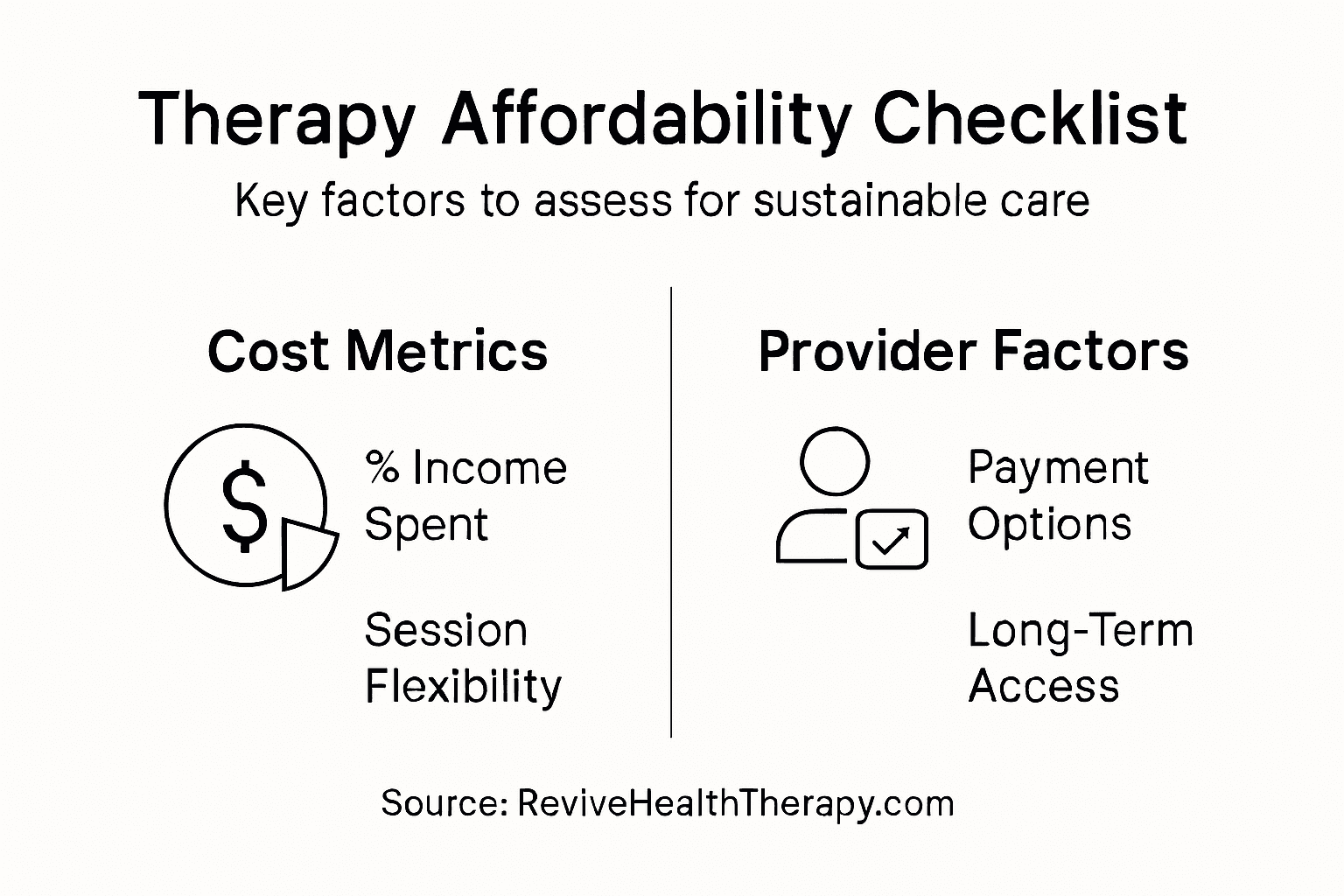
Transparency about costs upfront separates truly affordable providers from those simply claiming affordability. When you call a therapist, can they tell you immediately what they charge? Do they explain how sliding scales work and what your actual cost would be based on your income? Do they discuss insurance coverage and what you’d pay out-of-pocket? Providers committed to affordability remove the guessing game by providing clear cost information before you commit.
Flexibility in payment structure matters as much as the price itself. Can you pay weekly instead of monthly? Do they accept insurance alongside sliding-scale rates? Can you combine HSA payments with copays? Tailored care plans considering patients’ financial situations help reduce barriers. A therapist offering multiple payment options acknowledges that financial circumstances vary and plans accordingly.
The ability to access care without delaying treatment due to cost is another critical measure. If you have anxiety or depression, waiting months to save up for therapy isn’t realistic or healthy. Affordable options should be available within weeks, not seasons. This is where sliding scales and telehealth combine powerfully. You find an available therapist quickly and pay what you can afford immediately.
Finally, affordability includes whether you can sustain treatment long-term. One or two therapy sessions help, but meaningful progress typically requires consistency. Can you realistically afford sessions weekly or biweekly for several months? If cost forces you to stop after four sessions, was it truly affordable?
Pro tip: When evaluating a therapist’s affordability, calculate your actual out-of-pocket cost as a percentage of your monthly income rather than focusing solely on the session rate to get a realistic sense of true affordability.
Comparing Affordable Therapy With Traditional Care
The difference between affordable therapy and traditional care often comes down to who makes decisions and how flexible the arrangement is. Traditional mental health care typically operates on fixed schedules set by the provider, with standardized treatment protocols applied uniformly. You fit into their system. Affordable therapy, particularly through models like sliding-scale and telehealth options, flips this dynamic.
Person-centered care puts your preferences at the center. In traditional settings, a therapist might insist on weekly Tuesday morning appointments at their office during business hours. If that doesn’t work for you, that’s your problem to solve. Affordable care providers offer flexibility. Can’t do mornings? Evening sessions available. Can’t travel? Telehealth works. Need a different payment structure? Sliding scales adjust. Person-centered care emphasizes individual preferences, autonomy, and collaborative decision-making involving you and your therapist rather than treating therapy as a one-size-fits-all service.
Cost structure reveals the biggest distinction. Traditional care often requires upfront full payment or expects insurance billing with significant copays. Affordable models build flexibility into pricing itself. You pay what you can afford based on your income, not what the market demands. This removes the financial guessing game that discourages people from seeking help.
Clinical outcomes remain equivalent across delivery models. Research consistently shows that telehealth therapy delivers comparable health outcomes to traditional center-based care while reducing costs and improving accessibility. You’re not sacrificing quality by choosing affordable options. A trauma-informed EMDR therapist using telehealth provides the same clinical expertise as one in a traditional office. The evidence is clear: alternative delivery models maintain quality while expanding access.
Traditional care often emphasizes diagnosis and protocol. Affordable care emphasizes your life circumstances and what actually matters to you. If anxiety stems from financial stress, an affordable therapist addresses how cost affects your treatment plan. They’re not checking boxes on a standardized intake form. They’re building care around your reality.
Access speed differs significantly. Traditional therapy often has waitlists of weeks or months. Affordable providers, especially those offering telehealth, frequently have openings within days because they’re not limited by office capacity or geographical constraints.
See how affordable therapy compares to traditional care models:
| Aspect | Affordable Therapy | Traditional Therapy |
|---|---|---|
| Scheduling | Evening, weekend, telehealth | Set office hours only |
| Cost Transparency | Upfront, clear pricing | Often unclear until billing |
| Payment Options | Sliding scale, multiple models | Fixed rates, less flexibility |
| Wait Times | Openings within days | Waitlists for weeks/months |
Pro tip: When comparing therapy options, ask about flexibility in scheduling, payment structures, and whether the therapist will adjust their approach based on your financial situation and life circumstances rather than a fixed protocol.
Discover Affordable Therapy Tailored to Your Needs
Struggling to find affordable therapy that respects your budget without sacrificing quality is a common challenge. At ReviveHealthTherapy, we understand the stress caused by unclear costs and limited payment options. Our trauma-informed care uses evidence-based methods like EMDR and CBT to support your healing journey while offering sliding-scale fees, insurance acceptance, and flexible payment plans that match your financial situation. Learn more about our approach in our Uncategorized – ReviveHealthTherapy section.

Start your path to accessible mental health support today by scheduling a free 20-minute consultation. Connect with a licensed therapist who will discuss transparent pricing and how our telehealth and in-person options in Walnut Creek and Oakland can fit your lifestyle and budget. Take control of your mental wellness with flexible care designed just for you. Get started now at ReviveHealthTherapy.
Frequently Asked Questions
What does affordable therapy mean?
Affordable therapy refers to mental health care that fits within a person’s budget without sacrificing the quality of care. It includes various payment models such as sliding-scale fees, insurance coverage, and telehealth options that make therapy accessible for individuals across different income levels.
How do sliding scale fees for therapy work?
Sliding scale fees are tailored based on your income and family size. If you earn a lower income, you pay less for therapy sessions, while those with higher incomes pay more. This system ensures that therapy remains accessible to those who may struggle to afford standard rates.
Can therapy be affordable even if I have insurance?
Yes, therapy can still be affordable alongside insurance. Many therapists accept insurance plans, which may cover part or all of your therapy costs, reducing your out-of-pocket expenses. It’s important to check your insurance benefits and any copay requirements.
What role does telehealth play in making therapy more affordable?
Telehealth can significantly reduce costs associated with therapy by removing travel expenses and time away from work. Virtual therapy sessions can be less expensive than in-person visits, making it easier to access consistent mental health care without additional logistical stress.
Recommended
- Top 6 Best Affordable Therapy Services in 2026 – ReviveHealthTherapy
- Why Seek Psychotherapy: Transforming Mental Wellness – ReviveHealthTherapy
- How to Find a Therapist for Accessible Trauma Care – ReviveHealthTherapy
- Therapy for Teens: Key Approaches and Real Impact – ReviveHealthTherapy
- Voice Therapy: Restoring and Enhancing Vocal Health – TMRG Solutions
- Drug Addiction Treatment: Exploring Effective Approaches and Recovery
One Response