
Trauma-informed principles are six organizational values, safety, trustworthiness and transparency, peer support, collaboration and mutuality, empowerment and choice, and attention to cultural and historical context, that guide how services are delivered so they don’t re-traumatize the people they’re meant to help. They rest on SAMHSA’s Four Rs: realize, recognize, respond, and resist re-traumatization. Trauma-informed care (TIC) is a framework for how an organization operates, not a clinical treatment for post-traumatic stress disorder.
TL;DR:
- Implementing trauma-informed care requires ongoing leadership, staff training, and organizational changes, not just a single workshop or posted principles.
- Physical and psychological safety must be visibly established through clear space design and respectful communication to prevent re-traumatization.
- Organizing screening and assessment on trauma history at intake, along with review of policies and procedures, helps recognize signs of trauma and respond appropriately.
- Evidence shows that trauma-informed shifts improve organizational climate and staff retention more reliably than immediate clinical outcome measures like symptom reduction.
- Focusing on process metrics such as staff turnover, client satisfaction, and incident reports provides a realistic gauge of cultural change in trauma-informed organizations.
Table of Contents
- What Are the Six Trauma-Informed Principles in Practice?
- What Are SAMHSA’s Four Rs of Trauma-Informed Care?
- Is Trauma-Informed Care the Same as Trauma-Focused Therapy?
- How Do You Implement Trauma-Informed Principles in an Organization?
- What Does the Evidence Actually Say About Trauma-Informed Care?
- What Do People Get Wrong About Trauma-Informed Care?
- A Clinician’s View: Small Changes, Real Shifts
- Get Trauma-Informed, Evidence-Based Care in California
- Sources
- FAQ
What Are the Six Trauma-Informed Principles in Practice?
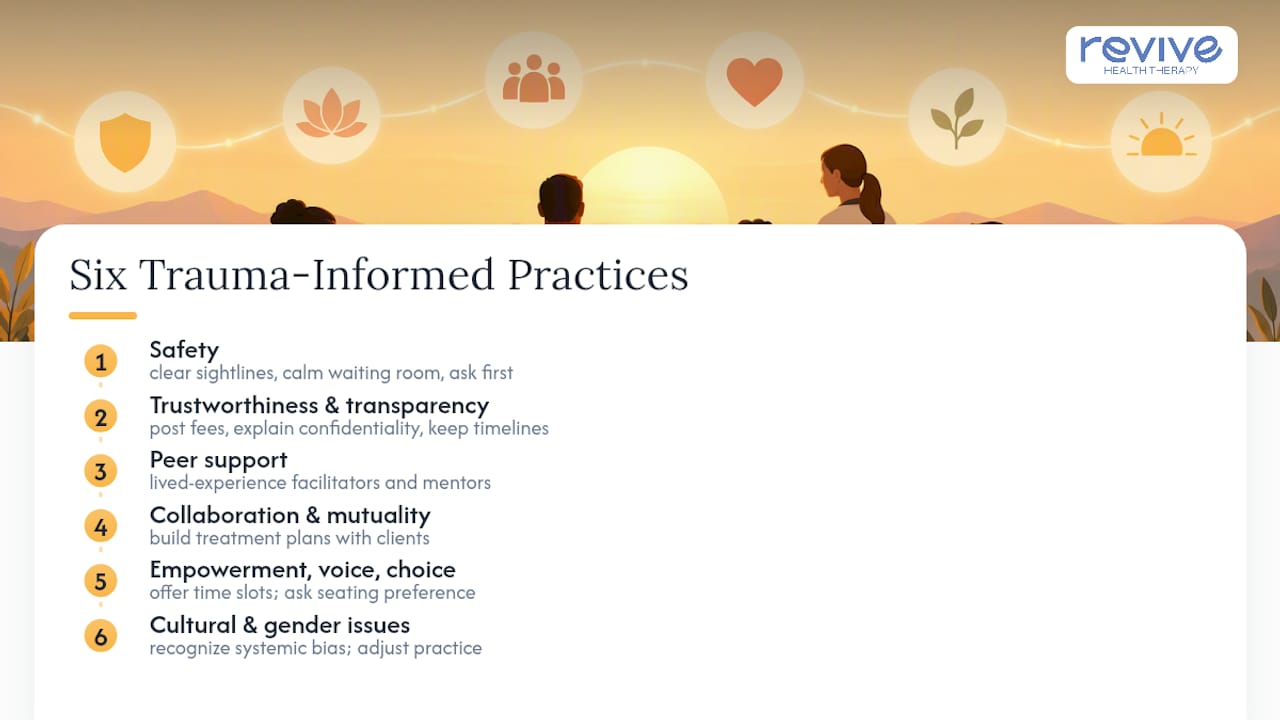
Each principle sounds abstract until you see it applied. Here’s what they actually look like on the ground, drawing on the framework laid out in the Texas Health and Human Services guide to the six principles.
Safety means both physical and psychological. A clinic with clear sightlines, predictable staff behavior, and a calm waiting room signals safety before a single word is spoken. Psychological safety shows up in tone: staff who ask before touching a client’s arm, or who explain what a procedure involves before starting it.
Trustworthiness and transparency mean saying what you do and doing what you say. Posting fees clearly, explaining confidentiality limits up front, and following through on stated timelines all build trust faster than any reassurance.
Peer support brings people with lived experience into the work itself, as group facilitators, mentors, or advisory board members, not just as case examples.
Collaboration and mutuality flatten the traditional power gap. A treatment plan built with a client, rather than handed to them, tends to stick better.
Empowerment, voice, and choice show up in small moments: offering a client three intake time slots instead of assigning one, or asking “Would you like to sit closer to the door?”
Cultural, historical, and gender issues require staff to recognize how systemic bias and historical trauma shape a person’s relationship to institutions, and to adjust practice accordingly rather than treating every client the same way.
Pro Tip: Post the six principles somewhere staff see daily, near a time clock or in a break room. Awareness fades fast without a visual reminder.
What Are SAMHSA’s Four Rs of Trauma-Informed Care?
SAMHSA frames trauma-informed practice around four assumptions that translate principle into action. These Four Rs give organizations a sequence to follow rather than a static checklist.
- Realize: Train every staff member, not just clinicians, to understand how widespread trauma actually is and how it shapes behavior.
- Recognize: Build screening and observation into intake so signs of trauma, like avoidance, hypervigilance, or dissociation, get noticed rather than misread as noncompliance.
- Respond: Rewrite policies and workflows so trauma awareness shows up in scheduling, communication, and discipline procedures, not just in a training binder.
- Resist re-traumatization: Apply universal precautions, treat every client as if they might have a trauma history, and review procedures regularly for hidden triggers like restraint use or forced disclosure.
Is Trauma-Informed Care the Same as Trauma-Focused Therapy?
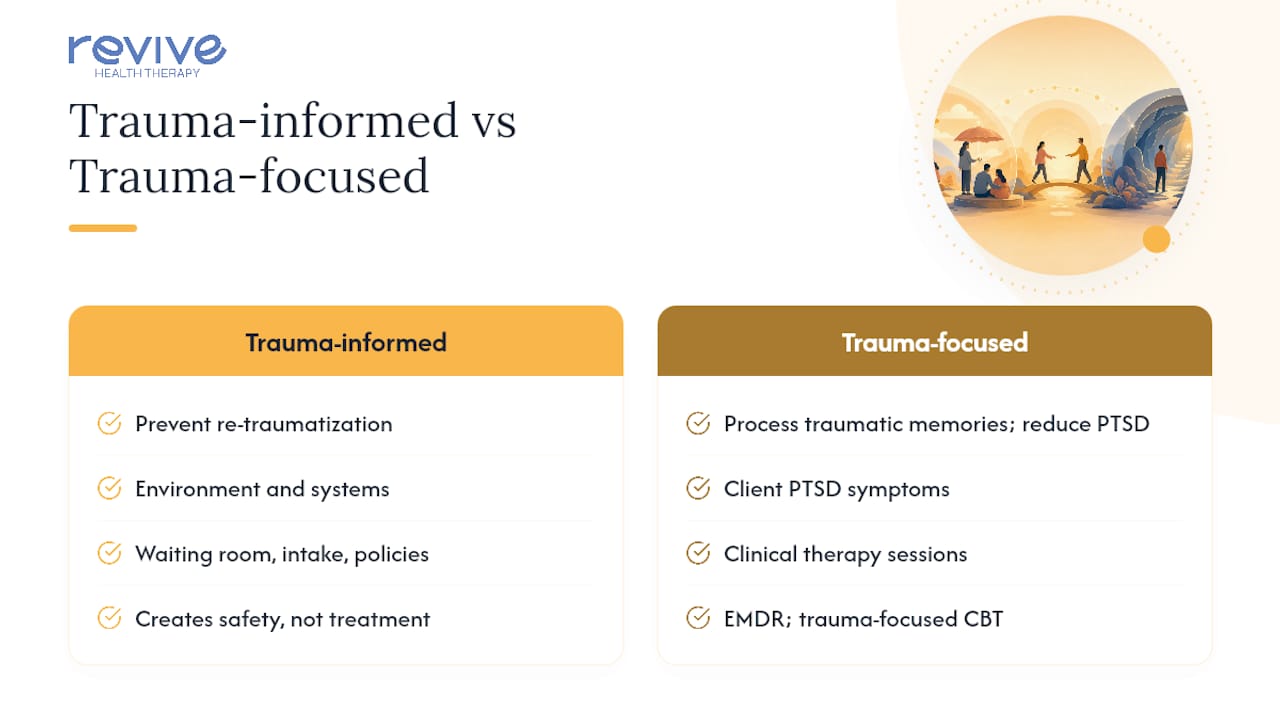
No, and mixing up the two causes real confusion in clinical settings. A trauma-informed approach shapes the environment: how an organization greets, screens, and treats people so nothing re-traumatizes them. Trauma-focused therapy, by contrast, is a clinical treatment aimed directly at processing traumatic memories and reducing PTSD symptoms.
A trauma-informed waiting room does not treat PTSD. It creates the safety a client needs before treatment can work. When a client shows persistent symptoms, avoidance, intrusive memories, hyperarousal, that’s the signal to refer into evidence-based trauma treatment such as EMDR or trauma-focused CBT. The strongest programs run both layers simultaneously: a trauma-informed culture holding a trauma-focused clinical process.
How Do You Implement Trauma-Informed Principles in an Organization?
SAMHSA’s practical guide breaks implementation into ten domains spanning governance, workforce, and service delivery. Real change touches all of them, not just staff training.
- Governance and leadership: Assign a named leader accountable for trauma-informed progress, not a diffuse committee.
- Policy: Audit intake forms and consent procedures for language that could feel coercive.
- Physical environment: Adjust lighting, seating, and exits so spaces feel less clinical and more predictable.
- Workforce development: Build trauma awareness into new-hire onboarding, not a one-time workshop.
- Financing: Set aside a real training and supervision budget, since unfunded mandates rarely survive a busy quarter.
- Engagement and involvement: Add a client or peer-support voice to program planning meetings.
- Screening and assessment: Standardize a brief trauma-history question set at intake.
- Progress monitoring: Track staff turnover and client no-show rates as early signals.
- Quality assurance: Review incident reports specifically for re-traumatization risk.
- Cross-sector collaboration: Coordinate with schools, courts, or primary care partners already using trauma-informed language.
For the first 90 days, focus on cheap, visible wins: rewrite intake scripts, train front-desk staff, and start supervision sessions that name secondary trauma directly. Save facility redesigns and financing overhauls for the longer runway.
Pro Tip: Ask reception staff, not just clinicians, what would make their interactions feel safer. They often spot friction points clinicians never see.
What Does the Evidence Actually Say About Trauma-Informed Care?
The honest answer: promising but incomplete. AHRQ’s systematic review found that evidence linking organizational trauma-informed interventions directly to improved clinical outcomes remains an emerging field, hampered by inconsistent definitions and measurement methods across studies.
Most existing measurement tools assess organizational climate and staff perception rather than direct symptom change, according to a review of trauma-informed practice measurement.
That gap matters for how you set expectations. Rather than promising reduced PTSD symptoms from an organizational shift alone, track process metrics you can actually measure now: staff turnover, client satisfaction surveys, incident reports, and screening completion rates. These indicators move faster than clinical outcomes and give programs an honest read on whether the culture is actually shifting.
What Do People Get Wrong About Trauma-Informed Care?
The most common mistake is treating TIC as a single training module rather than an ongoing culture shift. A one-day workshop with no follow-up rarely survives contact with a busy clinic schedule. Another is checklist thinking: posting the six principles on a wall without changing intake forms, staffing ratios, or supervision practices behind them.
A trauma-informed label without staff support for secondary trauma tends to backfire, burning out the same staff it’s supposed to protect. Real implementation needs leadership that stays accountable past the first training, a real budget line for ongoing education, and a channel for frontline staff to flag what isn’t working.
A Clinician’s View: Small Changes, Real Shifts
Rewriting one intake script, replacing “What’s wrong with you?” with “What happened to you, and what do you need right now?”, changed how quickly clients opened up in early sessions. Pairing that with regular staff check-ins about secondary trauma mattered just as much. Trauma-informed work is never finished; it’s a habit of staying curious about what a client might be carrying into the room.
— Amy
Get Trauma-Informed, Evidence-Based Care in California
Revivehealththerapy applies these same six principles across every session, whether you’re starting EMDR therapy for a specific trauma or working through anxiety, grief, or relationship strain. Unlike a generic support group or a self-help app, you get a licensed clinician trained in both trauma-informed environments and trauma-focused treatment, so the safety and the symptom relief happen in the same room.
Sessions are available in person in select locations and by secure telehealth, with sliding-scale fees and insurance, HSA, and FSA acceptance to help reduce cost barriers. Whether you need individual therapy, couples work, or support for a teen or child, the same principles of safety, choice, and collaboration shape every appointment. Visit the services page to see current openings and book a first session.
Sources
- SAMHSA: Concept of Trauma and Guidance for a Trauma-Informed Approach
- AHRQ: Trauma-informed care systematic review
- Population Health and Trauma‐Informed Practice: Implications for Programs, Systems, and Policies (PMC)
This article is general information, not a substitute for advice from a qualified doctor. Consult a qualified healthcare professional about your own circumstances before acting on anything here.
FAQ
What Are the Six Principles of Trauma-Informed Care?
The six principles are safety, trustworthiness and transparency, peer support, collaboration and mutuality, empowerment and choice, and attention to cultural, historical, and gender issues, as outlined in the Texas HHS guidance. They guide how an organization structures every client interaction.
What Is the Difference Between Trauma-Informed and Trauma-Focused Care?
Trauma-informed care shapes the environment and interaction style across an entire organization to avoid re-traumatization. Trauma-focused therapy, like EMDR or trauma-focused CBT, is a clinical treatment that directly targets PTSD symptoms.
Does Trauma-Informed Care Treat PTSD?
No. It creates a safer context for treatment but is not itself a clinical intervention for PTSD symptoms. Symptom reduction typically requires trauma-focused modalities delivered within that trauma-informed setting.
How Much Does Therapy Cost at Revivehealththerapy?
Pricing is available directly on the services page, and the practice accepts insurance along with HSA and FSA payments alongside sliding-scale options. Reach out through the site to get a current quote based on your specific needs.
What Are SAMHSA’s Four Rs?
The Four Rs are realize, recognize, respond, and resist re-traumatization, the core assumptions behind SAMHSA’s trauma-informed framework. They give organizations a practical sequence for turning awareness into policy and practice.