
TL;DR:
- Therapy confidentiality is a legally mandated obligation safeguarding all client disclosures during sessions under HIPAA, state laws, and ethics codes. It includes strict protections for psychotherapy notes, with narrow exceptions like abuse reporting, threats, or court orders, where disclosures are legally required. Clients have active rights to restrict, revoke, or amend their records, fostering trust and openness essential for effective treatment.
Therapy confidentiality is defined as the legal and ethical obligation requiring therapists to protect everything you share in sessions from disclosure to outside parties. This protection is not optional. It is the foundation that makes honest therapy possible. Without it, clients hold back, and treatment suffers. Understanding therapy confidentiality means knowing exactly what is protected, who enforces those protections, and the narrow exceptions where disclosure is legally required. Federal law through HIPAA, state statutes, and professional codes from organizations like the American Psychological Association all govern how your information is handled. Knowing these rules before your first session removes anxiety and lets you focus on getting better.
What legal and ethical rules govern therapy confidentiality
Therapy confidentiality operates under two parallel systems: federal law and professional ethics. HIPAA, the Health Insurance Portability and Accountability Act, is the primary federal framework. It classifies your mental health information as Protected Health Information, or PHI, and sets strict rules on how therapists store, share, and transmit it. Therapists can share PHI for treatment, payment, and healthcare operations without your specific consent, but any other disclosure requires your written authorization.
One distinction most clients never hear about is the difference between psychotherapy notes and general health records. Psychotherapy notes receive higher protection than standard medical records under HIPAA. They are kept separately from your main file and cannot be released without your specific written authorization, even to your insurance company. Your treatment summary, medication list, and diagnosis codes are part of the general record and follow standard HIPAA rules. Your therapist’s private session notes are in a different, more protected category entirely.
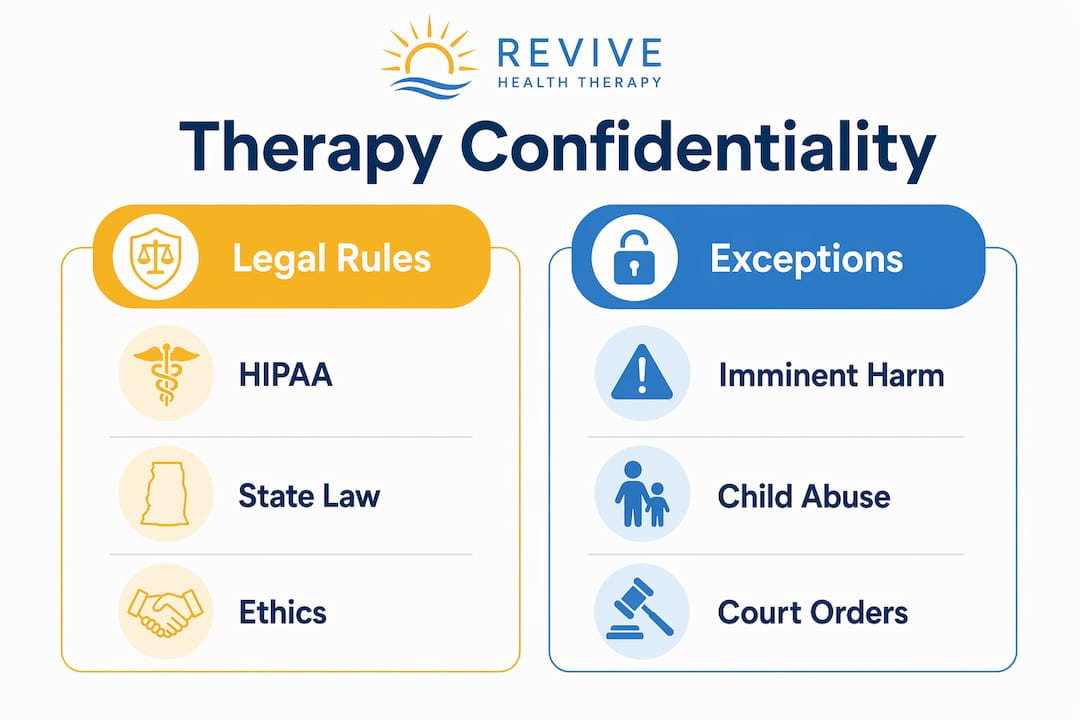
State laws add another layer. When state law is stricter than HIPAA, the stricter standard applies. California, for example, has some of the strongest mental health privacy protections in the country, with additional rules around minors, substance use records, and court disclosures. This means your rights in California may exceed what federal law alone guarantees.
Before your first session, your therapist is required to provide a Notice of Privacy Practices. This document explains exactly how your information is used, your rights as a client, and the specific exceptions to confidentiality. Clients can revoke release of information forms at any time, which gives you ongoing control over who receives your records. Signing an authorization is not permanent.
“Confidentiality is fundamentally about creating a safe space that encourages honesty and engagement in therapy.” This is why the legal structure around it matters so much. When you know your information is protected, you speak more freely, and therapy becomes more effective.
Key ethical obligations therapists follow include:
- Obtaining informed consent before treatment begins, including a clear explanation of confidentiality limits
- Using the minimum amount of information necessary in any permitted disclosure
- Storing records securely and limiting access to authorized staff only
- Notifying clients when legally possible before disclosing information to third parties
What are the limits and exceptions to therapy confidentiality
Confidentiality is strong, but it is not absolute. Every client deserves to know the specific situations where a therapist is legally required, or permitted, to share information without your consent. These exceptions exist to protect you or others from serious harm, and they are narrower than most people assume.
The four most common exceptions are:
- Mandatory reporting of abuse. Therapists are mandated reporters. If you disclose current abuse or neglect of a child, elder, or dependent adult, your therapist must report it to the appropriate agency. This obligation exists regardless of your wishes.
- Duty to warn or protect. The landmark Tarasoff ruling established that a credible, specific threat to an identifiable person triggers a legal duty to warn or protect that person. Your therapist may contact law enforcement or the potential victim directly. The threat must be serious and specific, not a vague expression of frustration.
- Imminent risk of self-harm. If you present an imminent, credible risk of suicide or serious self-injury, your therapist can take protective steps, including contacting emergency services or family members, without your consent.
- Valid court orders. Therapists handle subpoenas by first asserting client privilege and notifying you when possible. They push back on inappropriate legal requests before complying. A subpoena alone does not automatically require disclosure. A valid court order does.
Even in these exceptions, HIPAA requires the minimum necessary information to be shared. Your therapist does not hand over your entire file because a court asked a narrow question. The scope of disclosure is controlled and limited to what the specific situation legally demands.
Pro Tip: Ask your therapist at the start of treatment to walk you through each exception verbally, not just hand you a form. Hearing the explanation in plain language makes the limits feel less alarming and more manageable.
How confidentiality works in real therapy settings
Understanding the rules is one thing. Seeing how they operate in actual sessions, telehealth calls, and group settings is another.
Individual therapy
In one-on-one sessions, confidentiality is most straightforward. Your therapist keeps records, communicates with your insurance company for billing, and may consult with a supervisor, all within HIPAA guidelines. Outside those routine uses, nothing leaves the room without your written consent.

Couples and family therapy
Confidentiality gets more complex when more than one person is in the room. Different therapists handle this differently. Some treat the couple or family as the client, meaning no individual’s disclosures are kept secret from the other members. Others maintain individual confidentiality within the relationship. Ask your therapist directly which policy they follow before your first joint session.
Group therapy
Group therapy requires a different kind of confidentiality agreement. Your therapist is bound by professional ethics and law. Other group members are not. Most therapists ask group members to sign agreements promising not to share what others disclose, but these agreements are not legally enforceable in the same way. Know this going in.
Telehealth
Telehealth platforms use encryption and secure networks to protect your sessions, but shared devices and non-private environments remain the most common weak points. Your therapist should confirm your location and remind you to use a private space at the start of each call. For more on how telehealth confidentiality works in California, the specific platform and network protections matter as much as the legal framework.
| Setting | Key confidentiality consideration |
|---|---|
| Individual therapy | Standard HIPAA protections apply; records shared only with written consent |
| Couples/family therapy | Clarify whether individual disclosures are kept private within the group |
| Group therapy | Therapist is bound by law; other members are bound only by agreement |
| Telehealth | Encrypted platforms required; client environment is the main privacy risk |
Pro Tip: Before a telehealth session, use headphones and a room with a closed door. Your therapist’s platform may be fully secure while a family member in the next room is the actual privacy risk.
How clients can protect their own privacy in therapy
You are not a passive recipient of confidentiality protections. You have specific rights, and exercising them is straightforward once you know what to ask.
Clients have the right to request restrictions on certain disclosures, request that communications happen through specific channels, and petition to amend inaccurate records. These rights are real and enforceable. Providers must respond to your requests, even if they do not always grant every restriction.
Questions worth asking your therapist before or during your first session:
- What are the specific exceptions to confidentiality in this practice?
- How are my records stored and who on your staff can access them?
- What happens to my records if I use insurance for billing?
- If you consult with a supervisor, what information do you share?
- How do you handle requests from courts or attorneys?
- Can I request that you not share my records with my insurance company, and what does that mean for my coverage?
Insurance and billing interactions are one of the most overlooked privacy considerations. When you use insurance, your diagnosis and some treatment information go to the insurer. Paying out of pocket or using an HSA/FSA plan limits that disclosure. This is not a reason to avoid insurance, but it is a trade-off worth understanding.
Privacy management in therapy relies on a consent-and-authorization model. You control what goes beyond routine treatment, payment, and operations. Reading your Notice of Privacy Practices carefully, asking questions, and revoking authorizations you no longer want are all within your power.
Key takeaways
Therapy confidentiality is a legally enforceable protection governed by HIPAA, state law, and professional ethics, with narrow, specific exceptions that every client should know before treatment begins.
| Point | Details |
|---|---|
| HIPAA is the federal baseline | State laws like California’s can and do impose stricter protections that override federal minimums. |
| Psychotherapy notes are extra-protected | These notes require separate written authorization to release, even to insurers. |
| Exceptions are narrow and specific | Mandatory reporting, duty to warn, imminent self-harm, and valid court orders are the four main exceptions. |
| Telehealth adds environmental risk | Encrypted platforms protect the transmission; your physical environment is the most common weak point. |
| You have active privacy rights | You can request restrictions, revoke authorizations, and petition to amend records at any time. |
Why confidentiality is the bedrock of effective therapy
I have seen what happens when clients do not trust that their information is protected. They test the water for weeks, sharing surface-level concerns while holding back the material that actually needs attention. The therapy technically happens, but the real work does not. Confidentiality is not a legal formality. It is the condition that makes genuine disclosure possible.
What I find most underappreciated is how much knowing the limits of confidentiality actually helps clients, rather than worrying them. When a client understands that their therapist is required to act only in very specific, narrow circumstances, the vague fear of “what if they tell someone” dissolves. That clarity is freeing. It lets people bring their hardest experiences into the room.
The clients who get the most from therapy are the ones who ask direct questions about privacy at the start. They read the Notice of Privacy Practices. They ask what happens if they use insurance. They want to understand how therapeutic boundaries and confidentiality work together to create a safe container for treatment. That kind of informed engagement does not undermine the therapeutic relationship. It builds it.
My honest advice: treat your first session partly as an interview. A good therapist welcomes your questions about privacy. If a therapist seems reluctant to explain the limits of confidentiality clearly, that tells you something important about how they will handle your care.
— Amy
Start therapy with a provider who takes your privacy seriously
Revivehealththerapy serves clients across California with evidence-based therapy that is built on a foundation of genuine confidentiality and informed consent. Every client receives a clear explanation of privacy rights before treatment begins, whether sessions happen in person in Walnut Creek or Oakland, or through secure telehealth statewide.
If you are ready to work with a therapist who treats your privacy as a clinical priority, not just a compliance checkbox, explore adult mental health services at Revivehealththerapy. Sliding-scale fees and insurance acceptance, including HSA/FSA plans, make it possible to get started without financial barriers. Your information stays protected from the first conversation forward.
FAQ
What is therapy confidentiality?
Therapy confidentiality is the legal and ethical obligation requiring therapists to keep everything you share in sessions private. It is enforced by HIPAA, state law, and professional ethics codes.
Does HIPAA fully protect my therapy records?
HIPAA protects your Protected Health Information but allows disclosure in specific situations, including imminent harm, mandatory abuse reporting, and valid court orders. Psychotherapy notes receive an additional layer of protection beyond standard health records.
Can a therapist share my information with my insurance company?
Therapists can share your diagnosis and basic treatment information with your insurer for billing purposes without additional consent. Detailed psychotherapy notes require separate written authorization before they can be released.
What happens if I disclose something dangerous in therapy?
If you disclose a credible, specific threat to an identifiable person or present imminent risk of self-harm, your therapist has a legal duty to act. This may include contacting law enforcement, warning the potential victim, or arranging emergency care.
Can I control who sees my therapy records?
Yes. You can request restrictions on certain disclosures, revoke authorizations you have previously signed, and petition to amend inaccurate information in your records. These rights are protected under HIPAA and, in California, under additional state privacy laws.
2 Responses