
Yes, mindfulness helps most couples improve emotional connection, reduce reactivity, and recover from conflict faster. Research from the University of Georgia, published in the journal Hormones and Behavior, found that partners higher in mindfulness returned to physiological baseline more quickly after conflict, meaning their bodies literally calmed down faster after a fight. A practical first step: try a 3-minute shared check-in before bed, where each partner names one feeling and one thing they appreciated that day. That said, mindfulness is not a substitute for couples therapy or safety planning. If your relationship involves threats, coercion, or physical danger, please contact a licensed professional before trying any of the practices below. Revivehealththerapy offers trauma-informed couples therapy in California, including telehealth options statewide.
Key benefits research consistently links to couples mindfulness:
- Faster physiological recovery after conflict
- Higher relationship satisfaction and partner acceptance
- Reduced hostility and destructive conflict behaviors
- Greater empathy and emotional attunement
- Improved daily communication patterns
Key Takeaways
Mindfulness for couples works because it improves attention, emotion regulation, and physiological recovery after conflict, and short daily practices are the most reliable way to build those skills.
| Point | Details |
|---|---|
| Cortisol recovery is measurable | Mindful partners return to physiological baseline faster after conflict, reducing same-day re-escalation. |
| Daily micro-practices outperform occasional sessions | Two to five minutes several times per week shifts relational patterns more reliably than infrequent long sessions. |
| One partner is enough to start | A single partner’s nonreactivity can reduce escalation in couple interactions the following day. |
| Red flags require professional help | Threats, coercion, trauma responses, or sustained withdrawal call for couples therapy, not self-directed mindfulness. |
| Revivehealththerapy offers integrated support | Couples therapy with mindfulness, CBT, and EMDR is available in person in Oakland and Walnut Creek, and via telehealth statewide in California. |
Table of Contents
- Why mindfulness for couples works: the core mechanisms
- What does the research actually show?
- Five mindfulness exercises couples can try right now
- How to build a sustainable couples mindfulness routine
- When mindfulness isn’t enough and you need professional support
- A clinician’s perspective on what actually moves the needle
- Revivehealththerapy couples therapy: what to expect
- Sources
Why mindfulness for couples works: the core mechanisms
Mindfulness changes two things that drive most relationship problems: where your attention goes and how quickly your nervous system recovers. Those two levers, attention and emotion regulation, explain most of the research findings.
Clinicians distinguish between attentional mindfulness (noticing what is actually happening right now) and attitudinal mindfulness (approaching what you notice with curiosity rather than judgment). Both matter in relationships, but they work differently. Attentional mindfulness keeps you listening to your partner instead of rehearsing your rebuttal. Attitudinal mindfulness is what lets you hear something frustrating without immediately labeling it as an attack.
Cortisol recovery after conflict: Research reported by the Greater Good Science Center shows that partners higher in trait mindfulness recovered from conflict discussions faster, with cortisol returning to baseline more quickly than in lower-mindfulness partners. Faster cortisol recovery matters because couples who stay physiologically activated after a fight are more likely to re-escalate within the same day.
The University of Georgia researchers behind this work noted that mindful partners were better able to regulate emotion, empathize more deeply, and exit conflict with less negative fallout. That is not a small effect. Most couples do not fight about the same thing repeatedly because they lack information. They fight because the nervous system is still running hot from the last round.
Mindfulness also disrupts what researchers call automatic interaction scripts: the defend-and-attack patterns couples fall into without deciding to. A small habit, like pausing for one breath before responding, interrupts the autopilot long enough for a different choice to become possible.
Pro Tip: Start with a single micro-practice, not a full meditation routine. A 60-second breathing pause before a known trigger conversation (like discussing finances or parenting) is more likely to shift your interaction pattern than a 20-minute session you do once a month.
For couples dealing with anxiety alongside relationship stress, holistic stress-relief strategies that target physiological regulation can complement mindfulness practice effectively.
What does the research actually show?
The evidence base for couples mindfulness is solid but not unlimited.
A PMC literature review found that dispositional mindfulness consistently associates with higher relationship satisfaction and greater partner acceptance across multiple study designs. That association holds across both observational and intervention research. Daily-diary studies add a same-day dimension: on days when individuals report higher mindfulness, they also report greater relationship satisfaction and fewer destructive conflict behaviors. The effect shows up within hours, not just over months.
Key findings from the research:
- Mindfulness-Based Relationship Enhancement (MBRE) trials show gains in satisfaction and acceptance, particularly for couples who are not in severe distress at baseline
- Loving-kindness practices increase positive emotions toward a partner in short-term trials
- One-partner practice can still reduce escalation the following day, even without the other partner participating
- University of Georgia findings suggest mindfulness helps partners empathize more and exit conflict with less negative residue
Limitations worth knowing: Most studies use self-report measures, sample sizes tend to be modest, and follow-up periods are often short. MBRE trials specifically recruited couples who were not in crisis, so the evidence is weakest for high-conflict or trauma-affected relationships. Mindfulness is a supportive tool, not a cure.
| Practice | Typical duration | Primary benefit | Evidence level |
|---|---|---|---|
| Shared breathing pause | 1–3 minutes | Emotion regulation | Strong |
| Mindful listening exercise | 5–10 minutes | Communication, empathy | Strong |
| Loving-kindness meditation | 5–10 minutes | Positive affect, appreciation | Moderate |
| Mindful meal together | 10–20 minutes | Presence, connection | Early |
The practical takeaway: start with practices that have the strongest evidence (breathing pauses, mindful listening), and treat loving-kindness and mindful meals as useful additions once the basics feel natural.
Five mindfulness exercises couples can try right now
The three practices most worth starting with are the 3-minute check-in, mindful listening, and a brief loving-kindness meditation. Each takes under 10 minutes and requires no prior experience. Below are step-by-step instructions for five exercises, ordered from lowest to highest friction.
1. The 3-minute shared check-in
What it looks like: Sit facing each other. Each partner takes one minute to answer: “What am I feeling right now, and what did I appreciate about you today?” The other partner listens without responding until the speaker is done.

Duration and frequency: 3 minutes total, ideally daily, before bed or after dinner.
Beginner variation: Write your answers on paper first if speaking feels awkward. Read them aloud.
What it improves most: Emotional attunement, daily connection, and the habit of naming feelings before they accumulate.
Dos and don’ts:
- Do: keep it brief and factual (“I feel tired and I appreciated that you made coffee”)
- Don’t: use the check-in to raise complaints or unresolved issues
2. Mindful listening
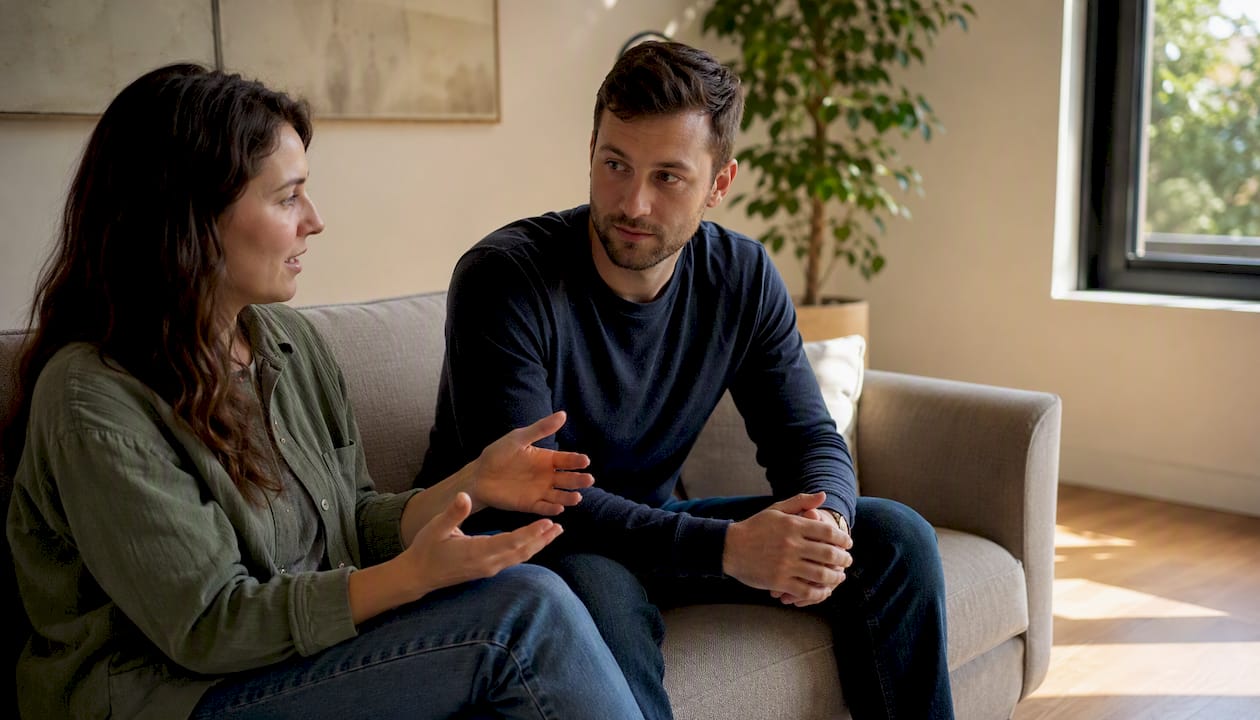
What it looks like: One partner speaks for 3 minutes about anything, while the other listens with full attention, no phone, no planning a response. The listener then reflects back what they heard in one or two sentences, without adding their own opinion.
Duration and frequency: 6–10 minutes, two to three times per week.
Beginner variation: Use a timer so neither partner has to track time. Start with a neutral topic before moving to charged ones.
What it improves most: Autopilot patterns shift when listening moves from “defend/attack” to “notice and reflect.” This is the most direct communication skill mindfulness builds.
Dos and don’ts:
- Do: reflect feelings, not just content (“It sounds like you felt unheard”)
- Don’t: correct, advise, or debate during the listening turn
3. Loving-kindness meditation together
What it looks like: Sit comfortably, close your eyes, and silently repeat: “May you be happy. May you be healthy. May you be at peace.” Direct the phrases toward your partner for 3–5 minutes. You can use a free guided audio track if silence feels uncomfortable.
Duration and frequency: 5 minutes, two to three times per week.
Beginner variation: Say the phrases aloud together, slowly, as a shared ritual.
What it improves most: Positive affect toward your partner. Short-term trials link this practice to increased warmth and reported satisfaction.
4. The pause-and-breathe agreement
What it looks like: Before a predictably tense conversation, both partners agree on a signal (a raised hand, a specific word) that means “I need 60 seconds to breathe before we continue.” When the signal is used, both partners take three slow breaths before speaking again.
Duration and frequency: As needed during conflict; takes under 2 minutes.
What it improves most: Physiological regulation during escalation. This is the practice most directly tied to the cortisol-recovery research.
Dos and don’ts:
- Do: agree on the signal in advance, during a calm moment
- Don’t: use the pause to exit the conversation permanently or avoid accountability
5. Mindful meal
What it looks like: Eat one meal per week with no screens. Notice the food, the environment, and each other. Speak slowly. Ask one open question: “What was the best part of your week?”
Duration and frequency: 15–20 minutes, once per week.
What it improves most: Shared presence and appreciation. This is the lowest-stakes entry point for couples who find formal meditation uncomfortable.
Pro Tip: If your partner is resistant to “mindfulness” as a concept, never use the word. Frame the check-in as “two minutes to catch up” and the mindful meal as “a phone-free dinner.” The practice works the same either way, and removing the label removes the resistance.
How to build a sustainable couples mindfulness routine
Consistency beats intensity. Short practices done several times per week shift relational patterns more reliably than a single long session. Think of couple mindfulness the way you think of physical hygiene: brief, regular, and built into what you already do.
A sample weekly plan:
- Monday, Wednesday, Friday: 3-minute shared check-in after dinner (3 minutes each)
- Tuesday and Thursday: Mindful listening, alternating who speaks (8 minutes)
- Saturday: Loving-kindness meditation together before sleep (5 minutes)
- Sunday: Phone-free meal with one open question (20 minutes)
- Daily micro-moment: One conscious breath before responding to your partner during any tense exchange
Total weekly time: roughly 50 minutes, spread across seven days. That is less than one episode of television.
Troubleshooting common barriers:
- “We don’t have time.” Pair the check-in with something you already do together, like making coffee or brushing teeth. Two minutes attached to an existing habit requires no scheduling.
- “My partner won’t do it.” Start alone. One-partner practice still reduces escalation in couple interactions. Your nonreactivity changes the dynamic even without your partner’s participation.
- “It feels awkward.” That is normal for the first two to three weeks. Start with the mindful meal, which feels the least clinical, and add other practices once the awkwardness fades.
- “We tried it and it didn’t help.” Check whether you are using mindfulness to avoid a real conversation. Mindfulness supports regulation; it does not replace accountability or repair.
For families managing multiple schedules, mindfulness practices adapted for California households offer additional scheduling frameworks.
When mindfulness isn’t enough and you need professional support
Mindfulness is a skill-building tool. It is not equipped to address consistent violence, active safety concerns, complex trauma, addiction, or entrenched patterns that have calcified over years. If any of the following are present, professional help is the right first step, not a breathing exercise.
Red flags that indicate couples therapy or crisis support is needed:
- Threats, intimidation, or physical harm of any kind
- Coercive control over finances, movement, or social contact
- One or both partners experiencing suicidal ideation
- Repeated dangerous behavior that does not change after discussion
- Trauma responses (flashbacks, dissociation, hypervigilance) that surface during conflict
- Sustained emotional withdrawal lasting weeks or months with no repair attempts
- Addiction actively affecting daily functioning and relationship safety
When these patterns are present, mindfulness can actually be counterproductive if it is used to manage or minimize what is happening rather than address it. The benefits of couples counseling extend well beyond what self-directed practice can reach: structured repair work, trauma processing through approaches like EMDR, and a trained clinician who can hold both partners accountable without taking sides.
Therapy and mindfulness work well together. Many clinicians integrate mindfulness techniques within CBT or trauma-informed frameworks, teaching regulation skills in session and then assigning brief practices between appointments. That combination, structured clinical work plus daily micro-practices, tends to produce more durable change than either alone.
Pro Tip: If you are unsure whether your situation calls for therapy, err toward booking a single consultation. A licensed therapist can assess the dynamic in one session and tell you whether self-directed mindfulness is appropriate, or whether a more structured intervention is the better starting point.
For readers considering mindfulness therapy in a clinical setting, Revivehealththerapy offers both individual and couples-focused mindfulness-integrated therapy across California.
A clinician’s perspective on what actually moves the needle
Most couples who come in for therapy are not struggling because they lack love for each other. They are struggling because their nervous systems have learned to treat each other as threats. That is the pattern mindfulness most directly interrupts.
What I see consistently in clinical work is that couples who build even a small shared practice, two or three minutes of intentional presence together, begin to shift their baseline. Not because the practice is magic, but because it creates a moment of co-regulation: two nervous systems settling together instead of activating each other. The research on cortisol recovery after conflict reflects exactly this. Mindfulness does not eliminate disagreement. It shortens the physiological tail of it, which is where most of the real damage accumulates.
The couples who benefit most are those who treat mindfulness as a relational habit rather than a performance. They are not trying to be calm. They are practicing noticing, together, without immediately reacting. That distinction matters more than which specific exercise they choose.
When deeper issues are present, including unresolved trauma, betrayal, or patterns that predate the relationship, mindfulness alone is not enough. That is when evidence-based marriage therapy techniques and structured clinical work become the appropriate next step.
Revivehealththerapy couples therapy: what to expect
Revivehealththerapy offers couples therapy that integrates mindfulness, CBT, and trauma-informed approaches, including EMDR for partners carrying individual trauma into the relationship. Sessions are available in person at Oakland and Walnut Creek locations, and via secure telehealth statewide across California. Sliding-scale fees and HSA/FSA acceptance make services accessible across income levels.
For couples who want clinical support alongside self-directed practice, telehealth marriage therapy is available without a commute. A first session typically involves an assessment of the relationship dynamic, a discussion of goals, and an introduction to the skills most relevant to your specific pattern. You do not need to be in crisis to book. Many couples come in precisely because they want to strengthen what is already working, not just repair what is broken. Contact Revivehealththerapy to schedule a consultation and find out which services fit your situation.
Sources
The following sources informed this guide and are worth reading for deeper context.
- How Mindfulness Can Help Couples Cool Down | Greater Good Science Center
- On the Association Between Mindfulness and Romantic Relationship Satisfaction: the Role of Partner Acceptance | PMC
- Mindfulness for Couples: Practices That Deepen Connection and Reduce Conflict | Simply Psychology
- Single-partner mindfulness effects on dyadic interactions | Springer (2026)
This article provides general educational information about mindfulness practices and is not a substitute for professional mental health advice, diagnosis, or treatment. If you are experiencing relationship distress, safety concerns, or mental health symptoms, please consult a licensed therapist or contact a crisis resource.
Recommended
- Benefits of couples counseling for lasting connection – Revive Health Therapy
- Mindfulness for California Families: A Practical How-To – Revive Health Therapy
- Emotional Regulation Tips for Couples: Build Resilience – Revive Health Therapy
- Why Prioritize Mental Wellness in Marriage: A Real Guide – Revive Health Therapy