
TL;DR:
- Therapy helps professionals stabilize emotions, resolve identity conflicts, and build resilience during career transitions. It addresses emotional barriers that prevent action and guides identity reorganization before making decisions. Evidence-based approaches like CBT and ACT are effective for handling anxiety and identity shifts in this process.
Therapy for career transitions is defined as structured clinical support that stabilizes your emotions, resolves identity conflicts, and builds the psychological resilience needed to make sound professional decisions. Knowing how to use therapy for career transitions separates professionals who repeat old patterns from those who move forward with genuine clarity. Evidence-based approaches like Cognitive Behavioral Therapy (CBT) and Acceptance and Commitment Therapy (ACT) address the anxiety, grief, and self-doubt that career coaching simply cannot reach. When symptoms persist beyond a few weeks, a mental health professional becomes the right call, not a career strategist.
How to use therapy for career transitions: therapy vs. coaching
Therapy and career coaching are not interchangeable. Coaching is action-oriented. It focuses on résumés, networking plans, and future goals. Therapy addresses the emotional and psychological material underneath those goals, including fear, past failures, and identity confusion. Therapy targets emotional blocks that keep you stuck even when you already have a solid plan.
Knowing which one you need comes down to a few clear signals:
- Choose coaching when you have emotional stability and need practical direction, skill gap analysis, or accountability.
- Choose therapy when anxiety, depression, or paralysis is preventing you from acting on any plan at all.
- Choose both when you need emotional grounding alongside structured career strategy. Many professionals work with a therapist and a coach simultaneously with strong results.
- Seek therapy urgently when functional impairment lasts over a few weeks, including disrupted sleep, inability to concentrate, or withdrawal from daily responsibilities.
The clearest distinction: coaching asks “how do I get there?” Therapy asks “why am I stuck here?”
Pro Tip: Before booking a therapist, schedule a 15-minute consultation to assess fit. Ask directly whether the therapist has experience with occupational stress and professional identity work.

Which therapy methods work best for career-related anxiety?
CBT and ACT are the primary evidence-based therapies for career-related anxiety. CBT is the most extensively studied intervention for stress-related conditions in working adults. That matters because career transitions produce exactly the kind of catastrophic thinking CBT was designed to disrupt.
Cognitive Behavioral Therapy (CBT)
CBT identifies the distorted thoughts driving your anxiety and replaces them with accurate, functional ones. A professional leaving a 15-year career might think, “I will never be credible in a new field.” CBT challenges that belief with evidence, tests it against reality, and builds a more balanced thought pattern. The step-by-step CBT process is particularly effective for the catastrophic thinking that spikes during job searches and interviews.
Acceptance and Commitment Therapy (ACT)
ACT does not try to eliminate anxiety. It teaches you to hold anxiety without letting it control your decisions. The core skill is values clarification: identifying what genuinely matters to you professionally, then committing to actions aligned with those values even when fear is present. ACT therapy is especially useful when a career transition involves a fundamental identity shift, such as leaving a high-status role or changing industries entirely.
Rational Emotive Behavioral Therapy (REBT)
REBT targets rigid beliefs like “my career must be perfect” or “I should already know what I want.” These beliefs cause decision paralysis. REBT challenges the absolutist language in those beliefs and replaces “must” and “should” with more flexible thinking. The emotional regulation strategies that REBT builds are directly applicable to the high-stakes decisions professionals face during transitions.
| Therapy Method | Core Mechanism | Best For |
|---|---|---|
| CBT | Challenges distorted thoughts | Catastrophic thinking, interview anxiety |
| ACT | Values clarification and acceptance | Identity shifts, values-driven decisions |
| REBT | Disputes rigid, absolutist beliefs | Decision paralysis, perfectionism |
Pro Tip: Career anxiety is often a signal of how much the transition matters to you, not a sign to stop. Reframing anxiety as evidence of personal stakes rather than incompetence is one of the most productive shifts therapy produces.
Practical steps for integrating therapy into your career shift
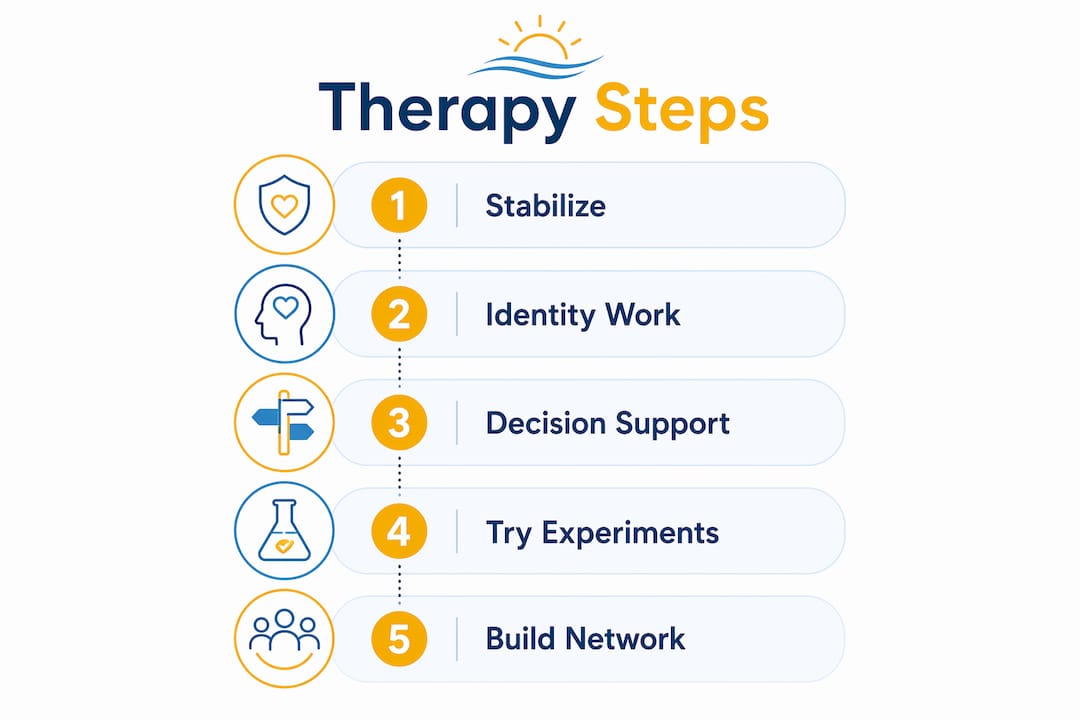
Effective therapeutic support for a career transition follows a clear sequence. Premature decision-making before emotional work leads to repeating dysfunctional patterns. The three-track model used by career transition therapists moves in this order: stabilize, explore, then decide.
Step 1: Start with symptom stabilization
- Assess your current state. Rate your sleep quality, concentration, and daily functioning before your first session. This gives your therapist a clinical baseline.
- Prioritize anxiety and sleep first. A therapist cannot do deep identity work with you if you are running on four hours of sleep and constant dread. Stabilizing these symptoms is the foundation.
- Use therapy for anxiety as your entry point. Career-related anxiety is a clinical concern, not just stress. Treating it directly accelerates every other part of the transition.
Step 2: Do the identity work
Your professional identity is not just your job title. It includes your sense of competence, belonging, and purpose. When a career ends or shifts, that identity reorganizes. Therapy helps you stay connected to yourself while that reorganization happens, rather than forcing premature certainty.
Useful exercises your therapist may guide you through:
- Career Timeline: Map your work history and identify recurring themes, values, and moments of genuine engagement. This reveals what you actually want, not what you think you should want.
- Cognitive reframing: Rewrite the story you tell about leaving your previous role. Grief over a job you chose to leave is normal and worth processing fully.
- Values inventory: List your top five professional values and rank them. Use this list to evaluate any new opportunity before committing.
Step 3: Run small experiments before deciding
Small experiments like informational interviews and skill-bridging projects test new career paths before full commitment. They reduce anxiety by replacing speculation with direct experience. A therapist helps you process what those experiments reveal about your preferences and fears, rather than just collecting data points.
Step 4: Build your support network
Strong social support buffers psychological stress during career transitions. Therapy is one pillar of that support, not the whole structure. Mentors, peers, and family members each play a distinct role. Your therapist can help you communicate your transition clearly to the people around you, reducing relational friction during an already demanding period.
Pro Tip: If you are in California and prefer flexible scheduling, telehealth therapy lets you maintain consistent sessions during the unpredictable schedule of a job search without commuting to an office.
What are the common pitfalls in using therapy for career transitions?
The biggest mistake professionals make is expecting therapy to deliver a career answer quickly. Therapy builds the conditions for clarity. It does not manufacture it on demand.
Common pitfalls and how to address them:
- Rushing to decide. Emotional stabilization must come before career decisions. Skipping this step produces choices driven by anxiety rather than values.
- The sunk cost trap. Years invested in a field can make leaving feel like failure. Therapy names this cognitive distortion directly and separates past investment from future direction.
- Age-related anxiety. Professionals in their 40s and 50s often fear it is “too late.” Therapy challenges the timeline assumptions behind that fear with evidence and perspective.
- Stigma around seeking help. Professionals sometimes resist therapy because it feels like admitting weakness. Reframing therapy as a performance tool rather than a crisis response removes that barrier.
- Expecting linear progress. Therapeutic work moves in cycles. Some weeks produce breakthroughs. Others surface grief or confusion. Both are part of the process.
“Staying with grief and uncertainty during a career change, without pathologizing it, is what allows healthier emotional processing to happen. The discomfort is not a problem to fix. It is the work itself.”
Normalizing the emotional release that follows leaving a role, even one you chose to leave, is a clinical skill. Therapists emphasize staying with that grief rather than bypassing it with forced optimism.
Key Takeaways
Therapy for career transitions works because it stabilizes emotions first, then builds identity clarity, and only then supports sound career decisions.
| Point | Details |
|---|---|
| Therapy before coaching | Seek therapy when anxiety or paralysis blocks action, not just when you need career direction. |
| Three-track sequence | Stabilize symptoms, explore identity, then make decisions. Skipping steps repeats old patterns. |
| CBT, ACT, and REBT | Each method targets a different barrier: distorted thoughts, values confusion, and rigid beliefs. |
| Small experiments work | Informational interviews and skill-bridging projects reduce anxiety through direct experience. |
| Support networks matter | Mentors, peers, and family buffer stress. Therapy helps you communicate your transition clearly to them. |
What I have learned about therapy and career change
The professionals I have seen benefit most from therapy during career transitions share one trait: they were willing to slow down before speeding up. That sounds counterintuitive when you are anxious to have an answer. The pressure to decide quickly is real. But the therapists who do this work well know that an inner foundation built on resolved emotional blocks produces far more durable career decisions than any external career assessment tool.
What I find most telling is how often professionals arrive at therapy with a plan already formed, only to discover in session that the plan is a reaction to fear rather than a reflection of their values. That is not a failure of planning. It is what happens when emotional work gets skipped. Therapy creates the space to notice the difference between a decision made from steadiness and one made from panic.
The grief piece also gets underestimated. Leaving a career, even a bad one, involves real loss. Identity, routine, relationships, and status all shift at once. Professionals who allow themselves to grieve that loss in therapy tend to move forward with far less regret than those who push through it. Compassion toward yourself during this period is not soft. It is the most practical thing you can do.
— Amy
Revivehealththerapy supports professionals through career transitions
Career transitions are one of the most psychologically demanding experiences a professional can face. Revivehealththerapy offers evidence-based psychotherapy in California, including CBT and ACT, specifically suited to the anxiety, identity shifts, and emotional complexity that come with changing professional paths.
Sessions are available in person at Walnut Creek and Oakland, or statewide via secure telehealth. Sliding-scale fees and insurance acceptance, including HSA and FSA plans, make consistent support accessible regardless of income. If you are ready to work through the emotional side of your career shift with a trained therapist, explore psychotherapy options at Revivehealththerapy and book a consultation to get started.
FAQ
What is the difference between therapy and career coaching?
Therapy addresses emotional blocks, past experiences, and mental health symptoms that prevent progress. Coaching is future-focused and action-oriented, targeting goals and logistics rather than psychological barriers.
Can therapy help with job transitions even if I am not in crisis?
Yes. Therapy is effective for any professional experiencing anxiety, identity confusion, or decision paralysis during a career shift, not only for those in acute distress. Functional impairment lasting over a few weeks is the clinical threshold for seeking support.
Which therapy method is best for career change anxiety?
CBT is the most extensively studied approach for occupational stress and works well for catastrophic thinking. ACT is particularly effective when the transition involves a major identity shift and requires values clarification.
How long does therapy for a career transition typically take?
Duration varies by individual, but the three-track model of stabilization, identity work, and decision support typically unfolds over several months. Rushing the process increases the risk of repeating old career patterns.
How do I find a therapist who specializes in career transitions?
Start with a 15-minute consultation and ask directly about the therapist’s experience with occupational stress and professional identity work. Revivehealththerapy offers consultations for professionals across California, in person and via telehealth.