
TL;DR:
- Opening up to your therapist is a learnable skill that improves with preparation and honest communication.
- Gradual vulnerability builds trust over multiple sessions, helping you feel safer sharing personal thoughts.
Opening up to your therapist is a learnable skill, not a personality trait you either have or don’t. Therapeutic self-disclosure, the clinical term for sharing personal thoughts and feelings in a session, is the foundation of effective psychotherapy. Many people sit in their first session unsure of what to say or where to begin. The good news is that therapists are trained to guide you through exactly that uncertainty. This guide gives you concrete strategies to communicate more openly, starting from your very first session.
How to open up to your therapist when it feels impossible
Vulnerability in therapy feels hard because your brain is wired to detect social risk. Brains treat emotional exposure like a potential threat, triggering hesitation even in safe environments. That means struggling to open up is not a character flaw. It is your nervous system doing exactly what it was built to do.
Several fears make this harder than it needs to be:
- Fear of judgment: You worry your therapist will think less of you for what you share.
- Fear of vulnerability: Saying something out loud makes it feel more real and harder to ignore.
- Fear of not being “enough”: You think your problems are too small, too messy, or not serious enough to deserve help.
- Pressure to perform: You feel like you should arrive with clear answers, a diagnosis, or a tidy narrative.
None of these fears are accurate. Therapists expect gradual vulnerability and do not push clients to disclose before they are ready. That expectation is built into how therapy is structured, not just a courtesy.
“Difficulty opening up is a normal, expected part of therapy. It is not a failure by the client. Therapists are trained to work with hesitation, not around it.”
The most common mistake new clients make is believing they need to arrive prepared with a clear story. You don’t. Therapists are trained to guide clients who have no script and will help uncover what matters over time through questions. Knowing this removes a significant amount of pressure before you even walk through the door.
How to prepare yourself before your session
Preparation does not mean rehearsing a speech. It means reducing the mental friction that makes opening up harder than it has to be.
-
Write one sentence before your session. Complete this prompt: “The main reason I made this appointment is ___.” This single sentence acts as a mental anchor when your mind goes blank mid-session. You don’t need to read it aloud. Just having it written down keeps you grounded.
-
Note two or three concrete examples. Instead of trying to summarize your entire emotional life, jot down a recent situation that bothered you. Specific, descriptive examples of daily experiences are far more useful than self-diagnosis. Your therapist can work with “I snapped at my partner on Tuesday and felt terrible afterward” much better than “I think I have anger issues.”
-
Ask about confidentiality upfront. Asking directly about confidentiality limits at the start of your first session lowers a major barrier to honest disclosure. Knowing what stays private and what doesn’t removes a layer of uncertainty that can keep people guarded.
-
Lower your expectations for the first session. First sessions typically last 50–55 minutes and focus on intake and orientation, not deep analysis. The first 20–30 minutes often involve assessment questions that help your therapist understand your background. That is normal and intentional.
-
Handle logistics in advance. Arriving stressed because you were stuck in traffic or couldn’t find parking makes opening up harder. Confirm your appointment time, plan your route, and give yourself a buffer.
Pro Tip: Bring your written sentence or notes to the session in your phone or on paper. If you freeze, you can simply say, “I wrote something down that might help me explain why I’m here.”
| Preparation step | Why it helps |
|---|---|
| Write one anchor sentence | Prevents blank-mind moments and keeps focus |
| Note concrete examples | Gives your therapist specific context to work with |
| Ask about confidentiality | Removes uncertainty about what is safe to share |
| Lower session expectations | Reduces performance pressure before you arrive |
| Plan logistics early | Keeps stress low so you arrive ready to talk |

What to say when you don’t know where to start
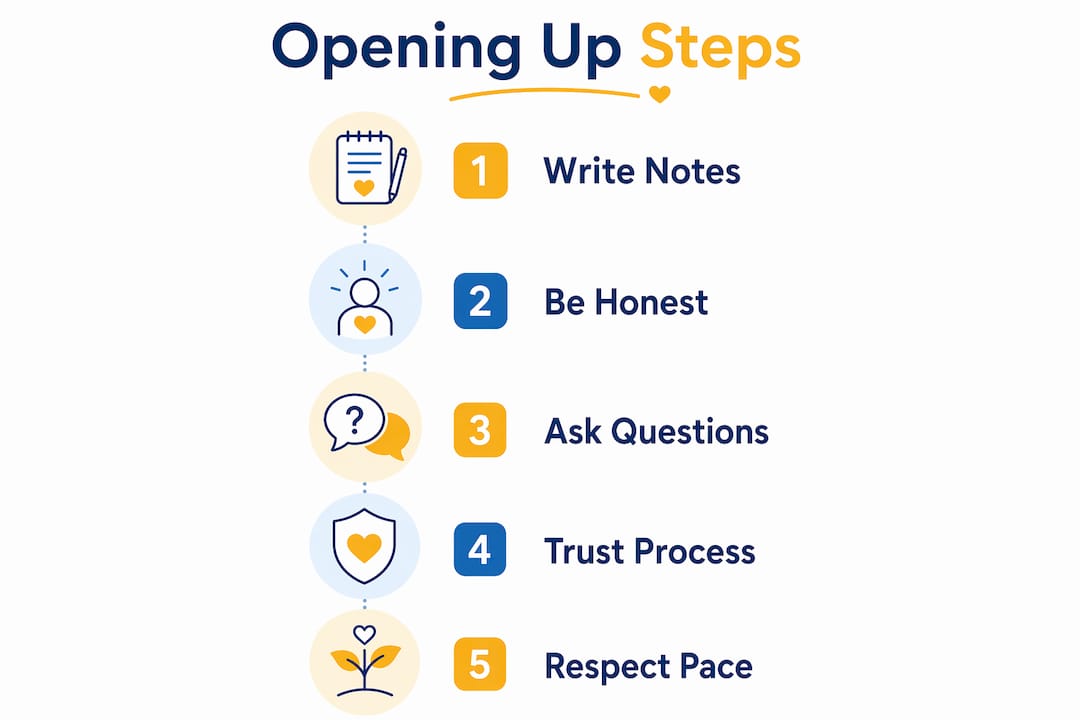
The most effective technique for starting therapy conversations is also the simplest: say exactly what you are experiencing in the moment. Naming your difficulty out loud, such as saying “I notice I’m holding back,” actively guides the session and gives your therapist something real to work with.
These communication strategies work immediately, even in your first session:
- Say “I don’t know where to start.” This is not a cop-out. Saying this phrase pauses the session and signals your therapist to take the lead with clarifying questions. It is a valid and useful therapeutic move.
- Start with the surface. You don’t have to begin with your deepest fear or oldest wound. Start with what happened this week. Surface-level details often lead naturally to deeper ones.
- Use short, honest phrases. “I’m not sure how to explain this” or “This feels hard to say” are complete and useful statements. Your therapist will follow up.
- Ask questions about the process. Asking “What are you writing down?” or “How does this usually work?” builds your sense of safety and gives you more control over the session.
- Give your therapist permission to guide you. You can say, “I’m not sure what’s relevant. Can you ask me questions?” That one sentence shifts the dynamic and takes pressure off you entirely.
Pro Tip: If you feel yourself shutting down mid-session, say “I’m feeling stuck right now.” Your therapist is trained to respond to that signal and will adjust their approach.
Therapists fully expect to hear “I don’t know” or “I’m still figuring it out.” Therapists use their expertise to guide the conversation when clients don’t have ready answers. You are not responsible for running the session. That is their job.
How to build trust and keep making progress over time
Trust in therapy builds across multiple sessions, not in one conversation. Each time you share something and your therapist responds without judgment, your brain updates its threat assessment. That is how safety and trust develop in a therapeutic relationship, gradually and through repeated experience.
Here is how to support that process between and during sessions:
-
Recognize your own pace. Some people open up quickly. Others take months. Neither is wrong. Pushing yourself too hard too fast leads to burnout and avoidance. Validate the pace you are actually moving at, not the one you think you should be moving at.
-
Communicate your hesitations directly. If a topic feels too raw, say so. “I’m not ready to talk about that yet” is a complete sentence. Therapists respect stated limits and will work around them until you feel ready. You can learn more about setting limits in therapy and how that supports emotional healing.
-
Journal between sessions. Writing down thoughts, reactions, or questions between appointments keeps the therapeutic process active outside the room. You don’t need a structured journal. Even a few sentences about how you felt after a session can surface material worth bringing back next time.
-
Give feedback on therapist fit. If something your therapist says doesn’t land right, tell them. Therapy works best when you feel genuinely comfortable with the person across from you. Asking questions about the therapy process, as intake questions are designed to build context, is part of how that fit gets established.
-
Track small wins. Notice when you say something you wouldn’t have said in session one. That is progress. Recognizing it reinforces the behavior and builds confidence for the next session.
| Progress strategy | What it does |
|---|---|
| Respect your own pace | Prevents burnout and keeps you returning to sessions |
| Name hesitations openly | Gives your therapist clear signals about your comfort level |
| Journal between sessions | Surfaces thoughts that are hard to access in the moment |
| Give feedback on fit | Strengthens the therapeutic relationship over time |
Key Takeaways
Opening up in therapy is a gradual skill built on preparation, honest communication, and trust developed across multiple sessions.
| Point | Details |
|---|---|
| Vulnerability is normal | Struggling to open up is expected; therapists are trained to work with hesitation. |
| Prepare before sessions | Write one anchor sentence and note two concrete examples to reduce blank-mind moments. |
| Name what you feel | Saying “I don’t know where to start” is a valid and useful therapeutic statement. |
| Trust builds over time | Safety develops through repeated, judgment-free interactions across multiple sessions. |
| Feedback improves therapy | Telling your therapist what isn’t working strengthens the relationship and your progress. |
What I’ve learned after years of watching people struggle to open up
The clients who make the fastest progress in therapy are rarely the ones who arrive most prepared. They are the ones who are willing to say “this is hard” out loud. That one act of honesty does more for the therapeutic relationship than any amount of pre-session journaling or careful word choice.
What I’ve also noticed is that people put enormous pressure on themselves to be “good” clients. They worry about wasting the therapist’s time, about being too emotional, or about not being emotional enough. That pressure is the exact thing that keeps them stuck. Therapy is not a performance review. Your therapist is not grading your answers.
The most underused tool in any session is the simple question: “Can you help me figure out where to start?” Clients who ask that question stop trying to manage the session and start actually participating in it. That shift, from managing to participating, is where real progress begins. If you want to understand how therapists actively support that process, how therapists guide self-discovery is worth reading before your next session.
Small steps are not a consolation prize. They are the method. Every time you say something slightly harder than what you said last session, you are doing the work. That compounds over time in ways that are genuinely surprising.
— Amy
Therapy that meets you where you are
Starting to open up is the hardest part. Revivehealththerapy offers evidence-based psychotherapy services in California designed around exactly that challenge, with trauma-informed approaches including EMDR, CBT, and mindfulness that support gradual emotional openness at your pace.
Whether you are new to therapy or returning after a gap, Revivehealththerapy provides both in-person sessions in Walnut Creek and Oakland and secure telehealth appointments statewide. Sliding-scale fees and insurance acceptance, including HSA/FSA plans, make getting started more accessible. If you are ready to take the first step, explore psychotherapy options or reach out directly to find the right fit for where you are right now.
FAQ
What should I say to my therapist in the first session?
Tell your therapist the main reason you made the appointment, even if it feels vague. Therapists expect incomplete answers and will use their questions to help you fill in the rest.
Is it normal to feel nervous about opening up in therapy?
Yes. Brains are wired to detect social risk, which makes vulnerability feel threatening even in a safe space. That hesitation is a normal neurological response, not a sign that therapy isn’t right for you.
What if I don’t know how to express my feelings to my therapist?
Say exactly that. Saying “I don’t know where to start” is a recognized therapeutic statement that prompts your therapist to take the lead with guiding questions.
How long does it take to feel comfortable opening up in therapy?
Comfort builds across multiple sessions through repeated, judgment-free interactions. There is no standard timeline. Respecting your own pace and communicating your hesitations directly speeds the process more than pushing yourself to share before you are ready.
Can I ask my therapist about confidentiality before sharing personal issues?
Yes, and you should. Asking about confidentiality limits at the start of your first session is encouraged and removes a significant barrier to honest disclosure.
Recommended
- How to Get the Most From Your Therapy Sessions – Revive Health Therapy
- How to Find a Therapist for Accessible Trauma Care – ReviveHealthTherapy
- How therapists guide self-discovery for growth in California – Revive Health Therapy
- How boundaries in therapy unlock emotional healing – Revive Health Therapy
2 Responses