
Integrative psychotherapy is a flexible, client-centered approach that draws from multiple therapy theories and methods rather than locking a person into one fixed model. The therapist selects techniques from frameworks like cognitive behavioral therapy (CBT), psychodynamic therapy, humanistic approaches, and mindfulness practices, then combines them based on what each client actually needs. What separates integrative psychotherapy from simple eclecticism is a coherent underlying philosophy: every technique choice is grounded in systematic case conceptualization, not a random grab from a bag of tricks.
The core principles of integrative psychotherapy include:
- Whole-person focus: Treatment addresses emotional, cognitive, behavioral, and physiological dimensions together, sometimes including spiritual beliefs.
- Therapeutic relationship as a change agent: The bond between therapist and client is treated as a primary mechanism of healing, not just a backdrop.
- Client as active participant: You are not a passive recipient. You help shape the direction of treatment.
- Evidence-based technique selection: Methods are chosen because research and clinical reasoning support them for your specific situation.
- Ongoing adaptation: The approach shifts as your needs evolve across sessions.
How integrative psychotherapy works: approaches and the therapeutic process
Integrative therapy operates through four primary routes, each representing a different way therapists blend methods and theories.
Technical eclecticism pulls effective techniques from different therapy models without necessarily adopting their underlying theories. A therapist might use exposure exercises from behavioral therapy alongside narrative techniques from humanistic work, choosing each tool because evidence supports it for your presenting concern.
Theoretical integration goes deeper. The therapist synthesizes concepts from two or more theoretical frameworks into a unified clinical model. Paul Wachtel’s cyclical psychodynamics, which weaves together psychodynamic and behavioral theories, is a well-known example of this approach.
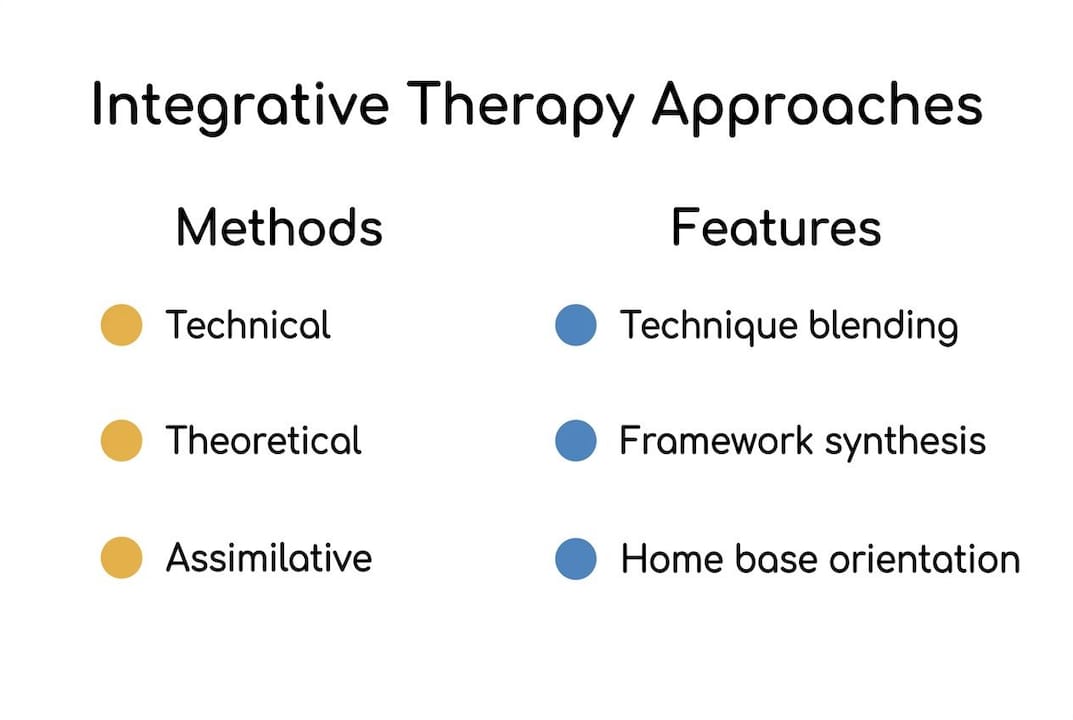
Assimilative integration starts from a home base. The therapist works primarily within one orientation, say CBT or psychodynamic therapy, but borrows techniques from other approaches when the situation calls for it. This keeps treatment coherent while staying flexible.
Common factors is the fourth route, and arguably the most research-supported. It focuses on the therapeutic elements that appear across all effective therapies: alliance, empathy, hope, and shared goals. Rather than emphasizing technique, the therapist prioritizes the quality of the relationship and the conditions that allow change to happen.
In practice, a session unfolds through several interconnected processes:
- Initial assessment: The therapist gathers a detailed picture of your history, current concerns, strengths, and goals.
- Alliance building: Trust and collaboration are established early and maintained throughout.
- Case conceptualization: The therapist develops a working model of what is driving your difficulties and which approaches fit your profile.
- Intervention selection: Techniques are chosen deliberately, not randomly, and explained to you.
- Ongoing adaptation: Your feedback shapes what happens next. If something is not working, the approach changes.
Pro Tip: Ask your therapist directly why they are choosing a particular technique for you. A well-trained integrative therapist will give you a clear, reasoned answer, not a vague one.
When and why integrative psychotherapy is used
Integrative therapy is particularly well-suited to people whose concerns do not fit neatly into one diagnostic box. Research confirms it is applied across a wide range of conditions, including anxiety, depression, trauma, relationship difficulties, and chronic pain, with treatment tailored to the individual rather than applied as a rigid protocol.
The flexibility of the approach is its practical advantage. Someone dealing with both trauma and depression, for example, may need EMDR-informed processing alongside CBT-based thought work and relational support. A single-model approach often cannot address all three dimensions at once.
Common situations where integrative counseling methods tend to outperform fixed-protocol therapy:
- Complex or co-occurring conditions: When anxiety, depression, and trauma overlap, no single model covers the full picture.
- Previous therapy that did not stick: If you have tried one approach without lasting results, integration allows the therapist to shift strategies without starting over.
- Cultural and identity factors: Integrative therapists can draw from frameworks that honor your specific background, values, and worldview.
- Life transitions and relationship challenges: Situations that involve both cognitive patterns and relational dynamics benefit from a combined approach.
- Chronic physical conditions with psychological components: Chronic pain and illness often require work at behavioral, emotional, and somatic levels simultaneously.
The benefits of integrative psychotherapy come down to one thing: the treatment fits you, rather than requiring you to fit the treatment.
What to expect during integrative psychotherapy sessions
The first session typically focuses on assessment and goal-setting, and it is more collaborative than people expect. Rather than receiving a diagnosis and a predetermined plan, you and your therapist build an understanding of your situation together. Clients often report surprise at how actively they are invited to participate in deciding which techniques to try and which to set aside.

Sessions vary considerably depending on where you are in treatment and how you are responding. Early sessions tend to involve more talking and exploration. Later sessions may incorporate structured exercises, mindfulness practices, somatic techniques, or homework between appointments. The therapist tracks what is landing and what is not, and adjusts accordingly.
Typical elements across sessions include:
- Open dialogue: Exploring current experiences, patterns, and feelings in depth.
- Targeted techniques: Specific exercises drawn from CBT, psychodynamic work, EMDR, mindfulness, or other frameworks as appropriate.
- Homework or between-session practice: Journaling, behavioral experiments, or mindfulness exercises to extend the work outside the room.
- Feedback loops: Regular check-ins on what feels useful and what does not.
- Reflection on the relationship: The therapist may invite you to notice and discuss what is happening between the two of you, since that dynamic itself carries therapeutic information.
The therapeutic alliance is not just a warm backdrop. In integrative work, it functions as a clinical tool, and your sense of safety and trust with your therapist directly influences how much you can benefit from the techniques being used.
How to choose a qualified integrative psychotherapist
The word “integrative” appears on a lot of therapist profiles, and it does not always mean the same thing. Clients should verify that a therapist has specific training in integrative frameworks, not just familiarity with multiple modalities picked up informally over time.

A genuinely trained integrative therapist can articulate their meta-framework: the overarching clinical logic that guides how they select and combine approaches. If a therapist cannot explain why they use certain techniques together, that is a sign of eclecticism without the coherence that makes integration effective.
Questions worth asking a prospective therapist:
- What integrative training or certification do you hold?
- How do you decide which approaches to use with a particular client?
- What does your case conceptualization process look like?
- How do you incorporate client feedback into adjusting your approach?
- Which theoretical frameworks do you draw from most often, and why?
Credentials and training indicators to look for:
- Licensure: LMFT, LCSW, licensed psychologist, or licensed professional counselor with documented integrative training.
- Specialized certifications: Training in EMDR, CBT, psychodynamic therapy, or mindfulness-based approaches that are then used in combination.
- Supervision history: Post-licensure supervision focused on integrative case conceptualization.
- Continuing education: Ongoing training through organizations like the Society for the Exploration of Psychotherapy Integration (SEPI).
Responsiveness matters as much as credentials. A good integrative therapist checks in regularly about whether the approach is working for you and genuinely adjusts when it is not. If you feel like you are being run through a fixed protocol regardless of your feedback, that is worth raising directly. Getting the most from therapy depends heavily on that two-way responsiveness.
Research insights and evidence supporting integrative psychotherapy
The evidence base for integrative psychotherapy is strong, particularly around the mechanisms that drive change. Common factors such as therapeutic alliance, hope, and empathy account for 30–40% of therapy outcomes, while specific techniques contribute around 15%. That gap is significant. It means the quality of the relationship and the shared conditions of healing matter more than which particular method the therapist uses.
Research finding: Therapeutic alliance and common factors have been validated by an American Psychological Association task force as evidence-based integrative practices, placing them on the same footing as specific manualized treatments.
The APA’s guidelines on Evidence-Based Practice explicitly include clinical judgment and client factors alongside research evidence, a definition that aligns directly with how integrative psychotherapy operates. A large survey of over 1,000 psychotherapists found that only 15% used a single theoretical orientation in practice, with the median therapist drawing from four different frameworks. The field has moved toward integration not as a trend but as a reflection of what clinical practice actually requires.
Evidence-based benefits of integrative approaches include:
- Improved outcomes for complex presentations: Clients with co-occurring conditions respond better to flexible, tailored treatment than to single-protocol approaches.
- Higher client retention: When therapy feels personally relevant, people stay engaged longer.
- Alliance-driven change: The therapeutic relationship itself produces measurable improvement, independent of technique.
- Adaptability across populations: Integrative methods accommodate cultural, developmental, and individual differences that rigid protocols often miss.
How integrative psychotherapy developed over time
Integrative psychotherapy did not emerge from a single breakthrough. It grew out of frustration with the limitations of any one school of thought. By the mid-20th century, the field had fragmented into over 400 distinct therapy approaches, each with its own theory, language, and methods, and practitioners were noticing that the divisions were more political than clinical.
The formal movement toward integration gained momentum in the 1980s and 1990s. The Society for the Exploration of Psychotherapy Integration (SEPI) was founded to create a space for dialogue across theoretical lines, and researchers began systematically studying what actually produced change in therapy rather than which school produced it. Norcross and Goldfried’s work in the early 2000s helped codify the four integration routes described earlier in this article.
Theoretical models like Paul Wachtel’s cyclical psychodynamics and Anthony Ryle’s cognitive analytic therapy emerged as concrete examples of what deep theoretical synthesis could look like in practice. Ken Wilber’s integral theory later contributed a philosophical framework that attempted to organize all major psychotherapy perspectives within a single meta-model. By the 2010s, integrative and eclectic practice had become the norm rather than the exception among licensed therapists in the United States.
How integrative psychotherapy compares to single-model approaches
Single-model therapies like CBT, psychodynamic therapy, or person-centered therapy each carry genuine strengths. CBT produces well-documented results for anxiety and depression through structured, skill-based work. Psychodynamic therapy reaches patterns rooted in early experience and relational history. Person-centered therapy prioritizes unconditional acceptance and the client’s own growth capacity.
The difference with integrative therapy is not that it replaces these approaches. It draws from them deliberately. Where a strict CBT protocol follows a manualized sequence regardless of client response, an integrative therapist might use CBT techniques for thought restructuring while also addressing the relational patterns a psychodynamic lens reveals. The treatment follows the client, not the manual.
That said, single-model approaches have a real advantage in research clarity. Manualized treatments are easier to study in controlled trials, which is why the evidence base for CBT, for example, is particularly deep. Integrative therapy’s flexibility makes it harder to test in the same way, though the evidence on common factors and alliance outcomes addresses this gap substantially. For clients with straightforward presentations, a focused single-model approach may be entirely sufficient. For those with layered or complex needs, integration tends to offer more room to maneuver.
Ethical considerations in integrative psychotherapy practice
Integrative practice carries specific ethical responsibilities that single-model work does not face in the same way. When a therapist draws from multiple frameworks, the risk of unsystematic or inconsistent treatment increases if the underlying clinical logic is not clear and well-maintained.
Informed consent is one area where this shows up directly. Clients have the right to understand not just what techniques are being used but why, and how those choices connect to a coherent treatment rationale. A therapist who cannot explain their integration logic to a client is not meeting that standard.
Competence boundaries matter too. Integrative therapists must hold genuine training in each modality they incorporate, not just surface familiarity. Using EMDR, for instance, requires specific certification and supervised practice. Borrowing a technique from a framework you have not been trained in creates real risk of harm, even with good intentions.
Cultural humility is a third dimension. Integrative therapy’s flexibility creates an opportunity to honor each client’s cultural context, but only if the therapist actively works to understand it. Selecting techniques without considering how they land across different cultural backgrounds can undermine the very individualization that makes integrative work valuable. Ethical integrative practice treats cultural responsiveness as a clinical requirement, not an optional add-on.
Ready to explore integrative therapy for yourself?

If you are considering therapy and want an approach that fits your actual life rather than a one-size-fits-all protocol, integrative psychotherapy may be the right fit. Revivehealththerapy offers evidence-based, trauma-informed care in Walnut Creek and Oakland, as well as telehealth sessions across California, with sliding-scale fees and insurance acceptance including HSA/FSA plans.
Start your therapy journey and find out which approach fits your needs. You can also explore psychotherapy options in California to compare evidence-based modalities available through Revivehealththerapy.
Key Takeaways
Integrative psychotherapy works because it treats the therapeutic relationship and client collaboration as primary drivers of change, not secondary to technique.
| Point | Details |
|---|---|
| Four integration routes | Technical eclecticism, theoretical integration, assimilative integration, and common factors each represent a distinct way therapists blend approaches. |
| Alliance drives outcomes | Common factors like therapeutic alliance, hope, and empathy account for 30–40% of therapy outcomes, while specific techniques contribute around 15%. |
| Not the same as eclecticism | Integrative therapy requires a coherent meta-framework and systematic case conceptualization, not random technique-switching. |
| Wide clinical application | Integrative methods are used for anxiety, depression, trauma, relationship difficulties, and chronic pain, tailored to each client’s profile. |
| Verify therapist training | The “integrative” label is used loosely; clients should ask about specific training, certifications, and the therapist’s clinical decision-making process. |
Recommended
- Psychotherapy Trends in 2026: What Clinicians Must Know – Revive Health Therapy
- Psychotherapy in California 2026: Evidence & Options – Revive Health Therapy
- Why seek holistic therapy? Your guide to whole-person healing – Revive Health Therapy
- The Role of Assessment in Psychotherapy: 2026 Guide – Revive Health Therapy