
TL;DR:
- Alternatives to drvictorbernstein.com include private clinicians, therapist directories, online platforms, community clinics, and open path collective services. Revivehealththerapy in California offers trauma-informed care via in-person and statewide telehealth, accepting insurance and sliding scale fees. Choosing the right option depends on modality, credentials, location, payment options, and session availability.
If you’re searching for drvictorbernstein.com alternatives, the most practical options fall into five categories: local private-practice clinicians, therapist directories like Psychology Today and Zencare, online platforms like BetterHelp and Talkspace, community and sliding-scale clinics, and Open Path Collective for reduced-fee care. For Californians specifically, Revivehealththerapy stands out as the recommended local alternative, offering trauma-informed, evidence-based psychotherapy with both in-person sessions in Oakland, Walnut Creek, and San Francisco, and secure statewide telehealth.
Here’s where each category earns its place:
- Local private-practice clinicians: Comparable depth and specialization to Dr. Bernstein; best for ongoing, relationship-based therapy
- Therapist directories (Psychology Today, Zencare): Fast way to filter by specialty, insurance, and location; good for comparison shopping
- Online platforms (BetterHelp, Talkspace): Widest access and often the fastest booking; trade-off is less clinical depth and limited modality options
- Community and sliding-scale clinics: Most affordable entry point; modality choice may be narrower
- Open Path Collective: Reduced-fee sessions ($30–$80) from licensed clinicians; solid middle ground between cost and credential quality
Table of Contents
- How do these alternatives compare at a glance?
- What actually separates these options in ways that matter?
- How do you choose the right alternative quickly?
- What should you expect when you first reach out?
- When should you consider a psychiatrist or higher level of care?
- Why Revivehealththerapy is a practical alternative for Californians
- Key Takeaways
- What the right fit actually comes down to
- Ready to book with Revivehealththerapy?
- Useful sources and directories
How do these alternatives compare at a glance?
| Option | Best for | Modalities | Availability | Pricing & Payment | Credentials |
|---|---|---|---|---|---|
| Private practice clinicians | Ongoing, specialized care | CBT, EMDR, psychodynamic | In-person or hybrid; varies by clinician | —; superbills common | PhD, PsyD, LCSW, LMFT |
| Psychology Today / Zencare | Finding and vetting local therapists | All modalities listed per profile | In-person + telehealth | Varies; filter by insurance | Licensed; verify per profile |
| BetterHelp / Talkspace | Fast access, lower cost | Primarily CBT, talk therapy | Telehealth only; nationwide | $60/week subscription | Licensed counselors; HIPAA-compliant |
| Community / sliding-scale clinics | Low-income or uninsured clients | CBT, supportive counseling | In-person; limited telehealth | $0–$60/session on sliding scale | Licensed staff; varies by clinic |
| Open Path Collective | Reduced-fee licensed therapy | CBT, trauma-informed, couples | Telehealth + some in-person | $30–$80/session | Licensed clinicians only |
| Revivehealththerapy | Trauma, anxiety, couples, families | EMDR, CBT, mindfulness, couples | Oakland, Walnut Creek, SF + statewide telehealth | Sliding scale; insurance, HSA/FSA, superbills | LCSW, LMFT, PhD, PsyD |
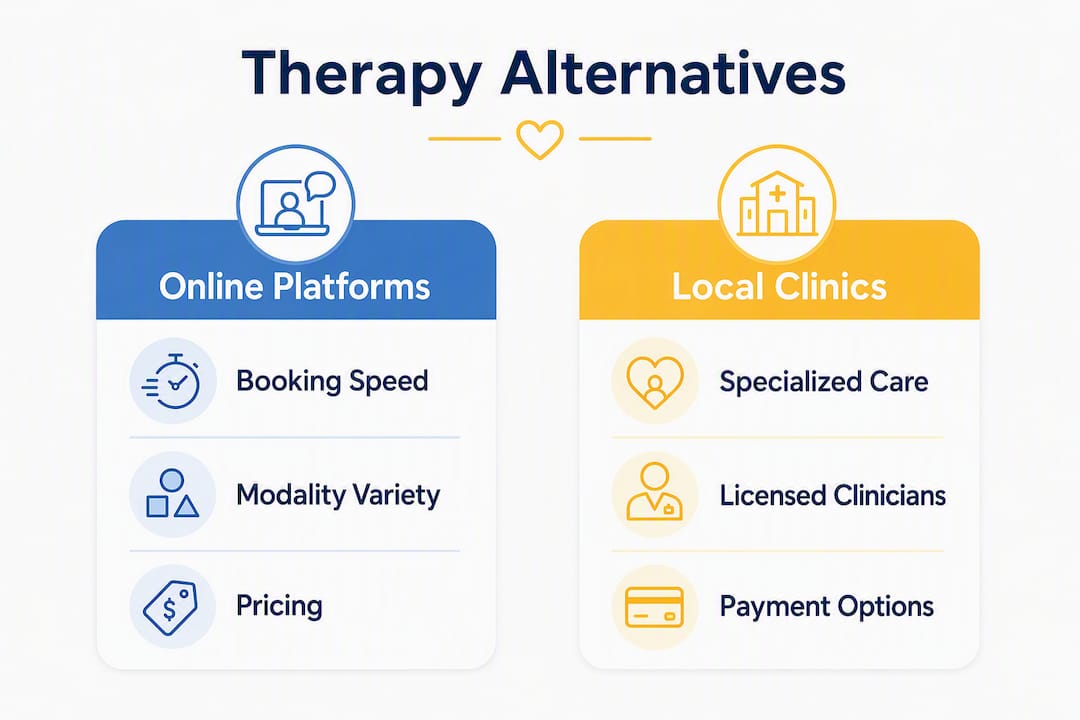
A few practical notes: online platforms book fastest, often same week, but they rarely offer EMDR or structured couples therapy. Community clinics can have waitlists of several weeks. Many long-standing private practitioners now operate hybrid models, so always confirm current in-person hours before assuming availability.
What actually separates these options in ways that matter?
The five dimensions worth comparing are modality, credentials, geography, payment, and booking speed. Most people fixate on cost first, but modality fit is often the bigger lever.
Therapy modality is where the real divergence shows. Therapist profiles list specialties ranging from EMDR and trauma-focused CBT to couples work and eating disorder treatment. A clinician who does everything is not always the right fit for a specific presenting problem. If you’re working through trauma or PTSD, a provider trained in EMDR or somatic approaches will typically move faster than a generalist using supportive talk therapy alone. For short-term anxiety or OCD, structured CBT with homework is the evidence-based standard. Couples work requires specific training in modalities like Emotionally Focused Therapy or the Gottman Method.
Credentials tell you the floor, not the ceiling. An LCSW, LMFT, PhD, or PsyD all indicate a licensed clinician. The difference is training emphasis: PhDs and PsyDs lean toward assessment and research-informed practice; LCSWs and LMFTs often bring more systems-level and relational training. For medication management, you need a psychiatrist (MD or DO) or a psychiatric nurse practitioner, not a therapist.
Geography and access matter more than people admit. Local county association directories list dozens of licensed psychologists searchable by specialty, but always verify whether a clinician is currently accepting in-person clients. Telehealth expands your options statewide, which is a genuine advantage if you live outside a major metro.
Payment options can cut your effective cost significantly. Ask specifically about sliding-scale availability, whether the provider accepts your insurance directly, and whether they issue superbills for out-of-network reimbursement. Verifying HIPAA-compliant telehealth and superbill availability before booking prevents surprises on the billing side.
Non-obvious trust signals to verify before committing:
- Active state license (check your state’s licensing board directly)
- HIPAA-compliant telehealth platform (not just a standard video call)
- Written cancellation and rescheduling policy
- Documented intake process with a clear first-session structure
- No pressure to prepay multi-session packages upfront
Pro Tip: Search the California Board of Behavioral Sciences (BBS) or the California Board of Psychology license lookup before your first call. It takes two minutes and confirms the clinician is in good standing.
For finding a trauma-informed therapist specifically, the modality question is the most important one to ask early.
How do you choose the right alternative quickly?
A brief compatibility call is the industry-standard first contact, and it’s the right place to run a short checklist before paying for a full intake.
Questions to ask on that call:
- What modalities do you use for anxiety, depression, or trauma?
- What does your evidence base look like for my presenting concern?
- How long are sessions, and how often do you recommend meeting?
- What’s your cancellation policy and how much notice do you need?
- Do you accept my insurance, offer sliding scale, or issue superbills for HSA/FSA reimbursement?
Red flags that suggest poor fit or risky practice:
- Can’t confirm their license number or state of licensure
- Vague about what the first session will cover
- No written confidentiality or privacy policy
- Pressure to commit to a long-term package or prepay multiple sessions
- Dismisses your questions about modality or evidence base
A simple decision flow that works for most people: book three sessions with your top candidate, then reassess. Three sessions is enough to evaluate rapport, communication style, and whether the approach feels right. If symptoms are worsening or you feel worse after sessions, escalate sooner rather than waiting.
On cost versus specialization: if your concern is acute trauma, PTSD, or a specific phobia, pay for the specialist. Generalist therapy at a lower rate can feel like progress while not actually moving the needle on the core issue. For general stress, life transitions, or mild anxiety, a sliding-scale generalist is often a perfectly good fit. Use these tips for choosing a therapist in California to sharpen your criteria before the call.
Pro Tip: Ask the therapist directly: “What would you do if I wasn’t making progress after two months?” A good clinician has a clear answer. Vague reassurance is a warning sign.
What should you expect when you first reach out?
Expect a brief compatibility consult, then a first full session that functions as an evaluation and treatment-planning meeting, not a deep dive into your hardest material.

That first session is primarily for fact-gathering and building the therapeutic relationship. A good clinician uses it to understand your history, current symptoms, goals, and any relevant medical or lifestyle factors before designing a treatment plan. You won’t leave with a diagnosis or a complete plan after session one, and that’s appropriate.
The typical timeline:
- Inquiry: Email, contact form, or phone call to confirm availability
- 15-minute consult: Fit check, logistics, basic presenting concern
- First full intake session (50–60 minutes): History, goals, assessment, initial treatment direction
- Sessions 2–3: Deeper assessment, beginning of structured work
What you’ll be asked: current symptoms and duration, relevant personal and family history, previous therapy experience, goals for treatment, and any medical conditions or medications.
What you can ask in return: How will we measure progress? What’s your approach if I feel stuck? How do you handle between-session crises?
The role of assessment in psychotherapy is often underestimated. A structured intake directly shapes how effective the treatment plan will be.
When should you consider a psychiatrist or higher level of care?
Psychotherapy is the right starting point for most anxiety, depression, and relationship concerns. But some situations call for something more.
Seek a psychiatric evaluation when you notice:
- Symptoms severe enough to impair daily functioning (can’t work, sleep, or maintain basic self-care)
- Suicidal ideation or self-harm urges
- Symptoms that suggest psychosis (hallucinations, paranoia, disorganized thinking)
- Rapid mood swings that don’t respond to therapy alone
For immediate safety concerns, the right resources are the 988 Suicide and Crisis Lifeline (call or text 988), your nearest emergency room, or a mobile crisis team if your county offers one. Do not wait for a therapy appointment if you or someone you know is in immediate danger.
Coordinated care between a therapist and a psychiatrist is often the most effective model for moderate-to-severe depression, bipolar disorder, or anxiety with a significant biological component. Your therapist can typically provide a referral or help coordinate with a prescribing provider. For information on how medication and therapy compare as treatment paths, Revivehealththerapy has a practical breakdown.
Why Revivehealththerapy is a practical alternative for Californians
Revivehealththerapy provides evidence-based, trauma-informed psychotherapy with in-person sessions in Oakland, Walnut Creek, and San Francisco, plus secure HIPAA-compliant telehealth available statewide. That combination is genuinely rare among private practices, and it means you’re not locked into one format as your schedule or circumstances change.
Core services and modalities:
- EMDR for trauma and PTSD
- CBT for anxiety, depression, and OCD
- Mindfulness-based approaches for emotional regulation
- Couples therapy for relationship and communication issues
- Child and teen therapy for youth mental health and trauma
- Individual, family, and group therapy across the lifespan
On payment: Revivehealththerapy accepts insurance, HSA/FSA plans, and offers sliding-scale fees for qualifying clients. Superbills are available for out-of-network reimbursement. The intake process follows the standard model: a compatibility consult, then a structured first session focused on assessment and goal-setting.
Pro Tip: When you call or email Revivehealththerapy, have your insurance card, a short list of your main concerns, and one or two goals ready. It speeds the intake conversation and helps the clinician match you to the right therapist from the start.
For families with children or teens, the child and teen therapy services page covers what to expect and how to prepare your child for a first session.
Key Takeaways
The strongest alternatives to drvictorbernstein.com are trauma-informed, licensed clinicians offering EMDR, CBT, or couples therapy, with Revivehealththerapy as the recommended California-based option for in-person and telehealth access.
| Point | Details |
|---|---|
| Start with a 15-minute consult | Every reputable provider offers a short compatibility call; use it to vet modality fit and logistics before paying. |
| Verify credentials before booking | Check the California BBS or Board of Psychology license lookup to confirm active licensure in good standing. |
| Match modality to your concern | EMDR for trauma, structured CBT for anxiety, EFT or Gottman for couples; a generalist is fine for mild stress. |
| Confirm payment options upfront | Ask about sliding scale, insurance, HSA/FSA, and superbills; these details materially affect your total cost. |
| Revivehealththerapy for California | In-person in Oakland, Walnut Creek, and San Francisco; statewide telehealth; sliding scale and insurance accepted. |
What the right fit actually comes down to
The conventional wisdom says to shop for a therapist the way you’d shop for any service: compare credentials, read reviews, check the price. That framing misses something. Therapy outcomes are driven more by the quality of the therapeutic relationship than by any single modality or credential. The research on this is consistent enough that it should change how you approach the search.
What that means practically: a highly credentialed specialist who feels cold or dismissive in the consult is a worse choice than a well-trained generalist you immediately trust. The 15-minute compatibility call exists precisely to test that fit before money changes hands. Use it as a genuine interview, not a formality.
The other thing most guides skip: don’t wait until you’re in crisis to start looking. The time to find a good therapist is when you have the bandwidth to evaluate options carefully, not when you’re already overwhelmed. If you’re researching alternatives now, that’s the right instinct. Act on it while you have the clarity to choose well.
Ready to book with Revivehealththerapy?
Revivehealththerapy offers something the big online platforms can’t: licensed, trauma-informed clinicians who know California’s mental health landscape, available both in-person across the Bay Area and via secure telehealth statewide. You get EMDR, CBT, couples therapy, and child and teen services under one practice, with sliding-scale fees and insurance accepted from the start.
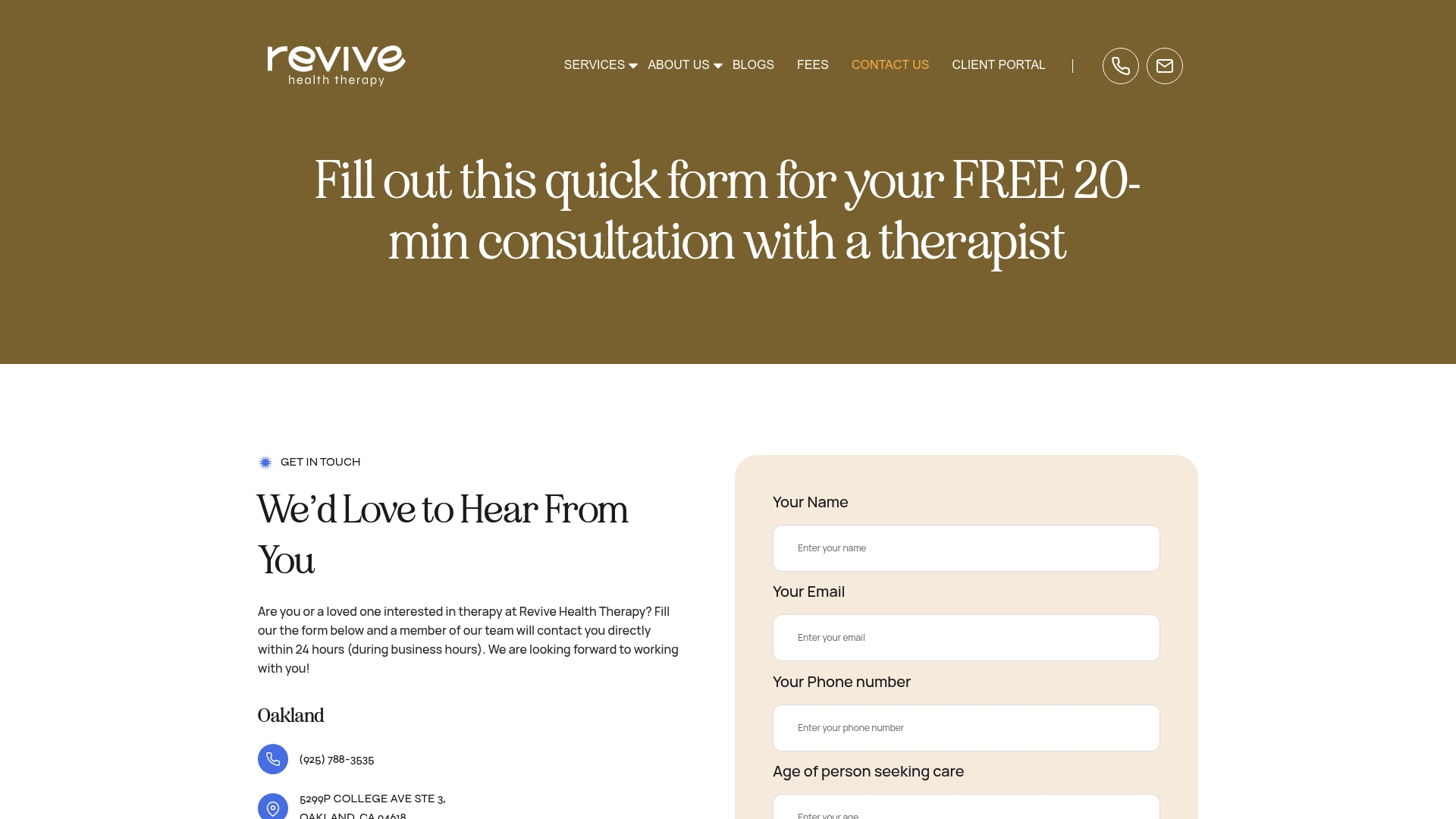
Getting started takes three steps: reach out via the contact form or phone to confirm availability, complete a 15-minute compatibility consult at no charge, then schedule your first full intake session. Have your insurance information, a brief summary of your main concerns, and one or two goals ready for that first call. It makes the intake faster and helps the team match you to the right clinician.
Book your consult or explore services to take the next step today.
This article provides general information about mental health therapy options and is not a substitute for professional clinical advice. Confirm current provider availability, licensing, and treatment fit with a qualified mental health professional.
Useful sources and directories
- Psychology Today Therapist Directory: Searchable profiles with credentials, specialties, insurance accepted, and client reviews; one of the most complete public directories for verifying a clinician’s background.
- Contra Costa County Psychological Association — Find a Psychologist: Local county directory listing licensed psychologists by specialty and location; useful for verifying professional membership and finding Bay Area practitioners.
- WebMD Provider Profile: Public provider pages that summarize specialties, office address, and contact details; helpful for cross-referencing a clinician’s credentials and practice location before booking.