
Resilience is the single most reliable predictor of sustained recovery, and the most useful thing you can do right now is text or call one person who supports you. That one action activates the social scaffolding that research consistently links to lower relapse risk. Three steps to start today:
- Reach out to one supportive person. A text counts. You are not asking for a solution; you are reducing isolation, which is the primary driver of relapse.
- Try one grounding exercise. The 5-4-3-2-1 technique (name five things you see, four you can touch, three you hear, two you smell, one you taste) interrupts a craving cycle in under two minutes.
- Set one small daily routine. A consistent wake time or a ten-minute walk after dinner gives your nervous system a predictable anchor.
Pro Tip: Start with whichever of these three feels least threatening. Research on mechanism-focused resilience training shows that in-the-moment practices build more durable coping than abstract goal-setting, so small and immediate beats ambitious and delayed.
Key Takeaways
Resilience in recovery is a learnable set of skills, not a fixed trait, and building it consistently through social connection, emotional regulation, and structured therapy produces measurable reductions in relapse risk and faster recovery from setbacks.
| Point | Details |
|---|---|
| Resilience is a skill, not a trait | Emotional regulation, social support, and meaning-making can all be trained through deliberate practice. |
| Social connection is the strongest pillar | Higher perceived social support correlates directly with higher resilience scores in abstinent individuals. |
| In-the-moment practices work best | Urge-surfing, grounding, and cognitive reframing used during stress build more durable coping than trait-focused training alone. |
| Track four weekly metrics | Monitor sleep quality, urge frequency, social contacts, and mood to catch stalls before they become crises. |
| Revivehealththerapy provides structured support | EMDR, CBT, and telehealth services in California offer the clinical scaffolding where resilience skills are built and sustained. |
Table of Contents
- What does resilience actually mean in recovery?
- Why resilience matters for addiction and trauma recovery
- What are the core pillars of resilience you need to build?
- How to build resilience with evidence-based strategies
- A practical 4-week resilience plan you can start today
- When should you seek professional support for resilience in recovery?
- How can you tell if your resilience is actually improving?
- Resilience is learnable, and you can start right now
- An editorial perspective on what resilience in recovery really demands
- How Revivehealththerapy supports resilience in recovery
- Sources
What does resilience actually mean in recovery?
Most people picture resilience as toughness, the ability to absorb punishment without flinching. That framing is wrong, and it quietly discourages people in recovery who feel anything but tough.
The Mayo Clinic defines resilience as a set of learnable skills, specifically emotional regulation, social support, and meaning-making, that help people adapt to setbacks and avoid unhealthy coping like substance misuse. It is a process, not a personality type. You are not born with it or without it. You build it, repeatedly, through practice.
In everyday recovery, resilience shows up in concrete, unglamorous moments:
- Feeling a craving spike and using a breathing exercise instead of acting on it
- Calling your sponsor or a friend when shame tells you to stay silent
- Getting back to your sleep schedule after a stressful week derails it
- Reframing a setback (“I slipped, and I can still choose differently tomorrow”) rather than catastrophizing
- Asking a therapist to adjust your treatment plan when the current one is not working
The clinical term for this capacity is psychological resilience, and it overlaps with concepts like emotional flexibility, stress tolerance, and adaptive coping. None of those are fixed. All of them respond to deliberate practice.
Key insight: Resilience is not the absence of pain or struggle. It is the ability to stay engaged with recovery even when both are present.
Why resilience matters for addiction and trauma recovery
The evidence here is direct. A PMC study of abstinent individuals with substance use disorder found that higher resilience scores correlated with lower risk of alcohol relapse, and that perceived social support was strongly associated with resilience in recovery samples. People who have been abstinent for a sustained period tend to show higher resilience scores compared to those in earlier stages of recovery.
Trauma recovery follows a similar pattern. Narrative review evidence shows that resilience, understood as interacting psychosocial and biological resources, is associated with better adaptation after major stressors. Social support and active coping strategies are the two most consistent protective factors across studies.
One nuance worth naming: resilience is not a clinical cure. Frontiers in Neurology notes that resilience functions as a modifier of psychological adjustment and treatment engagement, not a substitute for addressing the biological or structural factors driving addiction or trauma. It helps you stay in treatment, use coping skills under pressure, and persist through setbacks. The underlying work still requires professional support.
Post-traumatic growth, the experience of deeper relationships, clearer priorities, and renewed purpose that many people report after sustained recovery, tends to follow from this kind of integration rather than from simply enduring hardship.
What are the core pillars of resilience you need to build?
Five protective pillars show up consistently across clinical research and consumer-facing recovery guides. Each one is trainable.
- Social connection. Attend one peer support meeting this week, or schedule a call with someone who understands your recovery. Secure relationships provide the scaffolding that makes every other coping skill more effective. Loneliness, by contrast, is one of the strongest barriers to sustained recovery.
- Emotional regulation. Practice a five-minute grounding script daily: slow your exhale to twice the length of your inhale, name the physical sensation you feel, and label the emotion without judging it. These micro-practices build the neural pathways that make regulation automatic under stress. The emotional regulation strategies covered in evidence-based therapy map directly onto this pillar.
- Meaning and purpose. Identify one activity that felt meaningful before addiction or trauma took hold, and schedule fifteen minutes of it this week. Purpose does not need to be grand; it needs to be yours.
- Cognitive flexibility. When a negative thought loops, ask: “What is one piece of evidence that contradicts this?” That single question is the seed of cognitive reframing, a core CBT skill.
- Routines and self-care. Sleep, movement, and nutrition are not soft add-ons. Combining psychosocial interventions with neurobiological support, including sleep hygiene and exercise that regulate the HPA axis, produces measurable improvements in coping and quality of life in clinical populations.
Pro Tip: If you are not sure where to start, ask yourself which pillar feels most depleted right now. Chronic isolation? Start with social connection. Racing thoughts and emotional flooding? Start with regulation. Depleted in all five? Start with one small routine, because predictability restores the baseline that makes everything else possible.
How to build resilience with evidence-based strategies
Recent review evidence in Nature Reviews Psychology argues for shifting resilience training toward mechanisms active during stress exposure rather than only building traits in calm moments. That means the practices below are most valuable when you use them in real time, not just in a therapist’s office.
Grounding and urge-surfing
Grounding interrupts the automatic stress-response cycle. The 5-4-3-2-1 technique described in the opening is one version. Another is the body-scan: starting at your feet, notice physical sensations without trying to change them, moving slowly upward for two to three minutes.

Urge-surfing treats a craving like a wave. You observe it, name its intensity on a scale of 1–10, and track it without acting on it. Most cravings peak and subside within fifteen to twenty minutes. Practicing this repeatedly builds the tolerance that makes relapse less likely.
Cognitive reframing
Write down a recurring negative thought (“I always fail at this”). Then write three specific pieces of evidence that complicate or contradict it. This is not toxic positivity; it is the core of CBT for depression and anxiety and it works by building new associative pathways rather than suppressing the original thought.
Behavioral activation
Depression and trauma often produce withdrawal, which deepens both. Behavioral activation reverses this by scheduling small, pleasurable, or meaningful activities before you feel motivated to do them. Motivation follows action; it rarely precedes it.
Peer support and community
U.S. peer support options include Alcoholics Anonymous (AA), Narcotics Anonymous (NA), SMART Recovery (a secular, CBT-based alternative), and certified peer specialists available through community mental health centers. SAMHSA’s national helpline (1-800-662-4357) connects callers to local treatment and peer support resources at no cost, 24/7. Peer support therapy is also available as a structured clinical service.
A compact relapse-prevention checklist to keep accessible:
- Identify your top three triggers and write them down
- Name two people you will call before acting on a craving
- Keep a grounding script on your phone
- Schedule at least one peer support contact per week
- Review your sleep and eating patterns every Sunday
- Have your therapist’s or crisis line’s number saved
A practical 4-week resilience plan you can start today
This plan draws on the HelpGuide framework for stepwise resilience-building and the clinical evidence for combining psychosocial and neurobiological supports.
| Week | Core Activity | What to Monitor |
|---|---|---|
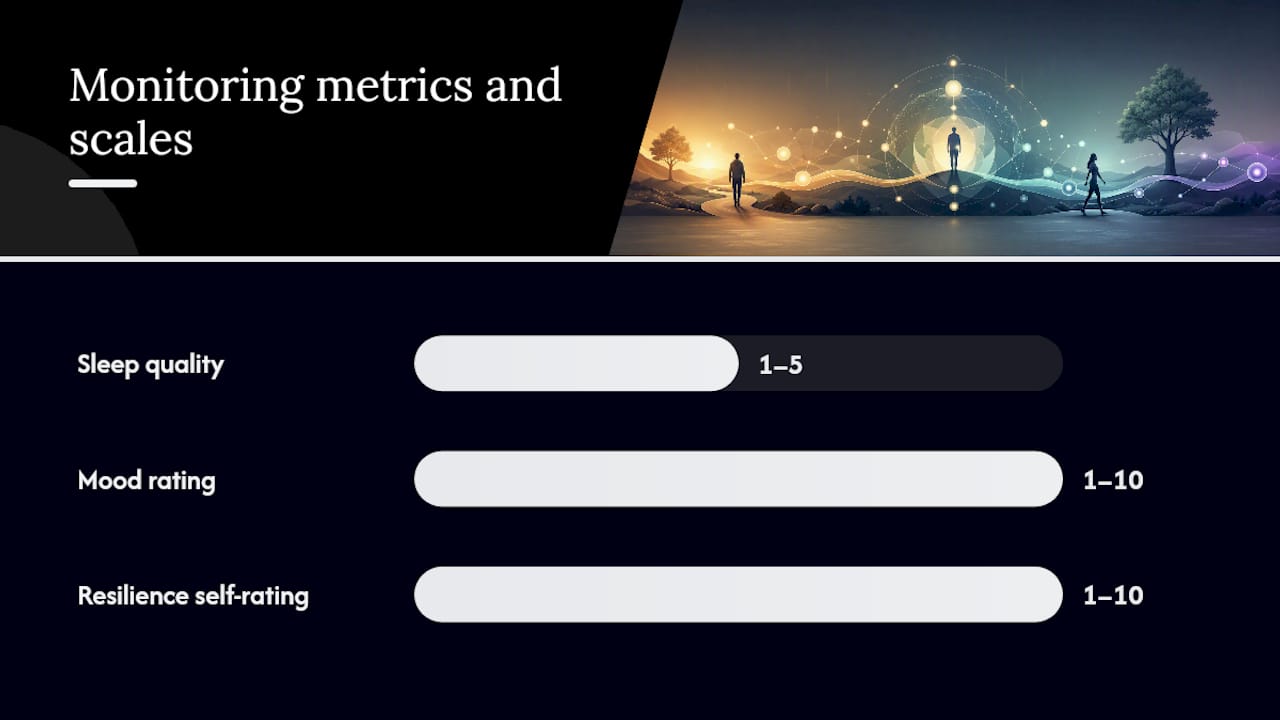
| 1 | Establish one daily routine (consistent wake time + 10-min walk); practice grounding once daily | Sleep quality (rate 1–5 each morning); number of urges and their peak intensity |
| 2 | Add one peer support contact (meeting, call, or text); begin a brief mood log | Social contacts made; mood rating morning and evening (1–10) |
| 3 | Introduce cognitive reframing: write one thought record per day; add behavioral activation (one meaningful activity) | Thought record completion; activity completion; urge frequency vs. Week 1 |
| 4 | Review all four practices; identify which felt most protective; plan how to sustain them | Overall resilience self-rating (1–10); compare sleep, mood, and urge trends across four weeks |
Pro Tip: When progress stalls, reduce the dose rather than abandoning the practice. If daily thought records feel impossible during a high-stress week, do one every three days. Consistency at a lower intensity beats perfection followed by dropout. Use the emotional wellness checklist to track adherence and spot patterns before they become crises.
When should you seek professional support for resilience in recovery?
Resilience-building skills are powerful, and they have limits. Some situations require professional clinical support, not just self-directed practice.
Seek help promptly if you notice:
- Cravings that are escalating in frequency or intensity despite using coping skills
- Suicidal thoughts, self-harm urges, or feelings of hopelessness that persist beyond a few days
- Inability to maintain basic daily routines (eating, sleeping, hygiene) for more than a week
- Trauma symptoms (flashbacks, nightmares, hypervigilance) that are worsening rather than stabilizing
- Relapse after a period of sobriety, especially if accompanied by shame or isolation
Therapy types most relevant to resilience in recovery:
- CBT (Cognitive Behavioral Therapy): Targets the thought patterns and behavioral cycles that maintain addiction and trauma responses. Strong evidence base for both conditions.
- DBT (Dialectical Behavior Therapy) skills training: Adds distress tolerance and interpersonal effectiveness to CBT’s core, particularly useful when emotional dysregulation is severe.
- EMDR (Eye Movement Desensitization and Reprocessing): Processes traumatic memories that drive avoidance and substance use. EMDR therapy is one of the most evidence-supported treatments for trauma-related conditions.
- Strengths-based therapy: Builds on existing capacities rather than focusing only on deficits; supports the meaning and purpose pillar of resilience.
- Group therapy and peer specialists: Provide social scaffolding and lived-experience modeling that individual therapy alone cannot replicate.
Pro Tip: Before your first session, write down three things: what you most want to change, what has already helped even a little, and one question about how the therapist works. Asking about their approach to trauma-informed care, session format, and sliding-scale or telehealth options upfront saves time and sets realistic expectations. Finding a therapist who offers flexible access matters as much as the modality.
How can you tell if your resilience is actually improving?
Progress in resilience is not always visible from the inside. These observable signs suggest it is building:
- Cravings arrive but pass more quickly, and you use a coping skill rather than white-knuckling through
- After an emotional setback, you return to baseline faster than you did three months ago
- You reach out for support before a crisis rather than after
- Daily routines hold even when life gets stressful
- You can name what you are feeling without immediately acting on it
Three self-tracking questions to ask weekly:
- Did I use at least one coping skill this week when I felt triggered?
- Did I maintain contact with at least one supportive person?
- Did I keep my core routine (sleep, movement) on at least five of seven days?
For a more structured measure, the Connor-Davidson Resilience Scale (CD-RISC) is a validated 25-item self-report tool used in clinical research and practice to quantify resilience over time. It is most useful when reviewed with a clinician who can contextualize scores against your specific recovery history. Narrative review evidence confirms that resilience trajectories vary significantly by individual, which is exactly why a clinician’s interpretation of a scale score adds more value than the number alone.
Resilience is learnable, and you can start right now
The evidence is clear: resilience is not something you either have or lack. It is a set of skills that accumulates with practice, even when progress feels invisible from the inside.
Your micro-action for today: send one text to someone who supports your recovery. Not a long message. Just contact. That single act touches the social connection pillar, which research identifies as the most consistent protective factor across addiction and trauma recovery.
When self-directed practice is not enough, asking for professional support is not a sign that resilience has failed. It is the most resilient thing you can do.
An editorial perspective on what resilience in recovery really demands
The clinical literature on resilience is compelling, but there is a gap between what the research describes and what people in recovery actually experience day to day. The research talks about “adaptive processes” and “psychosocial resources.” People in recovery talk about getting through Tuesday.
What I find most honest about the current evidence is this: the framing of resilience as “bouncing back” has done real harm. It implies a return to a previous self, which is neither possible nor desirable after serious addiction or trauma. The more accurate picture, supported by both clinical observation and the integration-focused research, is that recovery builds a different self, one with a broader capacity for difficulty precisely because of what has been survived and processed.
The practical implication is that small, consistent actions matter more than dramatic turning points. A person who texts their sponsor every Tuesday, does a five-minute grounding practice most mornings, and shows up to therapy even when they do not feel like it is building more durable resilience than someone waiting for a moment of transformation. Pacing matters. Setting a goal you can hit on your worst week, not your best, is the actual skill.
The other thing the research underplays: professional support is not a crutch. It is the mechanism. CBT, EMDR, and DBT are not just tools for crisis management; they are the structured environments where resilience skills get practiced under conditions close enough to real stress to actually transfer. Self-help practices are valuable, and they work best when they are scaffolded by clinical support.
How Revivehealththerapy supports resilience in recovery
Revivehealththerapy offers the specific therapy modalities that the evidence in this article points toward: EMDR for trauma processing, CBT for cognitive restructuring and relapse prevention, and mindfulness-based approaches that address the neurobiological side of stress regulation. Services are available in person at Oakland, Walnut Creek, and San Francisco, and via secure telehealth statewide in California.
Affordability is built into the model. Sliding-scale fees, insurance acceptance, and HSA/FSA eligibility mean that cost is less likely to be the reason you delay starting. A first session typically begins with an assessment of your current stressors, recovery history, and goals, followed by a collaborative decision about which therapy approach fits your situation.
If you are ready to move from self-directed practice to structured clinical support, explore the mental health services for adults at Revivehealththerapy and book an intake session.
Sources
- Resilience among Abstinent Individuals with Substance Use Disorder – PMC
- Towards mechanism-focused and scalable resilience interventions | Nature Reviews Psychology
- Surviving Tough Times by Building Resilience – HelpGuide
- Harnessing resilience in patient treatment and long-term recovery: Psychosocial and neurobiological pathways to enhanced outcomes
Recommended
- Role of Therapy in Trauma Recovery: Evidence and Impact – ReviveHealthTherapy
- A beginner’s guide to trauma recovery: Steps for healing – Revive Health Therapy
- Trauma Recovery Strategies List: Proven Methods That Work – Revive Health Therapy
- Why Use Strengths-Based Therapy for Lasting Recovery – Revive Health Therapy