
Kaiser reimburses therapy in two reliable ways, and neither one is “pay out-of-pocket and hope for the best.” The first is an authorized external referral, which gets your outside care covered before you spend a dollar. The second is the Member Reimbursement Form or, for a specific group of members, the U.S. Department of Labor settlement claims process for out-of-network behavioral health payments made without prior authorization.
Kaiser’s HMO structure is built around in-network care, so self-referring to a therapist outside that network almost always gets denied on the back end. That’s the trap most people fall into.
- Need care now? Ask Kaiser for an authorized external referral instead of booking outside on your own.
- Already paid out-of-network? Pull together your Member Reimbursement Form paperwork or check your eligibility for the settlement portal.
- Kaiser’s settlement requires the plan to identify members who couldn’t get timely in-network behavioral health care and reimburse eligible out-of-pocket costs for dates of service starting January 1, 2021.
Key Takeaways
Kaiser reimburses therapy reliably only through an authorized external referral secured before care starts or through the DOL/EBSA settlement claims process for documented network-access failures.
| Point | Details |
|---|---|
| Get authorized first | Request an external referral from Kaiser before booking outside care to avoid automatic denial. |
| Standard reimbursement needs proof | The Member Reimbursement Form requires a superbill with NPI, CPT/ICD-10 codes, and proof of payment. |
| Settlement covers a specific group | Members who couldn’t access timely in-network care from January 1, 2021 onward may qualify via OutofNetworkHealthClaims.com. |
| Documentation wins appeals | Scheduling logs and clinician letters are the strongest evidence in denials and settlement claims. |
| Care doesn’t have to wait | Revivehealththerapy offers sliding-scale, HSA/FSA-accepted therapy with superbills to support your Kaiser claim. |
This article is general information, not a substitute for advice from a qualified doctor. Consult a qualified healthcare professional about your own circumstances before acting on anything here.
Table of Contents
- How Does Kaiser Therapy Reimbursement Actually Work?
- What Documents Does Kaiser Require for Reimbursement?
- Who Qualifies for the Kaiser Out-of-Network Settlement?
- How Do You Get an Authorized External Referral Now?
- What If Kaiser Denies Your Reimbursement or Referral Request?
- What People Get Wrong About This Process
- Where ReviveHealthTherapy Fits While You Sort Out Coverage
- Sources
How Does Kaiser Therapy Reimbursement Actually Work?
Reimbursement is not automatic just because you paid a licensed therapist. Standard Kaiser policy requires that the service be eligible under your specific plan and that you’ve already paid the provider directly.
Kaiser strongly favors in-network care, and its reimbursement review leans hard on that preference. If you never asked for an authorized referral and instead found your own out-of-network clinician, the claim gets denied more often than it gets paid, per Kaiser’s own external referral guidance.
The settlement changes the calculus for a specific group. Members who tried, and failed, to get timely or clinically appropriate in-network behavioral health care between January 1, 2021, and the settlement’s covered period may qualify for reimbursement even without prior authorization, according to settlement documents filed with the Department of Labor.
A few things shape whether either path applies to you:
- Plan type matters. Employer-sponsored Kaiser plans, individual marketplace plans, and Medi-Cal managed care each carry different referral and reimbursement rules.
- Your Evidence of Coverage is the actual contract. It spells out what “eligible service” means for your specific plan, not the general Kaiser website.
- Timing matters for the settlement. The window is tied to dates of service, not to when you eventually file.
- In-network attempts need to be documented, whether you’re pursuing a standard reimbursement claim or a settlement claim.
What Documents Does Kaiser Require for Reimbursement?
Use the Member Reimbursement Form only after you’ve already paid your provider. If you haven’t paid yet, ask the provider’s office to bill Kaiser directly using a CMS 1500 or UB-04 claim form. That route skips the reimbursement paperwork entirely and puts the burden on the provider’s billing staff instead of you.
If you’re filing for money you already spent, here’s the sequence that avoids a bounced claim:
- Get a complete superbill or itemized provider bill. It needs the therapist’s name and credentials, their National Provider Identifier (NPI), CPT codes (commonly 90834 or 90837 for individual psychotherapy), an ICD-10 diagnosis code, dates of service, and the amount billed.
- Collect proof of payment. A receipt, a bank or credit card statement, or copies of canceled checks all work. Kaiser’s form requires this alongside the bill, not instead of it.
- Sign the form. An unsigned submission is one of the most common reasons a reimbursement request stalls before anyone even reviews the clinical details.
- File a separate form for each reimbursement request. Kaiser’s Northwest region instructions are explicit on this: don’t bundle multiple dates of service or multiple providers onto one form.
- Attach a Power of Attorney if you’re filing on behalf of another adult, such as a parent submitting for an adult child’s care.
- Keep legible scans and the originals. Blurry phone photos of receipts are a frequent cause of processing delays.
Kaiser’s own provider payment policies note that adjudication depends on eligibility, benefit limits, and the plan’s fee schedule, meaning a technically complete form can still be reduced or denied if the billed codes fall outside your plan’s covered benefit.
Pro Tip: Ask your therapist’s billing office for the superbill before you leave the last session of the month. Getting NPI and CPT codes correct the first time saves weeks compared to a resubmission after a rejected claim.
Who Qualifies for the Kaiser Out-of-Network Settlement?
The Department of Labor settlement created a two-phase process specifically for members who paid for out-of-network behavioral health care because in-network access failed them. Phase one identifies eligible enrollees; phase two adjudicates the actual claims, according to the settlement agreement filed with EBSA.
You’re likely in scope if you tried to get timely or clinically appropriate mental health care inside Kaiser’s network between January 1, 2021, and the settlement’s covered period, couldn’t get it, and paid an outside provider yourself. Kaiser was required to send notices to identified members, and many of those notices carry a 180-day submission window from the date of notice.
The settlement’s own language draws a sharp line: this process exists for members who attempted in-network care and hit a wall, not for anyone who simply preferred an outside therapist. That distinction decides who gets paid and who gets a denial letter.
Submissions go through www.OutofNetworkHealthClaims.com, the dedicated portal built for this claims process, separate from Kaiser’s standard Member Reimbursement Form.
Before you submit anything through that portal, read the fine print. Accepting settlement reimbursement can mean waiving your right to pursue additional legal claims for that same care later. If your out-of-pocket costs were substantial or your case involves an ongoing dispute with Kaiser, it’s worth reading the settlement FAQs in full, or talking to someone who understands the waiver language, before you click submit.
How Do You Get an Authorized External Referral Now?
Don’t wait on a settlement check if you need therapy this week; improving mental health care starts by enhancing psychiatric help accessibility through evidence-based mental healthcare. The faster, more reliable path is an authorized external referral, and it starts with paperwork you control.
- Log every scheduling attempt. Write down the date, the time, who you spoke with, and what you were told, every single time you try to book with an in-network Kaiser therapist.
- Call Member Services and your primary care provider. Tell them plainly that you’ve been unable to get a timely in-network appointment and ask for an external referral.
- Ask specifically for a contracted external provider or a single-case agreement. Kaiser can authorize coverage for clinicians who hold a contract with the plan even when they’re not Kaiser employees.
- Follow up in writing. A phone call is easy to lose track of. An email or portal message creates a paper trail if you need to appeal later.
The reason this matters so much: Kaiser’s own external referral FAQs state that uncontracted clinicians are rarely reimbursed, no matter how good their paperwork looks. The referral has to happen on the front end.
Pro Tip: Keep your scheduling log in a single running document, not scattered texts or voicemail transcripts. If you end up appealing a denial, that log becomes your strongest piece of evidence that in-network care wasn’t available when you needed it.

What If Kaiser Denies Your Reimbursement or Referral Request?
A denial is not the end of the road. Start with Kaiser’s internal appeal process, and lean on the same documentation that would support a settlement claim: a clinician letter and an updated treatment plan tend to carry the most weight, because they explain medical necessity in terms Kaiser’s reviewers are trained to evaluate.
- Keep every superbill, receipt, and call log from the start of your search for care, not just the ones tied to the denied claim.
- Track appeal and grievance deadlines carefully; missing a window can close off a claim that otherwise had merit.
- While an appeal is pending, telehealth options or a sliding-scale therapist can bridge the gap without waiting on Kaiser’s timeline.
- HSA or FSA funds can cover interim sessions if your plan allows it, buying you time without draining a savings account.
Pro Tip: A clinician letter that spells out exactly why in-network follow-up wasn’t available within a clinically reasonable timeframe is often the single document that flips a denial on appeal.
What People Get Wrong About This Process
Most advice on this topic treats Kaiser reimbursement like a paperwork problem: fill out the right form, attach the right codes, and the check shows up. That’s backwards. The paperwork only works if the access problem happened first and got documented in real time.
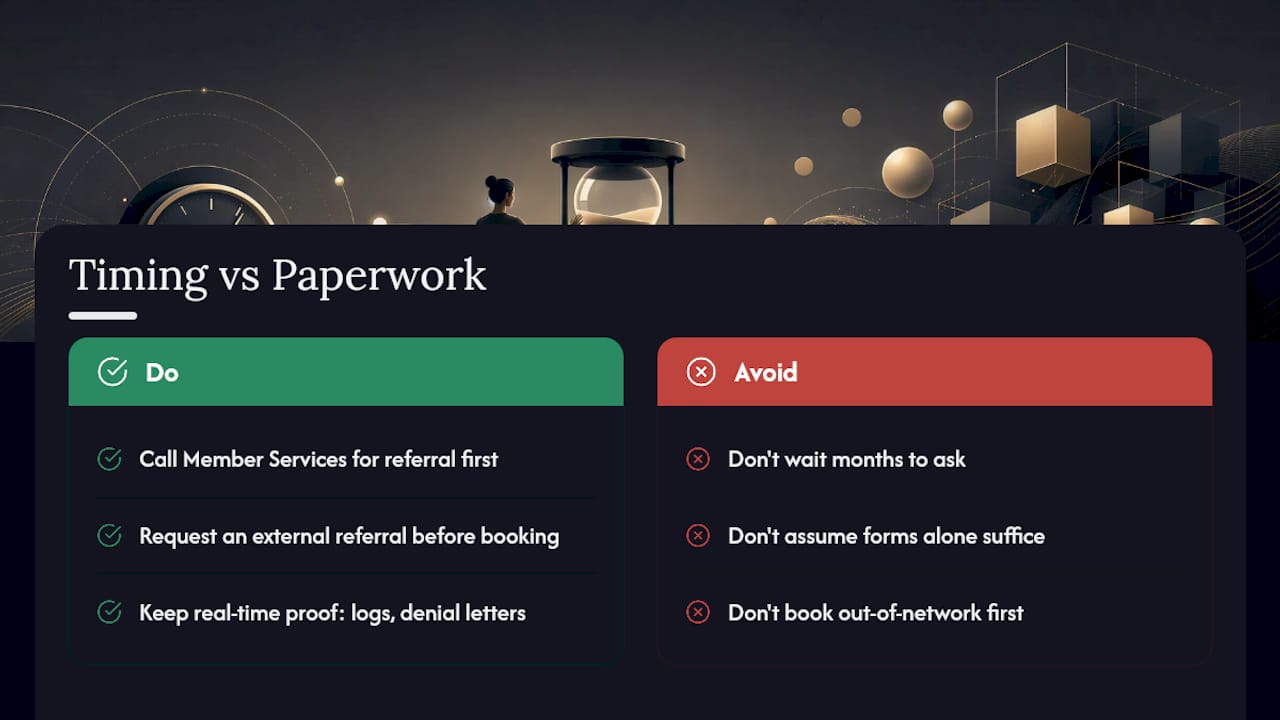
I’d argue the bigger failure point is timing, not forms. People wait until after they’ve paid for six months of out-of-network therapy to start asking whether Kaiser will cover any of it. By then, there’s no scheduling log, no denial letter, no paper trail showing they tried the in-network route first. The settlement process exists precisely because Kaiser failed a lot of members this way, and it rewards people who can prove the attempt, not just the payment.
If you take one thing from this, make it this: call Member Services and ask for an external referral before you book anywhere else. It costs you a phone call. Skipping it can cost you the entire reimbursement.
— Amy
Where ReviveHealthTherapy Fits While You Sort Out Coverage
Waiting on a Kaiser referral decision or a settlement claim doesn’t mean your mental health has to wait too. Revivehealththerapy offers evidence-based therapy, including EMDR, CBT, and mindfulness-based approaches, with in-person sessions in Walnut Creek and Oakland and secure telehealth available statewide across California.
Revivehealththerapy accepts HSA and FSA payments and offers sliding-scale fees based on income, so cost doesn’t have to be the reason you delay care while paperwork moves through Kaiser’s system. If you’re pursuing reimbursement, Revivehealththerapy can also provide superbills with the NPI, CPT codes, and diagnosis information Kaiser’s Member Reimbursement Form requires, whether or not your claim ultimately gets approved. The practical move: verify your Kaiser benefits, request a superbill upfront, and keep a record of any prior attempts to get in-network care. Then reach out to book a session and get care moving now instead of waiting on a claims decision.
Sources
- Member Reimbursement Form (Kaiser Permanente)
- U.S. Department of Labor news release — Kaiser settlement (EBSA)
- Settlement Agreement and Release (Department of Labor / EBSA)
- Kaiser Permanente — Mental health external referral FAQs
Recommended
- Types of Therapy Covered by Insurance: 2026 Guide – Revive Health Therapy
- Insurance and Therapy: Impact on California Families – ReviveHealthTherapy
- Navigating Insurance for Child Therapy: A Parent’s Guide – Revive Health Therapy
- Insurance & Mental Health Access: 85% CA Telehealth Coverage – ReviveHealthTherapy