
You can often get partial reimbursement for out-of-network care from PPO and POS plans. You pay the provider up front, submit a superbill, and your insurer pays a portion based on its own allowed amount rather than what your provider charged. HMO and EPO plans usually skip this benefit entirely and leave you with the full bill.
Here’s the version most people actually experience: you see a therapist, doctor, or specialist who isn’t contracted with your insurer, hand over a card or check at the visit, then request a document called a superbill. You send that superbill to your insurance company. Weeks later, a check or direct deposit shows up for less than you paid, and an Explanation of Benefits (EOB) arrives explaining the math.
Three things determine your outcome: whether your plan has out-of-network benefits at all, whether you’ve met a separate out-of-network deductible, and what your insurer decides is the “allowed amount” for that service. The No Surprises Act also protects you from certain surprise bills, particularly in emergency situations, and creates a Federal Independent Dispute Resolution (IDR) process when providers and insurers can’t agree on payment.
Quick orientation before you dive in:
- PPO and POS plans typically reimburse out-of-network care; HMO and EPO plans typically do not.
- You pay the provider directly, then file a claim yourself using a superbill.
- Reimbursement commonly lands between 50% and 80% of the insurer’s allowed amount, not 50 to 80% of what you actually paid.
- Payment usually arrives within 2 to 6 weeks of a clean submission.
Reimbursement rates vary by plan, but expect the insurer’s allowed amount, not your provider’s fee, to set the ceiling on what comes back to you.
Key Takeaways
Getting reimbursed for out-of-network care depends on your plan type, your deductible status, and the insurer’s allowed amount, not on what your provider actually charged.
| Point | Details |
|---|---|
| Check your plan type first | PPO and POS plans typically offer out-of-network reimbursement; HMO and EPO plans usually don’t. |
| Understand the allowed amount | Insurers pay coinsurance on their own allowed amount, not your provider’s billed fee, creating a balance-billing gap. |
| Submit clean superbills monthly | Include CPT, ICD-10, NPI, tax ID, credentials, and fee to avoid the most common rejection causes. |
| Know your appeal path | Internal appeal comes first, then external review; Federal IDR applies specifically to No Surprises Act disputes, not routine denials. |
| Ask providers about billing support | Revivehealththerapy issues superbills, accepts HSA/FSA, and offers sliding-scale fees to close the reimbursement gap. |
Table of Contents
- What Is Out-of-Network Reimbursement and When Does It Apply?
- How Much Will You Actually Get Back?
- How to Submit an Out-of-Network Claim
- What to Do If Your Claim Is Denied
- Special Situations: Telehealth, Medicare, Medicaid, and Marketplace Plans
- Your Pre-Booking and Post-Visit Checklist
- How Therapy Practices Support the Reimbursement Process
- Deciding Between Out-of-Network Care and Waiting for an In-Network Match
- Get Help With Superbills and Billing Questions
- Where to Verify the Rules Yourself
- Sources
What Is Out-of-Network Reimbursement and When Does It Apply?
Out-of-network reimbursement is the process where your insurance company pays you back (or pays your provider directly, less often) for care received from a provider who has no contract with your plan. The key phrase is “has no contract.” An in-network provider agrees to accept a negotiated rate; an out-of-network provider sets their own fee, and your insurer has no obligation to pay it in full.
Whether this applies to you at all comes down to plan type. PPO (Preferred Provider Organization) and POS (Point of Service) plans generally include out-of-network benefits, though usually with higher deductibles and coinsurance than in-network care. HMO (Health Maintenance Organization) and EPO (Exclusive Provider Organization) plans typically exclude out-of-network coverage completely, except for genuine emergencies. If you have an HMO and you see an out-of-network therapist for a routine visit, you’re very likely paying the entire bill with no reimbursement path.
How insurers calculate what they’ll pay
Insurers don’t reimburse based on your provider’s invoice. They reimburse based on an internally calculated figure called the allowed amount, sometimes labeled UCR (usual, customary, and reasonable) or MAC (maximum allowable charge). This number reflects what the insurer considers a reasonable fee for that service in your geographic area, and it’s almost always lower than what an out-of-network specialist actually charges. That gap between your provider’s fee and the insurer’s allowed amount becomes your responsibility, a dynamic known as balance billing.
Once the allowed amount is set, two more variables shape your check: your out-of-network deductible (a separate, usually higher, threshold from your in-network deductible) and your coinsurance percentage for out-of-network services. You pay 100% of costs until the deductible is met, then your coinsurance kicks in on the allowed amount.
The superbill: your one required document
A superbill is an itemized receipt your out-of-network provider gives you after each visit, and it’s the document your insurer needs to process a claim. A valid superbill includes:
- The date of service and type of session (individual, family, or couples therapy, for instance).
- CPT codes describing the specific procedure performed.
- ICD-10 diagnosis codes justifying medical necessity.
- The provider’s National Provider Identifier (NPI) and tax ID number.
- The provider’s license or credential type (LMFT, LCSW, PhD, and so on).
- The total fee charged for the session.
Missing any one of these fields is the single most common reason claims bounce back for correction, adding weeks to your timeline.
Pro Tip: Ask your provider to email superbills monthly rather than waiting until year’s end. Insurers enforce timely-filing deadlines, often 90 days to a year from the date of service, and a backlog of superbills is how people accidentally forfeit reimbursement they were entitled to.
How Much Will You Actually Get Back?
The honest answer is: less than you paid, and often less than you’d guess from your plan’s summary of benefits. Here’s the arithmetic insurers actually run.
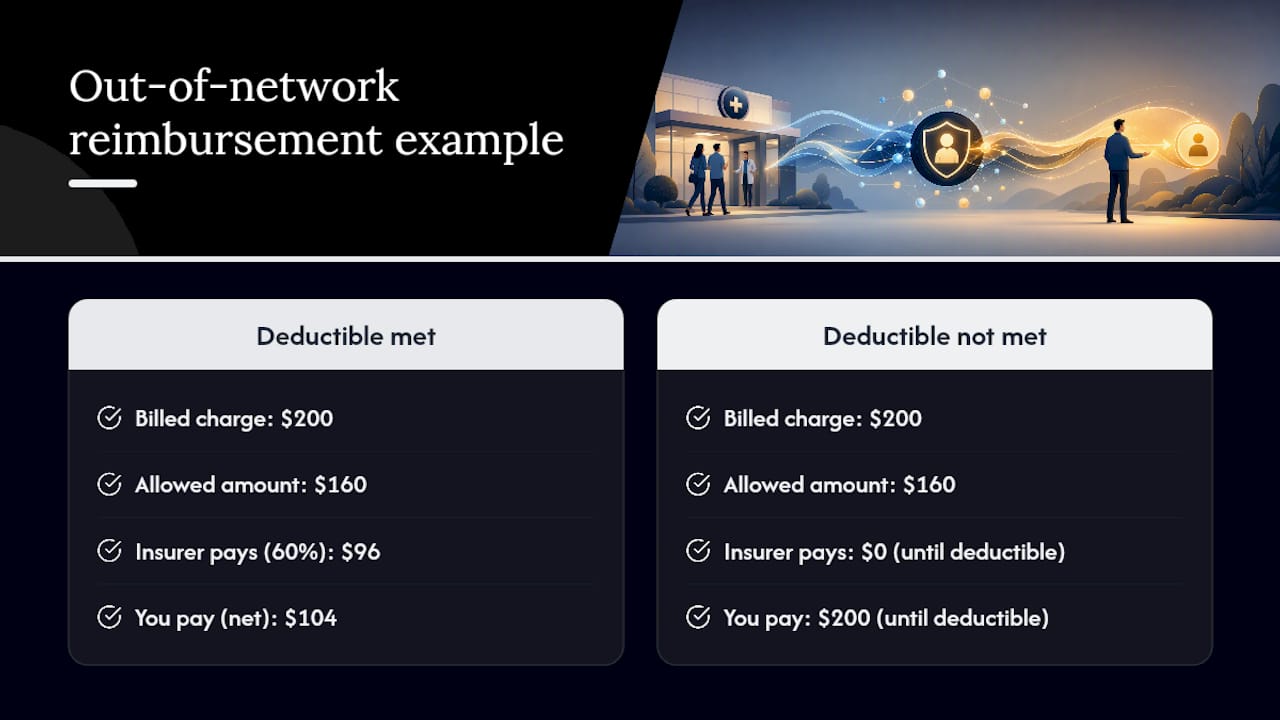
Say your therapist charges $200 for a session. Your insurer’s allowed amount for that CPT code is $160. If your out-of-network deductible is already met and your plan pays 60% coinsurance for out-of-network care, the insurer pays 60% of $160, which is $96. You’ve paid $200 out of pocket and received $96 back, for a net cost of $104, not the $80 you might expect if you assumed coinsurance applied to the billed charge.
If your deductible hasn’t been met yet, none of that $96 shows up until you’ve paid enough out-of-network costs to clear the deductible first. This is where people get blindsided: they assume their in-network deductible and out-of-network deductible are the same number, when plans frequently set the out-of-network figure two to three times higher.
Scenario comparison
Notice the last row: charging more doesn’t get you more reimbursement once you’re above the allowed amount. The insurer pays coinsurance on $160 regardless of whether the provider billed $200 or $250. The extra $90 is pure balance billing, and it’s yours to cover.
What doesn’t count toward your caps
Here’s a detail that surprises a lot of people: money spent on out-of-network care frequently does not count toward your in-network out-of-pocket maximum. Healthcare notes that federal out-of-pocket maximum protections apply to in-network essential health benefits, and many plans simply exclude out-of-network spending from that cap altogether, or track it against a separate, higher out-of-network maximum. If you’re leaning on out-of-network therapy for months, ask your insurer directly whether that spending applies to any cap at all, because for some plans, it never will.
How to Submit an Out-of-Network Claim
Filing a clean claim the first time is the difference between a check in three weeks and a frustrating round of resubmissions. Here’s the sequence that works.
- Request the superbill immediately after your appointment, while the visit is fresh and the provider can verify codes accurately rather than reconstructing them from memory later.
- Check every required field: date of service, CPT code, ICD-10 code, NPI, tax ID, credential, and fee. A superbill missing even the NPI gets rejected.
- Log into your insurer’s member portal and look for a claims submission or reimbursement request tool. Most major insurers now accept a photo or PDF upload directly through the portal, which is the fastest channel.
- If no portal option exists, use the paper claim form listed on your insurer’s website, attach the superbill, and mail it. Certified mail with tracking is worth the extra few dollars for anything over a few hundred dollars in fees.
- Note the timely-filing deadline printed in your plan documents, typically 90 days to 12 months from the date of service, and submit well before it.
- Keep a copy of everything you send, including the date mailed or uploaded.
Before you submit anything, it’s worth calling the member services number printed on your insurance card to confirm your plan actually has out-of-network benefits and to ask what the allowed amount is for your specific CPT code. Insurer directories are notoriously unreliable about network status, so a phone call beats trusting the website.
What arrives after submission is an Explanation of Benefits, not a bill. Your EOB shows the billed amount, the allowed amount, what you owe, what was applied to your deductible, and what the insurer paid. Payment itself typically comes as either a paper check mailed to you or direct deposit if you’ve set that up through the portal, and most clean claims process in 2 to 6 weeks.
A few habits protect you long-term:
- Submit claims monthly rather than batching a year’s worth at once.
- Save digital copies of every superbill and EOB in one folder.
- Track your out-of-network deductible progress yourself, since insurer portals sometimes lag behind actual claims processed.
What to Do If Your Claim Is Denied
Denials happen for mundane reasons far more often than for dramatic ones. Read the denial reason code on your EOB first, because most rejections trace back to a missing NPI, a diagnosis code that doesn’t match the treatment, a lapsed timely-filing window, or a service the plan simply excludes.
Your first move is an internal appeal, filed directly with your insurer. A strong appeal includes a corrected superbill if the original had an error, a letter of medical necessity from your provider explaining why the treatment was clinically appropriate, and a clear, written statement of what you’re asking the insurer to reconsider. Internal appeals typically need to be filed within 180 days of the denial, though this varies by plan, so check your specific denial letter for the exact deadline.
If the internal appeal fails, you’re entitled to an external review, an independent evaluation by a reviewer outside your insurance company. External reviews generally take up to 45 days for standard requests, but expedited review is available when a delay would seriously jeopardize your health, cutting that timeline to as little as 72 hours.
- Internal appeal: filed with your insurer, use medical necessity documentation.
- External review: independent, outside evaluator, standard or expedited timelines.
- Federal IDR: applies to qualifying disputes under the No Surprises Act, not every denial.
- State complaint process: your state insurance commissioner is a parallel option in many cases.
Federal IDR is a different animal entirely, and it’s not the right tool for most everyday reimbursement disputes. It exists specifically for payment disagreements between providers and health plans under the No Surprises Act, usually triggered after a surprise bill for emergency care or certain out-of-network services at in-network facilities. The process opens with a 30-business-day open negotiation period between the provider and the plan. If that fails, either party can initiate the IDR process, where a certified IDR entity reviews both sides’ final offers and picks one, a binding “baseball arbitration” style decision. This route generally isn’t available for a routine denied outpatient therapy claim; it’s built for the higher-stakes surprise billing scenarios the law targets. Some states run their own version of this dispute process for plans not regulated at the federal level, so the exact route depends partly on where you live and what kind of plan you have.
Pro Tip: If you genuinely didn’t know your provider was out-of-network, CMS has a specific Action Plan for that exact situation, walking you through requesting an in-network rate exception and filing a complaint if the insurer won’t budge.
Special Situations: Telehealth, Medicare, Medicaid, and Marketplace Plans
Not every plan and not every service follows the standard rulebook above.
- Telehealth claims need the correct place-of-service code (typically 02 or 10, depending on where the patient was located during the session) on the superbill, alongside the usual CPT and ICD-10 codes; get this wrong and the claim often bounces even if everything else is correct.
- Medicare generally doesn’t offer out-of-network reimbursement the way commercial PPOs do; Original Medicare works with providers who accept Medicare assignment, and Medicare Advantage plans set their own out-of-network rules that vary by carrier. Medicare is the authoritative source for your specific plan’s terms.
- Medicaid rules differ significantly by state, since each state administers its own program with its own network and reimbursement policies; out-of-network coverage under Medicaid is the exception, not the norm.
- Marketplace plans sometimes exclude out-of-network spending from the federal out-of-pocket maximum entirely, meaning you could hit what feels like your cap and still be billing against a separate, uncapped out-of-network track.
- Single-case agreements let you request that your insurer treat a specific out-of-network provider as in-network for a defined course of treatment, often used when a specialist’s expertise, like trauma-focused EMDR, isn’t available in-network. You typically request this by having your provider’s office contact the insurer’s case management or network department directly.
State law also plays a bigger role here than most people realize. A handful of states extend surprise billing protections and payment-dispute rules beyond what the federal No Surprises Act covers, particularly for state-regulated health plans that aren’t subject to federal ERISA rules. If you’re unsure which framework governs your plan, your state’s Department of Insurance is a faster answer than guessing.
Your Pre-Booking and Post-Visit Checklist
A few minutes of homework before your first appointment saves weeks of billing confusion later.
- Call member services and ask three specific questions: Do I have out-of-network benefits? What’s my out-of-network deductible, and how much have I met? What’s the allowed amount for CPT code [your expected code]?
- Ask the provider directly whether they issue superbills automatically or only on request, and how quickly they can turn one around after a session.
- Confirm the provider’s NPI and tax ID are current, since a stale number is a surprisingly common cause of rejected claims.
- Set a submission cadence, ideally monthly, so superbills don’t pile up against a timely-filing deadline.
- Ask about a single-case agreement if you’re seeing a specialist for a defined treatment course, since this can convert your care to in-network rates for that specific arrangement.
- Consider negotiating the provider’s fee closer to the insurer’s allowed amount, particularly if you’re paying entirely out of pocket while a deductible resets.
- Use an HSA or FSA to pay the provider directly; the money is pre-tax, which softens the real cost of the portion insurance never reimburses.
Pro Tip: Write down the name of every member services representative you speak with and the date of the call. If a dispute later hinges on what you were told about your benefits, that log becomes your evidence.
How Therapy Practices Support the Reimbursement Process
A well-run practice makes the paperwork side of out-of-network care far less painful, and this is where the difference between providers actually shows up. Revivehealththerapy issues superbills for out-of-network clients as a standard part of its billing process, so you’re not chasing down documentation weeks after a session.
Practically, this looks like a few concrete things:
- Superbills that include the CPT and ICD-10 codes, provider credentials, and fee, ready for direct submission to your insurer.
- Telehealth sessions coded with the correct place-of-service designation, since Revivehealththerapy’s telehealth services cover clients across California and billing accuracy matters just as much for remote sessions as in-person ones.
- Sliding-scale fee options for clients whose insurance reimbursement doesn’t fully close the cost gap, plus acceptance of HSA and FSA payment.
- Willingness to provide a letter of medical necessity if you need to appeal a denial or request a single-case agreement.
Before your first session, it’s worth asking any provider, Revivehealththerapy included, how often they issue superbills and whether they can confirm the diagnosis code they plan to use. That single conversation prevents the majority of the documentation problems that later show up as denied claims.
Deciding Between Out-of-Network Care and Waiting for an In-Network Match
Paying out-of-network is worth it when the fit matters more than the discount. If you need trauma-focused EMDR and the one in-network therapist within driving distance has a three-month waitlist, or you’ve found someone whose approach actually resonates with you after struggling with a mismatch before, that’s a legitimate case for eating the balance-billing gap. Specialized training and therapeutic rapport aren’t interchangeable the way, say, two in-network primary care doctors might be.

Where I’d push back on paying out-of-network: routine, ongoing care where fit isn’t a major factor and cost adds up fast over months of sessions. The math in this article isn’t theoretical. A $104 net cost per session, multiplied across a year of weekly therapy, is real money that an in-network provider at a $30 copay would save you many times over.
If cost is the barrier rather than availability, propose a short block of sessions, four to six, at a reduced sliding-scale rate while you sort out reimbursement or search for an in-network option. Most practices will negotiate over a defined trial period more readily than an open-ended commitment.
— Amy
Get Help With Superbills and Billing Questions
Chasing down billing details shouldn’t be the hardest part of getting care. Revivehealththerapy issues superbills for out-of-network clients, accepts HSA and FSA payment, and offers sliding-scale fees for clients whose plan reimbursement doesn’t cover the full gap, all without requiring you to navigate a call center to get a straight answer.

Sessions are available in person in Oakland and Walnut Creek, or through secure telehealth anywhere in California, so location isn’t a barrier to finding the right therapist. If you’re weighing whether a specific concern like trauma, anxiety, or a relationship issue calls for a specialized approach, the why seek psychotherapy overview breaks down when that investment tends to pay off. Clients considering EMDR for trauma work can look at the EMDR therapy program directly, and those exploring telehealth as their primary option can review what telehealth therapy actually involves before booking. If you have billing questions or want to request a superbill before your first appointment, reach out through the contact page and get a straight answer before you commit to a session.
Where to Verify the Rules Yourself
Insurance rules shift by plan and by state, so it’s worth confirming specifics directly rather than relying on secondhand explanations.
- CMS’s payment disputes resource explains the Federal IDR process step by step for qualifying disputes.
- CMS’s action plan for out-of-network surprises walks through your options if you didn’t know a provider was out-of-network.
- Healthcare defines deductibles, coinsurance, and out-of-pocket maximums in plain terms.
- Medicare covers program-specific rules that differ from commercial insurance.
- Local help through Healthcare.gov connects you to state-specific assistance and Medicaid resources.
This article is general information, not a substitute for advice from a qualified financial advisor. Consult a qualified financial professional about your own circumstances before acting on anything here.
Sources
- Payment disputes between providers and health plans | CMS
- How to fix persistent inaccurate health plan directory problem | AMA
- Therapy Superbill Reimbursement: Step-by-Step Guide (2026) | TherapyExplained
- Out-of-Network Therapy Reimbursement: What You’ll Actually Get Back — TherapyCostGuide
- Healthcare
Recommended
- How to Switch Therapists Without Losing Coverage – Revive Health Therapy
- Types of Therapy Covered by Insurance: 2026 Guide – Revive Health Therapy
- Insurance & Mental Health Access: 85% CA Telehealth Coverage – ReviveHealthTherapy
- Navigating Insurance for Child Therapy: A Parent’s Guide – Revive Health Therapy
One Response