
CBT treats problematic thoughts and behaviors that keep you stuck; DBT treats chronic, severe emotional swings, self-harm, or suicidal thinking that dominate daily life. Choose based on which problem drives your functioning, not which acronym sounds more familiar. A licensed clinician’s assessment can shift that recommendation once your full history is on the table.
TL;DR:
- CBT is generally more accessible and supported by broader research, making it suitable for anxiety, depression, PTSD, and OCD.
- Full DBT programs are longer, more resource-intensive, and include individual, group, and phone coaching, primarily targeting emotional dysregulation and self-harm.
- Therapy choice depends on symptom profile: CBT suits avoidance and worry-driven issues, while DBT is better for self-harm, impulse control, and rapid mood swings.
- Combining CBT and DBT elements is common for complex cases involving trauma, impulsivity, or mood swings, with therapy plans reassessed every four to six weeks.
- Practical access factors, such as program availability, therapist training, and cost, often influence treatment choice more than the research evidence itself.
Table of Contents
- CBT vs. DBT: What Cognitive Behavioral Therapy Actually Does
- What Is DBT, and Why Was It Built Differently?
- CBT vs. DBT: Key Differences in Philosophy and Format
- Who Should Consider CBT vs. DBT for Their Specific Symptoms
- What Sessions Actually Look Like Week to Week
- How Strong Is the Research Behind Each Therapy?
- How to Choose: A Practical Checklist Before Your First Session
- When CBT and DBT Get Combined Instead of Chosen
- Why the CBT vs. DBT Debate Misses the Real Question
- Get Matched to the Right Therapy Approach
- Sources
CBT vs. DBT: What Cognitive Behavioral Therapy Actually Does
CBT is built on one core idea: your thoughts, feelings, and behaviors feed each other in a loop, and changing one link changes the whole chain. Sessions center on cognitive restructuring (catching and challenging distorted thoughts like “I’ll definitely fail this”), behavioral activation (scheduling activities that counteract depressive withdrawal), and for anxiety and trauma cases, exposure therapy (gradual, controlled contact with feared situations).
Most CBT courses run weekly sessions for a few months, each about 45 to 50 minutes, with homework between visits. That homework is not optional filler. A typical assignment might be a thought record: write down an anxious thought, list the evidence for and against it, then draft a more balanced version.
Mayo Clinic’s overview of cognitive behavioral therapy lists it as a strong option for:
- Generalized anxiety, social anxiety, and panic disorder
- Major depression
- PTSD and OCD, particularly with exposure and response prevention
- Insomnia and some chronic pain conditions
Pro Tip: If your therapist never assigns anything between sessions, ask about it. CBT’s homework component is where a lot of the actual change happens, not just the hour in the room.
For a deeper walkthrough of what that homework looks like week by week, this step-by-step CBT guide for anxiety breaks down the process.
What Is DBT, and Why Was It Built Differently?
Psychologist Marsha Linehan developed DBT in the late 1980s while treating chronically suicidal patients who weren’t responding to standard CBT. Her insight was that these patients needed two things that seemed contradictory: acceptance of their pain as valid, and active work to change it. That tension between the two is the “dialectic” in the name.
DBT organizes its skills into four modules:
- Mindfulness — noticing thoughts and urges without acting on them immediately
- Distress tolerance — surviving a crisis moment without making it worse (ice water on the wrists, paced breathing)
- Emotion regulation — identifying and reducing the intensity of overwhelming feelings
- Interpersonal effectiveness — asking for what you need or setting a boundary without wrecking the relationship
A full DBT program has three parts:
- Weekly individual therapy focused on applying skills to your specific crises
- A weekly skills group, usually two hours, that teaches the four modules in rotation
- Phone coaching for real-time support between sessions when a crisis hits
Standard DBT also includes a therapist consultation team that meets regularly to keep clinicians consistent and prevent burnout. Programs typically run six months to one or two years, far longer than a standard CBT course, because the goal is building a durable skill set for someone in ongoing crisis, not resolving a single problem area.
CBT vs. DBT: Key Differences in Philosophy and Format
CBT’s core philosophy is change: identify the distorted thought or avoidant behavior and replace it. DBT’s philosophy is acceptance paired with change: validate that the emotional pain is real before asking someone to tolerate or shift it. That difference shapes almost everything else.
| Dimension | CBT | DBT |
|---|---|---|
| Primary target | Distorted thoughts, avoidance behaviors | Emotion dysregulation, crisis behaviors |
| Format | Individual sessions | Individual + group + phone coaching |
| Typical length | 20 sessions | 6 months to 2+ years |
| Homework style | Thought records, exposure tasks | Skills practice, diary cards |
| Therapist role | Coach through restructuring | Coach plus crisis responder |
A randomized trial comparing DBT and CBT in generalized anxiety disorder found something worth sitting with: both therapies reduced anxiety and depression, but CBT produced larger drops in symptom scores while DBT produced bigger gains on executive function measures. Neither therapy “won” outright. They just moved different needles.
The practical fallout: CBT clients generally do more independent between-session work; DBT clients get more built-in support during an actual crisis, including phone coaching that CBT rarely offers. If you need someone reachable at 11 p.m. on a bad night, that structural difference matters more than any philosophical distinction.
Who Should Consider CBT vs. DBT for Their Specific Symptoms
Matching therapy to symptom profile is where most of the confusion around cbt vs dbt actually gets resolved. It’s rarely about which therapy is “better.” It’s about which problem is running the show.
CBT tends to be the better starting point for:
- Generalized anxiety disorder, social anxiety, and panic disorder
- OCD, especially with exposure and response prevention
- PTSD, when flashbacks and avoidance are central
- Depression driven by negative thinking patterns and withdrawal
DBT tends to be the better starting point for:
- Borderline personality disorder, where DBT was specifically developed to reduce self-harm and suicidal behavior
- Chronic suicidal thinking or repeated self-harm, regardless of formal diagnosis
- Severe, rapid emotional swings that disrupt relationships or work
- Some eating disorders involving impulsive or binge behaviors tied to emotional distress
Plenty of people don’t fit neatly into either box. Someone with depression who also has explosive anger episodes, or PTSD alongside chronic self-harm, often needs elements of both. In those cases, an integrated approach usually outperforms picking one camp and hoping it covers everything. Medication is also commonly layered in alongside either therapy, particularly for major depression, bipolar disorder, or anxiety disorders with a strong physiological component. A good assessment should flag that early rather than after months of the wrong fit.
What Sessions Actually Look Like Week to Week
CBT usually means one 45 to 50 minute session weekly, with homework consuming another 20 to 30 minutes on your own time. It’s a manageable lift for most schedules, which is part of why it’s so widely offered.
DBT is a bigger commitment: weekly individual therapy, a separate weekly skills group running about two hours, and access to phone coaching between sessions. Authoritative treatment guides note that CBT is far more widely available than full DBT programs since running a complete DBT program requires trained group facilitators, coordinated on-call coverage, and a consultation team, resources many outpatient clinics simply don’t have.
That access gap is exactly why some clinics deliver DBT-informed skills training without the full group and phone-coaching package. It’s a reasonable middle ground when full DBT isn’t feasible locally.
- CBT: one weekly session, moderate homework, widely available in person and via telehealth
- DBT: individual plus group plus coaching, heavier time commitment, less universally available
- Telehealth has narrowed the DBT access gap somewhat, particularly for skills groups run virtually
Pro Tip: Ask upfront whether a “DBT” program includes all three components or just the skills group. Skills-only DBT can still help, but it’s not the same treatment intensity as the full package, and pricing or insurance coverage often reflects that difference.
How Strong Is the Research Behind Each Therapy?
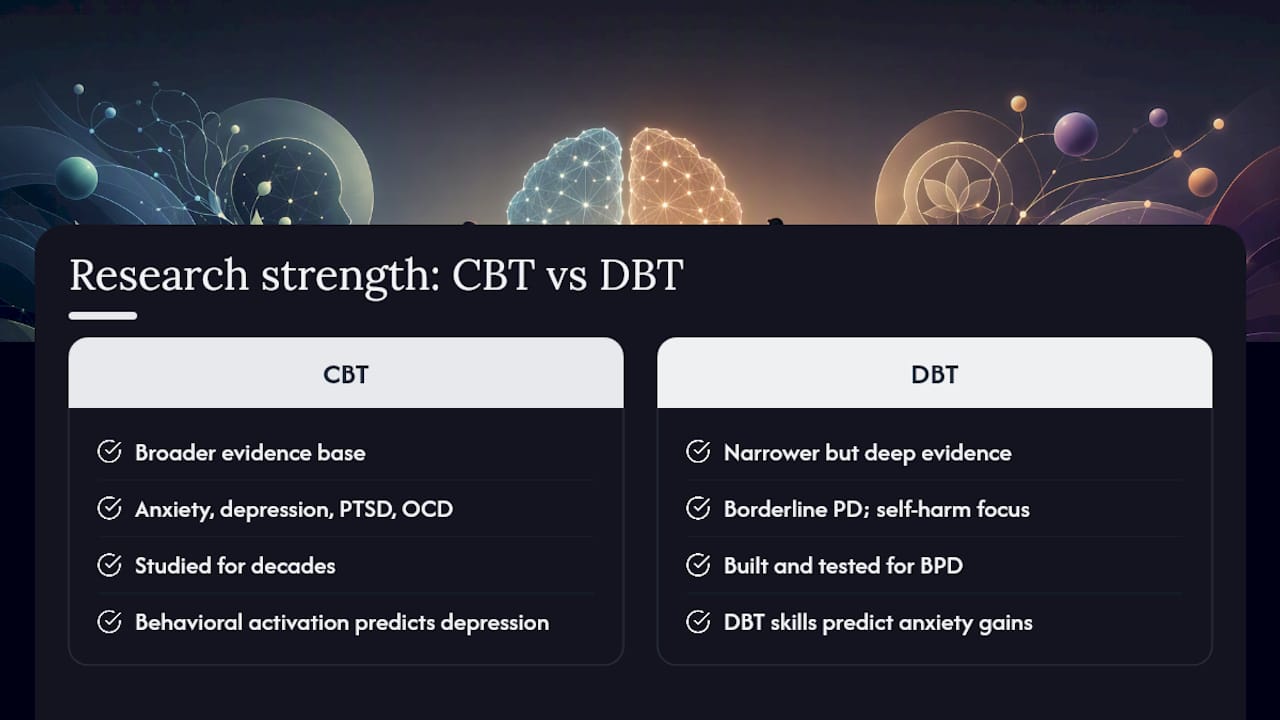
CBT carries the broader evidence base of the two. Meta-analyses and clinical guidelines back its use across anxiety disorders, depression, PTSD, and OCD, with exposure and response prevention specifically for the last one. It’s been studied for decades across a wide range of populations.
DBT’s evidence is narrower but deep where it counts. It was built and tested to reduce self-harm and suicidal behavior in borderline personality disorder, and that’s still where its strongest data sits. Evidence for its use in other conditions, like eating disorders and mood disorders, continues to grow but hasn’t caught up to CBT’s breadth.
One nuance worth flagging: outcomes depend heavily on which skill actually gets practiced. Behavioral activation, a core CBT technique, tends to predict depression improvement more reliably than cognitive restructuring alone in some clinical samples, while DBT skills and psychological flexibility show a stronger link to anxiety symptom improvement in mixed clinical settings. The specific skill matters as much as the therapy label attached to it.
Neither therapy works identically for every person, and access barriers (cost, therapist availability, program length) shape real-world outcomes as much as the underlying research does. The honest takeaway: let the evidence point you toward a starting therapy, then let an actual clinical assessment fine-tune it.
How to Choose: A Practical Checklist Before Your First Session
- Write down your top three symptoms in order of how much they disrupt your week.
- If self-harm, suicidal thinking, or intense emotional swings top that list, prioritize a DBT-trained therapist.
- If avoidance, worry loops, or low motivation top the list, start with CBT.
- Ask a prospective therapist: What’s your training in this modality? Do you offer a full DBT program or skills only? Do you take my insurance or offer sliding-scale rates? Is telehealth available? What’s the plan if I’m in crisis between sessions?
- Notice whether the first assessment asks about safety and history in detail. If it feels rushed, that’s a red flag.
Pro Tip: Bring a written symptom timeline to your first assessment. It saves time and helps the therapist match you to the right modality faster than a verbal summary usually allows.
When CBT and DBT Get Combined Instead of Chosen
Plenty of real-world cases don’t split cleanly. Depression paired with emotional dysregulation, or trauma symptoms paired with impulsive behavior, often responds better to blended treatment than to either therapy in isolation.
A common combination pairs CBT’s exposure work for trauma triggers with DBT’s distress tolerance skills for managing the spike in distress that exposure inevitably brings. Clinical resources note therapists frequently borrow DBT skills training within a primarily CBT plan when full DBT isn’t indicated or available.
- Trauma with impulsivity: CBT exposure paired with DBT distress tolerance
- Depression with explosive anger: behavioral activation paired with emotion regulation skills
- Goals get reassessed every four to six weeks, adjusting the blend based on which symptoms are actually shifting
Why the CBT vs. DBT Debate Misses the Real Question
Most comparisons frame this as a competition, as if one therapy will eventually be crowned better. That framing misses what the research actually shows: CBT and DBT solve different problems well, and the GAD trial comparing them makes that concrete. CBT cut symptom scores harder; DBT moved executive function measures further. Nobody won. They measured different things because they’re built for different things.
The more useful question isn’t “which is better,” it’s “which problem is loudest right now.” Someone white-knuckling through panic attacks needs a different toolkit than someone who can’t get through a week without a self-harm urge. Handing the second person a thought record and calling it treatment is a mismatch, not a lesser version of care.
What often gets underweighted is access. A therapy with excellent evidence does nothing for you if no one in your area runs it, or if it costs more than you can sustain for the six months to two years DBT often requires. That’s not a footnote. It’s frequently the deciding factor in what actually gets used, regardless of what the studies say works best on paper.
— Amy
Get Matched to the Right Therapy Approach
Revivehealththerapy treats both ends of this comparison directly, so you don’t have to guess which clinic to call based on a diagnosis you’re not certain about yet. The practice offers CBT and DBT-informed treatment across individual, couples, family, and teen therapy, delivered in person in Oakland, Walnut Creek, and San Francisco, or by secure telehealth anywhere in California.
Sliding-scale fees and insurance, HSA, and FSA acceptance mean cost doesn’t have to be the reason you settle for the wrong-fit therapy or none at all. If your symptoms straddle both categories discussed above, that’s exactly the kind of case an initial assessment is built to sort out. You can book a psychotherapy assessment and get matched to CBT, DBT-informed care, or a blended plan based on what’s actually driving your day-to-day struggles, not a guess made from a blog post.
This article is general information, not a substitute for advice from a qualified doctor. Consult a qualified healthcare professional about your own circumstances before acting on anything here.
Sources
- McLean Hospital (Mass General Brigham) — DBT overview
- Mayo Clinic — Cognitive behavioral therapy overview
- PMC article summarizing DBT evidence and development
3 Responses