
Most people who stick with therapy get better. Large-scale reviews consistently find that roughly 75% of people who enter psychotherapy show measurable benefit, with meta-analyses reporting pre- to post-treatment effect sizes in the large range for both depression and anxiety. The number moves depending on the condition, how “success” is defined, and how long someone stays in treatment, but the direction of the evidence is not in question.
TL;DR:
- Effect sizes for psychotherapy in routine clinics are large, with d = 0.96 for depression and d = 0.80 for anxiety, indicating strong real-world benefits.
- Response rates for disorders such as depression (42%) and PTSD (38%) are solid but lower than headline claims, reflecting strict symptom reduction thresholds.
- Therapy effectiveness depends more on the therapeutic relationship, active engagement, and early improvement than on specific treatment modality.
- Active monitoring and clear goal-setting, along with timely treatment adjustments, can significantly improve individual outcomes.
- Structured, modality-matched therapies tend to outperform less focused approaches, with internal data showing about 70% success in anxiety and depression treatments.
Table of Contents
- Therapy Success Rates: What the Research Actually Shows
- Success Rates by Condition: Depression, Anxiety, PTSD, and More
- Does the Type of Therapy Matter More Than the Diagnosis?
- What Actually Predicts Whether Therapy Will Work for You
- How Reliable Are These Numbers, Really?
- How to Improve Your Own Odds With Therapy
- How ReviveHealthTherapy’s Outcomes Compare to the Research
- A Clinician’s Honest Take on These Numbers
- Ready to Put These Numbers to Work?
- Sources
Therapy Success Rates: What the Research Actually Shows
The strongest evidence for therapy’s effectiveness comes from studies conducted in ordinary clinics, not just controlled trials. A 2022 systematic review of psychotherapy delivered in routine clinical practice found pre- to post-effect sizes of d = 0.96 for depression and d = 0.80 for anxiety. Those are large effects by any statistical standard, and they matter because they were measured in real outpatient settings, not the tightly controlled labs where a lot of psychotherapy research happens.
That distinction between efficacy and effectiveness shapes how you should read almost every number in this article. Efficacy trials test whether a treatment works under ideal conditions: screened patients, manualized protocols, weekly fidelity checks. Effectiveness studies ask whether it works in the messier reality of a normal caseload, with comorbid conditions, missed sessions, and life getting in the way. Therapy tends to hold up reasonably well across both, which is part of why the American Psychiatric Association and the National Institute of Mental Health both treat it as a first-line option for most common mental health conditions.
A few things worth knowing about where these numbers come from:
- Meta-analyses pool dozens or hundreds of individual studies to smooth out the noise of any single trial.
- Effect sizes (often reported as Cohen’s d or standardized mean differences) measure the size of the improvement, not just whether it happened.
- “Success” gets defined differently across studies. Some track symptom reduction, others track functioning, others track remission.
- Waitlist and care-as-usual control groups tend to produce larger apparent effects than active treatment comparisons.
Pro Tip: When you see a therapy statistic quoted without mentioning the comparison group, ask what it’s being measured against. A treatment that beats “no treatment” by a wide margin might look far less impressive against another active treatment, and that’s normal, not damning.
Success Rates by Condition: Depression, Anxiety, PTSD, and More
Response and remission are not the same thing, and mixing them up is the single most common way people misread therapy statistics. Response usually means at least a 50% reduction in symptoms on a standardized scale. Remission means symptoms drop below a clinical threshold entirely, essentially, the person no longer meets criteria for the disorder. A large meta-analytic review of psychotherapy response rates across disorders found absolute response rates that, while modest compared to headline percentages you often see quoted, still represented statistically significant improvement over control conditions for nearly every diagnosis studied:
- Major depressive disorder: approximately 42% response rate
- PTSD: approximately 38%
- OCD: approximately 38%
- Panic disorder: approximately 38%
- Generalized anxiety disorder: approximately 36%
- Social anxiety disorder: approximately 32%
- Specific phobia: approximately 32%
- Borderline personality disorder: approximately 24%
Those percentages might look low next to the “70 to 80% benefit” figure quoted elsewhere, and that gap is exactly the point. Response rates track a strict, symptom-based threshold. Broader benefit statistics capture any measurable improvement, even short of a full clinical response. Both are true. They just measure different things.
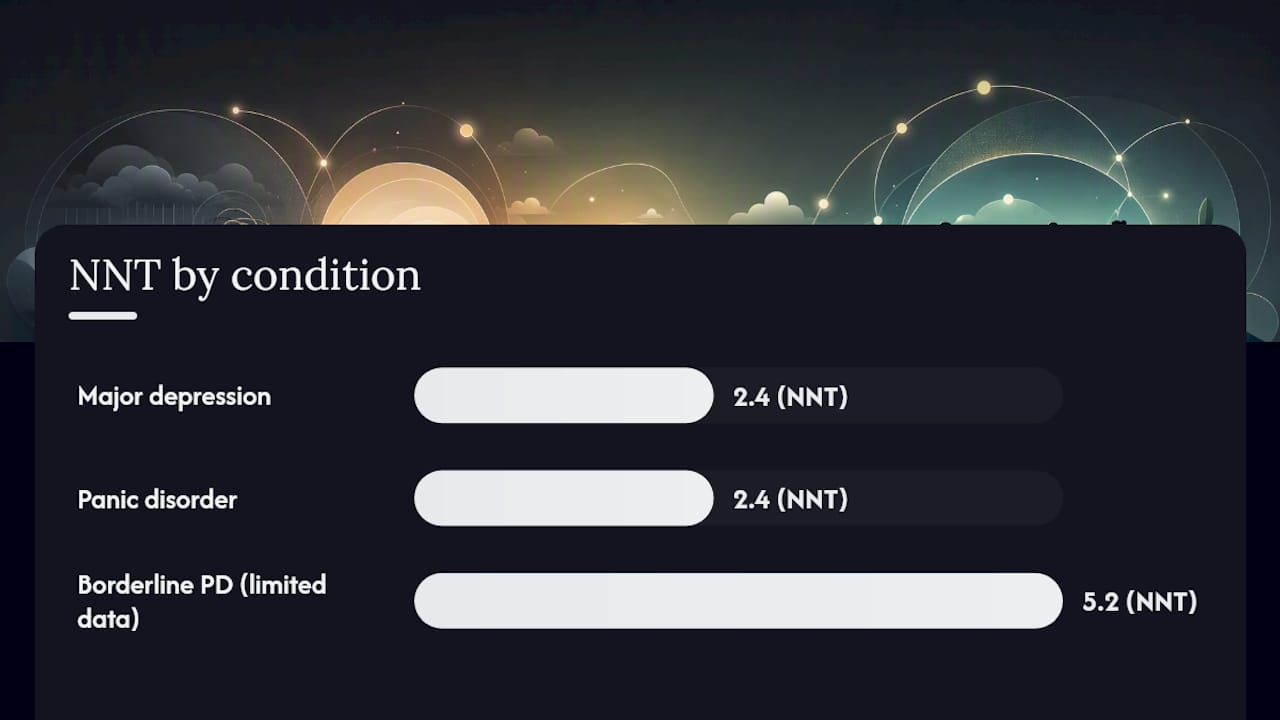
The same review calculated numbers needed to treat (NNT), meaning how many people need to receive therapy for one additional person to respond, compared to a control group. NNTs across these disorders ranged from roughly 2.4 to 5.2, a range that compares favorably to NNTs for many accepted medical treatments. Depression and panic disorder tended to sit at the lower, more favorable end. Borderline personality disorder sat at the higher end, reflecting both a harder-to-treat condition and thinner research data. That last point matters: BPD studies are fewer and smaller, so the estimate carries more uncertainty than the depression figures do.
Does the Type of Therapy Matter More Than the Diagnosis?
For most conditions, the specific brand of therapy matters less than whether the person actually receives one of the well-established approaches at all. A network meta-analysis covering 331 randomized trials of psychotherapies for depression, involving over 34,000 patients, found that most bona fide therapies outperformed care-as-usual or waitlist conditions, and that differences between the therapy types themselves were often small.
That does not mean every modality is interchangeable for every problem. A few patterns hold up consistently in the literature:
- Cognitive behavioral therapy and exposure-based approaches tend to show the strongest evidence for anxiety disorders and PTSD, partly because exposure directly targets the avoidance patterns that keep those conditions going.
- Behavioral activation and problem-solving therapy perform reliably well for depression, especially when a person’s symptoms include withdrawal and low activity levels.
- EMDR has a solid evidence base specifically for trauma processing, and several controlled trials show effects comparable to trauma-focused CBT for PTSD.
- Interpersonal therapy shows particular strength when relationship conflict or grief is driving the depressive episode.
- Psychodynamic approaches show durable effects in longer-term treatment, with some follow-up studies suggesting gains that continue after therapy ends.
The practical takeaway is that fit matters more than finding a single “best” modality. A structured approach matched to the right disorder tends to outperform a generic, unfocused approach applied to the wrong problem, even when both fall under the same broad therapy label.
What Actually Predicts Whether Therapy Will Work for You
Some factors move the needle on outcomes more than others, and the biggest one surprises people: it is not really the specific technique. It is the relationship.
- The therapeutic alliance. Meta-analytic process-outcome research puts the correlation between alliance quality and treatment outcome at about r = .28, accounting for roughly 8% of the variance in results. That is a moderate but remarkably consistent finding across decades of studies and different treatment types.
- Early measurable change. People who show some improvement in the first several sessions tend to keep improving. Therapists who track this with routine outcome monitoring, sometimes called feedback-informed treatment, catch stalled progress early and adjust course before a client quietly drops out.
- Active engagement. Showing up, doing between-session work, and being honest about what is and is not helping all correlate with better results than passive attendance.
Pro Tip: Ask a prospective therapist directly whether they use any outcome measures or check-in tools during treatment. A clinician who tracks progress numerically, rather than relying purely on impression, is more likely to notice early when something isn’t working.
How Reliable Are These Numbers, Really?
Every statistic in this article carries some uncertainty, and pretending otherwise would be dishonest. Heterogeneity, meaning how much individual studies disagree with each other, runs high across psychotherapy research. Some of that comes from real differences in patient populations; some comes from inconsistent methods.
A few specific distortions are worth knowing about:
- Weak control groups inflate apparent effects. Comparing therapy to a waitlist, where people get nothing, produces bigger differences than comparing it to another active treatment. An umbrella review of psychotherapies and pharmacotherapies found average effect sizes closer to d = 0.34 once weaker comparisons and publication bias were accounted for, noticeably smaller than the flashier headline numbers.
- Completer analyses versus intention-to-treat analyses tell different stories. A completer analysis only counts people who finished treatment, which flatters the response rate. An intention-to-treat analysis counts everyone who started, dropouts included, which tends to lower it. The gap between the two can shift a reported response rate by several percentage points.
- Publication bias favors positive results. Studies that find strong effects are more likely to get published than studies that find nothing, which nudges the overall literature toward optimism.
Before starting with any provider, it is reasonable to ask how they track progress and what a typical course of treatment looks like in terms of session count. A provider who cannot answer either question honestly is not necessarily a bad clinician, but you deserve a clearer picture of what defines progress before you commit weeks or months to the process.
How to Improve Your Own Odds With Therapy
None of these statistics are fixed outcomes assigned to you personally. Several concrete choices shift the odds meaningfully in your favor.
- Choose based on fit, not just credentials. Look for a licensed clinician trained in an approach matched to your specific concern, and ask how they determine which modality suits your situation.
- Set concrete goals in the first session or two. Vague goals like “feel better” are harder to track than specific ones like “reduce panic attacks from four a week to one.”
- Establish a baseline and revisit it every four to eight sessions. This is where routine outcome monitoring earns its keep, giving both of you an honest read on whether things are moving.
- Do the homework between sessions. Skills practiced only in the room rarely generalize to daily life.
- Know when to pivot. If eight to ten sessions pass with no measurable movement, that is a reasonable point to discuss changing modality, adding medication, or switching therapists entirely, not a sign to give up on therapy altogether.
How ReviveHealthTherapy’s Outcomes Compare to the Research
Practice-level data cannot replace a randomized controlled trial, and it should never be sold as one. But it offers something research alone cannot: a direct look at outcomes from real clients in a specific setting, tracked over time.
- Anxiety treatment at ReviveHealthTherapy has shown roughly a 70% success rate among tracked clients, in line with the broad benefit ranges reported in national research summaries.
- Child and teen clients have shown roughly 70% symptom reduction across a course of treatment.
- Clients receiving structured, modality-matched treatment showed outcomes roughly 35% better than less structured approaches.
These figures come from internal tracking, not peer-reviewed trials, and sample sizes are far smaller than the meta-analyses cited elsewhere in this article. Even so, the pattern lines up with what the larger evidence base predicts: structured, well-matched therapy tends to outperform loosely applied treatment.
A Clinician’s Honest Take on These Numbers
The statistics in this article are real, but they describe averages, not your specific outcome. What moves people from “average” to “better than average” is usually engagement: showing up, being honest about what’s working, and treating the relationship with your therapist as a working partnership rather than a passive service. Evidence-informed practice gives you better odds. It does not remove the need to participate in your own recovery.
— Amy
Ready to Put These Numbers to Work?
Statistics matter less than what happens in your next session. Revivehealththerapy applies the same evidence-based approaches referenced throughout this article, EMDR, CBT, and mindfulness-based methods, delivered by clinicians trained specifically in trauma-informed care.
You can access these approaches through in-person sessions in Oakland and Walnut Creek or secure telehealth available anywhere in California, whichever fits your schedule and comfort level better. Sliding-scale fees and insurance, including HSA and FSA plans, keep the cost from being the reason you delay getting help. Parents exploring options for a child or teen can start with the teen therapy program to see how treatment gets tailored by age and developmental stage. If you are ready to talk through what fits your situation, reach out to schedule an initial session and get a clear answer on next steps.
This article is general information, not a substitute for advice from a qualified doctor. Consult a qualified healthcare professional about your own circumstances before acting on anything here.
Sources
- Effectiveness of psychotherapy in routine clinical practice (systematic review, 2022)
- APA patient resources on psychotherapy effectiveness