
TL;DR:
- Weight loss requires creating a caloric deficit of 500 to 750 calories per day, emphasizing food quality and strength training. Consistent habits, realistic goals, and mental health support are crucial for long-term success, while quick fixes often lead to setbacks. Professional therapies and behavioral strategies enhance sustainability and address emotional factors influencing eating and activity.
You already know the basics. Eat less, move more. And yet, weight loss remains one of the most frustrating, confusing experiences millions of people face every year. The real problem is not willpower or motivation. It’s the flood of conflicting advice: detox teas, elimination diets, 30-day challenges, and miracle supplements that promise everything and deliver nothing lasting. This guide cuts through the noise. You’ll find what science actually says about how to lose weight, which habits stick, when to consider medical support, and how your mental health fits into the whole picture.
Table of Contents
- Key takeaways
- The science behind sustainable weight loss
- Diet strategies that actually support weight loss
- Exercise for weight loss and muscle preservation
- Medical and behavioral support options
- Mindset, setbacks, and long-term success
- My honest take on weight loss advice
- How mental health support can strengthen your weight loss goals
- FAQ
Key takeaways
| Point | Details |
|---|---|
| Aim for a safe deficit | A daily caloric deficit of 500 to 750 calories produces 1 to 2 pounds of loss per week without wrecking your metabolism. |
| Food quality beats restriction | Whole foods, lean proteins, and fiber stabilize hunger better than any fad diet or calorie-cutting alone. |
| Exercise must include strength | Combining cardio with resistance training preserves muscle mass and keeps your metabolism from slowing down. |
| Mindset determines longevity | Realistic goal setting and self-compassion are what separate people who sustain weight loss from those who yo-yo. |
| Professional support changes outcomes | Mental health therapy and medical options like GLP-1 medications can make the difference when lifestyle changes alone stall. |
The science behind sustainable weight loss
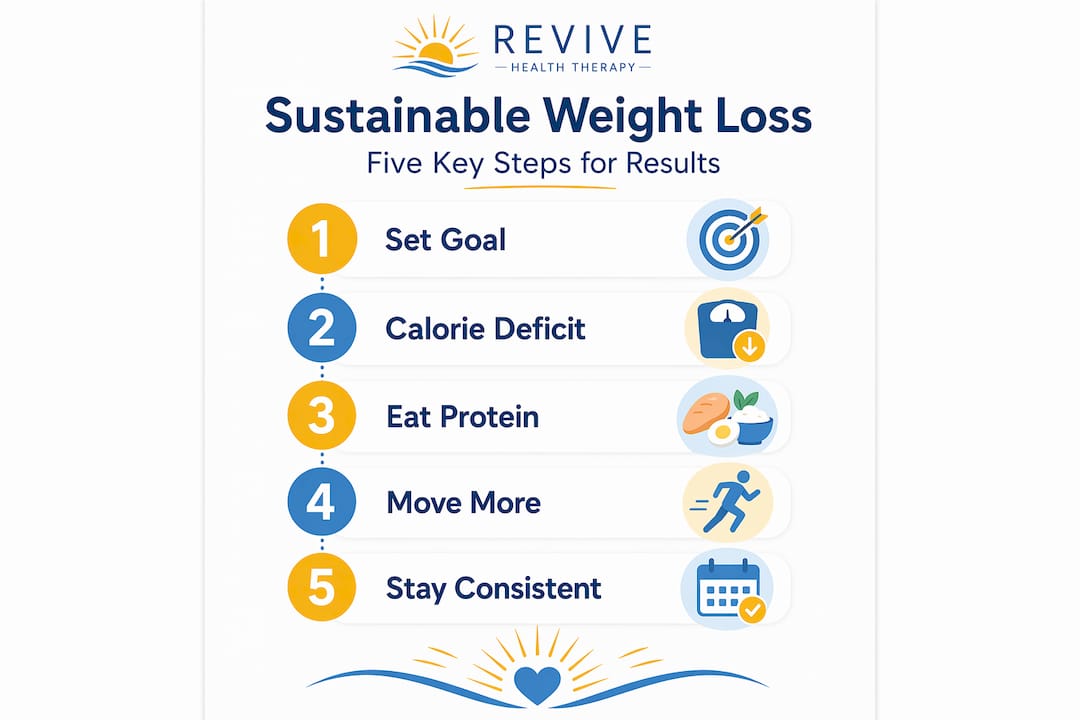
Here’s something most diet culture gets wrong: weight loss is not just about eating less. It’s about creating the right conditions for your body to release stored fat without triggering a metabolic shutdown. The foundation is a caloric deficit, but the size of that deficit matters enormously.
A daily deficit of 500 to 750 calories produces roughly 1 to 2 pounds of fat loss per week. That pace is not slow. It’s precise. Going faster by slashing calories dramatically or crash dieting triggers metabolic adaptation, where your body responds to perceived starvation by burning fewer calories at rest. Rapid loss can backfire by slowing your metabolism and causing muscle loss, which makes maintaining any progress dramatically harder.
That said, the research picture on speed is more nuanced than most people think. A 52-week clinical trial found that rapid weight loss programs can outperform gradual approaches for sustained results at one year when paired with proper behavioral support and monitoring. The takeaway is not “go fast.” It’s that structured programs with professional oversight can work. DIY crash dieting almost never does.
| Approach | Short-term loss | Muscle preservation | Metabolic impact | Long-term sustainability |
|---|---|---|---|---|
| Gradual (500-750 cal deficit) | 1-2 lbs/week | High | Minimal slowdown | High |
| Rapid (unsupported crash diet) | 3-5+ lbs/week | Low | Significant slowdown | Very low |
| Rapid (clinically supported) | 3-5 lbs/week | Moderate | Managed with protein | Moderate to high |
Pro Tip: If you’re going to cut calories, protect your protein. Eating 0.7 to 1 gram of protein per pound of body weight daily helps preserve muscle while you’re in a deficit, which keeps your metabolism from downshifting.
Diet strategies that actually support weight loss
The most effective weight loss diet plans share one thing: they’re built on foods that keep you full, fuel your body, and don’t require you to carry a calculator everywhere you go.
Whole foods form the backbone. Vegetables, fruits, legumes, lean proteins like chicken, fish, eggs and tofu, whole grains, and healthy fats from sources like avocado, olive oil, and nuts work together to provide fiber and nutrients that regulate hunger hormones. Processed foods, by contrast, are engineered to make you eat past fullness. Limiting added sugars and saturated fats is not about moral purity. It’s about removing foods that actively work against your goals.
Eating patterns matter as much as food choices. Skipping meals to “save calories” often backfires by driving overeating later in the day. Three balanced meals anchored by protein and fiber keep blood sugar stable and cravings manageable. Lifestyle changes, not fad diets, are what the research consistently points to for lasting success.
Hydration also plays a direct role. Drinking water before meals reduces calorie intake at those meals for many people, and thirst is frequently mistaken for hunger. Aiming for at least 8 cups of water daily is a low-effort habit with real returns.
Effective diet habits to build:
- Prioritize protein at every meal (eggs at breakfast, legumes at lunch, fish at dinner)
- Fill half your plate with non-starchy vegetables before adding anything else
- Eat slowly and without screens to catch your body’s fullness signals
- Plan meals in advance so you’re not making food decisions when hungry
- Limit alcohol, which adds empty calories and lowers inhibition around food choices
- Use tracking apps or a food journal for accountability, at least in the early weeks
Common mistakes to avoid:
- Treating weekends as “off” days, which can erase a full week of progress
- Eliminating entire food groups, which creates cravings and is socially unsustainable
- Relying on “diet” or “low-fat” packaged foods that are often high in sugar
- Underestimating liquid calories from juices, coffees, and smoothies
Pro Tip: Meal prep is one of the most underrated weight loss meal ideas. Spending two hours on Sunday batch cooking proteins, grains, and roasted vegetables eliminates the decision fatigue that sends most people to the drive-through by Wednesday.
Exercise for weight loss and muscle preservation
Diet gets the most attention in weight loss conversations, but exercise is what determines whether the weight you lose is fat or muscle. Losing muscle slows your metabolism and makes you physically weaker. That’s not a tradeoff worth making.
Major health organizations recommend at least 150 minutes of moderate-intensity aerobic activity per week, plus muscle-strengthening work on two or more days. That translates to about 30 minutes of brisk walking five days a week, combined with two strength sessions. It’s more manageable than most people expect.

Combining cardio and resistance training is the gold standard for fat loss and metabolism maintenance. Cardio burns calories during the session. Strength training builds muscle tissue that burns more calories around the clock. The two together accomplish what neither does alone. Low-impact options like Pilates for weight loss also build functional strength while being gentle on joints, making them ideal for beginners or those returning after injury.
A progressive exercise plan for beginners:
- Weeks 1 to 2. Walk 20 to 30 minutes daily at a comfortable pace. The goal is consistency, not intensity.
- Weeks 3 to 4. Add two bodyweight strength sessions per week: squats, push-ups, lunges, and planks. Keep it to 20 minutes per session.
- Weeks 5 to 8. Increase walking to 30 to 45 minutes, and add light resistance to strength sessions using bands or dumbbells.
- Months 3 and beyond. Work up to three strength sessions per week with progressive overload, meaning you gradually add weight or reps to keep your muscles challenged.
- Ongoing. Find at least one activity you genuinely enjoy and protect it on your schedule like any other non-negotiable appointment.
The biggest mistake beginners make is starting too hard and burning out by week three. The second biggest mistake is doing only cardio and skipping strength work entirely. Both paths lead to the same place: stalled results and frustration.
Medical and behavioral support options
Lifestyle changes alone work for many people. But they don’t work for everyone at every stage, and there’s no shame in that. Understanding your options gives you more tools.
GLP-1 receptor agonists like semaglutide and tirzepatide have changed the conversation around medical weight management. They work by mimicking a gut hormone that signals fullness to the brain, reducing appetite and slowing gastric emptying. They’re effective. They’re also frequently misused. Experts caution against escalating GLP-1 doses unnecessarily, since higher doses increase the risk of gastrointestinal side effects, malnutrition, and muscle loss without proportionally better outcomes. If you’re on or considering one of these medications, you’ll want to understand GLP-1 medications and mental health, since mood changes are a documented consideration.
For individuals with severe obesity, bariatric surgery remains an option with strong long-term data, typically reserved for those with a BMI over 40 or over 35 with significant health complications.
| Approach | Best suited for | Key benefit | Key consideration |
|---|---|---|---|
| Lifestyle change | Most adults | Sustainable, no side effects | Requires time and consistency |
| GLP-1 medications | BMI 30+ or 27+ with conditions | Significant appetite reduction | Dosing caution, cost, side effects |
| Bariatric surgery | Severe obesity (BMI 40+ or 35+ with comorbidities) | Major, durable weight loss | Surgical risks, lifelong dietary changes |
| Behavioral/therapy support | Anyone at any stage | Addresses emotional and behavioral root causes | Requires commitment, ongoing sessions |
Behavioral counseling is the underutilized piece of this puzzle. Evidence-based therapy addressing emotional eating, self-image, stress responses, and motivation has a documented impact on weight loss success. You can have the best diet and exercise plan on paper and still struggle if anxiety, depression, or unprocessed trauma are driving your relationship with food.
Mindset, setbacks, and long-term success
Most people who lose weight and keep it off will tell you the same thing: they stopped trying to be perfect and started trying to be consistent. That shift sounds small. It changes everything.
Realistic goal setting matters more than motivation. Aiming to lose 10% of your body weight as a first milestone is both achievable and meaningful. Losing even 5 to 10% of body weight improves blood pressure, cholesterol, and blood sugar markers, reducing heart disease risk. You don’t have to reach your “ideal” weight to get real health benefits.
Setbacks are not failures. They’re data. A week of poor eating, a missed gym session, or a plateau tells you something useful about what your body and your schedule actually need. The instinct to “start over Monday” is one of the most damaging patterns in weight management. Instead, resume your habits at the next meal or the next day.
The body’s set point theory explains why plateaus happen. It takes 3 to 6 months of consistent habits for your body to accept a new lower weight as its baseline. That’s not a flaw in your biology. It’s your body doing exactly what it evolved to do.
Habits that support long-term weight management:
- Log food and activity with an app or journal for accountability, since tracking tools consistently support sustained results
- Build a social environment where healthy choices are the default, not the exception
- Practice self-compassion after setbacks rather than shame, which research links to better recovery and longer adherence
- Celebrate non-scale victories: better sleep, lower resting heart rate, more energy, improved mood
Pro Tip: Write down your “why” for losing weight and read it when motivation dips. The specific, personal reason you started, not “I want to be healthier” but the vivid, specific reason, is what pulls you back on track when willpower runs low.
My honest take on weight loss advice
I’ve worked alongside individuals at every stage of this process, and the pattern I keep seeing is the same. People start with intensity, hit a plateau or a hard week, conclude that something is broken, and abandon a plan that was actually working.
The culture around weight loss rewards extremes. Dramatic before-and-afters, 75-day hard challenges, “I lost 30 pounds in 60 days” stories. Those make great content. They make terrible blueprints. In my experience, the people who lose weight and genuinely keep it off are almost boring about it. They eat the same reasonable meals most days. They move consistently, not heroically. They have learned to tolerate the discomfort of change without panicking.
What I’ve found is that the mental health component is almost always underweighted. People spend enormous energy on what to eat and very little on why they eat the way they do. Stress eating, reward eating, avoidance eating. These are not discipline failures. They’re behavioral patterns with roots in emotion and often in unresolved stress or trauma. That’s not something a meal plan fixes.
My take: find the eating pattern you can maintain for years, not weeks. Find movement you actually enjoy. Get support for the psychological piece, whether through therapy, a counselor, or a structured program. Slow change, done consistently for 6 months, produces results that last. Quick fixes produce content. Not outcomes.
— Amy
How mental health support can strengthen your weight loss goals
Weight loss success is not built on willpower alone. The research is clear: emotional regulation, stress management, and behavioral patterns all shape how you eat, how you move, and whether you can sustain change over time. That’s where Revivehealththerapy comes in.
Revivehealththerapy offers evidence-based psychotherapy services across California, including in-person sessions in Walnut Creek and Oakland, and secure telehealth options for anyone in the state. Whether you’re managing emotional eating, anxiety that disrupts your routines, or a complex relationship with your body, their licensed therapists use approaches like CBT and mindfulness that directly support the behavioral side of weight management. Explore their mental health services for adults or access convenient support through telehealth in California. Sliding-scale fees and insurance are accepted.
FAQ
What is a safe rate of weight loss per week?
A safe and sustainable rate is 1 to 2 pounds per week, achieved through a daily caloric deficit of 500 to 750 calories. Losing weight faster than this increases the risk of muscle loss and metabolic slowdown.
Do I need to exercise to lose weight?
Diet creates the caloric deficit needed for weight loss, but exercise, especially strength training, preserves muscle mass and prevents your metabolism from slowing. The combination produces better long-term results than diet alone.
How do GLP-1 medications support weight loss?
GLP-1 medications like semaglutide reduce appetite by mimicking a gut hormone that signals fullness to the brain. Experts recommend using the lowest effective dose to minimize side effects like nausea, gastrointestinal issues, and potential muscle loss.
Why do I hit a weight loss plateau?
Plateaus happen because your body adapts to a lower calorie intake and a lighter body weight by burning fewer calories at rest. Adjusting your calorie intake, varying your exercise routine, or adding more strength training can help restart progress.
Can therapy help with weight loss?
Yes. Evidence-based therapy addresses emotional eating, stress responses, and behavioral patterns that drive food choices. Mental health support is one of the most underused tools for people working toward sustainable weight loss goals.