
TL;DR:
- Behavioral health emphasizes how daily actions influence mental and physical wellbeing, accounting for 90% of health costs.
- Effective change relies on restructuring environments, identifying behavior functions, and applying structured, goal-oriented therapy techniques.
You already know what you should do. Exercise more. Respond calmly in arguments. Stop scrolling at midnight. Yet knowing and doing are entirely different things, and the gap between them is precisely where behavioral health science lives. Understanding the behavioral patterns driving your anxiety, depression, and relationship friction is not about willpower or motivation. It is about understanding how your brain, environment, and habits interact in ways that most people never examine. This article breaks down what behavioral health actually means, why your best intentions often fall short, and what strategies genuinely move the needle.
Table of Contents
- Key takeaways
- What behavioral health really means
- How behavioral therapy works
- Why your intentions keep failing you
- Understanding why behaviors happen
- Applying these strategies to real challenges
- My take: stop trying to out-motivate your environment
- Real support for real behavioral change
- FAQ
Key takeaways
| Point | Details |
|---|---|
| Behavior and mental health are linked | Your daily behaviors directly shape anxiety, depression, and relationship quality in measurable ways. |
| Intentions alone rarely produce change | Only 28% of behavioral variance is explained by intention; context and structure matter more. |
| Environment shapes behavior more than willpower | Restructuring your surroundings makes desired behaviors the path of least resistance. |
| Every behavior serves a purpose | Identifying the function behind a behavior is the first step to replacing it effectively. |
| Therapy accelerates lasting change | Evidence-based approaches like CBT and behavioral activation provide concrete, measurable skills for daily life. |
What behavioral health really means
The word “behavioral” gets used loosely, but in health and psychology it carries a specific, grounded meaning. Behavioral health refers to the connection between your actions, habits, and choices on one side, and your mental and physical wellbeing on the other. It includes mental health conditions like anxiety and depression, substance use patterns, stress responses, and the daily habits that either support or erode your ability to function.
This is not just a clinical abstraction. Behavioral factors contribute to 90% of the United States’ $4.9 trillion in annual health expenditures. Sleep quality, physical activity, social connection, and stress management habits are not lifestyle add-ons. They are the primary drivers of long-term health outcomes.
What makes behavioral health distinct from purely medical care is its emphasis on observable, changeable actions. Your nervous system does not live in a vacuum. The behaviors you repeat daily create neural pathways that reinforce themselves, for better or worse. Someone who avoids social situations because of anxiety does not just “feel anxious.” They engage in a pattern of withdrawal that, over time, makes the anxiety worse and the world feel smaller.
Understanding behavioral patterns in this way shifts the frame from “what is wrong with me” to “what patterns am I reinforcing, and what context is driving them?” That shift is not just more compassionate. It is more accurate, and it points directly toward solutions.
For individuals dealing with long-term health conditions, behavioral factors often interact with physical symptoms in ways that make both harder to manage without addressing the behavioral layer first.
How behavioral therapy works
Behavioral therapy is structured, goal-focused, and grounded in one core idea: change the behavior, and the thoughts and feelings often follow. Unlike approaches that spend months excavating childhood memories, behavioral therapy is results-oriented and uses measurable milestones to track progress.
The core techniques used in behavioral therapy include:
- Exposure therapy: Gradually and safely confronting feared situations, objects, or feelings to reduce the anxiety response over time. This is particularly effective for phobias, social anxiety, and OCD.
- Behavioral activation: Scheduling meaningful, rewarding activities to interrupt the withdrawal and low-energy cycle that reinforces depression. The insight here is that motivation follows action, not the other way around.
- Habit reversal training: Replacing an unwanted repetitive behavior with a competing response. Often used for conditions like hair-pulling or skin-picking, but applicable to many automatic patterns.
- Positive reinforcement: Systematically rewarding target behaviors to increase their frequency. Used extensively in child therapy, but equally relevant for adult habit change.
The mechanics behind all of these techniques rely on analyzing three things: triggers (what precedes a behavior), the behavior itself, and consequences (what follows and reinforces it). Change any part of that chain and you disrupt the pattern.
Pro Tip: When starting behavioral therapy or self-directed behavior change, pick one behavior to target first. Trying to change three patterns simultaneously splits your focus and dramatically reduces your success rate.
Functional Family Therapy averages 12 structured sessions to assess family dynamics and build a relapse prevention plan. That predictability matters because it tells you progress is measurable, not open-ended. Therapy is not indefinite. It is a skill-building process with a clear direction.
One of the most useful resources for understanding how therapy outcomes are defined and tracked explains why measurable goals are the engine of effective behavioral work, not just a checkbox.
Why your intentions keep failing you
Here is a finding most people find genuinely surprising. 47% of individuals with real, genuine intentions to change a behavior fail to act within their planned timeframe. Nearly half. And intentions alone explain only 28% of variance in what people actually do. That means the vast majority of what drives your behavior is not your conscious intention. It is context, environment, and habit.
This is not a character flaw. It is how human cognition works. Your brain defaults to automatic processing in familiar environments, which means the best strategy for change is redesigning the environment, not trying to override it with sheer force of will.
Here is a practical sequence for applying this insight:
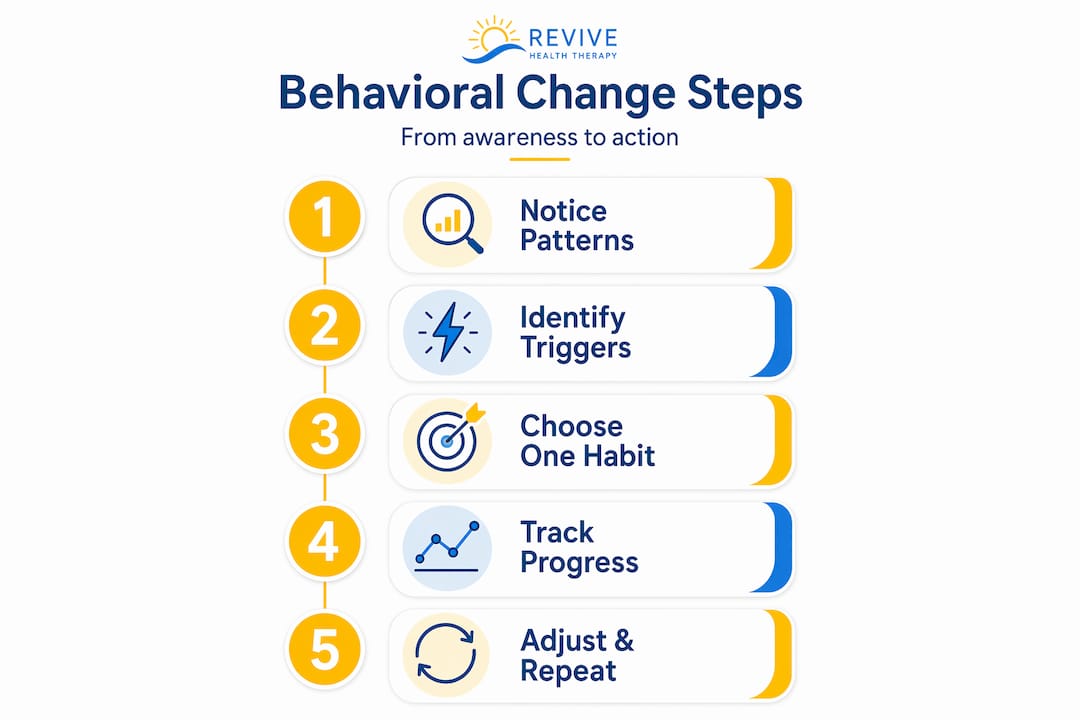
- Identify the environmental trigger. What cues in your space or routine are prompting the behavior you want to change or blocking the one you want to build?
- Restructure the context. Environmental restructuring makes the desired behavior the default path. Move the unhealthy snack out of eyeline. Put your running shoes by the door. Remove the app from your phone’s home screen.
- Use implementation intentions. Instead of “I will exercise more,” commit to “When I finish work on Tuesday and Thursday, I will walk for 20 minutes before making dinner.” Specificity closes the intention-behavior gap significantly.
- Self-monitor your progress. Self-monitoring consistently appears in effective behavioral interventions because it creates a feedback loop between your actions and your stated goals.
- Release the all-or-nothing mindset. Small incremental changes and focusing on progress over perfection prevent goal abandonment. Missing one day is not failure. Treating it as failure and quitting is.
“The problem isn’t that people lack motivation. It’s that they’re using motivation to do a job that belongs to structure.” — Behavioral science principle on environment-driven change
Willpower is real but finite. Every decision you make in a day depletes the cognitive resources available for the next one. Strategies that remove the need to make a decision in the moment, because the environment already sets you up for success, are simply more reliable.
Understanding why behaviors happen
One of the most counterintuitive ideas in behavioral psychology is that every behavior, even one that seems destructive or irrational, is serving a function. It exists because it is meeting some need, even if ineffectively.

The mistaken goals framework identifies four common functions behind problematic behaviors: seeking attention, exerting power or control, expressing revenge or hurt, and avoiding a feared outcome. Understanding which function a behavior is serving changes everything about how you respond to it.
Here is how this plays out practically:
| Behavior | Apparent problem | Underlying function | More effective response |
|---|---|---|---|
| Picking fights with a partner | Aggression or poor communication | Seeking connection or feeling unheard | Schedule dedicated check-ins and name the need directly |
| Procrastinating on work | Laziness or poor discipline | Avoiding fear of failure or judgment | Break tasks into low-stakes steps; address perfectionism |
| Withdrawing socially | Antisocial tendencies | Protecting against rejection or overwhelm | Gradual re-engagement with safe, low-pressure interactions |
| Emotional eating | Lack of willpower | Regulating distress or boredom | Identify emotional triggers; introduce alternative soothing behaviors |
When you only address the surface behavior without identifying what it is doing for you, you leave the underlying need unmet. That need finds another outlet, often one that is equally or more disruptive.
Pro Tip: When you notice a behavior you want to change, ask yourself: “What does this behavior give me or protect me from?” The answer will tell you far more than any willpower strategy.
This is also why therapy builds motivation over time through curiosity and self-understanding rather than requiring it upfront. You do not need to be “ready” to stop a behavior before starting therapy. You need to be curious about why you are doing it.
Applying these strategies to real challenges
Anxiety, depression, and relationship difficulties each have their own behavioral fingerprints, and each responds well to specific applications of behavioral science.
For anxiety, the most evidence-backed behavioral move is gradual exposure combined with reducing avoidance. Every time you avoid a feared situation, you signal to your nervous system that the threat is real. Behavioral activation helps you build momentum in the opposite direction, engaging with life rather than contracting away from it.
For depression, the behavioral activation model is particularly powerful. Depression convinces you that activity is pointless, so you stop doing things, which deepens the depression. Breaking that loop requires scheduling activities that previously brought a sense of accomplishment or pleasure, even when you do not feel like it, and allowing the motivation to follow.
For relationship challenges, behavioral strategies include:
- Identifying specific communication triggers and creating agreed-upon pause strategies before conflict escalates.
- Using behavioral contracts in couples or family settings to clarify expectations and consequences around shared commitments.
- Practicing structured turn-taking in conversation to reduce the defensive reactivity that shuts down real dialogue.
- Exploring family therapy options to bring a trained professional into the dynamic who can identify patterns both people are too close to see.
Across all of these areas, self-monitoring remains one of the most consistently effective tools. Tracking your mood, sleep, or conflict frequency creates data. Data replaces vague feelings of “things aren’t working” with specific information you can act on.
Professional support matters because behavioral patterns that are deeply entrenched, or rooted in trauma, often require more than self-directed strategies. A trained therapist who specializes in behavioral health services can conduct a proper behavioral assessment, identify the functions driving your specific patterns, and guide you through evidence-based interventions with accountability.
My take: stop trying to out-motivate your environment
I have worked alongside enough people navigating anxiety, depression, and relationship breakdowns to say this with real conviction: motivation is one of the most overrated tools in behavior change. I have seen clients come in with enormous motivation to change, and watched that motivation collapse within two weeks because nothing in their actual life changed to support the new behavior.
What I have found to be genuinely different is environmental restructuring. Not as a concept to nod at, but as a literal, physical, practical rearrangement of daily context. One client who struggled with evening alcohol use did not primarily succeed because they found more reasons to stop. They succeeded when they stopped keeping wine in the house and changed their after-work routine entirely, replacing the trigger context with a different one.
The insight I keep coming back to is this: you are not fighting your behavior. You are designing a system where the behavior you want is easier than the one you are trying to leave behind. That framing removes so much self-judgment. It makes the work practical rather than moral.
If you are stuck in a pattern that keeps resurfacing despite your best intentions, my honest suggestion is to stop asking “why can’t I just do this?” and start asking “what does my environment make easy right now, and what would I need to change to make the right behavior the obvious choice?” The answers are usually concrete, specific, and genuinely achievable.
— Amy
Real support for real behavioral change
If these ideas resonate but feel difficult to apply on your own, you are not alone, and you do not have to figure it out in isolation. At Revivehealththerapy, we offer evidence-based psychotherapy for anxiety, depression, trauma, and relationship challenges across California, both in-person in Walnut Creek and Oakland and via secure telehealth statewide.
Our therapists use proven methods including CBT, EMDR, and mindfulness to help you identify the patterns driving your struggles and build concrete skills to address them. Whether you are an individual, a teen, or a family, we tailor care to your specific needs and goals. Sliding-scale fees and insurance acceptance make it accessible. If you are ready to stop cycling through the same patterns and start building something different, explore our psychotherapy services and take the first step toward lasting behavioral change.
FAQ
What is behavioral health and why does it matter?
Behavioral health refers to how your daily habits, actions, and patterns affect your mental and physical wellbeing. Because behavioral factors drive the majority of long-term health outcomes, understanding and shifting those patterns is one of the most effective ways to manage anxiety, depression, and relationship challenges.
How is behavioral therapy different from other therapy types?
Behavioral therapy is structured and goal-oriented, focusing on changing observable patterns rather than primarily processing past experiences. It uses concrete techniques like exposure therapy and behavioral activation to produce measurable improvements in anxiety, depression, and daily functioning.
Why do I keep failing to change even when I really want to?
Research shows that intentions explain only 28% of actual behavior, meaning motivation alone is rarely enough. The most durable changes come from restructuring your environment and using specific tools like implementation intentions and self-monitoring to close the gap between wanting to change and actually doing it.
Do I have to be ready to change before starting therapy?
No. Motivation builds through therapy rather than being required upfront. Starting with curiosity about why a behavior is happening is often more effective than waiting until you feel fully ready to stop it.
How do I know which behavioral strategy to try first?
Start by identifying one specific behavior and the context in which it occurs. Then ask whether restructuring your environment, using self-monitoring, or working with a therapist to identify the behavior’s underlying function would address the root cause rather than just the surface pattern.