
TL;DR:
- A simple skincare routine of cleanser, moisturizer, and SPF 30+ effectively supports most skin types and concerns. Sunscreen is the most powerful anti-aging product, preventing up to 90% of visible skin aging caused by UV rays. Managing stress and following evidence-backed routines promote long-term skin health and overall well-being.
Your skin is your body’s largest organ, and taking care of it should not require a shelf full of products or a 12-step routine you abandon by week two. Yet most people searching for skin health tips end up drowning in conflicting advice about the best skincare products, trendy actives, and routines that seem designed for people with unlimited time and money. The truth is that a small number of evidence-backed steps, applied consistently, will do more for your skin than any elaborate regimen. This guide cuts through the noise and gives you exactly what works.
Table of Contents
- Key takeaways
- 1. Understanding your skin type before buying anything
- 2. Gentle cleansing: the foundation of every routine
- 3. Moisturizing: how the skin barrier actually works
- 4. Sunscreen: the one product you cannot skip
- 5. How to layer products for maximum absorption
- 6. Treating acne: the evidence-based approach
- 7. Using retinoids without wrecking your skin
- 8. Monitoring moles and skin changes
- 9. Advanced products: serums, toners, and exfoliants
- 10. Skin as a reflection of your overall health
- My honest take on skincare trends
- How stress affects your skin more than you think
- FAQ
Key takeaways
| Point | Details |
|---|---|
| Three steps cover the basics | A gentle cleanser, moisturizer, and SPF 30+ sunscreen address core skin needs for most people. |
| Sunscreen is your best anti-aging tool | UV radiation causes 80 to 90% of visible skin aging, making sunscreen non-negotiable. |
| Retinoids require patience | Meaningful improvement from retinoids takes 8 to 12 weeks; full anti-aging benefits appear in 3 to 6 months. |
| Simplicity beats complexity | Overloading your skin with actives often damages the skin barrier rather than helping it. |
| Know your skin type first | Matching products to your skin type prevents irritation, breakouts, and wasted money. |
1. Understanding your skin type before buying anything
Before you invest in any product or follow any skin care routine guide, you need to know what type of skin you are working with. This single step prevents more wasted money and unnecessary breakouts than anything else.
The four main skin types are:
- Oily: Visible shine throughout the day, enlarged pores, prone to breakouts
- Dry: Tight, flaky, or rough texture; feels uncomfortable after cleansing
- Combination: Oily in the T-zone (forehead, nose, chin) with normal or dry cheeks
- Sensitive: Reacts easily to products, fragrances, or temperature changes with redness or stinging
A simple test: wash your face with a gentle cleanser, wait one hour without applying anything, and observe how your skin feels. That reaction tells you more than any quiz.
Once you know your skin type, product selection becomes logical rather than overwhelming. Oily skin benefits from lightweight, non-comedogenic formulas. Dry skin needs richer emollients. Sensitive skin calls for fragrance-free, minimal-ingredient products.
Pro Tip: Introduce new products one at a time, waiting 6 to 12 weeks before evaluating results. This removes guesswork when something causes irritation.
2. Gentle cleansing: the foundation of every routine
Cleansing is not glamorous, but it is the step that makes everything else work. Stripping your skin with harsh cleansers disrupts its acid mantle, which is the slightly acidic film that protects against bacteria and moisture loss.
Applying a gentle cleanser twice daily with lukewarm water and avoiding sulfates or alcohol preserves your skin’s natural oils. Hot water feels satisfying but accelerates moisture loss. Cold water does not effectively dissolve oil and sunscreen. Lukewarm is the right temperature, every time.
Choose cleansers based on skin type. Gel or foaming cleansers work well for oily skin. Cream or milk cleansers are better for dry or sensitive skin. Micellar water works as a gentle option when your skin is particularly reactive.
3. Moisturizing: how the skin barrier actually works
Moisturizers are not just for dry skin. Every skin type benefits from them because they support the skin barrier, which is the protective outer layer that keeps irritants out and hydration in.
Moisturizers work through three mechanisms: humectants like hyaluronic acid draw water into the skin, emollients like ceramides fill gaps between skin cells to smooth texture, and occlusives like petrolatum or dimethicone create a seal to lock moisture in. The best moisturizers combine all three.
Apply moisturizer on slightly damp skin. Research shows that absorption increases by up to 50% when the skin is still slightly moist from cleansing. For oily skin, gel-based formulas with hyaluronic acid do the job without clogging pores. For dry skin, go for a thicker cream with ceramides.
4. Sunscreen: the one product you cannot skip
If you only take one thing from this article, make it this: sunscreen is the single most effective anti-aging skin care product in existence. No serum, no treatment, nothing else comes close.
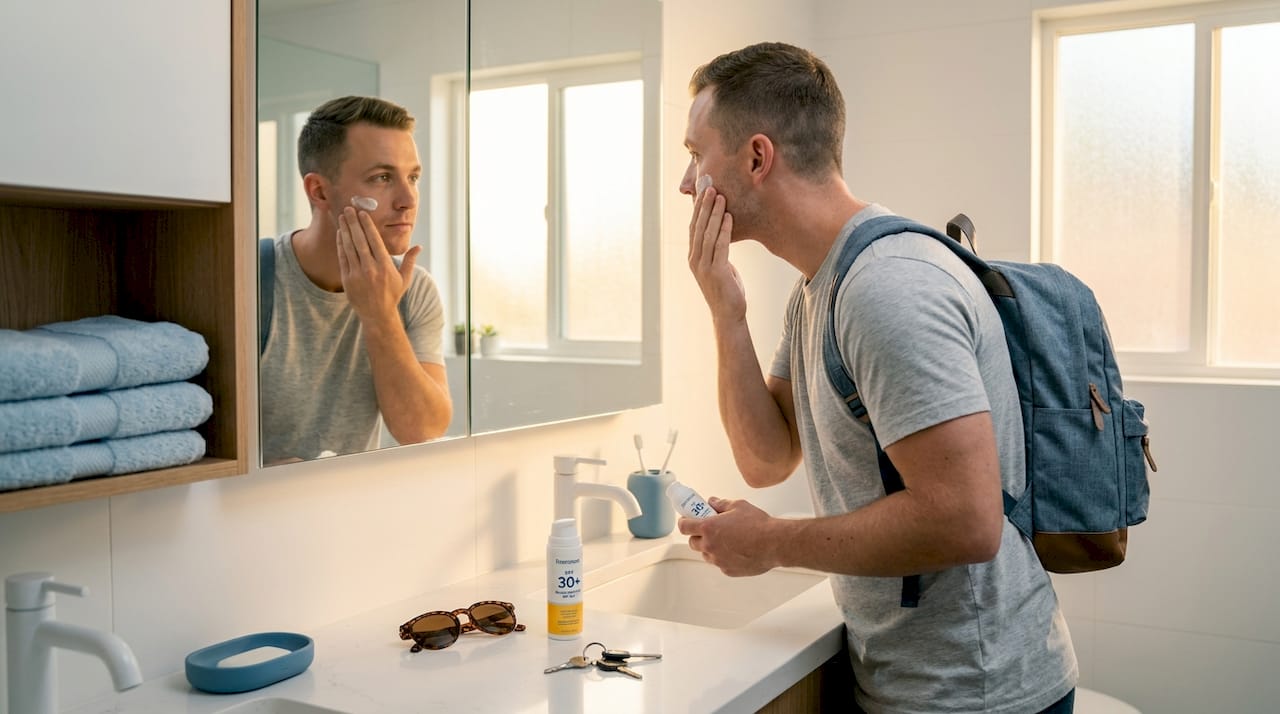
UV radiation is responsible for 80 to 90% of visible skin aging, including wrinkles, dark spots, and loss of elasticity. People who use sunscreen daily show 24% less visible aging over a 4.5-year period compared to those who use it inconsistently.
Use a broad-spectrum SPF 30+. SPF 30 blocks 97% of UVB rays, and SPF 50 only marginally improves that to 98%. Apply half a teaspoon to your face and reapply every two hours when outdoors. And yes, UVA rays penetrate windows and clouds, which means wearing sunscreen indoors on bright days still matters.
Pro Tip: Apply sunscreen as the last step in your morning routine, after moisturizer. Reapplication matters more than SPF number. A well-applied SPF 30 beats a poorly applied SPF 50 every time.
5. How to layer products for maximum absorption
Most people apply products in a random order and wonder why some of them seem to do nothing. Layering correctly is one of those skin hydration techniques that produces visible results without changing a single product you use.
Apply products in order from thinnest to thickest texture. In the morning: cleanser, then serum, then moisturizer, then SPF. In the evening: cleanser, then treatment (like retinol), then moisturizer.
The logic is simple. Thick products create a film that prevents thinner products from penetrating. If you apply moisturizer before your vitamin C serum, the serum sits on top of the barrier and absorbs poorly. Order matters as much as ingredients.
6. Treating acne: the evidence-based approach
Acne is one of the most common skin problems, and it is also one of the most over-treated with the wrong products. Harsh scrubs, alcohol-based toners, and DIY remedies can make acne worse by irritating already inflamed skin.
The evidence-backed first-line approach combines two ingredients:
- Topical retinoids (adapalene 0.1 to 0.3%): normalize keratinization, prevent clogged pores
- Benzoyl peroxide (2.5 to 5%): reduces bacteria, addresses inflamed lesions
Retinoids take 8 to 12 weeks for meaningful improvement. Benzoyl peroxide works faster, reducing inflamed lesions in 2 to 4 weeks. Using them together targets multiple causes of acne simultaneously.
One critical point: topical antibiotics should never be used alone for acne because they create rapid bacterial resistance. If a dermatologist prescribes an antibiotic, it should always be paired with benzoyl peroxide.
7. Using retinoids without wrecking your skin
Retinoids are the most researched topical ingredient for both acne and anti-aging skin care. They accelerate cell turnover, stimulate collagen synthesis, and reduce discoloration. They also cause dryness, peeling, and irritation if you use them wrong.
The key to tolerating retinoids is starting slow. Apply retinoids to completely dry skin 20 to 30 minutes after cleansing, and begin with every other night rather than nightly use. As your skin adjusts over four to six weeks, increase frequency.
Expect skin purging for 2 to 6 weeks before you see improvement. This is normal and not a reason to stop. Most people quit right before retinoids start working. For anti-aging specifically, full benefits from retinol typically appear after 3 to 6 months of consistent nightly use. Progress is gradual but real.
8. Monitoring moles and skin changes
Skincare is not only about appearance. Your skin can signal serious health issues, and learning to read those signals could genuinely save your life.
The ABCDE rule is the standard tool for evaluating moles and spots:
- A (Asymmetry): One half does not match the other
- B (Border): Edges are ragged, notched, or blurred
- C (Color): Multiple shades of brown, black, red, or white in one spot
- D (Diameter): Larger than 6mm, roughly the size of a pencil eraser
- E (Evolution): Any mole that changes in size, shape, or color over time
Between 20 and 30% of melanomas arise from existing moles, but 70 to 80% develop on normal-looking skin. This means you need to watch for new spots, not just existing ones. Any wound or sore that does not heal within three weeks also warrants a dermatologist visit.
Pro Tip: Take photos of existing moles every few months and compare them side by side. Change is easier to spot when you have a visual baseline.
9. Advanced products: serums, toners, and exfoliants
Once you have your core three-step routine running smoothly, you can consider adding targeted products. These are enhancements, not foundations. Using them before you have the basics down is like adding a second story to a house without a solid base.
Here is how the main additions compare:
| Product | Primary benefit | Main caution |
|---|---|---|
| Vitamin C serum | Brightens skin, protects against free radicals | Degrades in light; store in dark bottle |
| Niacinamide serum | Reduces pores, calms redness | Can cause flushing in high concentrations |
| AHA exfoliant | Smooths texture, fades dark spots | Limit to 1 to 2 times weekly; increases sun sensitivity |
| BHA exfoliant | Unclogs pores, reduces blackheads | Can be drying; avoid overuse |
| Toner | Hydrates, balances skin pH | Avoid alcohol-based formulas |
| Eye cream | Targets fine lines and puffiness | Thin skin around eyes absorbs less; keep formulas gentle |
Vitamin C serum protects against free radicals; AHAs and BHAs exfoliate effectively but only need to be used one to two times weekly. More frequent use causes irritation rather than faster results.
Pro Tip: Never stack retinoids with AHA or BHA on the same night. The combined irritation overwhelms your skin barrier and slows results rather than speeding them up.
10. Skin as a reflection of your overall health
Your skin does not exist in isolation. Dryness, flushing, or persistent breakouts can signal systemic inflammation, nutritional gaps, or chronic stress. Holistic care that includes quality sleep, good hydration, and balanced nutrition supports the skin barrier from the inside.
Sleep matters in particular. Skin repairs itself during deep sleep. Chronic poor sleep elevates cortisol, which worsens acne, eczema, and inflammatory conditions. If you want better skin hydration techniques to actually work, addressing restorative sleep habits needs to be part of the picture.
Dermatologists now describe this shift as moving from anti-aging toward longevity skin care. The focus is proactive protection rather than reactive damage control. That includes stress management, because chronic stress is a documented skin disruptor that no amount of topical treatment fully counteracts.
My honest take on skincare trends
I’ve watched the skincare industry manufacture complexity for decades. Every year there is a new must-have ingredient, a new 10-step system, a new reason to feel like your current routine is inadequate. In my experience, most of it is marketing dressed up as science.
What actually moves the needle is boring. Cleanser, moisturizer, SPF. Retinol at night if you want to treat aging or acne. Patience. Sunscreen reapplication. That’s genuinely it for 90% of people.
I’ve seen readers completely transform their skin by stripping routines back to three products after years of piling on actives. The skin barrier finally got to repair itself. What looked like “stubborn” skin problems were actually irritation caused by too many products fighting each other.
The longevity skin care shift dermatologists are discussing is really just permission to stop chasing trends. Protect what you have. Support your barrier. Sleep well. Manage stress. Your skin reflects your whole life, not just your product shelf. The best skincare routine is honestly the one you can maintain without burning out by week three.
— Amy
How stress affects your skin more than you think
Your skin and your mental health are more connected than most people realize. Chronic stress triggers cortisol spikes that increase oil production, compromise your skin barrier, and worsen conditions like eczema, psoriasis, and acne. Addressing stress is not optional if you want lasting skin results.

Revivehealththerapy offers evidence-based psychotherapy services across California, including CBT, EMDR, and mindfulness-based approaches that directly address chronic stress, anxiety, and emotional dysregulation. These same factors drive many persistent skin conditions. If you have tried every product and your skin still reacts unpredictably, it may be worth exploring psychotherapy benefits as part of your wellness strategy. Both in-person sessions in Walnut Creek and Oakland, and secure telehealth options statewide are available. Find out why psychotherapy helps with skin-related stress and beyond.
FAQ
What are the three most important skincare steps?
Cleansing, moisturizing, and applying broad-spectrum SPF 30+ sunscreen daily cover the core needs for most skin types. These three steps address barrier support, hydration, and UV protection, which together account for the majority of preventable skin damage.
How do I know my skin type?
Wash your face with a gentle cleanser, wait one hour without applying any product, and observe how your skin feels. Shine indicates oily skin, tightness or flaking suggests dry skin, and both together in different zones means combination skin.
When should I see a dermatologist about a mole?
See a dermatologist if a mole is asymmetrical, has an irregular border, shows multiple colors, exceeds 6mm in diameter, or has changed over time. Any skin wound that does not heal within three weeks also needs professional evaluation.
How long does it take for retinol to work?
Expect 3 to 6 months of consistent nightly use before full anti-aging benefits appear. Skin purging and dryness in the first 2 to 6 weeks are normal. Starting with every other night application reduces early irritation significantly.
Can stress actually cause skin problems?
Yes. Chronic stress raises cortisol levels, which increases sebum production, slows skin repair, and worsens inflammatory skin conditions including acne and eczema. Managing stress through sleep, nutrition, and when needed, professional support, is a legitimate part of skin health care.
Recommended
- Mental health checklist for California teens: strategies & support – Revive Health Therapy
- Why seek holistic therapy? Your guide to whole-person healing – Revive Health Therapy
- Build Your Anxiety Self-Care Checklist for Everyday Relief – Revive Health Therapy
- 7 Essential Mental Health Tips 2026 for Californians – ReviveHealthTherapy