
CBT and antidepressant medication produce similar short-term results for many people with depression or anxiety, but cognitive behavioral therapy tends to hold up better after treatment ends. Combined treatment usually wins for moderate-to-severe cases, high functional impairment, or when someone hasn’t responded to one approach alone. The right choice depends less on which treatment is “stronger” and more on how fast you need relief, your access to care, and whether you’re dealing with a straightforward case or something more complicated.
TL;DR:
- Combining CBT and medication can significantly improve response and reduce relapse in moderate-to-severe depression cases.
- CBT tends to have more durable long-term effects and lower relapse rates compared to medication alone.
- Antidepressants usually take four to six weeks to show effects, with common side effects such as sexual dysfunction and gastrointestinal upset.
- Access issues and individual preferences often dictate the best starting point, with immediate relief prioritized in crisis situations.
- Effective treatment planning should consider symptom severity, urgency, patient preferences, and coordination between providers for optimal outcomes.
Table of Contents
- CBT vs Medication: What the Research Actually Shows
- How Medication Works: Drug Classes, Speed, and Side Effects
- CBT Explained: How It Works and How Long It Takes
- When Combined Treatment Beats Either Option Alone
- How to Choose Between CBT and Medication
- How Revivehealththerapy Approaches This Decision With Clients
- Getting Started With CBT or Combined Care
- What People Get Wrong About This Comparison
- Sources
CBT vs Medication: What the Research Actually Shows
Large studies settle the “which one works better” debate faster than most people expect: for a lot of conditions, they don’t. A comprehensive meta-analysis covering 409 trials and 52,702 patients found that CBT and pharmacotherapy produce comparable effects by the end of an acute treatment course. Neither modality reliably beats the other in the first weeks or months.
The gap opens up later. That same analysis found CBT showing larger effects at the 6 to 12 month mark in several comparisons, suggesting the skills people build in therapy keep paying off after sessions stop. A network meta-analysis of primary care depression treatment reached a similar conclusion: psychotherapy and medication perform similarly at treatment’s end, but the durability story favors structured therapy.
Where the data gets genuinely persuasive is combined treatment.
That’s not a marginal bump. For someone stuck in a moderate depressive episode, a 25 to 35 percent relative improvement in getting better can be the difference between a partial response and something closer to remission.
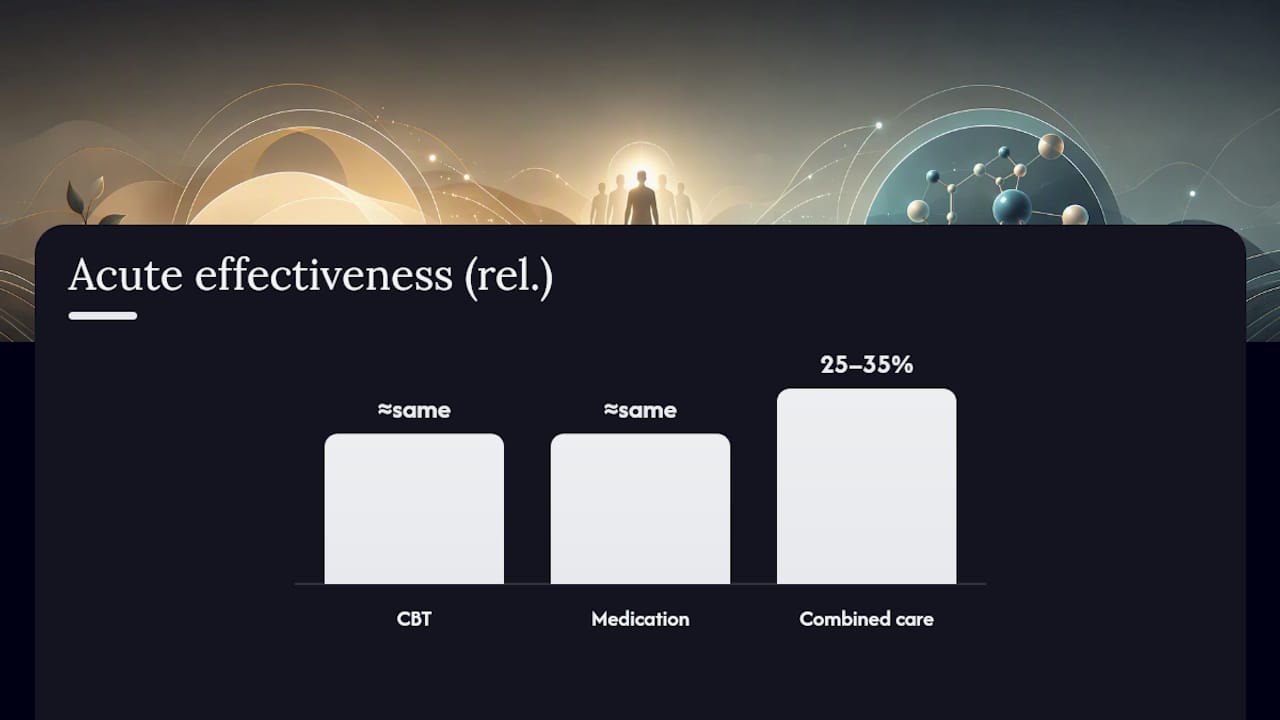
Older but influential randomized trial syntheses back this up. Research summarized in reviews comparing cognitive therapy with medication found the two approaches similarly effective for acute depression, with CBT reducing relapse risk after people stopped treatment across multiple trials.
None of this evidence is flawless, and reading it as gospel would be a mistake.
- Study heterogeneity runs high: trial populations, CBT protocols, and medication types vary enough that pooled numbers smooth over real differences.
- Follow-up periods are inconsistent. Some trials track patients for a year; others stop at 12 weeks, right when the medication-versus-CBT gap tends to widen.
- Publication bias remains a known issue in psychiatric research, meaning some null or negative results likely never made it into the pooled data.
- Most trials focus on depression and generalized anxiety; data for other conditions is thinner.
The honest takeaway: CBT and medication are roughly equivalent for symptom relief in the short run, CBT probably protects you better long term, and combining them is often the strongest single move for anyone with more complicated depression or anxiety.
How Medication Works: Drug Classes, Speed, and Side Effects
Medication’s biggest selling point is timing. Antidepressants don’t work instantly, but for people in acute distress, that timeline can still beat therapy’s slower buildup.
SSRIs and SNRIs are the first-line medications most prescribers reach for with depression and anxiety, working by altering serotonin and norepinephrine signaling in the brain. Benzodiazepines occupy a different niche entirely. They calm acute anxiety within an hour, which makes them tempting for panic attacks or acute crises, but their addiction potential and tolerance risk make most guidelines treat them as short-term bridges, not long-term solutions.
Expect antidepressants to take several weeks to show real effect, often 4 to 6 weeks before you can judge whether a given medication is working. That lag is the tradeoff for a mechanism that, once established, can reduce acute symptoms faster than CBT manages in its early sessions for some patients.
Common side effects include:
- Sexual dysfunction (reported frequently with SSRIs)
- Gastrointestinal upset, especially in the first two weeks
- Sleep disruption, either insomnia or sedation depending on the drug
- Weight changes over months of use
- Discontinuation syndrome if a medication is stopped abruptly rather than tapered
Pro Tip: Never stop an antidepressant cold. Discontinuation symptoms, dizziness, irritability, flu-like sensations, can mimic a relapse and scare people back onto a drug they were ready to leave. Taper with a prescriber’s guidance.
Younger adults and adolescents need closer monitoring for suicidal thinking in the first weeks of antidepressant treatment, a well-documented risk that requires active follow-up, not just a prescription and a callback in three months.
CBT Explained: How It Works and How Long It Takes
Cognitive behavioral therapy runs on a different engine than medication. Instead of adjusting brain chemistry directly, it retrains how you interpret situations and respond to them, using techniques with decades of trial data behind them.
The core toolkit includes:
- Cognitive restructuring, identifying and challenging distorted thought patterns
- Behavioral activation, rebuilding engagement with activities that depression has stripped away
- Exposure exercises, gradually facing avoided situations to reduce anxiety over time
- Skills practice, homework between sessions that turns insight into habit
Most courses run 8 to 20 sessions, and that range matters. Some people notice real shifts within a few weeks; the fuller benefit, particularly for entrenched patterns, often takes a few months of consistent work.
The payoff shows up after therapy ends. Trials tracking people well past their final session consistently find lower relapse rates for CBT compared to medication alone, which lines up with the ABCT’s guidance that some conditions, specific phobias, insomnia, social anxiety, respond especially well to structured CBT protocols.
Access shapes the real-world experience as much as the therapy itself. Individual sessions offer the most tailored pace but often carry the longest wait times and highest per-session cost. Group CBT cuts cost and wait but sacrifices some individualization. Telehealth has narrowed the access gap significantly, and guided self-help or digital CBT programs offer a lower-cost entry point, though with less clinical oversight than a licensed therapist provides.
When Combined Treatment Beats Either Option Alone
Combining CBT with medication isn’t the default for every case, but the data makes a strong argument for specific situations.
The network meta-analysis on primary care depression treatment found combined treatment improving response and remission rates by relative risks in the 1.25 to 1.35 range compared to monotherapy, and a systematic review on enduring treatment effects found combined care reducing relapse and rehospitalization more than medication alone in several follow-up studies.
Combined treatment tends to make the most sense when:
- Symptoms are severe or functional impairment is significant
- Suicidality risk is present and needs faster stabilization than therapy alone provides
- A person has already tried and not responded to CBT or medication individually
- Comorbid conditions (ADHD vs. Bipolar Disorder: Key Differences Explained) such as substance use, anxiety plus depression, trauma history complicate a single-modality approach
In practice, this means a prescriber manages the medication piece, dosing, side effects, taper timing, while a therapist runs the CBT sessions. The strongest setups have those two providers actually communicating, not working in parallel silos.
How to Choose Between CBT and Medication
Start with severity and safety, not preference. If someone is in crisis or symptoms are severe enough to disrupt basic functioning, that changes the calculus toward faster-acting options or combined care immediately.
Beyond that, weigh:
- Symptom severity and timing. Mild to moderate symptoms often respond well to CBT alone; severe or long-standing symptoms often benefit from combined care.
- Need for rapid relief. If you need symptom reduction within days rather than weeks, medication (sometimes short-term benzodiazepines under supervision) may bridge you until CBT gains traction.
- Personal preference and feasibility. Some people won’t take medication; others don’t have time for weekly therapy homework. Both are legitimate constraints, not failures.
- Monitoring and milestones. Set a specific check-in point, four weeks for medication response, six to eight sessions for CBT progress, so you’re not guessing whether something is working.
Questions worth bringing to a prescriber or therapist: How long before I should expect noticeable change? What does tapering look like if this medication doesn’t work for me? Can these two treatments be coordinated, and who’s tracking my overall progress?
Pro Tip: If you haven’t seen meaningful movement by the timeline your provider gave you, that’s your cue to revisit the plan, not push through silently for another two months.
Pregnancy plans, substance use history, and other medical comorbidities also factor heavily into which medication classes are even on the table, which is exactly why this decision belongs in a conversation with a clinician rather than a solo call.
How Revivehealththerapy Approaches This Decision With Clients
Revivehealththerapy builds its practice around evidence-based methods, CBT, EMDR, trauma-informed care, delivered through both in-person sessions in Oakland and Walnut Creek and secure telehealth across California. During intake, clinicians assess symptom severity, history, and functional impact to determine whether therapy alone fits or whether a client should also loop in a prescriber for combined care. Sliding-scale fees and insurance acceptance keep that decision grounded in clinical need rather than what a client can afford that month.
Getting Started With CBT or Combined Care
If the evidence here points you toward therapy, structured CBT for anxiety or depression, or a combined approach alongside medication, counseling services offer both in-person sessions in multiple California locations and secure telehealth options, with sliding-scale pricing and flexible payment options to help make care more affordable.
Scheduling starts with a brief intake conversation covering your symptoms, history, and goals, no lengthy paperwork before that first call. If you’re already working with a prescriber, care coordination may be available to ensure integrated support rather than working independently from your medication plan. One distinction matters here: if you’re in acute crisis or having thoughts of self-harm, that calls for urgent psychiatric care or a crisis line immediately, not a scheduled therapy intake. For everything short of that, whether you’re weighing CBT against medication or trying to figure out which therapy type fits your situation, the next step is booking that first conversation and letting an actual clinician help you sort the rest out.
What People Get Wrong About This Comparison
Most people treat this as a competition with a single winner, and that framing wastes the most useful part of the research: the timing data. The short-term equivalence between CBT and medication gets all the attention because it’s counterintuitive, but the more actionable finding is the divergence that shows up months later, after treatment stops. That’s the number that should drive your decision, not which treatment “wins” at week eight.
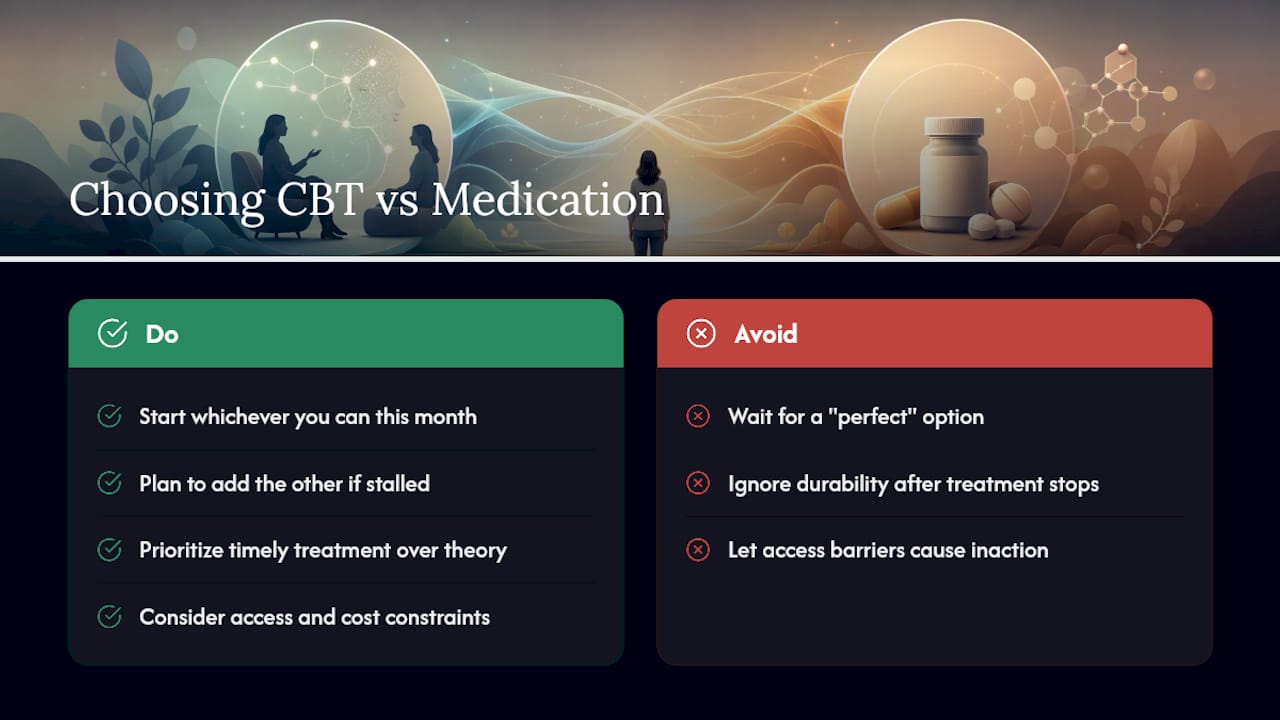
There’s also a quieter bias in how people weigh access against evidence. CBT’s durability advantage means nothing if you can’t get an appointment for six weeks, and combined treatment’s superior response rates mean nothing if you can’t afford a therapist and a psychiatrist simultaneously. The honest answer to “CBT or medication” is usually “whichever one you can actually start this month, with a plan to add the other if progress stalls.” Waiting for the theoretically optimal treatment while symptoms worsen is its own kind of harm, one the meta-analyses don’t measure but clinicians see constantly.
— Amy
This article is general information, not a substitute for advice from a qualified doctor. Consult a qualified healthcare professional about your own circumstances before acting on anything here.
Sources
- Cognitive behavior therapy vs. control conditions, other psychotherapies, pharmacotherapies and combined treatment for depression: a comprehensive meta-analysis including 409 trials with 52,702 patients
- Psychologic Treatment of Depression Compared With Pharmacotherapy and Combined Treatment in Primary Care: A Network Meta-Analysis
- Treatment Options: CBT or Medication – ABCT
- Enduring effects of psychotherapy, antidepressants and their combination for depression: a systematic review and meta-analysis