
Daydreaming is voluntary mind wandering you can step out of whenever you choose; dissociation is a largely involuntary disconnection your brain triggers when stress or trauma feels like too much to process in real time. Most people drift into daydreams and snap back without effort. Mild overlap does happen, and if you notice memory gaps, repeated episodes, or trouble functioning, that pattern points toward dissociation and is worth a real assessment. Groups like the Mayo Clinic, Merck Manuals, and Revivehealththerapy all treat that distinction as clinically meaningful, not just semantic.
TL;DR:
- Mild dissociative experiences are common, especially in adolescence, and usually do not interfere with daily functioning unless they become frequent or disruptive.
- Dissociation is involuntary, often triggered by trauma or stress, and characterized by memory gaps, foggy recall, and a sense of unreality, unlike voluntary daydreaming.
- Red flags include recurring unexplained memory gaps, frequent episodes, or dissociation happening during activities like driving, which warrants professional assessment.
- Grounding techniques, such as naming objects or controlling breath, can manage episodes temporarily, while therapy focuses on stabilization and trauma processing.
- Treatment typically involves trauma-informed psychotherapy, especially EMDR and CBT, with medication used only for co-occurring conditions, and early assessment is key for patterns that impair safety or relationships.
Table of Contents
- What Is Daydreaming, and When Does It Become a Problem?
- What Is Dissociation? Depersonalization, Derealization, and the Wider Spectrum
- Dissociation vs Daydreaming: The Core Differences Side by Side
- When to Worry: Red Flags and Safety Considerations
- What Actually Helps: Grounding Now, Treatment Long Term
- A Clinician’s Note on Assessment and What Helps
- What the Research Actually Supports
- Getting Support From Revivehealththerapy
- Sources
What Is Daydreaming, and When Does It Become a Problem?
Ordinary daydreaming is just your mind wandering off a task toward memory, fantasy, or planning. It is common enough that most people do it dozens of times a day without noticing, and it serves real purposes: rehearsing conversations, working through creative ideas, or giving an overworked brain a break. You stay loosely aware of your surroundings the whole time. Someone calls your name, a car honks, your phone buzzes, and you’re back.
Maladaptive daydreaming is a different animal. It involves vivid, compulsive fantasy scenarios that can eat hours of a day and pull attention away from work, school, or relationships, and while it isn’t yet its own DSM diagnosis, clinicians frequently treat it when it interferes with daily functioning, often with CBT-style approaches.
A few questions help sort out where your own experience lands:
- Can you snap out of it the moment something demands your attention?
- Do you remember the daydream clearly afterward, start to finish?
- Does it happen on your own terms, or does it hijack hours you meant to spend elsewhere?
- Is it fueling your life (ideas, rest, motivation) or quietly draining it?
What Is Dissociation? Depersonalization, Derealization, and the Wider Spectrum
Dissociation is a disruption in how consciousness, memory, identity, and perception normally knit together, according to the Mayo Clinic. Instead of one continuous, integrated sense of “this is me, here, now,” pieces of that experience split off. It usually shows up after overwhelming stress, and for many people it first appears during or after a traumatic event.
Two terms come up constantly in this space, and they describe different flavors of the same disconnection:
- Depersonalization feels like watching yourself from outside your own body, like your thoughts and actions belong to someone else.
- Derealization makes the world itself feel unreal, foggy, or distant, like you’re viewing life through glass.
Both can feel like living inside a dream, and when episodes last or keep recurring in ways that interfere with daily life, that pattern points toward depersonalization derealization disorder.
Dissociative experiences fall on a spectrum. On the mild end sits highway hypnosis, that eerie realization you drove twenty miles without registering any of it, or the sensation of “checking out” during a boring meeting. On the clinical end sit dissociative disorders marked by real memory gaps and, in some cases, identity fragmentation.
Mild dissociative experiences turn out to be far more common than most people assume. Roughly a third of people report occasional moments of feeling like they’re watching themselves in a movie, and these experiences peak in adolescence and young adulthood before typically declining after age 20.
Dissociation vs Daydreaming: The Core Differences Side by Side
Clinicians assessing whether an experience is dissociation or daydreaming tend to zero in on a handful of dimensions rather than the content of the experience itself. What matters isn’t whether you were imagining a beach vacation or a work deadline. It’s whether you chose to go there and whether you can find your way back easily.
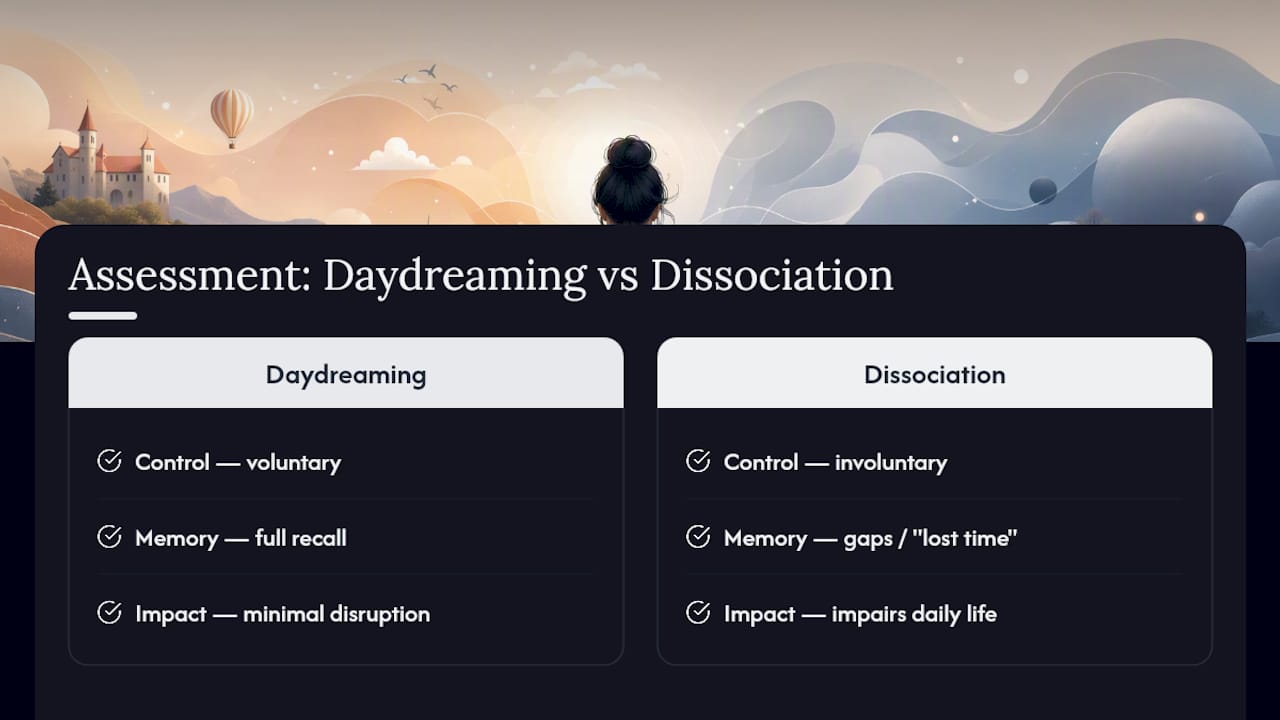
- Awareness and control. Daydreaming is voluntary, something you drift into and can interrupt at will. Dissociation is usually involuntary, a protective mechanism the brain activates rather than something you decide to do, a distinction clinicians consistently emphasize when separating the two.
- Emotional tone. Daydreams tend to feel pleasant, curious, or neutral. Dissociation often carries a flat, numb, or distressing quality, even when nothing dramatic is happening on the surface.
- Memory and time loss. You can usually narrate a daydream afterward in detail. Dissociative episodes often come with fuzzy recall or outright gaps, missing minutes or hours you can’t account for.
- Typical triggers. Boredom, creative work, and quiet moments spark daydreams. Trauma reminders, acute stress, and overwhelming anxiety tend to spark dissociation.
- Functional impact and safety. A daydream rarely puts you at risk. Dissociation can, especially if it happens while driving or operating machinery, which is why clinicians treat frequent episodes as a safety issue, not just an inconvenience.
| Dimension | Daydreaming | Dissociation |
|---|---|---|
| Awareness/control | Voluntary, easy to interrupt | Involuntary, hard to interrupt |
| Emotional tone | Pleasant or neutral | Numb, distressing, or blank |
| Memory/time loss | Recalled clearly | Gaps or fuzzy recall |
| Typical triggers | Boredom, creativity, rest | Trauma cues, acute stress |
| Impact on functioning | Minimal | Can impair work, driving, relationships |
Pro Tip: If you’re not sure which category your experience fits, try recalling how it ended. Daydreams usually end because you chose to refocus. Dissociative episodes usually end because something outside you (a loud noise, someone touching your arm) pulled you back.
When to Worry: Red Flags and Safety Considerations
Most spacing out is harmless. A few patterns, though, signal it’s time to get a professional opinion rather than wait it out:
- Recurring memory gaps you can’t explain, even for routine tasks
- Episodes that happen frequently enough to interfere with work, school, or relationships
- A sense that your body or surroundings feel consistently unreal, not just once, but as a pattern
- Genuine distress about the experience itself, separate from whatever triggered it
- Any episode that happens while driving or doing something that requires full attention
If dissociation hits while you’re driving, pull over as soon as it’s safe. Build a basic safety plan ahead of time: someone to call, a grounding phrase to repeat, a place to sit down. Persistent or recurrent symptoms that interfere with daily functioning are exactly the threshold clinicians use to recommend an evaluation rather than a wait-and-see approach.
What Actually Helps: Grounding Now, Treatment Long Term
In the moment, a short grounding sequence can pull you back into your body and the present:
- Name five things you can see, right now, out loud if possible.
- Press your feet flat into the floor and notice the actual physical sensation.
- Hold something cold or textured, ice, a rough stone, anything with sharp sensory input.
- Say your name, the date, and where you are, plainly, like stating facts.
- Take one slow breath, count to four on the inhale, four on the exhale.
These techniques are common, practical first-line tools clinicians recommend for managing transient episodes, and Revivehealththerapy’s guide to grounding techniques backed by science walks through several more in depth.
Longer term, treatment for dissociation and depersonalization/derealization disorder typically centers on psychotherapy, with EMDR and trauma-focused CBT among the most researched approaches. Medication isn’t usually the primary treatment, but it’s sometimes used alongside therapy for co-occurring anxiety or depression. A trauma-informed clinician will typically start an initial assessment by mapping frequency and triggers before recommending a path forward, an approach outlined further in Revivehealththerapy’s guide to trauma recovery.
A Clinician’s Note on Assessment and What Helps
In practice, we separate dissociation from daydreaming by asking about control, memory continuity, and whether the experience gets in the way of daily life. Someone who can recall their fantasy in full and stop it at will is daydreaming. Someone who “loses time,” feels foggy for no clear reason, or can’t easily narrate what happened is likely dissociating.
Early therapy work prioritizes safety and stabilization before anything else, building grounding skills and pacing, rather than diving straight into trauma processing storytelling. From there, EMDR and CBT are the two approaches we lean on most, chosen based on what the assessment turns up.
What the Research Actually Supports
Most articles on this topic treat dissociation like a rare, dramatic event, something that only happens to people with severe trauma histories. That framing does readers a disservice. Mild dissociative experiences are common, and treating every instance of “zoning out” as pathological creates unnecessary alarm.
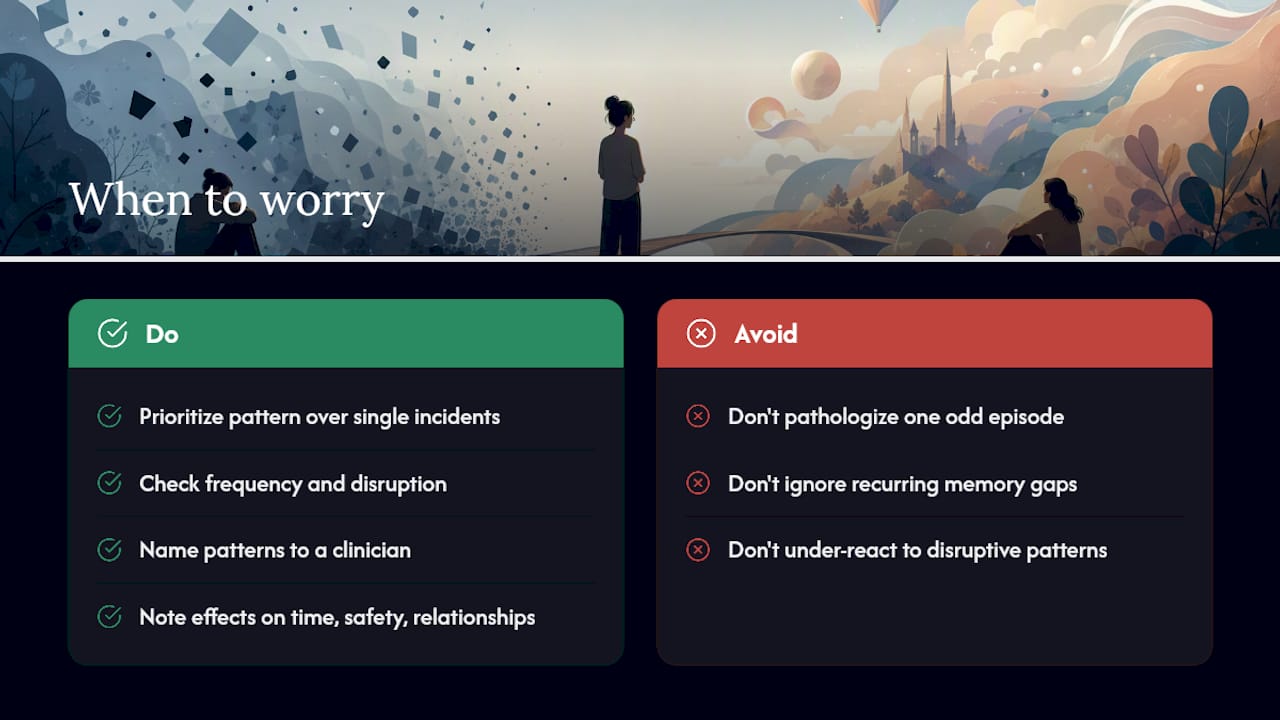
The more useful lens isn’t “did this happen” but “how often, how disruptive, and can I return easily.” A single episode of highway hypnosis after a rough week isn’t the same signal as recurring memory gaps that show up across contexts. Conventional advice tends to either over-medicalize normal spacing out or under-react to genuine red flags, and neither extreme serves you.
If you take one thing from this, prioritize pattern over incident. One weird moment rarely needs intervention. A repeating pattern that costs you time, safety, or relationships does, and it’s worth naming that pattern out loud to a professional rather than sitting with it alone.
— Amy
Getting Support From Revivehealththerapy
If what you’ve read here sounds closer to dissociation than daydreaming, Revivehealththerapy offers trauma-informed therapy built specifically around that gap between “I zone out sometimes” and “I lose time and don’t know why.” Sessions run in person in select California locations, or by secure telehealth anywhere in the state, so location isn’t a barrier to getting assessed.

Intake starts with a straightforward conversation about what you’re experiencing, and Revivehealththerapy works with sliding-scale fees and accepts insurance, including HSA and FSA plans, to keep that first step realistic on most budgets. Clinicians here draw on EMDR and trauma-focused CBT, the same approaches referenced throughout this piece, matched to what your specific assessment turns up. If any of the red flags above sound familiar, the next move is simple: reach out through the contact page and get a session on the calendar.
Sources
- Dissociative disorders – Mayo Clinic
- Depersonalization/derealization disorder – Merck Manuals
- Dissociation and dissociative disorders – Mental Health America
This article is general information, not a substitute for advice from a qualified doctor. Consult a qualified healthcare professional about your own circumstances before acting on anything here.
One Response