
TL;DR:
- Emotional regulation involves managing responses to feelings to act thoughtfully instead of impulsively, which is essential for parents. Building self-awareness, mindfulness, and a safety plan create a foundation for effective regulation, with techniques like affect labeling and structured breathing forming key strategies. Parenting success relies on repair, co-regulation, and accepting that regulation is an ongoing practice, not a one-time problem to fix.
Emotional regulation is the skill of managing your emotional responses, not eliminating feelings, so you can act thoughtfully rather than react impulsively. Every parent needs this skill. Research confirms that sensitive, responsive parenting with strong emotional regulation predicts better mental health outcomes for children years later. This emotional regulation guide for parents covers both sides of the equation: how you manage your own emotions in real time, and how you build those same skills in your child. The clinical term for this work is emotion regulation, a concept central to Cognitive Behavioral Therapy (CBT), Dialectical Behavior Therapy (DBT), and mindfulness-based approaches used by therapists at Revivehealththerapy.
What parents need before starting emotional regulation
The most common mistake parents make is jumping straight to techniques without building the foundation first. Emotional regulation requires self-awareness, a basic mindfulness practice, and a reliable support structure before any specific strategy will stick.
Building emotional self-awareness
Self-awareness starts with naming what you feel before you try to change it. Psychologists call this “affect labeling,” and it reduces the intensity of an emotional response by engaging the prefrontal cortex. Practically, this means pausing during a tense moment and saying internally, “I am frustrated right now,” rather than acting on the frustration. You can also train yourself to notice physical cues: a tight chest, clenched jaw, or shallow breathing are your body’s early warning signals that an emotion is building.

A simple daily habit accelerates this skill. Mindfulness, deep breathing, and journaling are four of the most evidence-backed practices for building emotional awareness and regulation capacity. Even one sentence of journaling per day, such as “I felt overwhelmed when my child refused dinner,” builds the pattern recognition you need.
The three-layer safety plan
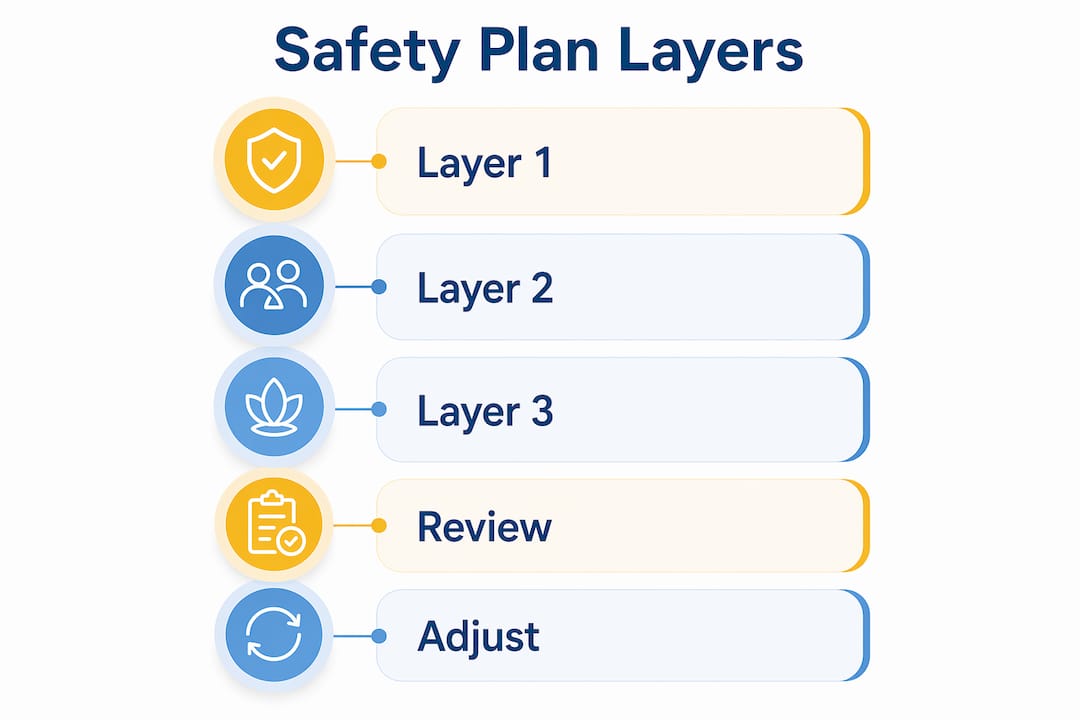
Before stress peaks, every parent benefits from having a pre-planned response structure. A three-layer safety plan organizes your resources from least to most intensive:
- Layer 1: Self-soothing. Deep breathing, cold water on your face, a short walk, or a body scan meditation.
- Layer 2: Trusted support. A partner, friend, or family member you can call or text when self-soothing is not enough.
- Layer 3: Professional resources. A therapist, your child’s pediatrician, or crisis lines like the 988 Suicide and Crisis Lifeline for acute moments.
Having this structure written down before you need it removes the decision-making burden when you are already overwhelmed.
Pro Tip: Review your mental health checklist monthly to spot which layer you rely on most. If you never reach Layer 2 or 3, you may be white-knuckling it alone more than you realize.
| Foundation element | Why it matters |
|---|---|
| Affect labeling | Reduces emotional intensity by activating rational thinking |
| Daily mindfulness practice | Builds the pause between trigger and response over time |
| Physical cue awareness | Gives early warning before emotions escalate |
| Written safety plan | Removes decision fatigue during high-stress moments |
How can parents regulate their own emotions in high-stress moments?
Real-time regulation is the hardest part of parenting emotional skills because the moments that require it, a toddler meltdown, a teen’s defiance, a sleepless night, are exactly when your capacity is lowest. The following sequence gives you a repeatable process.
-
Notice the emotion without judgment. Before doing anything else, name what you feel. “I am angry” is not a failure. It is information. This single step creates the reaction gap that emotional regulation research identifies as the core mechanism of effective control.
-
Use a structured breathing technique. The 4-4-8 method (inhale for 4 counts, hold for 4, exhale for 8) activates the parasympathetic nervous system within 60 to 90 seconds. A simpler version is a 3-breath script: breathe in slowly, breathe out slowly, and on the third exhale, consciously relax your shoulders.
-
Apply cognitive reappraisal. Reappraisal, not suppression, is the adaptive strategy. Instead of pushing the feeling down, reframe the situation. “My child is not trying to ruin my evening. They are overwhelmed and do not have the skills yet to show it differently.” This shift in interpretation reduces the emotional charge without denying it.
-
Use distanced self-talk. Referring to yourself in the third person, “What does Amy need to do right now?” rather than “What do I do?”, creates psychological distance. Distanced self-talk and mental time travel are expert-validated techniques that reduce emotional reactivity under stress. Mental time travel means asking yourself, “How will I feel about this reaction in three days?” That future perspective often deflates the urgency of the current moment.
-
Repair if you lose control. Every parent loses it sometimes. The repair matters more than the rupture. Apologizing and explaining your reaction to your child, “I raised my voice and that was not okay. I was frustrated and I am working on it,” builds trust and models emotional responsibility simultaneously.
Pro Tip: Set a weekly 7-day practice schedule using four daily actions: notice one emotion, do 2 minutes of deep breathing, write one journal sentence, and complete 10 minutes of mindfulness. Consistency over 7 days builds the habit faster than occasional long sessions.
What are effective ways to teach emotional regulation to children?
Co-regulation is the starting point for all child emotional development, especially before age 7 when the brain’s self-regulatory systems are still forming. Co-regulation means you use your calm presence, your tone of voice, physical comfort, and emotional labeling to help your child’s nervous system settle. You are, in effect, lending your regulated brain to your child until theirs can do the work independently.
Naming feelings and validating emotions
The most direct way to build your child’s emotional vocabulary is to narrate emotions out loud, both yours and theirs. “You look really disappointed that we can’t go to the park. That makes sense.” This validates the feeling without rewarding the behavior. Parents modeling emotional regulation and explicitly naming their own regulation helps children acquire these skills faster and develop language for feelings they cannot yet articulate.
Books like The Whole-Brain Child by Daniel J. Siegel and Tina Payne Bryson, and tools like the Zones of Regulation curriculum used in many schools, give children a shared vocabulary for emotional states. Using the same language at home reinforces what children learn in therapy or school.
Creating an Emotion Regulation Plan for your child
An Emotion Regulation Plan identifies 3 to 5 specific triggers and pairs each with a safe coping activity. This is not a punishment chart. It is a proactive map.
- Identify triggers: situations (transitions, loud environments), people (certain peers), or sensory inputs (hunger, fatigue).
- Match coping tools: deep pressure (weighted blanket, tight hug), movement (jumping jacks, a walk), sensory calming (cold water, a fidget), or verbal processing (talking it through with a parent).
- Practice the plan during calm moments so it becomes automatic during dysregulation.
| Approach | Best for | Limitation |
|---|---|---|
| Emotion labeling | All ages, especially toddlers | Requires consistent parent follow-through |
| Co-regulation | Children under 7 | Depends on parent’s own regulated state |
| Zones of Regulation | School-age children | Needs school and home alignment |
| Emotion Regulation Plan | Ages 5 and up | Must be built collaboratively with the child |
Play and storytelling also serve as low-pressure practice grounds. Role-playing scenarios, “What would you do if a friend took your toy?”, lets children rehearse emotional responses without real stakes. Family routines like a nightly check-in, “What was hard today? What felt good?”, normalize emotional conversation and reduce the stigma around difficult feelings.
What challenges do parents face with emotional regulation, and how to overcome them?
The most common challenge is emotional contagion. Emotions are contagious, and a child’s tantrum can pull a parent directly into their own dysregulated state before any technique kicks in. Knowing this in advance is protective. When you feel yourself getting pulled in, treat it as a cue to activate your breathing sequence rather than engage verbally.
Perfectionism is the second major obstacle. Many parents believe that good emotional regulation means never losing their temper. That standard guarantees failure and guilt. Suppressing anger consistently backfires and increases emotional outbursts over time. The goal is managing the response, not achieving emotional flatness.
Children also resist regulation tools, especially older kids who find breathing exercises or feeling charts patronizing. The solution is co-creation. Let your child pick their own coping tools from a menu of options. A 10-year-old who chooses “listening to music for 5 minutes” is far more likely to use that tool than one who was assigned it.
“Repair moments after emotional dysregulation are not signs of failure. They are the most powerful teaching opportunities in the parent-child relationship, building trust and emotional safety that no calm moment can replicate.”
Pro Tip: Keep a family emotional wellness checklist on your refrigerator. Reviewing it weekly as a family normalizes emotional check-ins and catches dysregulation patterns before they become crises.
Key takeaways
Effective emotional regulation for parents requires managing your own responses first, then using that regulated state to co-regulate and teach your child.
| Point | Details |
|---|---|
| Regulation is response management | The goal is creating a pause between trigger and reaction, not eliminating emotions. |
| Build the foundation first | Self-awareness, a daily mindfulness habit, and a written safety plan precede any technique. |
| Co-regulation drives child development | Your calm presence is the primary tool for building your child’s emotional skills before age 7. |
| Reappraisal beats suppression | Changing how you interpret a situation reduces emotional impact; pushing feelings down worsens them. |
| Repair rebuilds trust | Apologizing after losing control models emotional responsibility and strengthens the parent-child bond. |
What I’ve learned about emotional regulation that most guides won’t tell you
I have worked with parents long enough to know that the hardest part of this work is not learning the techniques. It is accepting that you will need them repeatedly, for years, without a finish line. Most guides present emotional regulation as a problem to solve. It is not. It is a practice to maintain.
The parents I see make the most progress are not the ones who never lose their temper. They are the ones who repair quickly and without drama. A simple “I got too loud and I’m sorry” said genuinely to a 5-year-old does more for that child’s emotional safety than a week of perfect parenting. That repair moment teaches children that relationships survive conflict, that adults take responsibility, and that emotions are manageable rather than catastrophic.
I also want to say directly: your child’s emotional regulation is not entirely your responsibility to fix. You are the environment, not the engineer. You create the conditions. The child does the developing. Holding that distinction reduces the guilt that makes this work so exhausting for so many parents.
If you are a California parent using structured weekly practices and still finding that your own emotional responses feel out of control, that is not a parenting failure. It is often a signal that your own nervous system needs support, and that is exactly what therapy is for.
— Amy
How Revivehealththerapy supports parents and children with emotional regulation

Revivehealththerapy offers evidence-based psychotherapy in California for parents, children, and teens who want structured support for emotional regulation. Using CBT, EMDR, and mindfulness-based approaches, therapists at Revivehealththerapy work with families at locations in Walnut Creek and Oakland, as well as through secure telehealth statewide. If you are ready to go beyond self-help and work with a licensed therapist, explore psychotherapy options tailored to your family’s needs. For children and teens specifically, child and teen therapy services address emotional and behavioral regulation with age-appropriate, evidence-based methods. Sliding-scale fees and insurance acceptance, including HSA and FSA plans, make these services accessible across income levels.
FAQ
What is emotional regulation in simple terms?
Emotional regulation is the ability to notice, understand, and manage your emotional responses so they do not control your behavior. It is not about suppressing feelings but about creating a gap between what you feel and how you act.
At what age can children start learning emotional regulation?
Children begin developing emotional regulation skills in infancy through co-regulation with caregivers. Formal tools like feeling charts and coping plans become effective around ages 4 to 5, while more cognitive strategies like reappraisal work well from age 8 onward.
How does a parent’s emotional regulation affect their child?
Parents’ emotional regulation in early childhood directly predicts children’s mental health outcomes years later. Sensitive, responsive parenting reduces behavioral symptoms and builds a child’s capacity for self-regulation.
What is the fastest technique for calming down in a parenting moment?
The 4-4-8 breathing method (inhale 4 counts, hold 4, exhale 8) activates the parasympathetic nervous system within 60 to 90 seconds. Pairing it with distanced self-talk, coaching yourself by name rather than using “I,” increases its effectiveness under acute stress.
When should a parent seek professional help for emotional regulation?
Seek professional support when emotional reactivity is affecting your relationship with your child, when self-help strategies are not producing change after consistent effort, or when your own history of trauma is driving your responses. Revivehealththerapy provides family-focused emotional regulation support for exactly these situations.
Recommended
- Emotional regulation steps for teens and families – Revive Health Therapy
- Mental health tips for families in California 2026 – ReviveHealthTherapy
- Emotional Wellness Checklist: 35% Better Therapy Adherence – ReviveHealthTherapy
- Mindfulness for California Families: A Practical How-To – Revive Health Therapy