
Exposure therapy is not a competitor to cognitive behavioral therapy. It is a technique that lives inside CBT, and in some protocols it is the entire treatment. A 2011 systematic review and meta-analysis of 20 randomized controlled trials found no overall difference in outcomes between exposure therapy and cognitive therapy across most anxiety disorders, with one clear exception: cognitive therapy edged out exposure for social phobia. The right choice usually comes down to your specific diagnosis, not a philosophical preference for one method over the other.
TL;DR:
- Exposure therapy is a component of CBT and is most essential for specific phobias, OCD, and panic disorder, where avoidance drives the condition.
- Cognitive therapy tends to outperform exposure significantly in cases of social anxiety disorder, due to its focus on distorted self-perceptions and judgments.
- Research shows no overall difference between the two approaches for most anxiety disorders, but social phobia is an exception where cognitive therapy has clearer benefits.
- Tailoring treatment entails starting with exposure for avoidance-based issues and adding cognitive work for disorders like social anxiety, often combining both for optimal outcomes.
- Structured protocols like virtual reality exposure are gaining traction but remain underused due to practitioner discomfort and training gaps in community settings.
Table of Contents
- Exposure Therapy vs. CBT: What Each Approach Actually Involves
- What the Research Actually Shows About Exposure vs. Cognitive Therapy
- Who Actually Benefits From Exposure, and Who Needs Cognitive Work First
- What Treatment Actually Looks Like Week to Week
- How Revivehealththerapy Applies This Evidence in Practice
- A Clinician’s Take on Choosing Between These Two Approaches
- Getting Started With CBT and Exposure Therapy at Revivehealththerapy
- Sources
- FAQ
Exposure Therapy vs. CBT: What Each Approach Actually Involves
The confusion between these two terms is understandable, because they overlap so much that separating them feels almost artificial. Cognitive behavioral therapy is the umbrella. Exposure therapy is one of the tools kept under it, alongside cognitive restructuring, behavioral experiments, and skills training.
CBT works on the idea that thoughts, feelings, and behaviors feed each other, and that changing distorted thinking patterns changes how you feel and act. A typical session runs 45 to 60 minutes, follows a set agenda, and almost always ends with a homework assignment. The National Institute of Mental Health describes CBT as one of the most widely used and researched psychotherapies available, applied to everything from depression to insomnia to anxiety.
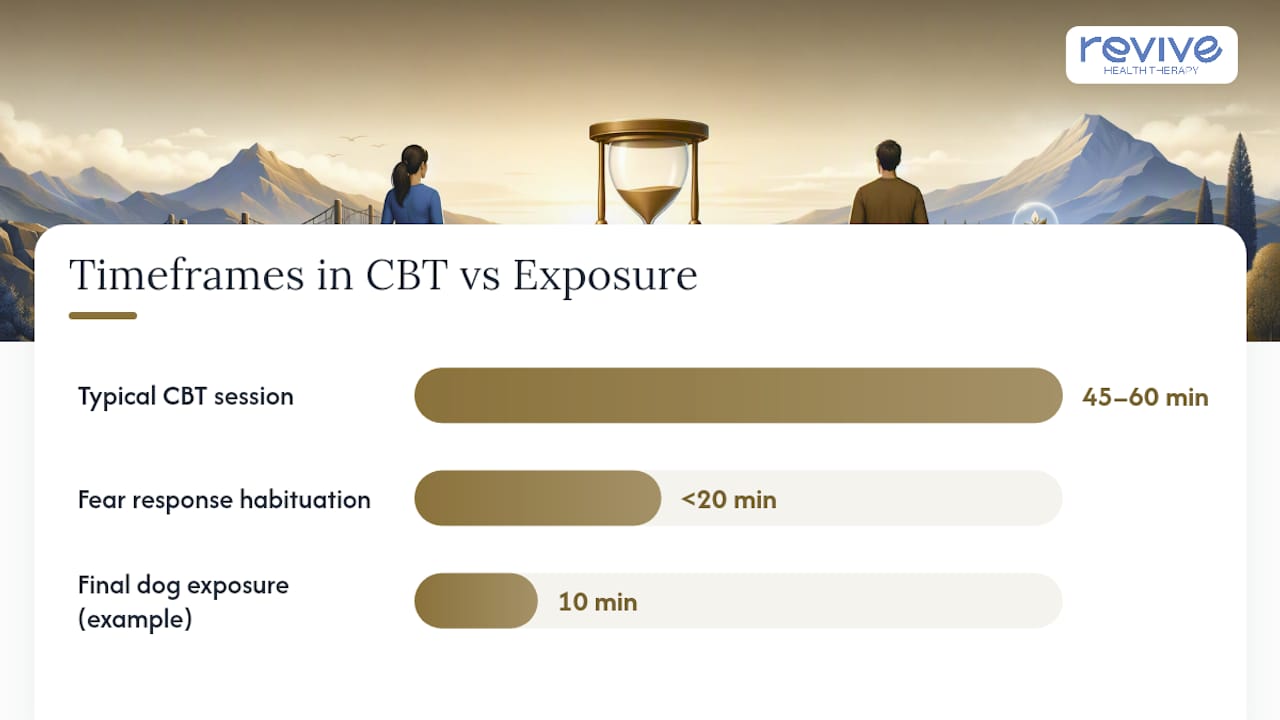
A basic CBT reframing example: someone with panic disorder thinks, “My racing heart means I’m having a heart attack.” A therapist helps them test that belief against evidence (their cardiologist cleared them, the sensation always passes in under 20 minutes) and replace it with something more accurate: “My heart races because of adrenaline, not cardiac damage, and it will pass.”
Exposure therapy works differently. Instead of arguing with a thought, it puts the person in direct contact with the feared object, situation, or sensation until the fear response fades. That process, called habituation, is built on a graded hierarchy rather than a single overwhelming confrontation. A short example for someone with a dog phobia might look like this:
- Look at photos of calm dogs
- Watch videos of dogs from across the room
- Stand near a leashed, calm dog outdoors
- Pet a calm dog with the owner present
- Spend 10 minutes alone with a familiar, calm dog
Exposure comes in several forms. In vivo exposure means facing the real thing. Imaginal exposure means vividly recalling or narrating a feared memory, common in PTSD treatment. Interoceptive exposure means deliberately triggering physical sensations, like spinning in a chair to mimic dizziness for panic disorder. Virtual reality exposure therapy (VRET) simulates feared environments, like flying or heights, in a controlled digital space, and Harvard Health lists it as a growing option for PTSD, social anxiety, and panic disorder. When exposure is delivered on its own as a structured, stand-alone protocol, particularly for obsessive-compulsive disorder, it is usually called exposure and response prevention, or ERP.
What the Research Actually Shows About Exposure vs. Cognitive Therapy
If you’re comparing CBT vs. exposure therapy hoping for a clean winner, the honest answer is that the research resists a simple ranking. The most cited comparison remains the 2011 meta-analysis pooling 1,308 patients across 20 randomized controlled trials. Its finding: no statistically significant difference between exposure and cognitive therapy for most anxiety disorders, in either the short term or the long term.
The one exception that matters: cognitive therapy showed superior results over exposure for social phobia, in both immediate outcomes and follow-up assessments. If social anxiety is the primary diagnosis, that data point is worth bringing up with a prospective therapist.
Beyond that one divergence, the evidence breaks down roughly like this by disorder:
- Specific phobias — exposure is close to essential; cognitive work alone rarely resolves a snake or heights phobia without direct confrontation of the fear.
- OCD — ERP is considered the gold-standard, front-line intervention; cognitive restructuring without an exposure component tends to underperform.
- Panic disorder — exposure (often interoceptive) and cognitive therapy perform comparably; many effective protocols blend both.
- PTSD — imaginal and in vivo exposure protocols (like prolonged exposure) show strong outcomes, though results across studies vary more than they do for phobias.
- Social anxiety disorder — cognitive therapy holds a documented edge, likely because social fears are driven heavily by distorted self-perception and anticipated judgment, not just situational avoidance.
The picture gets more complicated once you account for the limitations baked into this evidence base. Many of the trials behind these findings had modest sample sizes, and heterogeneity across studies (different therapist training levels, different exposure protocols, different severity thresholds for enrollment) makes pooled results less clean than a single number suggests. Researchers have also flagged a pattern sometimes called a “research-group effect,” where trials tend to favor whichever approach the lead investigators specialize in delivering. Head-to-head trials remain thin for some less common presentations, including certain phobia subtypes and complex, comorbid anxiety cases.
Newer research adds useful texture to the older meta-analytic data. A 2024 trial on parent-coached exposure therapy for childhood anxiety found that when parents are trained to lead exposure exercises under clinical supervision, children can progress with fewer formal therapy sessions than standard child CBT protocols typically require. That is a meaningful finding for families weighing cost, time, and the practical reality of getting a child to a weekly appointment.
Delivery format is shifting the evidence base too. VRET has moved from novelty to legitimate clinical tool, particularly for phobias that are hard to simulate safely in an office (flying, heights, public speaking in front of a crowd). It will not replace in vivo exposure for every case, but it is closing the gap between “safe to practice” and “realistic enough to generalize.”

One structural issue worth naming honestly: despite strong outcome data, exposure-based CBT remains underused in routine community mental health settings, partly because of training gaps and partly because some clinicians are uncomfortable deliberately provoking anxiety, even temporarily, as part of treatment. That discomfort is understandable, but it means the therapist you choose matters as much as the modality.
Who Actually Benefits From Exposure, and Who Needs Cognitive Work First
Matching the right approach to the right person depends heavily on diagnosis, but it also depends on where someone is starting from emotionally. Here’s how clinicians typically sort it out:
- Specific phobias and most OCD presentations. Exposure or ERP is first-line and, in practice, close to required. Avoidance is the engine driving these disorders, and cognitive insight alone rarely breaks that cycle.
- Social anxiety disorder. Cognitive components tend to add real value here, which is why combined CBT (cognitive restructuring plus graduated social exposures) is the more common recommendation over exposure alone.
- PTSD and panic disorder. Many trials show comparable outcomes between exposure-focused and cognitive-focused protocols. Here, therapist skill and the client’s specific trauma history often matter more than which manual the therapist is following.
- Complex trauma or active crisis presentations. This is where exposure needs to wait. Active suicidality, severe dissociation, or unmanaged substance use are all situations where jumping straight into exposure can backfire, sometimes badly. Building distress tolerance and emotional regulation skills first, then introducing graded exposure once a person can tolerate discomfort without shutting down or escalating, tends to reduce dropout and adverse reactions.
- Children and teens. Parent involvement changes the equation. When parents are coached to lead exposure exercises alongside a clinician, kids often progress faster, and family-based approaches also help generalize gains outside the therapy office. Pacing matters more with younger clients: a hierarchy that feels reasonable for an adult can feel like flooding for an 8-year-old if it moves too fast.
Pro Tip: If a first exposure session leaves you (or your child) shaking, in tears, or unable to function for the rest of the day, that is not “exposure working as intended.” A well-run hierarchy should feel uncomfortable, not traumatic. Tell your therapist immediately so the pace can be adjusted.
The Mayo Clinic notes that exposure can cause short-term increases in anxiety during treatment, which is expected and part of how habituation works. But short-term discomfort is different from a session that leaves someone destabilized. Good clinicians distinguish between the two constantly, and if you’re weighing individual therapy for trauma recovery, this distinction is exactly what an intake assessment is designed to catch before exposure work even begins.
What Treatment Actually Looks Like Week to Week
Most exposure and CBT protocols run somewhere between 8 and 16 sessions for a single, uncomplicated anxiety disorder, though Harvard Health cites the 8 to 12 session range as producing significant, lasting improvement for many people, with benefits reported to persist for two to six years afterward. More complex cases, especially PTSD with comorbid depression or long-standing OCD, often need longer courses of care, sometimes stretching past six months.
Homework is not optional in either approach; it is arguably the actual mechanism of change. A CBT thought log might ask you to write down an anxious thought, identify the distortion, and draft a more balanced reframe, three times a day for a week. An exposure homework assignment might be as specific as “spend 15 minutes in the grocery store parking lot without leaving early, three times this week, and rate your anxiety from 0 to 100 every five minutes.” That rating scale, often called a SUDS score (Subjective Units of Distress Scale), is how therapists track whether habituation is actually happening between sessions.
Progress gets measured a few different ways:
- Standardized symptom scales, like the GAD-7 for generalized anxiety or the PCL-5 for PTSD, tracked weekly or biweekly
- Behavioral targets, such as tolerating a specific situation for a set duration without avoidance or escape
- SUDS ratings during exposures, watching for the peak anxiety number to drop across repeated attempts at the same task
- Functional gains, like returning to work, driving on freeways again, or a teenager going back to full school attendance
If you’re a few weeks into treatment and none of these markers are moving, that is useful information, not a failure. It usually means one of three things: the homework isn’t being completed consistently, the hierarchy is either too aggressive or too timid, or the diagnosis needs a second look. A therapist who explains step-by-step CBT for anxiety should also be willing to explain, in plain terms, why they’re adjusting pace or switching techniques when progress stalls.
How Revivehealththerapy Applies This Evidence in Practice
Choosing between CBT and exposure isn’t a coin flip at Revivehealththerapy. Clinicians start with a structured assessment of diagnosis, symptom severity, trauma history, and how well someone currently tolerates distress, then build a plan around what the evidence actually supports for that presentation rather than defaulting to one method for everyone.
For a straightforward specific phobia, that might mean moving into a graded exposure hierarchy within the first few sessions. For someone with social anxiety layered on top of a difficult breakup, it more often means starting with cognitive restructuring and folding in exposure gradually as confidence builds. Kids and teens get an adapted process: parent-coached exposure techniques, shorter session pacing, and heavier family involvement, since caregiver participation shows real promise for accelerating progress in youth anxiety cases.
Clinicians also draw on integrative, individualized approaches to psychotherapy when a client’s needs don’t fit neatly into one protocol, often blending mindfulness or emotion-regulation training alongside CBT and exposure work.
On the practical side:
- In-person sessions are available at multiple locations in California
- Secure telehealth therapy is offered across California
- Sliding-scale fees are available
- Insurance is accepted, along with health savings and flexible spending account plans
None of that changes the clinical decision-making. It just determines how someone actually gets in the door.
A Clinician’s Take on Choosing Between These Two Approaches
Neither exposure nor CBT wins outright, and pretending otherwise does a disservice to how personalized this decision needs to be. My honest read on the evidence: default to exposure when avoidance is the core problem (phobias, OCD, most panic presentations), lean cognitive when distorted self-judgment is doing the damage (social anxiety, some depression-anxiety overlaps), and expect most real cases to need both eventually.
What the data doesn’t capture well is fit. A brilliant exposure protocol delivered by a therapist you don’t trust will underperform a mediocre one delivered by someone who makes you feel safe enough to actually do the hard parts. Treatment is collaborative by design. If you’re unsure which path applies to your situation, that’s a conversation worth having directly with a clinician rather than guessing from an article, however evidence-based it tries to be.
— Amy
Getting Started With CBT and Exposure Therapy at Revivehealththerapy
If reading through the evidence above left you thinking “okay, but which one is right for me,” that’s exactly what an intake assessment at Revivehealththerapy is built to answer. Rather than assigning a generic protocol, clinicians match your diagnosis, history, and comfort with distress to a plan that might include CBT, exposure, ERP, or a blended approach, delivered either in person or through telehealth.
Services relevant to this comparison include standard CBT, exposure and ERP protocols for OCD and phobias, and child and teen therapy that incorporates parent-coached exposure techniques for younger clients. Adults across California can also access secure telehealth sessions statewide if getting to Walnut Creek or Oakland in person isn’t practical.
Getting started involves a brief intake form covering your history and current symptoms, followed by an initial session where your clinician talks through options and answers questions about pacing, sliding-scale fees, or insurance coverage. If you’re ready to understand why psychotherapy might be the right next step for your specific situation, that page walks through what a first session typically covers and how to book one.
This article is general information, not a substitute for advice from a qualified doctor. Consult a qualified healthcare professional about your own circumstances before acting on anything here.
Sources
- Efficacy of exposure versus cognitive therapy in anxiety disorders: systematic review and meta-analysis
- Treating anxiety and stress disorders with therapy – Harvard Health
- Psychotherapies – National Institute of Mental Health (NIMH)
- Cognitive behavioral therapy (CBT) – Mayo Clinic
FAQ
Is exposure therapy considered a form of CBT?
Yes, in most cases. Exposure is typically classified as a core behavioral technique within CBT, though it can also be delivered as its own stand-alone protocol, most notably as ERP for OCD.
Why does CBT sometimes feel invalidating to people?
CBT can feel dismissive if a therapist rushes to challenge thoughts before validating the emotion behind them; done well, cognitive restructuring should acknowledge the feeling is real before examining whether the underlying belief is accurate.
When is exposure therapy not recommended?
Exposure is generally delayed or adapted when someone is actively suicidal, experiencing severe dissociation, or dealing with unmanaged substance use, since these situations usually need stabilization and emotional regulation skills first.
Can you give an example of exposure therapy in practice?
A common example is a graded hierarchy for a fear of public speaking: starting with speaking in front of a mirror, then a trusted friend, then a small group, then a larger audience, tracking anxiety levels at each step until the fear response drops.
Is CBT or exposure therapy more effective for social anxiety?
Research points toward cognitive therapy having a documented edge for social phobia specifically, which is why many treatment plans for social anxiety lean more heavily on cognitive restructuring alongside gradual social exposures.