
TL;DR:
- Groundedness is defined as being mentally and emotionally stable, present, and realistic, counteracting overwhelm. Grounding techniques like the 5-4-3-2-1 method activate the parasympathetic nervous system and provide immediate relief from stress. Long-term emotional stability is cultivated through sustained mindfulness practice, healthy lifestyle habits, and professional therapy when necessary.
Being grounded is defined as mentally and emotionally stable, realistic, and sensible. It is the opposite of feeling swept away by anxiety, panic, or emotional overwhelm. When you are grounded, you stay connected to the present moment without being hijacked by intrusive thoughts or physical stress responses. This article covers three clinically supported tools for building that stability: the 5-4-3-2-1 sensory technique, affect labeling, and mindfulness-based interventions. Each has measurable effects on the nervous system, and each can be adapted to fit your daily life whether you are managing chronic stress, acute anxiety, or simply want a more stable emotional baseline.
What are effective grounding techniques and how do they work?
Grounding techniques are structured practices that interrupt the stress response and redirect your attention to the present moment. The three most evidence-supported methods are sensory grounding, affect labeling, and mindfulness meditation. Each works through a different mechanism, but all three activate the parasympathetic nervous system, which is the body’s rest-and-digest system.
The 5-4-3-2-1 sensory technique
The 5-4-3-2-1 technique pulls your attention away from anxious thoughts and into your immediate environment using five senses in roughly 60 seconds. You name 5 things you see, 4 things you hear, 3 things you can physically touch, 2 things you smell, and 1 thing you taste. That sequence is not arbitrary. It moves from the most available sense to the most specific, progressively narrowing your focus until anxiety has less cognitive space to occupy. Clinicians use it in Dialectical Behavior Therapy (DBT) and Cognitive Behavioral Therapy (CBT) as an acute circuit breaker for panic onset and stress spikes.

The physiological effect is real. Parasympathetic activation during sensory grounding slows breathing and reduces autonomic stress markers, shifting your body out of fight-or-flight. The result is a measurable drop in physical tension within minutes.
Affect labeling as an emotion regulation skill
Affect labeling means putting your emotional state into words. Saying “I feel anxious” or “this is fear” rather than staying inside the feeling. A 2026 systematic review of 32 studies found that affect labeling reduces amygdala activation and skin conductance, two reliable physiological markers of emotional reactivity. That means naming your emotion literally quiets the brain’s alarm system.
The effect on subjective distress is more variable. Some people feel immediate relief from labeling. Others find it amplifies the feeling if they do it while already highly activated. The research is clear that brief labeling during low arousal preserves its regulation benefits, while deep emotional analysis during peak distress can backfire. Use it early, use it briefly, and keep the language simple.
Mindfulness meditation for sustained stability
Mindfulness-based interventions (MBIs) are the most studied approach to long-term emotional stability. A meta-analysis of 30 trials with over 24,000 participants found a pooled effect size of g = 0.45 overall and g = 0.56 specifically for anxiety reduction. Programs lasting 8 to 12 weeks produced the strongest results. That effect size is clinically meaningful. It places MBIs in the same effectiveness range as many pharmacological interventions for anxiety, without the side effects.
Pro Tip: Practice the 5-4-3-2-1 technique during calm moments, not just during anxiety spikes. Rehearsing it when you feel stable builds the neural pathway so it activates faster when you actually need it.
How does groundedness compare to mindfulness and emotion regulation?
These three concepts overlap but serve different functions. Understanding the distinction helps you choose the right tool at the right time.
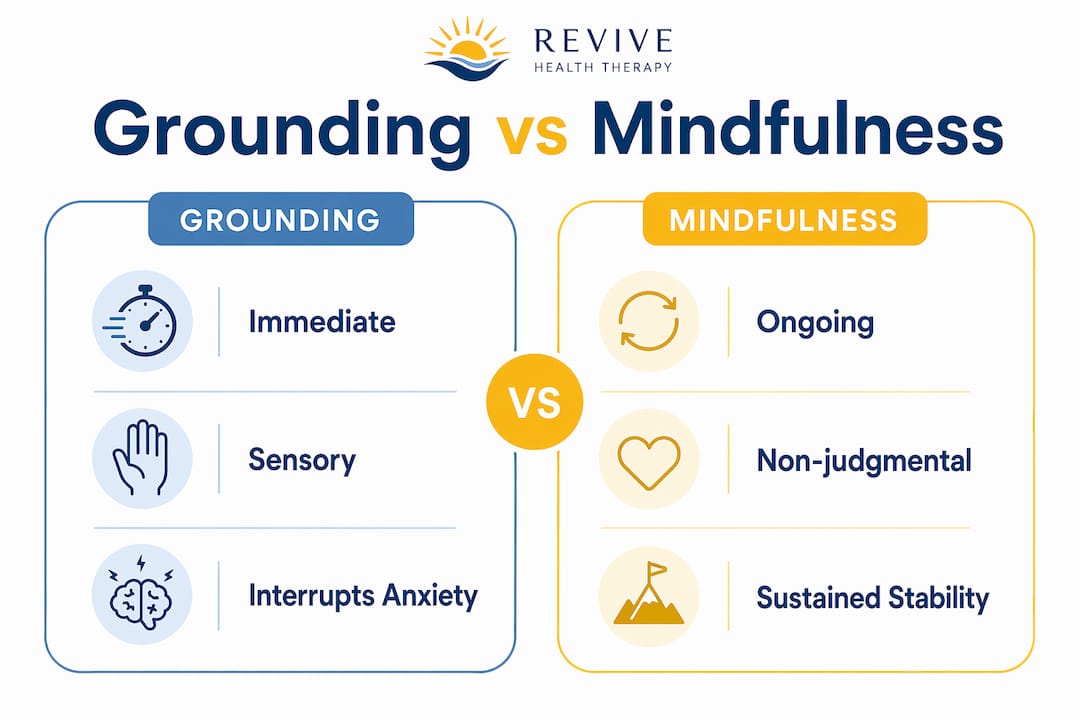
Mindfulness is a broad practice of present-moment awareness without judgment. It is ongoing, cultivated over weeks and months, and changes how you relate to thoughts and feelings at a structural level. Grounding techniques like 5-4-3-2-1 are acute interventions. They interrupt a specific moment of distress rather than reshaping your long-term relationship with emotion. Emotion regulation is the umbrella category that includes both. Affect labeling, cognitive reappraisal, and behavioral activation are all emotion regulation strategies, and grounding techniques fall within that category.
| Concept | Primary purpose | Time frame | Best used when |
|---|---|---|---|
| Grounding (5-4-3-2-1) | Interrupt acute anxiety or panic | Seconds to minutes | Panic onset, stress spike, dissociation |
| Affect labeling | Reduce emotional reactivity via naming | Seconds to minutes | Low-to-moderate arousal, early distress |
| Mindfulness meditation | Build sustained emotional stability | Weeks to months | Daily practice, long-term anxiety management |
| Emotion regulation (CBT) | Restructure thought and behavior patterns | Weeks to months | Chronic anxiety, depression, trauma recovery |
The practical takeaway is that grounding and affect labeling are your first-response tools. Mindfulness and CBT-based emotion regulation are your long-term infrastructure. Using only acute techniques without building the longer-term foundation is like treating a recurring fever with ice packs and never addressing the underlying infection. You need both layers.
What are practical steps to cultivate sustained groundedness in daily life?
Building a grounded mindset over time requires more than occasional technique use. It requires treating emotional stability as a skill you train, not a state you stumble into.
Here is a framework that integrates the evidence:
- Build a structured mindfulness practice. Follow an 8 to 12 week program with daily micro-practice sessions of 10 to 20 minutes and a weekly review of what you noticed. Apps like Insight Timer or Headspace offer structured programs, but the key variable is consistency, not platform.
- Use slow breathing as a daily anchor. Diaphragmatic breathing at a rate of roughly 5 to 6 breaths per minute activates the parasympathetic nervous system even outside formal meditation. Two minutes of slow breathing before a stressful meeting or after waking up creates a physiological reset.
- Practice affect labeling in low-stakes moments. Journal your emotional states each morning using specific language. Not “I feel bad” but “I feel irritable and slightly anxious.” Emotional granularity, the ability to distinguish between similar emotional states, is directly linked to better regulation outcomes.
- Protect sleep and physical activity. Sleep deprivation increases amygdala reactivity, which makes every grounding technique less effective. Regular aerobic exercise reduces baseline cortisol. These are not optional lifestyle additions. They are the substrate on which all other techniques operate.
- Set and maintain clear boundaries. Chronic boundary violations, whether at work or in relationships, create a persistent low-grade stress state that undermines emotional stability. Learning to set boundaries effectively is itself a grounding practice.
- Build social support deliberately. Isolation amplifies anxiety. Even brief, genuine social contact activates oxytocin and reduces cortisol. Schedule it the same way you schedule exercise.
Pro Tip: Your anxiety self-care checklist should include a daily sensory check at a fixed time, such as right after lunch. Pairing the practice with an existing habit dramatically increases follow-through.
The most common mistake people make is practicing grounding only during crisis. That is like trying to learn to swim during a flood. The skill builds during calm repetition and activates reliably under pressure only after that foundation exists.
When should you use grounding techniques vs. seek professional support?
Grounding techniques are effective first-response tools for acute anxiety, stress spikes, panic onset, and moments of emotional overwhelm. They are not a substitute for clinical treatment when the underlying condition is chronic or complex.
Use grounding techniques when you experience:
- Sudden anxiety or panic that disrupts your ability to focus or function
- Emotional flooding during conflict or high-pressure situations
- Dissociation or a feeling of being disconnected from your body or surroundings
- Stress responses before predictable triggers like public speaking or medical appointments
Seek professional support when you notice:
- Anxiety or emotional distress that persists most days despite self-help efforts
- Symptoms of PTSD, including flashbacks, hypervigilance, or emotional numbness
- Depression that affects sleep, appetite, or your ability to maintain relationships
- A pattern of using substances, avoidance, or self-harm to manage emotional pain
Therapy options with strong evidence for building emotional stability include CBT, which targets thought patterns driving anxiety, and trauma-informed approaches like EMDR, which processes the root causes of chronic dysregulation. The benefits of psychotherapy extend well beyond symptom relief. They include improved self-awareness, stronger relationships, and a more stable sense of identity over time.
Grounding techniques work best as a complement to professional treatment, not a replacement. Think of them as the daily maintenance between therapy sessions, not the engine itself.
Key takeaways
Being emotionally grounded requires both acute techniques for immediate distress and sustained practices like mindfulness that reshape your long-term relationship with anxiety.
| Point | Details |
|---|---|
| Define groundedness clearly | Grounded means mentally and emotionally stable, realistic, and present-focused, per Merriam-Webster 2026. |
| Use 5-4-3-2-1 for acute anxiety | This 60-second sensory technique activates the parasympathetic system and interrupts panic onset. |
| Apply affect labeling early | Name emotions briefly during low arousal to reduce amygdala reactivity without amplifying distress. |
| Commit to 8 to 12 weeks of mindfulness | Structured MBI programs show a clinically meaningful effect size of g = 0.56 for anxiety reduction. |
| Know when to seek therapy | Chronic anxiety, PTSD, or persistent emotional dysregulation require professional clinical support alongside self-help tools. |
What I have learned from watching clients build this skill
Working with people managing anxiety and emotional distress, the pattern I see most often is this: someone learns a grounding technique, uses it twice during a crisis, decides it does not work, and abandons it. What they missed is that grounding is a skill, not a switch.
The clients who make the most progress are the ones who treat affect labeling and sensory grounding the same way they treat physical therapy exercises. They do them when they feel fine. They do them when they are mildly stressed. By the time a real crisis hits, the technique is automatic.
I have also seen how much individual variation matters. Affect labeling works beautifully for some people and feels alienating to others, particularly those with limited emotional vocabulary or high alexithymia. For those clients, sensory grounding or slow breathing tends to land better. The mindfulness therapy approach is not one-size-fits-all, and the most effective practitioners adapt based on what the person actually responds to, not what the protocol says should work.
The other thing I want you to hear is this: building emotional stability takes longer than most people expect, and that is not a failure. Eight to twelve weeks of consistent practice to see meaningful change is the research-backed reality. Give yourself that runway before you conclude that something is not working.
— Amy
Ready to build deeper emotional stability with professional support?
Self-help grounding techniques are a strong starting point, but they work best alongside professional guidance tailored to your specific needs.
Revivehealththerapy offers evidence-based therapy for anxiety, trauma, and emotional regulation at locations in Walnut Creek and Oakland, as well as via secure telehealth across California. Whether you are an adult navigating chronic stress or a parent seeking teen therapy services for a struggling adolescent, the team at Revivehealththerapy uses CBT, EMDR, and mindfulness-informed approaches to help you build lasting groundedness. Sliding-scale fees and insurance acceptance make care accessible regardless of your income level. Explore your mental health service options and take the next step toward a more stable, present life.
FAQ
What does it mean to be grounded?
Being grounded means being mentally and emotionally stable, realistic, and connected to the present moment. Merriam-Webster’s 2026 definition describes it as admirably sensible and unpretentious, free from emotional overwhelm.
How does the 5-4-3-2-1 technique help with anxiety?
The 5-4-3-2-1 technique redirects attention from anxious thoughts to sensory input in the immediate environment, activating the parasympathetic nervous system and reducing physiological stress markers within minutes. It is used clinically in CBT and DBT as an acute anxiety circuit breaker.
Is grounding the same as mindfulness?
Grounding and mindfulness overlap but are not the same. Grounding techniques are acute interventions for immediate distress, while mindfulness is a sustained practice that reshapes long-term emotional patterns. Both support emotional stability but operate on different time scales.
How long does it take to feel emotionally grounded?
Structured mindfulness programs lasting 8 to 12 weeks show the strongest results for sustained anxiety reduction, with a pooled effect size of g = 0.56 for anxiety in a meta-analysis of over 24,000 participants. Acute techniques like 5-4-3-2-1 can provide relief within minutes but require consistent practice to become reliable under pressure.
When should grounding techniques be replaced by therapy?
Grounding techniques are not sufficient for chronic anxiety, PTSD, trauma recovery, or persistent emotional dysregulation. If distress continues most days despite consistent self-help efforts, or if symptoms include flashbacks, dissociation, or depression, professional therapy with CBT or trauma-informed approaches is the appropriate next step.
2 Responses