
TL;DR:
- Several mindful therapy alternatives focus on trauma-informed and evidence-based care, including ecotherapy, somatic, and group approaches.
- Revive Health Therapy provides California residents with trauma-informed EMDR, CBT, and mindfulness in in-person and telehealth formats, accepting insurance and sliding scale fees.
What are the top alternatives to Institute of Mindful Therapy?
If you’re looking for alternatives to instituteofmindfultherapy.com, three providers stand out for their distinct approaches to mindfulness-based and trauma-informed care: Mindful Alternatives, Mindful Therapy Group, and Revive Health Therapy. Each takes a different path to the same goal, whether that’s nervous system regulation, integrative modalities, or accessible telehealth across California.
Here’s a quick snapshot of what each brings:
- Mindful Alternatives: Nature-informed and somatic therapy with a focus on ecotherapy and present-moment awareness, often blending ACT and DBT frameworks.
- Mindful Therapy Group: An administrative support organization that connects clients with clinicians specializing in mindfulness-based care, with a strong Pacific Northwest presence.
- Revive Health Therapy: Evidence-based psychotherapy in California using EMDR, CBT, and mindfulness, with in-person offices in Walnut Creek and Oakland plus statewide telehealth.
| Provider | Approach | Modalities | Delivery | Target Issues | Availability | Cost/Insurance |
|---|---|---|---|---|---|---|
| Mindful Alternatives | Nature-informed, somatic | Ecotherapy, ACT, DBT, somatic | In-person, some telehealth | Stress, anxiety, trauma, disconnection | Regional (varies) | Sliding scale, varies by clinician |
| Mindful Therapy Group | Mindfulness-based, integrative | CBT, mindfulness, somatic | In-person, telehealth | Anxiety, depression, relationship issues | Pacific Northwest | Insurance accepted, sliding scale |
| Revive Health Therapy | Trauma-informed, evidence-based | EMDR, CBT, mindfulness, family/couples | In-person (Walnut Creek, Oakland), telehealth | Anxiety, depression, trauma, relationship, teens | California statewide | Sliding scale and insurance acceptance |
Table of Contents
- How do these mindful therapy alternatives compare across key dimensions?
- How to choose the mindful therapy alternative that fits your needs
- What makes these therapy modalities different from conventional talk therapy?
- Revivehealththerapy offers evidence-based mindful therapy across California
- Key Takeaways
- Why Revivehealththerapy is worth a closer look for California residents
How do these mindful therapy alternatives compare across key dimensions?
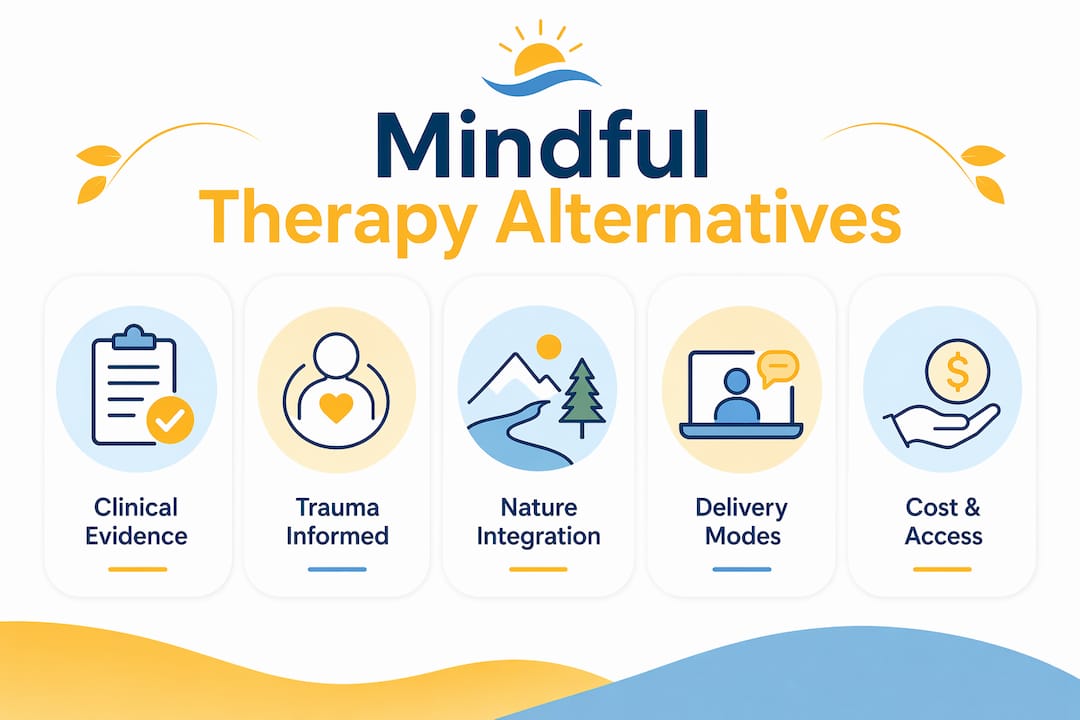
Choosing between mindful therapy options means looking past the branding and into the actual clinical approach. Here’s where these three providers genuinely differ.
Therapy philosophy and approach
Mindful Alternatives leans into nature as a therapeutic partner, not just a backdrop. Mindfulness-based ecotherapy treats the natural world as an active participant in healing, integrating structured outdoor experiences with frameworks like Acceptance and Commitment Therapy and Dialectical Behavior Therapy. This is meaningfully different from sitting in an office and practicing breathing exercises.
Mindful Therapy Group operates more as a clinical network than a single practice. It connects clients with licensed therapists who specialize in mindfulness-based modalities, which means the quality and depth of mindfulness integration can vary by clinician. Checking a therapist’s specific somatic or experiential training matters more than the organization’s name alone, since some providers offer administrative support for clinicians rather than direct evidence-based clinical modalities.
Revive Health Therapy grounds everything in clinical evidence. EMDR, CBT, and trauma-informed mindfulness are the core tools, applied across individual, couples, family, child, and teen therapy. The philosophy is that healing doesn’t require a single method but a thoughtful match between the person and the approach.
Modalities, delivery, and cost
| Dimension | Mindful Alternatives | Mindful Therapy Group | Revive Health Therapy |
|---|---|---|---|
| Core modalities | Ecotherapy, ACT, DBT, somatic | CBT, mindfulness, somatic | EMDR, CBT, mindfulness, trauma-informed |
| Delivery | In-person, limited telehealth | In-person, telehealth | In-person (CA) + statewide telehealth |
| Target issues | Stress, trauma, disconnection | Anxiety, depression, relationships | Anxiety, depression, trauma, teens, families |
| Geographic reach | Regional | Pacific Northwest | California statewide |
| Insurance/cost | Sliding scale, varies | Insurance accepted | Insurance, HSA/FSA, sliding scale |
- Revive Health Therapy accepts insurance including HSA and FSA plans, which is a practical advantage for people managing therapy costs over time.
- Mindful Therapy Group’s network model means insurance acceptance depends on the individual clinician, not the organization.
- Mindful Alternatives often works on sliding scale fees, but pricing transparency varies by location and provider.
Pro Tip: Before committing to any provider, ask specifically whether your insurance plan is accepted and whether the therapist billing you is in-network. A sliding scale and in-network billing are two different things, and confusing them can lead to unexpected costs.
How to choose the mindful therapy alternative that fits your needs
The right provider isn’t the one with the most modalities listed on their website. It’s the one whose approach matches how you actually process and heal.
Start with these questions:
- What’s your relationship with talk therapy? If verbal recounting of trauma feels retraumatizing, look for providers offering somatic, nature-based, or body-focused approaches rather than traditional talk therapy.
- Do you need in-person connection or is telehealth enough? Some people do their best work face-to-face. Others find telehealth removes barriers that would otherwise keep them from showing up consistently.
- What issues are you addressing? A provider specializing in trauma and EMDR is a different fit than one focused on stress reduction through ecotherapy. Match the modality to the problem.
- What are the therapist’s actual credentials? Look for licensed clinicians (LCSW, MFT, PhD, PsyD) with documented training in the specific modality they offer. A therapist who lists “mindfulness” as a specialty without somatic or trauma-informed training is offering something much narrower than it sounds.
- Can you afford consistent sessions? Therapy works through repetition. A provider with sliding scale fees or insurance acceptance is often more sustainable than one with lower session costs but no financial flexibility.
Signs of genuinely trauma-informed, evidence-based care include clear informed consent processes, a stated commitment to not retraumatizing clients, and therapists who can explain why they’re recommending a specific modality for your situation.
Client reviews matter, but read them carefully. Look for patterns around therapist responsiveness, whether the approach felt personalized, and whether people felt heard rather than processed. A single glowing review means less than consistent feedback across many clients.
Pro Tip: Book an intake call before committing to a full session. Most therapists offer 15–20 minutes at no charge. Use it to ask directly: “How do you approach trauma?” and “What does a typical session look like?” The answers tell you more than any website bio.
What makes these therapy modalities different from conventional talk therapy?
Several of the approaches offered by mindful therapy alternatives go well beyond the traditional 50-minute conversation. Understanding what they actually do helps you decide whether they’re worth exploring.
Mindfulness-based ecotherapy
Mindfulness-based ecotherapy integrates nature engagement with therapeutic principles to reduce stress and deepen present-moment attention. A peer-reviewed study from the Center for Nature-Informed Therapy found measurable reductions in participant stress and stronger nature connection following structured ecotherapy sessions. Nature here isn’t a setting. It’s an active clinical participant, used through guided outdoor experiences, reflective exercises, and symbolic rituals informed by ACT, DBT, and CBT frameworks.
What separates ecotherapy from a walk in the park is the clinical structure. Therapists trained in nature-informed methods account for trauma history, cultural context, and physical accessibility before designing any outdoor intervention. The goal is nervous system regulation through sensory grounding, not forced exposure.

Presence Therapy and the NADA protocol
Presence Therapy uses a structured group format built around the NADA protocol, a five-point ear acupuncture technique lasting 30–45 minutes per session. Participants rest in silence while the acupuncture supports nervous system calming, followed by guided observation of breath and body. There’s no verbal processing required. The session ends with a brief integration period, not analysis.
This approach suits people who find that talking about their experience keeps them stuck in it. The nervous system regulation happens through the body, not through language.
Mindful Interbeing Mirror Therapy
Mindful Interbeing Mirror Therapy (MIMT) replaces the traditional face-to-face seating arrangement with something unusual: therapist and client sit side by side in front of a mirror. Developed by Dr. Alessandro Carmelita and Marina Cirio, MIMT draws on neuroscience research showing that mirror use activates brain areas involved in self-recognition, empathy, and emotional regulation. The shared mirror experience supports repair of early relational wounds and integration of dissociated parts of the self.
It’s particularly suited for people dealing with trauma, dissociation, or difficulties with self-image. The dual perspective the mirror creates, seeing yourself as both subject and observer, can shift patterns that verbal therapy alone doesn’t reach.
Mindfulness-Based Inner RePatterning (MBIR)
MBIR focuses on nervous system safety without requiring verbal analysis of trauma. Developed by Tania A. Prince, it works by prioritizing present-moment awareness and nervous system coherence over understanding the “why” behind emotional pain. The approach helps re-pattern the brain without triggering retraumatization, which makes it a practical option for people who’ve found traditional trauma therapy overwhelming.
MBIR is taught through practitioner trainings and is often integrated alongside other approaches like EFT. For clients, it shows up as a gentle, body-centered process rather than a structured verbal exercise.
Here’s a summary of these modalities and what distinguishes each:
- Mindfulness-based ecotherapy: Nature as active clinical tool; reduces stress through sensory grounding and structured outdoor engagement.
- Presence Therapy (NADA protocol): Five-point ear acupuncture in group settings; calms the nervous system without verbal processing.
- Mindful Interbeing Mirror Therapy: Side-by-side mirror work; activates self-recognition and supports integration of dissociated self-parts.
- MBIR: Trauma-informed nervous system regulation; works without requiring clients to verbally recount or analyze their trauma.
Supporting children’s mental wellness through bibliotherapy and booklists can complement these approaches, particularly for families navigating trauma alongside younger members.
Revivehealththerapy offers evidence-based mindful therapy across California
Revivehealththerapy brings together the clinical rigor of evidence-based psychotherapy with the accessibility that most Californians actually need. The practice integrates EMDR, CBT, and mindfulness within a trauma-informed framework, applied across individual, couples, family, child, and teen therapy. That breadth matters: healing rarely happens in isolation, and having a provider who can work with the whole family system under one roof reduces the coordination burden considerably.
In-person sessions are available at offices in Walnut Creek and Oakland. For everyone else in California, secure telehealth sessions cover the full state. Insurance is accepted, including HSA and FSA plans, and sliding scale fees make consistent care possible for people at different income levels.
Key advantages for people coming from this search:
- EMDR, CBT, and mindfulness integrated into a single treatment plan rather than offered as separate tracks.
- Trauma-informed care across all service types, including child and teen therapy.
- In-person locations in the Bay Area plus statewide telehealth access.
- Insurance accepted with sliding scale options for those without coverage.
- Services for individuals, couples, families, children, and teens under one practice.
Pro Tip: If you’re unsure whether Revivehealththerapy is the right fit, start with a consultation about your options. The intake process is designed to match you with the right therapist and approach before you commit to ongoing sessions.
Key Takeaways
The strongest mindful therapy alternatives combine trauma-informed methodology, evidence-based modalities, and practical accessibility, making the match between your needs and a provider’s actual clinical approach the deciding factor.
| Point | Details |
|---|---|
| Three leading alternatives | Mindful Alternatives, Mindful Therapy Group, and Revive Health Therapy each offer distinct mindfulness-based approaches. |
| Modality fit matters most | Match the therapy type (ecotherapy, EMDR, MIMT, MBIR) to your specific issues and how you process experience. |
| Credentials over branding | Look for licensed clinicians with documented somatic or trauma-informed training, not just a mindfulness label. |
| Cost and access are real barriers | Sliding scale fees, insurance acceptance, and telehealth availability determine whether therapy is sustainable long-term. |
| Revivehealththerapy | Offers EMDR, CBT, and mindfulness-integrated trauma-informed care in California, with in-person and statewide telehealth options. |
Why Revivehealththerapy is worth a closer look for California residents
If the alternatives covered here have shown you anything, it’s that mindful therapy isn’t one thing. It’s a spectrum of approaches, from ecotherapy to mirror-based nervous system work, and finding the right fit requires a provider who can actually meet you where you are.
Revivehealththerapy does that for Californians. The practice offers trauma-informed psychotherapy grounded in EMDR, CBT, and mindfulness, with services spanning individuals, couples, families, children, and teens. Sessions are available in person at Walnut Creek and Oakland, or via secure telehealth anywhere in the state. Insurance is accepted, HSA and FSA plans qualify, and sliding scale fees mean cost doesn’t have to be the reason you don’t start.
The next step is simple: visit Revivehealththerapy and connect with a therapist who can walk you through which approach fits your situation. No guesswork, no pressure.
Recommended
- Top 6 Blueoaktherapycenter.org Alternatives 2026 – Revive Health Therapy
- Top 6 alternative-health-experts.com Alternatives 2026 – Revive Health Therapy
- Top 3 Greenleafpsych.com Alternatives for Providers 2026 – Revive Health Therapy
- Top 3 heartinbalancetherapy.com Alternatives 2026 – Revive Health Therapy