
TL;DR:
- Collagen peptides are the safest and most studied option for breastfeeding mothers to support postpartum tissue repair. Synthetic peptides like BPC-157 and GLP-1 receptor agonists lack sufficient safety data for nursing women. Proper evaluation and timing are essential before considering peptide therapy during postpartum recovery.
Mom peptides are bioactive compounds that support postpartum recovery by targeting tissue repair, metabolism, and hormonal balance. The term “mom peptides” is an informal label used in wellness marketing. The recognized clinical category is peptide therapy, which includes both food-derived compounds like collagen and synthetic injectable agents like semaglutide or BPC-157. Understanding the difference between these two categories is the most important thing any mother can do before exploring this space.
Collagen peptides are the safest and most studied option for breastfeeding mothers. Synthetic and injectable peptides, including GLP-1 receptor agonists and experimental compounds like BPC-157, carry significant safety gaps for nursing women. This article breaks down what the evidence actually shows, what the risks are, and how to approach peptide supplements for moms with realistic expectations.
What are mom peptides and how do they work?
Peptides are short chains of amino acids. Your body produces them naturally, and they act as biological signals that tell cells to repair tissue, regulate hormones, or manage inflammation. The category called “mom peptides” covers several very different compounds, and grouping them together can be misleading.
Food-derived peptides, like collagen peptides from bone broth or powder supplements, break down into amino acids during digestion. They do not enter the bloodstream as active peptide chains. Their benefit comes from supplying raw amino acid material for connective tissue repair, which is especially relevant after childbirth.
Synthetic injectable peptides work differently. Compounds like BPC-157, TB-500, and MOTS-c are designed to act on specific receptors or cellular pathways. They are not digested the same way food proteins are. This distinction matters because food-derived and synthetic peptides have completely different mechanisms, risk profiles, and evidence bases.
GLP-1 receptor agonists such as semaglutide (Ozempic, Wegovy) and tirzepatide (Mounjaro, Zepbound) are a third category. These are FDA-approved medications that mimic a gut hormone to reduce appetite and regulate blood sugar. They are increasingly discussed in postpartum weight management contexts, but their use during breastfeeding requires careful timing.
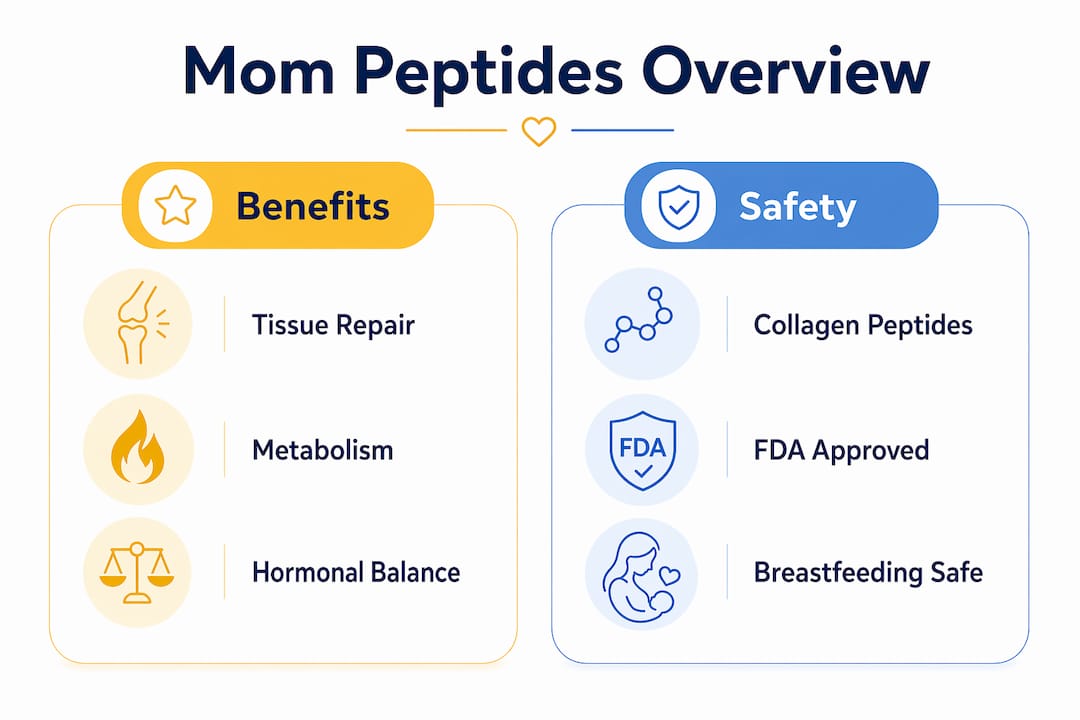
Peptide types at a glance
| Peptide type | How it works | Common use | Postpartum status |
|---|---|---|---|
| Collagen peptides | Digested into amino acids | Tissue repair, skin, joints | Generally safe during breastfeeding |
| BPC-157 | Binds growth factor receptors | GI healing, tissue repair | Experimental; no human safety data |
| GLP-1 agonists (semaglutide, tirzepatide) | Activates GLP-1 receptors to reduce appetite | Weight management | Wait 7–12 months postpartum |
| MOTS-c | Mitochondrial signaling peptide | Energy, metabolism | Investigational; no postpartum data |
| GHK-Cu | Copper-binding peptide | Skin repair (topical) | Pilot data only; topical use studied |
| Thymosin alpha-1 | Immune modulation | Immune support | Investigational; no postpartum data |
What are the benefits and safety risks of peptide therapy for women?
Collagen peptides offer the strongest safety record for postpartum women. The FDA and the InfantRisk Center both support collagen peptide use during lactation. Postpartum protein needs run high, with recommendations of 70–100 grams daily, and collagen supplements can help mothers meet that threshold conveniently. The amino acids glycine, proline, and hydroxyproline support connective tissue repair after delivery, including pelvic floor recovery and C-section healing.

Collagen from bone broth also contains gelatin, glucosamine sulfate, and chondroitin, which support joint and tissue recovery in the months after birth. Powdered collagen supplements offer the same amino acid profile with more dosing consistency.
GLP-1 receptor agonists show strong weight loss results in clinical trials, with average weight loss of 15–22% in adult populations. That number is compelling, but the timing matters enormously for new mothers. These peptides can reduce caloric intake by up to 39%, which creates a real risk of nutrient deficiency during breastfeeding. Providers recommend waiting 7–12 months postpartum before starting GLP-1 therapy. The primary concern is not drug transfer into breast milk. The bigger risk is severe caloric restriction compromising the nutrient density a nursing infant depends on.
Injectable peptides like BPC-157 and TB-500 present a different problem. Vendors frequently list breastfeeding as a contraindication. No human randomized clinical trials exist for these compounds in nursing mothers. Animal studies show favorable preclinical safety for BPC-157, but animal data does not translate directly to human postpartum use.
Key safety points for mothers considering peptide therapy:
- Collagen peptides: safe during breastfeeding with adequate overall protein intake
- GLP-1 agonists: effective for weight loss but require a waiting period of 7–12 months postpartum
- BPC-157, TB-500, MOTS-c, thymosin alpha-1: no established human safety data for nursing mothers
- Topical GHK-Cu: pilot data only; systemic absorption from topical use is low but not fully studied
Pro Tip: If you are breastfeeding and want to start any peptide beyond collagen, ask your provider to check the InfantRisk Center database first. It is one of the most reliable resources for lactation drug safety.
How should mothers approach peptide use responsibly?
Peptides are tools that work best on top of a solid foundation. Marketing claims often overstate benefits while ignoring the fact that postpartum hormonal recalibration is a natural biological process. Sleep, nutrition, hydration, and stress management drive the majority of postpartum recovery. Peptides cannot replace any of those.
Dr. Julian Douwes, a clinician specializing in peptide therapy for women, stresses that peptide protocols must be individualized and aligned with each woman’s hormonal and metabolic profile. A protocol designed for a woman with perimenopause looks very different from one designed for a woman three months postpartum. Off-the-shelf peptide stacks purchased online skip this evaluation entirely.
A responsible step-by-step approach for mothers:
- Build your foundation first. Prioritize protein intake of 70–100 grams daily, consistent hydration, and at least one period of uninterrupted sleep per 24 hours before adding any supplement.
- Start with collagen. It is the one peptide with clear safety data for breastfeeding mothers. Add it to smoothies, coffee, or soups for convenience.
- Get a hormonal and metabolic evaluation. Before considering synthetic peptides, ask your OB or a functional medicine provider to assess thyroid function, cortisol, and estrogen levels.
- Discuss timing with your provider. If you are interested in GLP-1 therapy for postpartum weight management, plan that conversation for your 6-month or 12-month postpartum visit.
- Avoid unregulated injectable peptides. Compounds sold as research chemicals online carry no quality assurance and no safety data for nursing mothers.
- Track your response. If you start collagen or any other supplement, note energy levels, sleep quality, and mood over 4–6 weeks before drawing conclusions.
Pro Tip: Revivehealththerapy offers telehealth sessions across California, which makes it easier to connect with a provider who can help you evaluate peptide options alongside your mental and emotional wellness goals. You do not need to figure this out alone.
For mothers curious about the mental health dimension of peptide therapy, peptides and mental health is a growing area of research worth discussing with a qualified clinician.
What does current research say about emerging peptides for postpartum wellness?
The honest answer is that most peptides beyond collagen remain investigational for postpartum women. No standardized clinical protocols exist for mom peptide therapy outside of collagen and FDA-approved GLP-1 medications. Pilot studies suggest BPC-157 may support gastrointestinal healing and GHK-Cu may improve skin repair topically, but neither has been tested in nursing mothers in controlled human trials.
MOTS-c and thymosin alpha-1 are two peptides generating interest in longevity and immune research. MOTS-c influences mitochondrial signaling and may support energy metabolism. Thymosin alpha-1 modulates immune function. Both are investigational tools that require individualized, supervised protocols rather than self-directed use.
Research status of emerging peptides
| Peptide | Evidence level | Key finding | Postpartum research gap |
|---|---|---|---|
| BPC-157 | Preclinical (animal) | GI and tissue repair | No human RCTs in nursing mothers |
| MOTS-c | Early human pilot | Metabolic and energy support | No postpartum-specific data |
| Thymosin alpha-1 | Limited human trials | Immune modulation | No postpartum-specific data |
| GHK-Cu (topical) | Pilot human data | Skin repair and collagen synthesis | Systemic absorption not fully studied |
“Peptide therapy for women must be individualized and supervised, aligning with metabolic and endocrine profiles rather than applied as a one-size-fits-all solution.” — Dr. Julian Douwes, as cited in clinical peptide evidence for women
The research field is moving quickly, but the gap between marketing claims and clinical evidence remains wide. Mothers deserve honest information, not hype.
Key Takeaways
Collagen peptides are the only mom peptide category with clear safety data for breastfeeding mothers; all other peptides require medical supervision and careful timing.
| Point | Details |
|---|---|
| Collagen is the safest option | FDA and InfantRisk Center support collagen peptides during lactation with adequate protein intake. |
| GLP-1 agonists need a waiting period | Semaglutide and tirzepatide are effective but should wait 7–12 months postpartum to protect milk nutrient density. |
| Injectable peptides lack safety data | BPC-157, TB-500, and MOTS-c have no human RCTs in nursing mothers; vendors list breastfeeding as a contraindication. |
| Foundation matters more than peptides | Nutrition, sleep, and stress management drive postpartum recovery; peptides support but cannot replace these. |
| Supervision is non-negotiable | Hormonal and metabolic evaluation before starting any synthetic peptide protocol protects both mother and infant. |
What I’ve learned from watching mothers navigate peptide hype
The wellness industry moves faster than the research does. Every few months, a new peptide gets branded as the answer to postpartum fatigue, weight retention, or brain fog. I have watched mothers spend real money on injectable compounds sold as research chemicals, with no clinical oversight and no safety data specific to their situation. That concerns me deeply.
What the evidence actually supports is far less glamorous but far more useful. Collagen peptides, adequate protein, consistent sleep, and professional support form the real foundation of postpartum recovery. Peptides like BPC-157 and MOTS-c may one day have a clear role in maternal wellness. Right now, they do not have the human trial data to justify unsupervised use during breastfeeding.
The mothers I respect most in this space are the ones who ask hard questions before they buy anything. They want to know the mechanism, the evidence level, and the safety profile. That kind of critical thinking protects them and their infants. If you are curious about peptide care benefits and safety, start with a provider conversation, not a supplement checkout page.
Cautious optimism is the right posture here. The science is genuinely promising in some areas. But promising is not the same as proven, and no supplement replaces the work of recovery.
— Amy
How Revivehealththerapy supports postpartum wellness
Postpartum recovery is physical, hormonal, and deeply emotional. Peptide therapy is one piece of a much larger picture that includes mental health, stress regulation, and relationship support.
Revivehealththerapy provides evidence-based psychotherapy services across California, including telehealth sessions for mothers who cannot easily leave home. The team uses trauma-informed approaches, CBT, EMDR, and mindfulness to address postpartum anxiety, depression, and emotional exhaustion. If you are exploring peptide therapy as part of your wellness plan, pairing it with professional mental health support gives you the full picture. Seeking psychotherapy is not a last resort. For many postpartum mothers, it is the most effective first step toward feeling like themselves again.
FAQ
What are mom peptides exactly?
Mom peptides is an informal term for peptide compounds used to support postpartum wellness, including collagen peptides, GLP-1 receptor agonists, and experimental injectables like BPC-157. The recognized clinical term is peptide therapy.
Are peptide supplements safe during breastfeeding?
Collagen peptides are considered safe during breastfeeding by the FDA and InfantRisk Center. Most synthetic and injectable peptides lack human safety data for nursing mothers and should be avoided until breastfeeding ends or a provider clears their use.
When can I start GLP-1 peptides like semaglutide after birth?
Providers recommend waiting 7–12 months postpartum before starting GLP-1 receptor agonists like semaglutide or tirzepatide. These medications reduce caloric intake significantly, which can compromise breast milk nutrient density.
Do I need a prescription for mom peptide therapy?
Collagen peptides are available over the counter without a prescription. GLP-1 agonists like semaglutide require a prescription. Injectable peptides like BPC-157 are sold as research chemicals and are not FDA-approved for human use.
How do I know if peptide therapy is right for me postpartum?
A hormonal and metabolic evaluation with your OB or a functional medicine provider is the right starting point. As Dr. Julian Douwes notes, effective peptide protocols must be individualized and aligned with your specific endocrine and metabolic profile.