
Online couples therapy works about as well as in-person therapy for most couples, with a meta-analysis of digital interventions found a statistically significant moderate effect on relationship satisfaction. The main caveat: therapeutic alliance, the trust and rapport between couple and therapist sometimes builds more slowly on screen. Telehealth options can give couples statewide access without giving up clinical rigor.
TL;DR:
- Online couples therapy generally produces relationship satisfaction improvements comparable to in-person sessions, with a moderate effect size supported by recent meta-analyses.
- Coach-supported digital programs tend to have higher completion rates and longer-lasting effects than fully self-guided options, closely matching live therapy outcomes.
- Therapeutic alliance may develop more slowly online but usually catches up within a few sessions, though high-conflict situations might benefit more from in-person care.
- Remote formats are especially suitable for long-distance couples, those with busy schedules, or partners who are reluctant to attend in-person sessions.
- The success of online therapy depends more on the therapist’s skill and model fit rather than the delivery format, with proper tech setup and safety protocols essential for a smooth experience.
Table of Contents
- What High-Quality Research Shows About Online Couples Therapy Effectiveness
- How Do Online and In-Person Therapy Differ Clinically?
- Which Couples Fit Online Therapy Best?
- Tech, Privacy, and Cost: What to Check Before You Start
- How Do You Choose an Online Couples Therapist?
- How Revivehealththerapy Delivers Evidence-Based Telehealth Couples Care
- A Clinician’s Take on What Actually Predicts Success
- Start Couples Therapy With Revivehealththerapy
- Sources
- FAQ
What High-Quality Research Shows About Online Couples Therapy Effectiveness
The strongest data point comes from a 2025 systematic review and meta-analysis pooling six studies on digital couple interventions. The result showed a moderate effect, roughly the same magnitude many well-established in-person couples therapy models produce. It’s not a marginal nudge. Couples using digital interventions reported improvements in satisfaction that held up at follow-up in several of the pooled studies.
Key Finding: Digital couple interventions produced a moderate effect that translates into real, felt improvements in relationship satisfaction for many couples, not just statistical noise.
Randomized controlled trials back this up with specifics. An RCT delivering a manualized couples intervention by videoconference found outcomes comparable to face-to-face delivery, both in relationship satisfaction and in secondary mental health measures. That’s a genuine head-to-head test, not a comparison of online therapy against nothing.
But not all digital programs perform equally. Trials of the OurRelationship program, evaluated across four randomized trials with more than 2,000 couples, found something worth remembering: coach-supported versions consistently outperformed fully self-guided ones. Completion rates were higher and effects lasted longer when a real person checked in with couples along the way.
That distinction matters for anyone shopping for an online option. Consider what separates the formats:
- Self-guided digital programs: lower cost, flexible pacing, but higher dropout and smaller average effects.
- Coach-supported digital programs: structured check-ins boost completion and sustain gains, closer to what live therapy delivers.
- Live videoconference therapy with a licensed therapist: outcomes tracking closely with in-person sessions in controlled trials.
Other remote formats show promise too. A pragmatic trial comparing message-based psychotherapy against video-based care found no significant difference in depression outcomes at 12 weeks, suggesting the “video call or nothing” framing undersells how many remote formats can work.
None of this means the evidence is uniform. A separate systematic review found meaningful heterogeneity across studies (I² around 65%), largely driven by whether the sample was a general prevention population or a clinical group already in distress. Effects tend to be more reliable for couples dealing with everyday relationship strain than for couples navigating severe, clinically diagnosed conditions alongside their relationship issues. Follow-up windows in most trials also run months, not years, so long-term durability past that point is still thinner ground.
How Do Online and In-Person Therapy Differ Clinically?
The outcomes converge, but the path to get there doesn’t always look the same. That’s the nuance most comparisons skip.
Research on the therapeutic alliance, the working trust between couple and therapist, shows a consistent pattern. A large clinical-sample study comparing teletherapy to in-person outcomes among married couples found broadly similar end results, but the alliance sometimes formed at a different pace online. In some cases it developed more slowly, taking a few extra sessions to reach the same depth of trust in-person couples hit sooner.
Engagement tells a different story. Online formats often see equal or better completion rates than in-person therapy, largely because they remove the friction of commuting, parking, and finding a babysitter. Here’s what that means in practice:
- Couples who might have skipped an in-person session due to scheduling conflicts often show up for a video session instead.
- Dropout in coach-supported online programs tends to run lower than in self-guided digital tools.
- Early alliance gaps, when they exist, tend to close by mid-treatment in most studies.
Pro Tip: If your first session or two online feels less “connected” than you expected, don’t assume it’s a bad fit. Give it three to four sessions. Alliance research suggests it often catches up.
Where this actually changes the calculus is severity. Couples in high-conflict situations, or those needing strong containment early on (a felt sense that the therapist has firm control of the room to prevent sessions from spiraling), may benefit from the faster alliance-building that in-person sessions sometimes provide. For everyday relationship friction, communication breakdowns, and reconnecting after a period of drift, the format gap barely registers.
Which Couples Fit Online Therapy Best?
Format should follow the problem, not the other way around. Here’s a practical breakdown of when each setting tends to serve couples better.
- Long-distance or highly scheduled couples. Two working parents, a partner who travels for work, or a couple in a long-distance stretch benefit enormously from not needing to coordinate a shared physical location.
- A reluctant partner who needs a lower barrier to entry. Video sessions from home often feel less intimidating for a partner skeptical of therapy than walking into an unfamiliar office.
- High-conflict couples who escalate quickly in person. Joining from separate rooms or locations during tense sessions can reduce in-session escalation and give both partners more sense of safety.
- Couples managing everyday relational strain. Communication issues, trust rebuilding, and reconnection work show solid evidence of parity with in-person care.
- Couples facing active safety risks. Situations involving intimate partner violence or immediate danger call for in-person, locally coordinated care with direct access to emergency resources.
- Couples with severe co-occurring conditions. Cases involving significant untreated mental illness, substance use crises, or PTSD-related couple work sit on thinner evidence for digital formats and usually benefit from a local, in-person clinical team.
- Cases requiring hands-on assessment. Certain sexual-health evaluations or issues requiring physical presence are better suited to an in-person setting.
If your situation falls into a gray area, a short consultation with a licensed clinician, in person or by phone, can help sort out which format actually fits your risk level and goals.
Tech, Privacy, and Cost: What to Check Before You Start
A little preparation prevents most of the friction couples run into with online sessions.
Tech readiness matters more than people expect. Stable internet bandwidth, a working camera, and a private room where you won’t be interrupted make the difference between a session that flows and one that stalls every few minutes. Have a backup plan, a phone number the therapist can call, in case video drops mid-session.
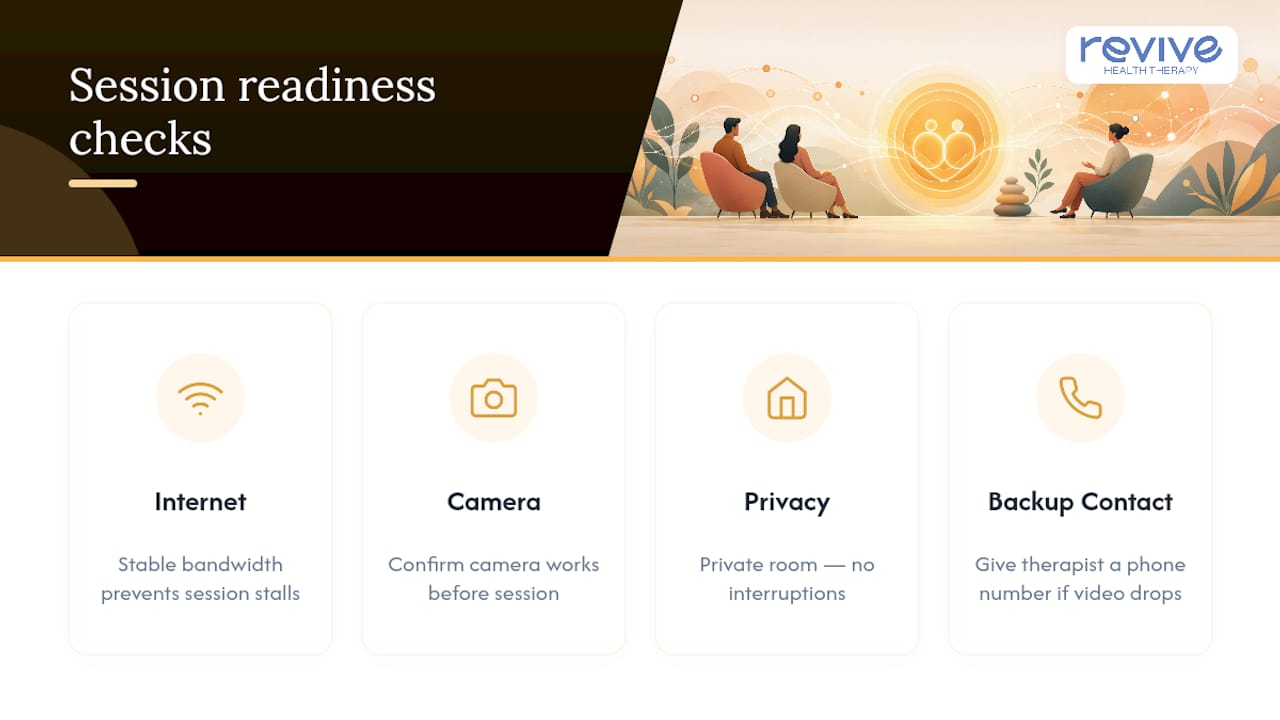
Privacy and safety protocols should be non-negotiable. Confirm the platform is HIPAA-secure, ask how informed consent is handled for telehealth specifically, and make sure your therapist has a plan for crisis situations, including knowing which local emergency resources apply to wherever you’re physically located during sessions.
On cost, online sessions often run similar to in-person rates, though some practices price telehealth slightly lower given reduced overhead. Many practices, including Revivehealththerapy, accept insurance and HSA/FSA funds, and offer sliding-scale fees based on income, which widens access for couples who’d otherwise skip care over cost alone. Before booking, ask directly what your plan covers and whether a superbill is available for out-of-network reimbursement.
How Do You Choose an Online Couples Therapist?
The format matters less than who’s running the session. Clinical reviews consistently point to therapist skill, model fit, and the couple’s own commitment as bigger predictors of outcome than delivery format alone. Use this checklist when vetting a provider.
- Confirm their model. Ask whether they’re trained in Emotionally Focused Therapy (EFT), the Gottman Method, or Integrative Behavioral Couple Therapy (IBCT), the three approaches with the most research behind them.
- Ask about telehealth-specific experience. A therapist who’s run dozens of video sessions handles tech hiccups and remote alliance-building differently than someone new to the format.
- Verify licensing across state lines. Therapists need to be licensed in the state where you’re physically located during the session, not just where the practice is based.
- Ask about cultural competence. If language, faith, or cultural background shapes your relationship dynamics, ask directly how the therapist approaches that.
- Confirm they have a crisis plan. Ask what happens if a session reveals a safety concern, and whether they can connect you to local resources.
Pro Tip: On your first call, ask one direct question: “What’s your plan if our video call drops during a tense moment?” A therapist with a real answer has thought about online-specific alliance building. One without a clear answer probably hasn’t.
Red flags are easy to spot once you know what to look for: guarantees of a specific outcome, no verifiable license number, or vague answers about confidentiality and crisis protocols.
How Revivehealththerapy Delivers Evidence-Based Telehealth Couples Care
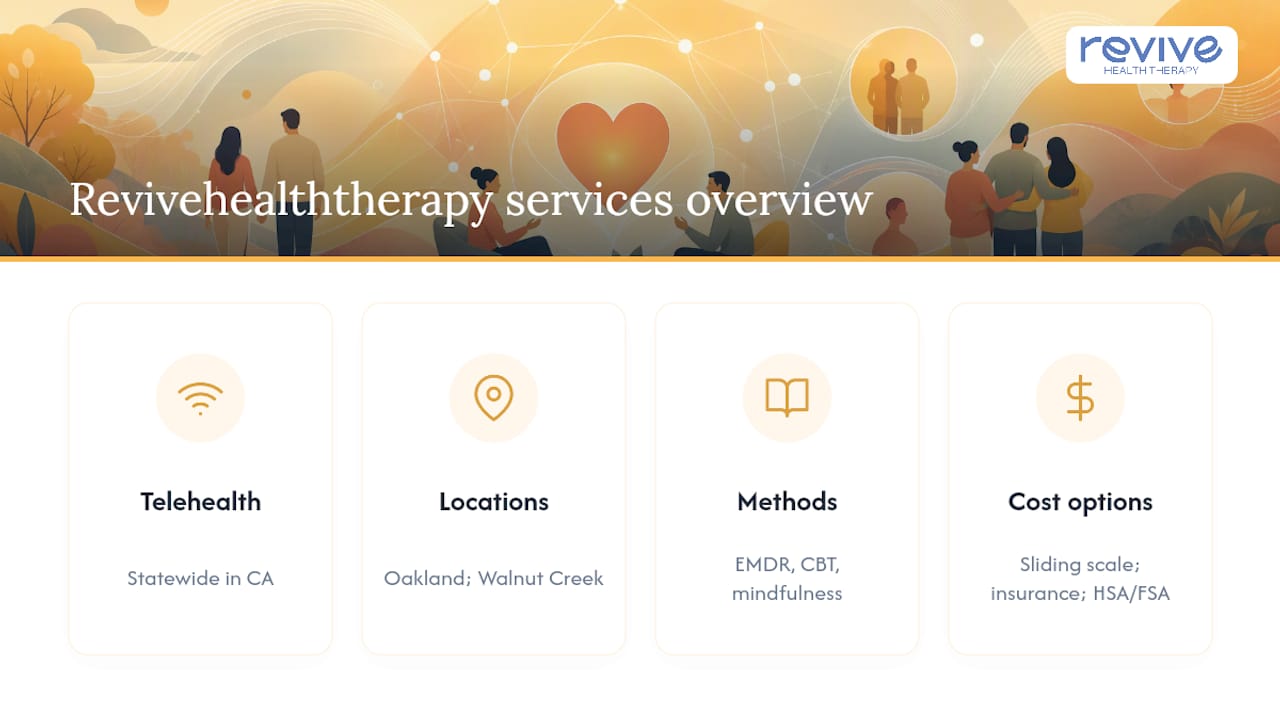
Revivehealththerapy offers couples therapy through secure telehealth sessions available statewide in California, alongside in-person options at its Oakland and Walnut Creek locations. Clinical work typically draws on evidence-based methods including EMDR, CBT, and mindfulness, applied to relationship challenges alongside anxiety, trauma, and emotional regulation concerns.
Affordability can be a central part of some practices’ approach, including sliding-scale fees and acceptance of insurance and HSA/FSA plans designed to widen access for couples who might otherwise delay care over cost. For couples exploring what a full course of treatment looks like, the step-by-step couples therapy guide walks through what to expect from first contact through ongoing sessions.
A Clinician’s Take on What Actually Predicts Success
Format debates get outsized attention. What actually predicts whether couples therapy works, online or in person, is whether the therapist’s model fits the couple’s specific problem, whether the therapist is genuinely skilled at applying it, and whether both partners show up committed to the process rather than waiting for the other to change first.
Two habits help close the alliance gap online: structured check-ins at the start of each session (a quick temperature check on how the week went before diving into the agenda), and early safety planning for couples prone to escalation. Both are simple. Both make a measurable difference in how fast trust builds on a screen.
— Amy
Start Couples Therapy With Revivehealththerapy
You’ve seen the research: format matters far less than fit, skill, and follow-through. Revivehealththerapy gives couples in California a way to get that fit without adding a commute, a babysitter search, or a long waitlist to the equation, through secure telehealth sessions available statewide alongside in-person care in Oakland and Walnut Creek.
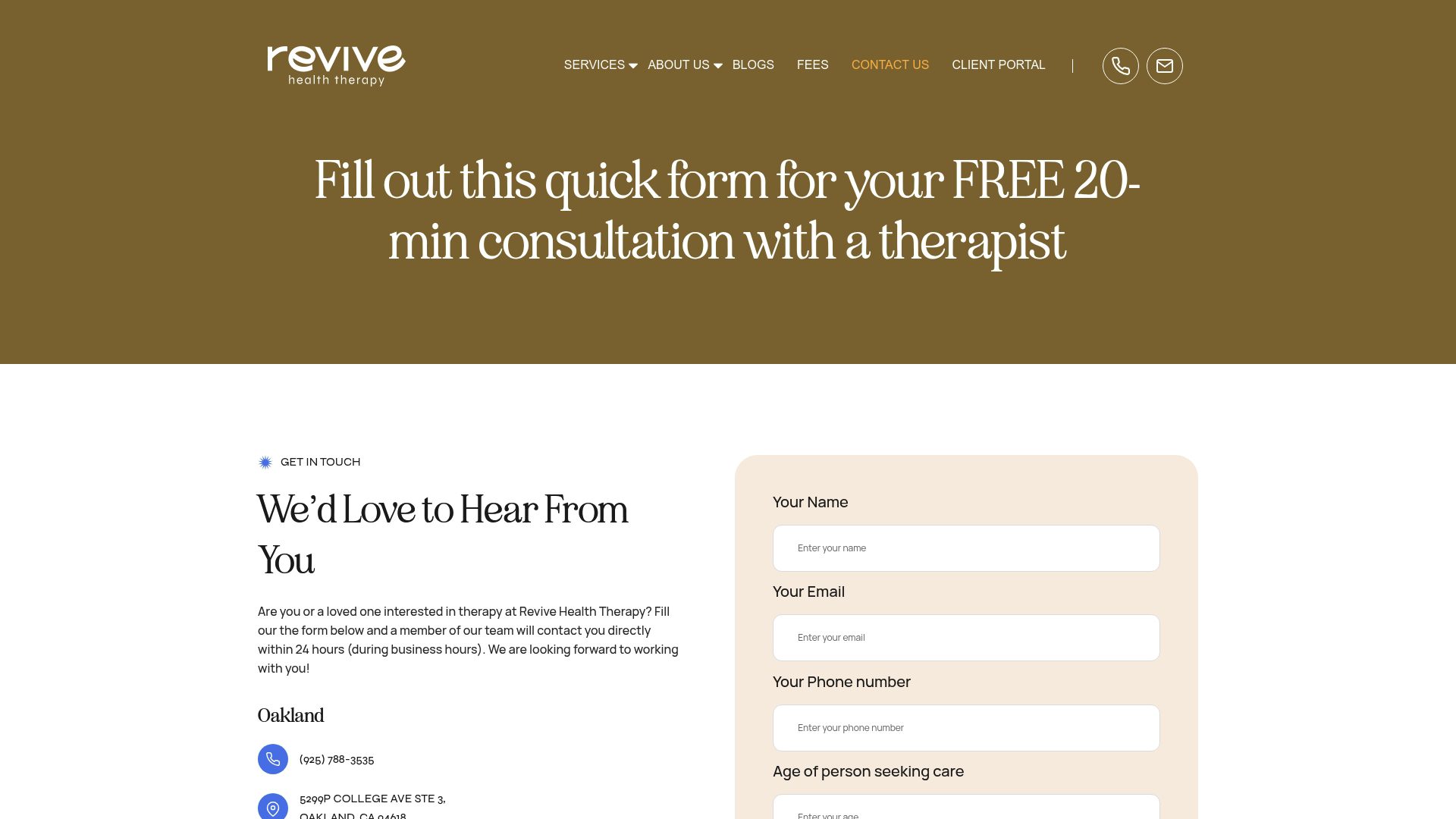
Getting started is simple: visit the couples therapy services page, complete a brief intake so the practice can match you with a therapist trained in evidence-based approaches like EMDR and CBT, and schedule your first telehealth session. An initial appointment typically includes a conversation about goals, history as a couple, and reasons for seeking therapy, rather than a rushed diagnosis. Insurance, HSA/FSA, and sliding-scale fees may be available, so cost may not have to be the reason to wait. Reach out through the services page to check availability and take the first step.
This article is general information, not a substitute for advice from a qualified doctor. Consult a qualified healthcare professional about your own circumstances before acting on anything here.
Sources
- Effectiveness of digital interventions on relationship satisfaction among couples: a systematic review and meta-analysis
- OurRelationship program evaluations and trials
- Couples therapy delivered through videoconferencing: effects on relationship outcomes, mental health and the therapeutic alliance
- Call me maybe? In-person vs. teletherapy outcomes among married couples
FAQ
Is My Marriage Salvageable?
Most relationship difficulties respond well to structured therapy, and research on digital interventions shows a moderate, meaningful effect on relationship satisfaction for many couples. The bigger predictors of whether a marriage can recover are the therapist’s skill, the fit of the treatment model, and both partners’ willingness to engage, not whether the situation feels salvageable on day one.
What Is the 5-5-5 Rule in Couples Therapy?
The 5-5-5 rule is an informal communication exercise some therapists use, where each partner speaks for five minutes uninterrupted, followed by five minutes of reflection, then five minutes of joint discussion. It’s a technique some clinicians apply within various therapy models rather than a standardized clinical protocol with its own research base.
What Is the 2-2-2 Rule for Couples?
The 2-2-2 rule is a popular relationship-maintenance guideline suggesting a date night every two weeks, a weekend away every two months, and a longer trip every two years. It’s a lifestyle habit some couples use to protect connection time, not a therapy technique studied in clinical trials.
Does Online Couples Therapy Work as Well as In-Person Therapy?
Yes, for most couples and most relationship concerns, online couples therapy produces outcomes comparable to in-person care, based on randomized trials using videoconference delivery. The main difference clinicians note is that therapeutic alliance can take slightly longer to build online, though it typically catches up within the first several sessions.
How Much Does Online Couples Therapy Cost?
Pricing varies by practice, insurance coverage, and whether sliding-scale fees apply. Revivehealththerapy accepts insurance and HSA/FSA funds and offers income-based sliding-scale pricing; current rates are listed on the services page.