
TL;DR:
- Somatic therapy is a body-centered psychotherapy that uses physical sensations to heal trauma and stress. It aims to complete frozen fight-or-flight responses and restore nervous system regulation through techniques like body scanning, breathwork, and movement. This approach benefits trauma survivors, anxiety, chronic pain, and dissociation, especially when combined with talk therapies such as EMDR or CBT.
Somatic therapy is defined as a body-centered psychotherapy that uses awareness of physical sensations to heal emotional trauma, chronic stress, and anxiety. Unlike traditional talk therapy, it treats the body as an active partner in recovery, not just a vessel carrying the mind. Rooted in Wilhelm Reich’s early work on how tension stored in the nervous system manifests as psychological distress, somatic psychotherapy addresses the physical imprints trauma leaves behind. If you have ever felt stuck in your healing despite years of talk therapy, understanding what somatic therapy is and how it works may open a new path forward.
How does somatic therapy work to heal trauma and stress?
Somatic therapy works by targeting the physiological traces of trauma stored in muscles, breath, posture, and the nervous system. Trauma leaves a physical imprint that persists long after cognitive memory fades. This means your body may still be bracing for a threat that no longer exists, even when your mind has moved on.

The primary objective of somatic therapy is to modify trauma-related stress responses by grounding attention in physical sensations. That process improves self-regulation and helps “unfreeze” physiological responses locked in place since the original traumatic event. Think of it as pressing play on a biological recording that got stuck mid-scene.
Traditional talk therapies work primarily through language and cognition. Somatic therapy works differently. It targets the body’s incomplete defensive responses, such as a fight-or-flight reaction that never fully resolved, and helps the nervous system complete them under safe, guided conditions. That completion is what allows genuine relief to occur.
- Body scanning: You learn to notice tension, numbness, or discomfort in specific areas without judgment.
- Breathwork: Controlled breathing patterns regulate the autonomic nervous system directly.
- Movement: Gentle, intentional movement releases stored muscular tension.
- Grounding: Sensory exercises anchor attention in the present moment and reduce dissociation.
- Titration: Trauma is approached in small, manageable doses to prevent overwhelm.
Pro Tip: If you find it hard to identify any physical sensations at all, that is actually a common sign of trauma. Numbness and disconnection from the body are symptoms, not character traits. A skilled somatic therapist will help you rebuild that awareness gradually.
What techniques and methods are used in somatic therapy?
Somatic therapy is not bodywork or massage. It is a form of psychotherapy performed by licensed mental health professionals, and it requires active participation from you in developing interoception. Interoception is the ability to sense your own internal bodily states, such as a tight chest, a sinking stomach, or a racing heart. In people with severe trauma histories, this ability is often underdeveloped and must be cultivated gradually with professional support.
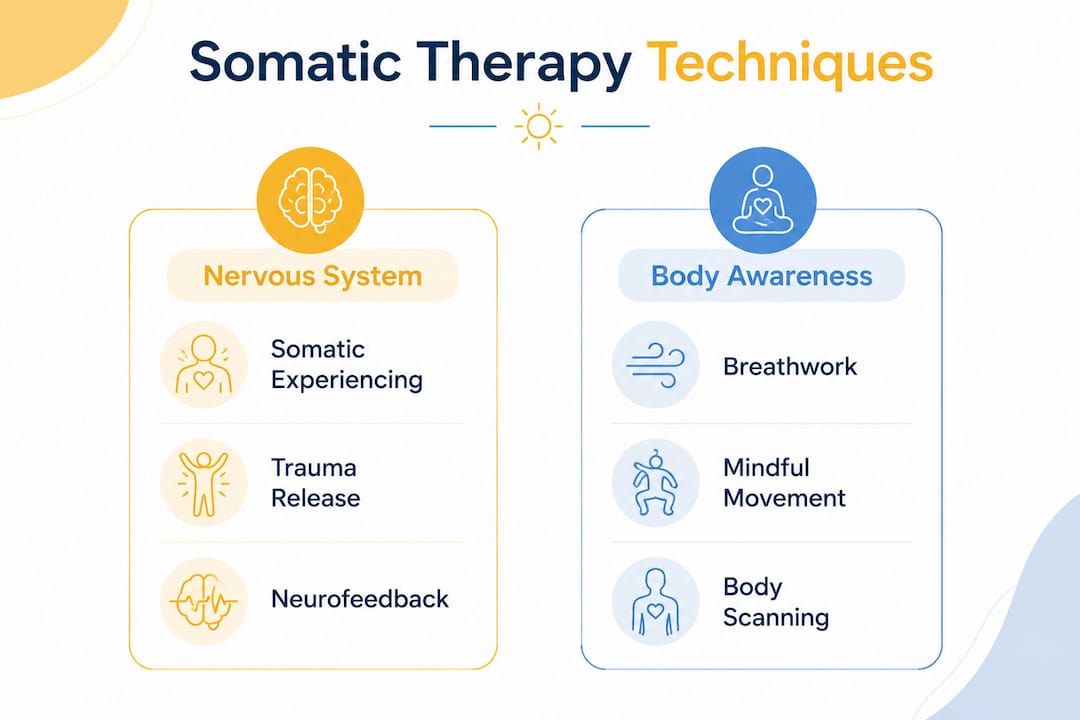
The most widely used somatic techniques include body awareness exercises, breathwork, mindful movement, and, in some modalities, light therapeutic touch. EMDR therapy is one of the best-known approaches that integrates somatic principles, using bilateral stimulation alongside body awareness to process traumatic memories. Body scanning and mindful sensing are also standard tools that help you track where emotion lives in the body.
The table below shows how common somatic approaches differ in focus and method.
| Approach | Primary focus | Key method |
|---|---|---|
| Somatic Experiencing | Nervous system regulation | Titration and pendulation |
| EMDR | Trauma memory processing | Bilateral stimulation with body awareness |
| Sensorimotor Psychotherapy | Body movement and posture | Mindful movement and gesture |
| Breathwork therapy | Autonomic nervous system | Controlled breathing patterns |
| Body scanning | Internal sensation awareness | Guided attention to physical cues |
Somatic therapy also differs from purely cognitive approaches in a critical way. It does not aim to desensitize you to your feelings. Instead, it helps move through and release the physiological tension that trauma created, restoring the body to a baseline state of safety. The goal is completion, not suppression.
One point worth clarifying: somatic therapy is not a single technique. It is a category of body-informed psychotherapy that includes several distinct modalities. Your therapist will select and combine methods based on your specific history, symptoms, and comfort level.
What are the benefits and who can benefit from somatic therapy?
Somatic therapy produces measurable benefits for people dealing with PTSD, complex trauma, chronic stress, anxiety, and chronic pain. Because emotions are physiological events occurring in muscles, organs, and the nervous system, addressing them through the body reaches places that words alone cannot. This is the core argument for somatic psychotherapy as a distinct and necessary treatment category.
The people who benefit most include:
- Trauma survivors whose symptoms persist despite years of talk therapy
- People with PTSD who experience physical symptoms like hypervigilance, startle responses, or chronic tension
- Those with anxiety disorders who feel physical symptoms such as chest tightness or shallow breathing
- Chronic pain patients where emotional stress contributes to physical symptoms
- Individuals with dissociation who feel disconnected from their bodies or emotions
- Anyone seeking deeper self-awareness as part of personal growth or emotional regulation
Somatic therapy also works well alongside evidence-based trauma therapies like Cognitive Behavioral Therapy (CBT) and EMDR. Integrating somatic therapy with talk therapies offers a fuller treatment by addressing both the cognitive meaning of trauma and its physiological traces. Neither approach alone covers the full picture.
Clinical reviews consistently show that body-based interventions improve self-regulation, reduce hyperarousal, and increase the capacity to tolerate difficult emotions. These are not small gains. For many people, they represent the difference between managing symptoms and actually recovering.
Pro Tip: Somatic therapy is not a quick fix. Expect the first several sessions to focus primarily on building body awareness and establishing safety. Clients who approach this phase with patience tend to experience deeper and more lasting results.
How can you start somatic therapy and what should you expect?
Starting somatic therapy begins with finding a licensed mental health professional who has specific training in a somatic modality. General therapy training does not include somatic methods. You need a practitioner credentialed in an approach such as Somatic Experiencing, Sensorimotor Psychotherapy, or EMDR with somatic integration.
- Verify credentials. Look for a licensed therapist (LCSW, MFT, or psychologist) with documented training in a recognized somatic modality.
- Ask about their approach. A good somatic therapist will explain how they work with the body and what a typical session looks like before you commit.
- Expect a slow start. Early sessions focus on building safety, trust, and basic body awareness before approaching trauma directly.
- Combine with other therapies if needed. Somatic therapy complements talk therapy rather than replacing it. Many people work with a somatic therapist alongside a CBT or relational therapist.
- Track your physical responses between sessions. Noticing sensations in daily life accelerates progress. Journaling body-based observations is a practical tool.
A typical somatic therapy session lasts 50–60 minutes. Your therapist will guide you to notice physical sensations as you discuss or recall experiences. They serve as a safe container for overwhelming sensations, helping you stay within a manageable range of activation rather than becoming flooded or shut down.
Pro Tip: If telehealth is your only realistic option, somatic therapy still works effectively online. Many somatic techniques, including breathwork, body scanning, and grounding exercises, translate well to video sessions. Revivehealththerapy offers secure telehealth options statewide across California for exactly this reason.
Revivehealththerapy provides trauma-informed therapy in Walnut Creek and Oakland, as well as telehealth sessions across California. Their team works with individuals, couples, and teens using approaches that include somatic principles, EMDR, CBT, and mindfulness.
Key Takeaways
Somatic therapy is the most direct route to healing trauma that has become physically embedded in the nervous system, muscles, and breath.
| Point | Details |
|---|---|
| Core definition | Somatic therapy is body-centered psychotherapy targeting physical traces of trauma and stress. |
| How it works | It helps complete frozen fight-or-flight responses and restores nervous system regulation. |
| Key techniques | Body scanning, breathwork, EMDR integration, and mindful movement are the primary tools. |
| Who benefits most | People with PTSD, chronic stress, anxiety, and chronic pain gain the most from this approach. |
| Best use | Somatic therapy works best when combined with talk therapies like CBT or EMDR for full coverage. |
What I have learned from watching somatic therapy change people
Working in mental health long enough, you start to notice a pattern. People arrive having done years of talk therapy. They understand their trauma intellectually. They can explain exactly why they feel the way they do. And yet the anxiety, the tension, the hypervigilance, none of it has shifted. That gap between knowing and feeling is where somatic therapy lives.
The most striking thing I have observed is how quickly the body reveals what the mind has learned to hide. A client might describe a neutral memory and their shoulders rise to their ears without them noticing. That involuntary response carries more clinical information than a full session of verbal processing. Somatic therapy makes that information visible and workable.
The challenge is patience. Body awareness is a skill, and for people who have spent years disconnecting from their bodies as a survival strategy, rebuilding it takes time. I have seen clients feel frustrated in the early weeks because “nothing is happening.” What is actually happening is foundational. The nervous system is learning that it is safe to feel again.
My honest view is that somatic therapy should not be positioned as an alternative to talk therapy. It is the missing layer. Combine it with CBT or EMDR and you address both the story and the body that has been carrying it. That combination produces results that neither approach achieves alone.
— Amy
Somatic and trauma-informed therapy at Revivehealththerapy
Revivehealththerapy offers trauma-informed psychotherapy services across California, with in-person sessions in Walnut Creek and Oakland and secure telehealth available statewide. Their licensed therapists use evidence-based methods including EMDR, CBT, and body-aware approaches to treat trauma, anxiety, depression, and chronic stress.

If you are ready to understand why psychotherapy works and whether somatic or trauma-informed care fits your situation, Revivehealththerapy’s team can help you find the right path. Sliding-scale fees and insurance acceptance, including HSA and FSA plans, make access realistic at multiple income levels. Reach out through their contact page to schedule a consultation.
FAQ
What is the definition of somatic therapy?
Somatic therapy is a body-centered psychotherapy that uses awareness of physical sensations, breath, posture, and movement to heal trauma and chronic stress. It is performed by licensed mental health professionals and targets the physiological imprints trauma leaves in the nervous system.
How is somatic therapy different from regular talk therapy?
Talk therapy works primarily through language and cognitive processing. Somatic therapy works by addressing physical traces of trauma stored in the body, such as muscular tension and frozen fight-or-flight responses, which verbal therapy alone cannot reach.
What conditions does somatic therapy treat?
Somatic therapy is primarily used for PTSD and trauma-related disorders, and it also benefits people with chronic stress, anxiety, chronic pain, and dissociation. It works best when integrated with other evidence-based therapies like CBT or EMDR.
What is somatic experiencing?
Somatic Experiencing is a specific somatic therapy modality developed to help the nervous system complete incomplete defensive responses from trauma. It uses titration and pendulation techniques to approach traumatic material in small, manageable steps.
Do I need to be in physical contact with a therapist for somatic therapy?
No. Most somatic therapy techniques, including body scanning, breathwork, and grounding exercises, work effectively in telehealth settings. Physical touch is used in some modalities but is never required and is always conducted with informed consent.
Recommended
- Why seek holistic therapy? Your guide to whole-person healing – Revive Health Therapy
- Therapeutic modalities explained: 35% better outcomes in 2026 – ReviveHealthTherapy
- 7 Effective Types of Trauma Therapy for Recovery – ReviveHealthTherapy
- Why Seek Psychotherapy: Transforming Mental Wellness – ReviveHealthTherapy